Table of contents

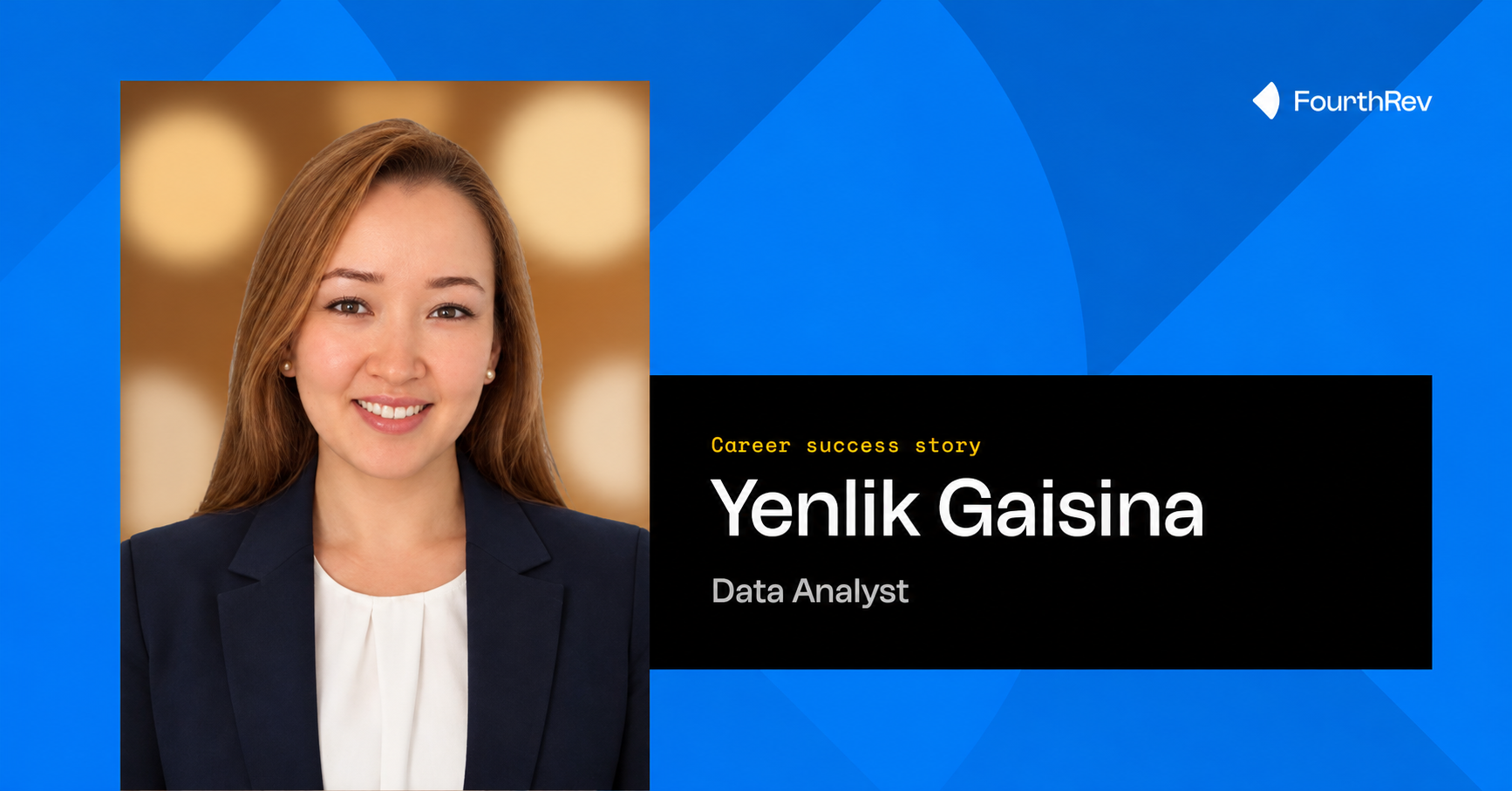
A year ago, Yenlik Gaisina was working as a senior administrator with no data science background. She had a master’s degree in public health, a full-time job and two children at home. After seven months in the Cambridge PACE Data Science With Machine Learning & AI Career Accelerator, she accepted a data analyst role at a law firm, and her colleagues watched her build, in a week, a tool that does what an expensive subscription couldn’t.
She recently joined us for an AMA webinar to tell her story.
Half in, half out
Yenlik says her biggest challenge at the start was doubt, not the content. Her administrative role had nothing to do with technical work, and she admits she was afraid of that.
“I was half in, half out. I was ready to just pull the plug out and just say, no. It’s not for me. I’m not good enough.”
She didn’t let go, and she’s glad she held on. What kept her going was a mix of structure, coaching and a cohort that supported each other throughout.
Learning one step at a time
Before the programme began, Yenlik learnt the Python basics she needed and drew on statistics from her public health master’s. Learners who need the same head start can take the free Python Prep Pathway before the programme begins.
From there, the Career Accelerator moves through four courses, each building on the last: statistics and core data science techniques, supervised machine learning, then natural language processing (NLP) and time series, and finally generative AI and large language models (LLMs) alongside a live Employer Project. Yenlik found the first assignment the hardest, because it was heavy on statistics and Python. Each one after it felt more manageable because she had already done the one before.
The programme asks for around 20+ hours a week, and Yenlik fitted them in early in the morning, during lunch breaks and late at night. Most of the learning is self-paced, and live classes run outside standard working hours. She recommends joining them live where you can, so you can ask questions as they come up.
A coach who turns problems into puzzles
Every learner has 12 months of 1:1 career coaching from the start of the programme, and Yenlik still meets her coach every month. At first, she says, she brought every obstacle to those sessions as proof that the plan wouldn’t work. Her coach, with experience of many learners before her, saw them differently.
She describes how her coach “could zoom out and see my huge problem as a little puzzle that you can actually tweak around, and then put it properly, and then this challenge isn’t a challenge anymore, it’s actually an opportunity, another step to grow.”
The coaching was practical, too. When Yenlik asked how she could use her new skills in an admin job, her coach asked whether she worked with data. She did: spreadsheets and procurement records she could analyse. That work later became central to her next role.
Sessions with her coach on CVs, LinkedIn, networking and interviews also changed how she presents herself.
“I don’t have this fear of the interviews, I don’t have fear of approaching people during the networking events. I’m just going there and being myself.”
Lucky 13 and a live Employer Project
The programme ends with a six-week Employer Project, in which learners work in teams on a business problem set by an industry partner. Yenlik’s team worked on a challenge from Inchcape, one of the organisations that have partnered on past projects.
She remembers being nervous at the start, because it meant working with a large company’s data.
“I thought I will not handle it, but when I got it, I was like, phew, I’ve done it all… it felt easier than I was expecting it to be.”
Her team of five came from design, finance, education, insurance, and business, and at first they pulled in different directions. The team asked Yenlik to lead, and she helped them see that their different backgrounds were their strength. They named themselves Lucky 13 after their team number.
The result, she says, “was a huge success. And Inchcape was actually impressed by what we were delivering.”
Proving it at work
Yenlik’s new skills soon showed at work. After moving to a new team, working alongside electrical engineers and project managers, she found they were paying for a costly tool that wasn’t doing what they needed.
She asked the quality manager and project managers what they expected from it, then built a new tool tailored to them. It pulls data from technicians, fills in the project management tool, and passes the information to the people requesting services. It took her a week.
“And people were mind-blown. They were like, how? How do you know this? And I was like, well, it’s something that I learned during my course in Cambridge, and they were all shocked.”
New opportunities followed, and Yenlik has now accepted an offer as a data analyst with a law firm. She’s clear about why. “And this is why my next employer is hiring me, because I have these skills of analysing procurement data.”
Her portfolio did much of the talking. Alongside her programme projects, she followed her curiosity: during a summer heatwave, she analysed why homes overheat and built a website that lets people check how sustainable their home is.
Her advice to new learners is to build your portfolio as you go, because it represents you when you’re not in the room.
Her advice if you’re where she was
Yenlik notes that most of her cohort already had some background in data and were growing their careers, so the programme isn’t only for people starting from scratch.
For anyone who is, her advice is to keep a steady rhythm rather than leave work until the deadline: “cutting time a little bit in the morning, a little bit in the evening, a little bit during the lunchtime. That’s what helps.” She also encourages learners to ask tutors, the support team, and each other questions freely.
Most of all, she wants people to know what she wishes she’d heard a year ago.
“I wish somebody was there for me to tell me, don’t be afraid. You’ll be so proud of yourself a year later.”
Could this be your next step?
Every learner’s path is different. If you’d like to see how the Cambridge PACE Data Science With Machine Learning & AI Career Accelerator could support yours, the brochure covers the curriculum, the Employer Project, career coaching, fees and payment options.
Share:


