Table of contents

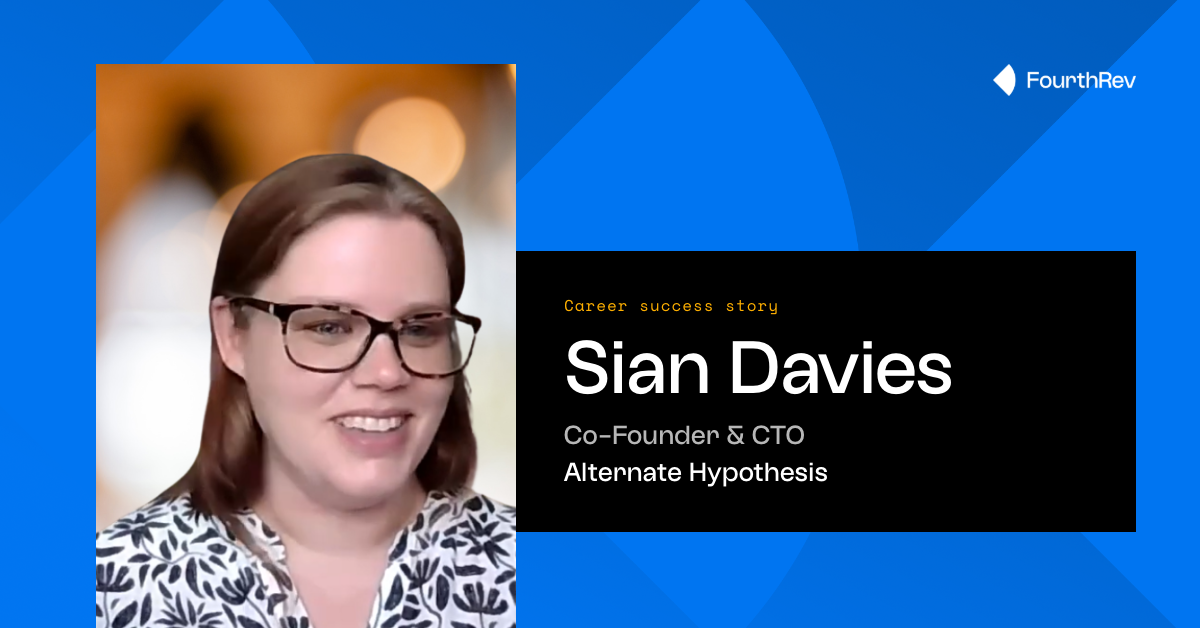
After more than eight years in genetics research, Sian Davies retrained in data science and AI and went on to co-found an AI startup. This is her career change story, told in her own words.
Sian is a past learner of the Cambridge PACE Data Science With Machine Learning & AI Career Accelerator, a 7-month programme she completed before making the leap.
“Don’t worry if you’re a career changer, you can do it. I did it,” says Sian.
She joined an Ask Me Anything webinar hosted alongside FourthRev to talk through that transition in detail, from her early days in the lab through to co-founding Alternate Hypothesis, a startup that uses AI to automate statistical testing.
Making the leap
Rather than a sudden change of direction, Sian’s move into data science built gradually, out of the data analysis she was already doing in her research role and a self-taught grasp of Python that had started to hit a ceiling.
“I’d reached the limit of what I could do with my current knowledge in terms of setting up automations and coding and analysis. So I really needed to take another step.”
Before committing, she joined one of the programme’s own information webinars to learn more. What convinced her to sign up was the practical, project-based way the programme was run, rather than a purely theoretical one.
“I think I liked the detail that this [programme] was going to go into, and the fact that you had projects. So you were doing practical application of the skills. It wasn’t just learning, you were actually applying.”
Putting the learning into practice
She credits the programme’s structure, in particular an early time-audit exercise, with helping her balance roughly 20 hours of study a week on top of everything else going on in her life.
“One of the things that they did with us in the beginning was getting us to set up time audits, which I found quite helpful. So I was keeping a weekly calendar, blocking off specific hours that I would be working on this.”
None of it stayed abstract for long. The statistics module, in particular, laid the groundwork for the business she has since built.
“The skills that we learned are very applicable, because you’re actually writing the code and building things and testing it within the course.”
The area she came away most confident in was large language models and fine-tuning, skills she now uses directly in her day-to-day work.
“The thing that I’ve really gained confidence in is probably the LLMs and things like fine-tuning, properly testing models and improving them. And that’s the thing that I’ve really carried on from the course into what I’m doing now.”
No coding background? That’s fine
She began the programme having only self-taught a little Python and done some Excel analysis. She had never built a model before.
She credits her career coach and her fellow learners, as much as the curriculum itself, with getting her to where she is now.
“I just self-taught a little bit of Python before…and I’d done some Excel analysis and things like that. I hadn’t built any models.”
Her message to anyone worried they aren’t technical enough:
“For me, it wasn’t too much of a problem… if you’re already working with computers, and you’ve already experimented a bit, and you’re already interested in coding… I think it’ll be fine.”
More than just the coursework
Sian points to the career coach and the cohort community as central to her progress, not just the curriculum.
“Mine was really helpful…and encouraging, and she helped a lot…through asking lots of questions, getting me to think about what I wanted.”
Her cohort turned into a long-term support network too, and it’s where she eventually met her Alternate Hypothesis co-founder, Indra Mayengbam, in person.
“In our cohort, we all kind of knew each other. We had WhatsApp groups, and that support was really invaluable as well.”
“I think you shouldn’t feel isolated doing it. In my experience, I didn’t. There was a very strong sense of community… You definitely feel like you’re part of a group.”
The Bank of England project
On the programme’s live employer project with the Bank of England, Sian and her team spent several weeks tackling a genuine, open-ended business problem, sharing leadership of the project as they went.
“In our team, we actually took turns leading… so we’d all get to experience it, because it was over a period of weeks.”
“It was really nice to see what we could achieve together of everything we’d learnt and we kind of had reasonably free rein about what to what techniques to employ to do the project. And, yeah, it’s good.”
Taking the lead in the final presentation and hand-in week stretched more than her technical ability.
“I hadn’t done much online work before starting this course. I certainly hadn’t given presentations online or spoken online before. So that was something that was very new to me. Giving a presentation online, on video.”
Asked what she found hardest across the whole Career Accelerator
“Every project was the hardest challenge until the next project came along.”
“Probably it would have been the final Employer Project, just because the scope of it was probably the biggest challenge.”
Where she is now
Sian now co-runs Alternate Hypothesis, a company applying AI to automate statistical testing and make it more accessible to businesses.
She’s clear that the programme played a major part in getting her there, and likely a much faster one than she would have managed alone. She’s still relying on what she learned on a day-to-day basis.
What gave her the confidence to actually start a company? She puts it down to a mix of things: her coach’s support and the confidence she built over the programme itself, in roughly equal measure.
As for whether the programme was worth what it cost, her view was simple: if it gets you where you want to go, it’s worth it.”
Her advice to the next cohort
“You get out what you put in…”
“You will learn all the foundations, but then it’s kind of up to you to take the extra step and pick the ones you want, and really dig into them, if you want to continue this afterwards..”
Download the brochure here to learn more about the curriculum, fees and more.
Share:


