Table of contents

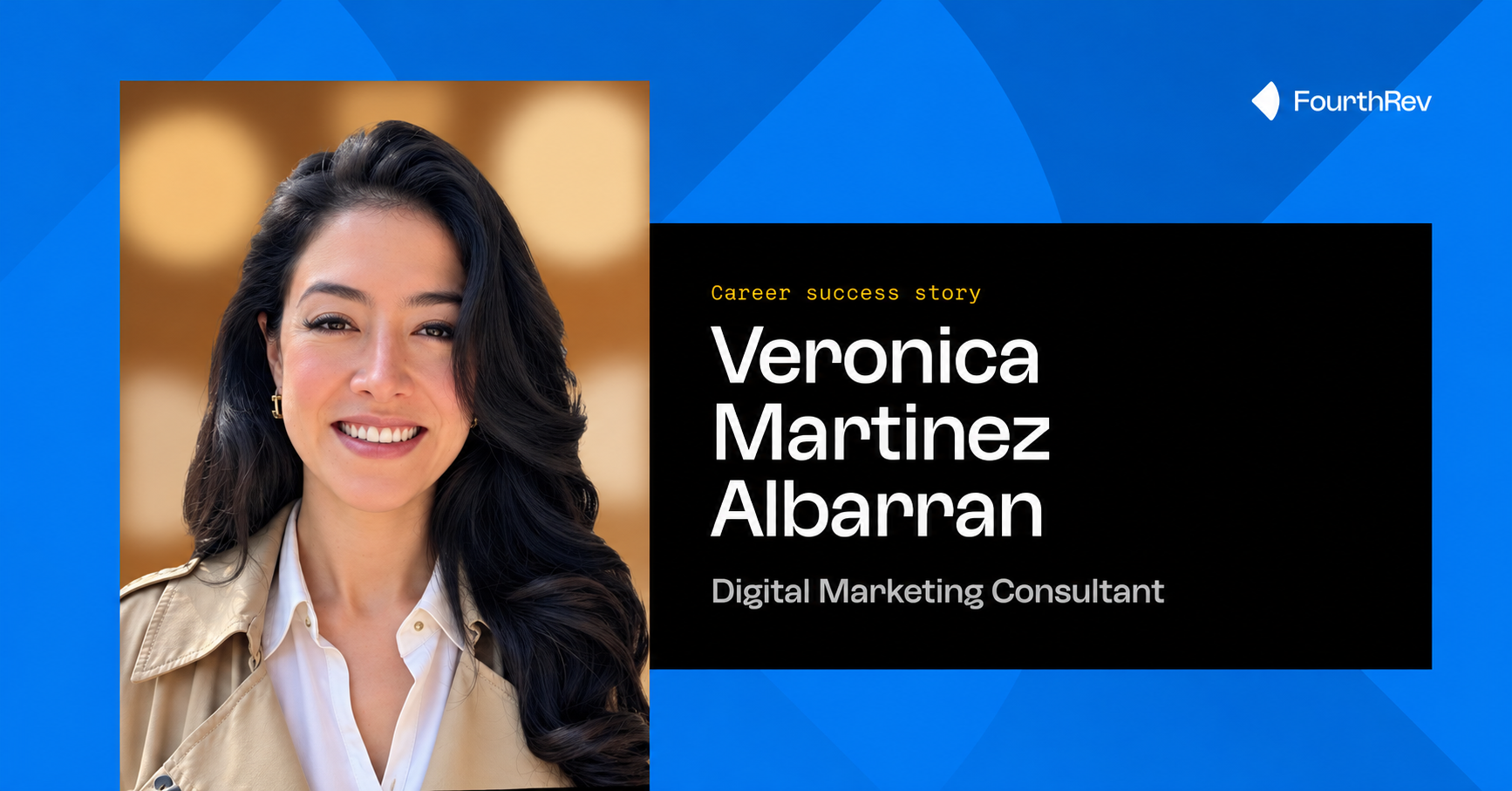
When Ana Veronica Martinez Albarran, who goes by Veronica, joined the LSE Digital Marketing Strategy & Analytics Career Accelerator in November 2025, she was in the middle of a career change.
She had a business background and had once run her own e-commerce brand, but by her own account, “my experience in digital marketing was almost close to none.”
She finished the programme in June this year, and three months later she landed a job at a digital marketing agency.
Veronica shared her story with prospective learners at a recent Ask Me Anything session, where she answered their questions about the workload, the Employer Project and what changed for her career. Here’s what she told them.
Choosing a programme built for a career change
Veronica knew what she wanted before she applied. She wanted live sessions, a certificate from a renowned institution, learning she could turn into practical experience, and a career coach to help her gain clarity on her career transition.
“I felt that it was a very holistic programme that encompassed a lot of things, not only the theoretical education, but the practice as well, and career coach,” she said.
Her business experience gave her a starting point. “There was, of course, a bit of understanding on my side of what marketing was,” she explained. “I did use a bit of marketing, but I didn’t have the in-depth knowledge or the technical knowledge of marketing.”
When one attendee asked whether someone with a business background but little marketing experience would be accepted, Veronica could answer from experience: “I was accepted as well, and it’s feasible to do it.”
Learning by doing
The programme runs for six months. Learners complete three six-week courses covering digital marketing strategy, data-driven campaigns, and digital marketing leadership, and each ends with a practical project. Veronica described the experience as “very practical”, because every course asked her to apply the theory to a case study.
She valued the final part most. The final six weeks are a live Employer Project, where learners work in small teams on a brief from a real organisation. “You get to work with real data, with a real company or organisation in solving a real problem,” she said.
Veronica’s team worked with Making Music, a UK non-profit organisation. The organisation shared its data and information, and the team had to identify new target audiences and create campaigns for them. It was also where she got to know her peers best. “In my personal experience, it was a lot of fun,” she said. “And also, I got to learn a lot from the peers that I was appointed to for this project.”
Help with the part she found hardest
Every learner works with a 1:1 career coach for up to 12 months: six months during the programme and six months after it. For Veronica, the coaching tackled a specific weakness.
“Specifically for me, I know, I really was terrible in networking, so my career coach helped me with that,” she said. Her coach showed her how to network well, which events to attend and what to expect when she got there. They also worked on her personal pitch, refined her CV and improved how she presented herself on LinkedIn. Veronica called the coaching “one of the most valuable things that this programme has”.
Fitting it around a full life
The programme is designed to be studied alongside other commitments, at around 16–20 hours a week. Veronica was honest that it’s demanding, and she said organising her time well was what made it work. Asked how she juggled study with her other commitments, she was clear: “It’s possible, it’s feasible. It definitely is.”
Her first month tested that. Veronica got married in November 2025, the same month her cohort began, and at first felt she was falling behind. She caught up with support from the programme team. “They were very understanding with that aspect, and I got an extension of one of the deadlines to hand in my project,” she said.
The interview that felt familiar
Three months after finishing, Veronica, who is based in Amsterdam, landed a job at a digital marketing agency. The hiring process brought her coursework straight back into view.
“I actually have a very funny case, because when I was going through the hiring process of the agency that I’m working for, they gave me one case study that was very similar to one of the projects that I did during the Career Accelerator,” she said.
She credits both her studies and the portfolio she built across the programme for the move, and she still draws on them in her new role. “Definitely these are tools and elements and knowledge that I’m using nowadays, and that helped me also get the job that I wanted.”
The LSE certificate helped too. Her employer recognised the institution, and as a result, she found her skills weren’t questioned as closely. “Definitely helpful to have a renowned institution like LSE to validate your studies,” she said. “It’s just, I guess, you get asked less questions, and people just know.”
Her advice for anyone considering the programme
When the AMA host asked what she would tell someone weighing up the programme, Veronica began with focus. “Definitely be very clear in what it is that you want to be getting out of this Career Accelerator before getting in.”
Her second piece of advice was practical: plan in advance how the study will fit into your life, because the workload takes planning. Her third was to make use of all the resources on offer, including the career coach and the career development sessions.
Veronica’s story is her own, but it shows how a business background can lead into digital marketing when it’s paired with practical projects, a live Employer Project and coaching that targets the skills you find hardest.
Considering a move into digital marketing?
Find out how the LSE Digital Marketing Strategy & Analytics Career Accelerator could support your next step, from the curriculum and the Employer Project to 1:1 coaching, fees and entry requirements.
Share:


