Table of contents

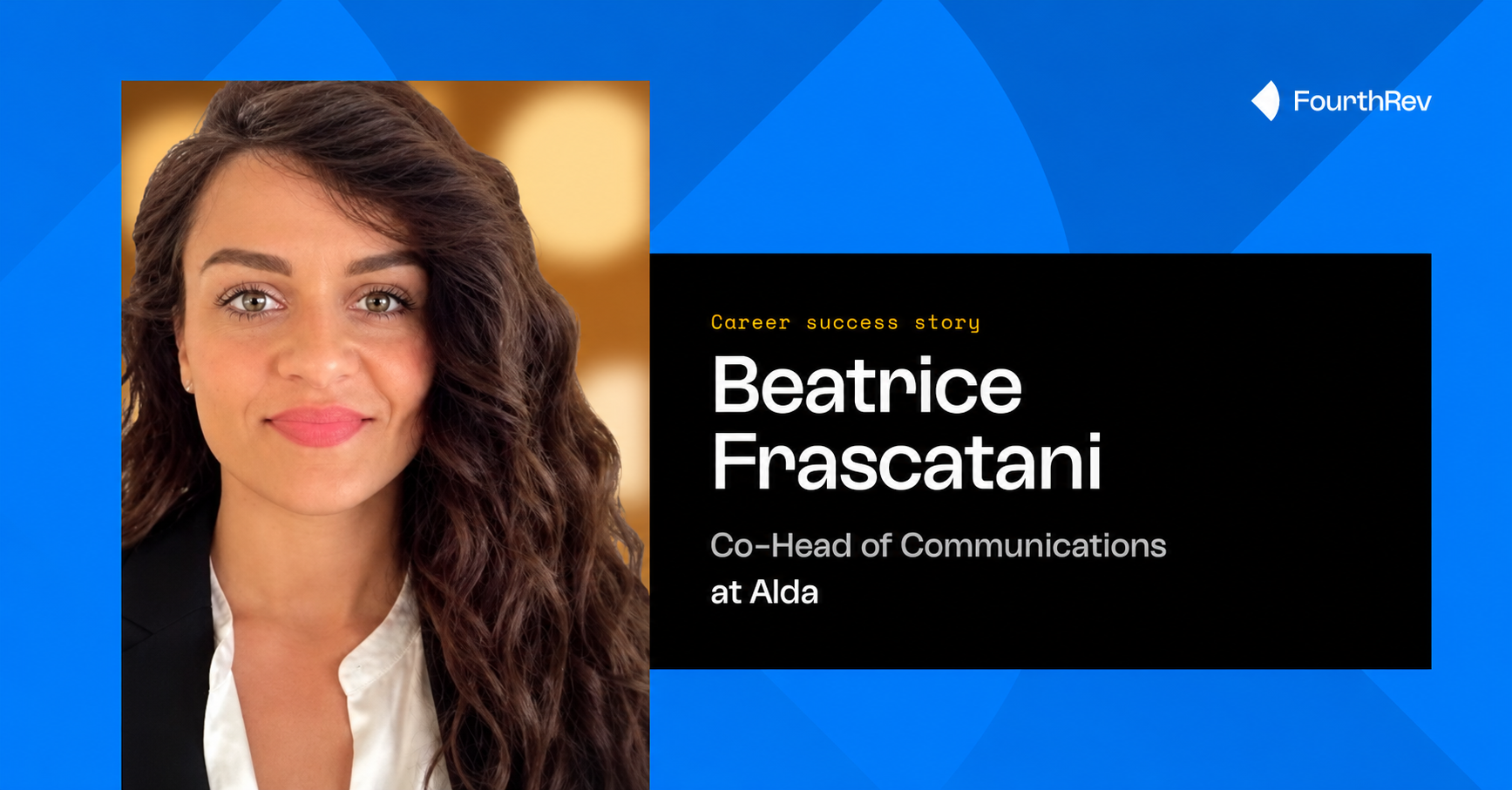
Plenty of people work alongside marketing for years without ever being taught it. Beatrice Frascatani, Co-head of Communications at Alda, was one of them. In a recent Ask Me Anything session, she shared what it took to fill that gap while working full-time, and what she does differently now.
Hitting a ceiling as deputy head
Beatrice’s path into communications started with politics and journalism. She studied political science and international relations in Italy, then completed master’s degrees in Amsterdam and Brussels, the second in media and journalism.
A traineeship in public policy communication at a Brussels consultancy introduced her to the field, and she later joined a non-profit back home as a communications manager and communications officer.
Over six years, she grew with the organisation. When her supervisor went on maternity leave, Beatrice stepped up as acting head of the communications department, leading a team of eight. When her supervisor returned, Beatrice became deputy head and started asking herself a familiar question:
“How can I improve my career? How can I grow a little bit more professionally?”
She felt she’d reached the most she could in that role. Then marketing found her. Her non-profit runs a for-profit organisation that wasn’t performing well, and Beatrice offered to take on its communications.
Despite five years in the field, it was harder than she expected. Non-profit communication, she explained, is about showing impact, not selling. In marketing terms, she was missing the basics. Coming from a communications background, she was less familiar with certain marketing-specific concepts, such as lead generation.
That’s why picking it up on the job wasn’t an option. She needed the theory first.
Six months over two weeks
Beatrice researched her options carefully. The programme had to be in English. She wanted structured content, the university and companies behind it, and learning she could do around her job. And she weighed quality against cost.
Courses lasting one or two weeks made her question what she could realistically learn in that time. A six-month programme with a Career Coach was different. She’s honest that the fee was a big decision, calling it “an investment for your life” and taking time before committing. Her verdict now: “I don’t regret it.”
Studying around a job that travels
Her biggest hesitation was time. Her job is demanding, she lives away from her home city and travels a lot for work. English isn’t her first language either, and it had been a while since she last earned a degree.
So where did the hours come from? “From weekends, that’s the real answer,” she said. She also studied after work, used some of her holiday, and told her organisation what she was doing. They were supportive, seeing the value it would bring them too. She didn’t sugar-coat the commitment:
“To be honest, it’s not really 16 hours a week, it’s a little bit more.”
A third read in a Brussels hotel
Her hardest moment came in Course 2, which covers data. Studying in a Brussels hotel during a work trip, she found herself reading the same module for the third time without it sinking in.
“Is it really worth it? Like, I’m really struggling. Am I capable of doing that?”
What changed things was talking to her peers. Everyone was finding parts of it hard, and the cohort’s WhatsApp group became an open channel for questions and doubts. Her takeaway: “you’re not alone in this process.”
Her success manager helped too. Beatrice mentioned they can arrange extensions, discuss pausing the programme if life gets in the way, and run weekly time-management sessions. “I really felt supported.”
From personas to team one-to-ones
She particularly enjoyed discovering new concepts, such as marketing attribution, and learning how to apply them in practice. For instance, attribution gave her valuable insights into which channels and activities generate results, helping her focus her efforts more effectively. The data module, though tough, taught her to handle data ethically and made GDPR far clearer.
The biggest shift came in Course 3, on digital marketing leadership. Beatrice realised she’d led a team of eight without ever learning how to lead. Her conversations had always focused on the organisation’s objectives, never her team’s own goals. After the course, she started one-to-one calls to understand what each person wanted, which gave her useful insight for the work itself, and for herself:
“So I understood what I was doing wrong, what I was doing right, where I could improve.”
She also came away more confident with AI. She’d used it a little in her communications work before, and the programme asked her to assess emerging tools and decide where they could improve an existing process. Her view is that AI keeps changing, so keeping up is ongoing, not a one-off.
A strategy across three time zones
The final six weeks were the Employer Project, a live brief from a real company that wanted to reach an audience it was missing. Beatrice’s team worked with the company’s real data, website and social media.
It was challenging. Teammates were spread across time zones, including the US and Singapore, and when one member hit a personal problem, the group regrouped and kept the deadlines. Beatrice says it taught her a lot about handling the unpredictable. Presenting taught her something else:
“You need to be confident about all the work that you did.”
The employer was very happy with the strategy, and some of the team’s suggestions were ideas the company hadn’t considered.
Her teammates left a mark as well. Some were working full-time while raising children, and seeing what they managed gave her “even more motivation than the one I had at the very beginning.”
Slowing down to build a strategy
Beatrice finished the programme in June and now manages communications and marketing for the for-profit organisation. Her first realisation was that strategy needs time.
Both organisations had grown so rapidly that their strategies had not yet fully evolved to keep pace with their growth, so she asked the executive directors to sit down and build one, starting with who their audience is. She now spends time on research and competitor analysis before anything else, because she sees strategy as “the base for everything”.
Her Course 3 project, applied to her own organisation, produced a new fundraising option that’s now part of her work. The new role also brought more responsibility and a salary increase.
Her Career Coach helped her manage anxiety around public speaking and imposter syndrome, and she brought her challenges she had to each session.
Her advice to prospective learners
She already had experience creating social media content and newsletters, but wanted to deepen her understanding of more data-driven approaches, such as experimentation and A/B testing. She didn’t have any marketing background, and in the end, she managed to do it.
She said people without a digital marketing background “should not worry about that, because you will have it afterwards.”
If you’re weighing a similar move, download the brochure for the LSE Digital Marketing Strategy & Analytics Career Accelerator to see how six months of online, part-time study, a live Employer Project and up to 12 months of 1:1 career coaching fit together.
Share:


