Table of contents

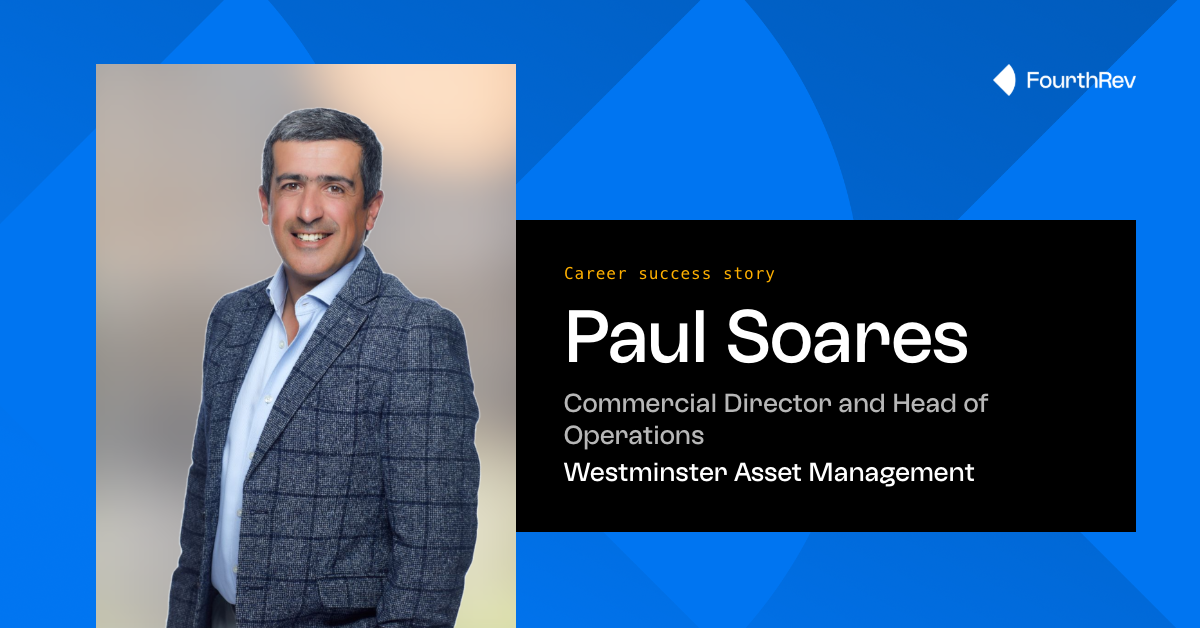
Paul Soares is Commercial Director and Head of Operations at Westminster Asset Management in Jersey, where he helps lead a regulated private client and asset management business.
When Paul spoke at a recent AMA webinar, he was working through the third of four courses on the LSE AI Leadership Accelerator and already applying what he had learned at work.
“I now move more quickly to underlying questions: what problem are we actually trying to solve? What decision are we trying to improve? Where is the real value? What has to be true for this to work? What governance needs to sit around this? That sounds simple, but it’s quite a significant shift from where I was before.”
For Paul, that shift is the heart of what the LSE AI Leadership Accelerator has given him.
His career has been built around growth, transformation, operating models and governance in a trust-based, regulated industry. He has also trained in Lean Six Sigma to Green Belt level, which shaped how he thinks about process discipline, control, and change that scales.
When AI became a leadership question
Paul’s decision to study came from a change he saw in his own role.
“AI had stopped being an interesting external topic and had become more of a real internal leadership question.”
Part of his job is to help lead the business through growth, operating discipline, governance and change, so AI couldn’t sit on the sidelines.
“So that means I can’t look at AI as something separate from our business. I have to think about it in terms of value, implementation, control, accountability, and readiness.”
He also saw a gap between how vendors present AI and what it takes on the buying side to make it useful, governable, and commercially credible. He noticed plenty of discussion about AI but less practical understanding of how to lead it inside a regulated business. He wanted a structured approach and a framework to work from.
Choosing a programme built for leaders
Paul compared several options, some more technical, some focused on finance and some only focused on regulation or specific tools. He found the LSE Accelerator through his own research, using AI to help.
“I researched a number of AI and leadership programmes, including options from leading universities in the UK and the US. The LSE AI Leadership Accelerator stood out because the skills and methods could be deployed immediately in my working environment.”
The deciding factor was fit, because Paul’s goal was to lead AI implementation more effectively rather than to become more technical for its own sake.
“This course is clearly designed for leaders, rather than for specialists. It focuses on strategy, decision making, governance, implementation, and really, at the core of it, business case thinking.”
Learning that went straight to work
Paul says he didn’t expect the depth the programme would reach, particularly on governance, leadership, and business cases. He also didn’t expect how soon it would show up in his day-to-day work.
“I found myself using the thinking almost straight away in discussions around operating models, management information, workflow designs I’m implementing, and governance and decision support. That is what makes it practical – it improves the quality of the discussions and conversations you’re already having.”
His organisation is now carrying out a full review to get the business ready for AI, covering infrastructure as well as software. That work includes putting guardrails around the firm’s chosen AI tool, reducing the risk of data leaking through staff using their own AI tools, and building a policy, framework, and phased implementation plan.
Paul says the programme has benefited both him and his organisation while he has been studying. The programme also changed how he approaches business cases.
“One of the risks with AI is that organisations can move too quickly from the possibility to the assumption.”
“Business cases are rarely just about what the technology can do. They’re about the value, the timing, the readiness, the confidence, and the control.”
Governance inside the design
For a regulated investment business, governance is critical, and the LSE Accelerator reinforced its role.
“What the programme has reinforced for me is that governance can’t sit outside AI adoption – it has to be inside the design from the get-go. In a regulated environment, the key question is not simply whether something is possible. It’s whether it’s proportionate, governable, and explainable to the regulators.”
Paul’s operational background already led him to think about how change gets embedded. The programme added a more explicit leadership dimension to that thinking, which he says he had not fully used before.
Coaching that turns ideas into action
Paul singles out the 1:1 leadership coaching that runs alongside the courses.
“At a senior level, the question is often less about whether the content is good, and more about how you apply it, how you position it, how you use it to sharpen your leadership focus.”
After one coaching session, he was set a task to complete before the next.
“In the month that intervened, that task and the outcome from it delivered huge value – not only to me personally, but hugely to my organisation as well.”
He is clear about where the responsibility sits.
“Your coach is there to steer you, but you’re the engine that needs to drive that thinking.”
Confidence, credibility, and a wider view
Paul describes his AI confidence as having grown, though not in a technical sense.
“My confidence has most definitely shifted – but I would describe it as executive confidence, rather than technical confidence. I feel more confident because I now have a stronger framework and clearer language for discussing AI with senior stakeholders.”
He also sees the LSE name as adding weight in conversations with executives, boards, clients, and wider stakeholders.
“It matters because it signals that this is not just a passing interest. It reflects a serious investment in building leadership capability around AI at a time when many organisations need exactly that.”
His cohort added another dimension. Coming from investment management, Paul valued hearing from peers in a wide range of industries, from large corporates to self-employed professionals. Their use cases differed, but he found many of the leadership questions were the same: how to create value, manage risk, lead change and build credibility.
Fitting the programme around a senior role
Paul is honest that the flexible format still takes effort.
“Applying and undertaking this course still requires a huge amount of discipline.”
What has worked for him is treating the programme as part of his current leadership challenges rather than something separate from work, so the time feels relevant from week to week. He cannot attend every live session, but recordings let him catch up in his own time.
Sharpening, not reinventing
Looking ahead, Paul believes future leadership roles will increasingly require the ability to connect commercial value, governance, change, and technology.
“I wouldn’t describe it as changing the fundamentals of who I am professionally – I describe it as strengthening and sharpening them.”
His advice to senior professionals under pressure to lead AI is to first clarify the capabilities they need. Deep technical training and narrow regulatory updates have their own routes.
If the need is to make good leadership decisions about where AI adds value, how it should be governed, how to build a credible case and how to lead adoption responsibly, he sees the LSE Accelerator as a strong place to start.
And the thing he wishes he had known before he began?
“I didn’t know how quickly it would improve the quality of my questions. I expected to gain knowledge, but what I found was a stronger decision framework.”
Lead AI in your organisation with the LSE AI Leadership Accelerator. Over six months online, you’ll build four board-ready deliverables (a board advisory memo, a business case, a change management strategy and an executive AI playbook), supported by 12 months of 1:1 leadership coaching.
Download the brochure here.
Share:


