Using Data to Tackle Climate-Driven Retail Disruptions on the LSE Data Analytics Career Accelerator

Introduction: Solving real business problems with data

Today’s employers are looking for more than technical know-how – they want data professionals who can solve real problems, work in teams, and communicate insights clearly. That’s why the LSE Data Analytics Career Accelerator culminates in a six-week Employer Project: a live, practical business experience where learners step into the role of a data analyst and deliver solutions to real companies.

This is where technical skills meet teamwork, stakeholder engagement, and real-world delivery. Learners apply everything they’ve learned over the previous six months of the Career Accelerator to deliver value for a real company – proving to themselves (and future employers) that they’re ready for data roles.

Past learners have used the Employer Project to stand out in job interviews, build credibility with hiring managers, and demonstrate experience that many early-career analysts simply don’t have.

“[The practical experience] is probably the reason why I got through the job interview process. Having that tangible evidence… is something I could really talk about in my job interview.” 

— Jon Minto, Career Accelerator Alumnus;
Changed careers from ski instructor to data analyst

For the most recent cohort, the Employer Project meant partnering with GAEA AI, a cutting-edge company using artificial intelligence to help businesses adapt to climate-related challenges.

To give you an accurate, inside look at what it’s really like to complete the Employer Project, we interviewed GAEA AI’s founder, Graeme Scott, along with two learners – Rachel Ong and Mateusz Lisiecki – so that you can see how this experience can accelerate your growth, confidence, and career.

Get a snapshot of the brief, approach and unique outcomes of the project from Graeme himself.

“It was really exciting to work with an established company and be given the opportunity to work on a business challenge they had faced – pitching our insights to them.”

— Rachel Ong, Career Accelerator Alumna

The challenge: Optimising stock during a heatwave

In 2022, Spain experienced an extreme heatwave that resulted in a national shortage of ice, disrupting supply chains and costing businesses revenue. GAEAAI challenged learners to investigate this real-world problem using historical sales, weather, and consumer behaviour data.

The brief: Uncover the drivers behind demand spikes, pinpoint conditions that predict sales surges, and recommend strategies to optimise stock levels during critical periods.

The project kicked off with a live briefing session between learners and the Employer Partner, during which the learners could ask questions and clarify expectations – just like in a real consultancy or in-house data team.

GAEA AI’s CEO, Graeme Scott, encouraged learners to step into the mindset of a business analyst, not just a coder.

“Spend time understanding the problem. Don’t rush into coding. Define the question, the context, the stakeholders. That’s how you create insights with real business impact.”

— Graeme Scott, Founder & CEO of GAEA AI

The solution: From raw data to actionable insight

Learners worked in agile teams to tackle the brief, applying a blend of technical and business skills, including exploratory data analysis, clustering techniques, forecasting models, and insight communication.

The project challenged them to solve a complex problem from start to finish: from initial scoping and data cleaning through model development to a final presentation to the GAEA AI stakeholders.

It’s a rare opportunity to see a full data project through – not just in theory, but in execution. As Rachel said, “The Employer Project gave us the opportunity to practise our newly acquired coding skills, which enhanced our learning.”

For Rachel, this meant using Python – the focus of Course 3 – to clean messy datasets, conduct exploratory analysis, and build predictive models. The project also gave her the opportunity to dive deeper into tools she’d been introduced to: “You can tap into a wide range of Python libraries.”

Mateusz applied techniques like K-means clustering to segment customers, and, as he explained, “built models to optimise stock forecasting, restocking and marketing strategy.” Reflecting on the challenge, he added: 

“You get to prove that you worked with a real-world business problem… the data was really messy. So you can talk about what you did to clean it, how you approached finding insights and built machine learning models.”

— Mateusz Lisiecki, Career Accelerator Alumnus

How the curriculum builds to this moment

The LSE Data Analytics Career Accelerator is designed to build fluency, problem-solving capability, and job-ready confidence through progressive, applied learning. Learners begin with foundational skills in data literacy, business problem-solving, and SQL. They then develop fluency in visualisation and data storytelling, before moving into Python programming, forecasting techniques, and machine learning. 

By the time learners reach the Employer Project, they’ve built a strong foundation and are ready to take on a real business data project.

“We needed the minimum skill level going into the project, and the Career Accelerator equipped us with a solid foundation. The project then gave us the platform to build on our existing skill set.” — Rachel 

Mentorship in action: Support, structure, and real-time feedback

Throughout the Employer Project, learners are supported by the programme team: 

  • Course Facilitators provide academic support, project coaching and feedback 
  • Success Managers keep learners on track with deadlines and workload
  • Career Coaches help them think ahead to interviews and portfolios

This guidance is deeply practical and focused on helping learners build clarity and confidence, and strong data instincts.

“We received specific and constructive feedback from our Facilitator Andre. He told us that our visualisations were great, but we could be more specific with our insights. He asked us to highlight impactful events, be more concise in some areas, and explain our predictive model in further detail.” — Rachel 

“Andre was like a compass, making sure we didn’t waste our time… he challenged us to provide data, visualisations and analysis – only then would he give feedback.” — Mateusz 

These feedback moments become turning points, helping learners sharpen their insights, improve their narratives, and think critically about impact.

Feedback from the Employer Partner

Alongside academic guidance, learners benefit from direct engagement with the employer – a rare opportunity to receive input from senior industry leaders. In the GAEA AI project, learners presented their work at two stages and received feedback directly from CEO Graeme Scott. As Rachel reflected, “GAEA AI’s business feedback made the experience feel authentic.”

“Graeme was very relaxed… for him there was no stupid question. He couldn’t give us answers, but he was prompting us in the right direction – which was really helpful.” — Mateusz 

“Preparing questions for our Q&A session with GAEA AI after exploring the datasets – that’s probably part of what we’ll have to do in our future roles as data analysts, and the Employer Project gave us a taste of what we might encounter.” — Rachel 

This feedback loop gives learners a taste of what it’s really like to work with stakeholders – adapting their work based on evolving needs, responding to questions, and refining their recommendations in real time.

Collaboration that mirrors the workplace

Data analysts rarely work in isolation – and neither do learners on this project. Each team organises itself like a real data team: assigning roles, scheduling check-ins, and sharing responsibility for the final outcome.

Rachel’s team used WhatsApp, Trello and Google Drive to stay organised and focused, and met multiple times a week to ensure momentum.

This collaboration isn’t just about logistics – it’s a learning opportunity in itself. Learners build soft skills like teamwork, communication, and delegation while learning from each other’s strengths.

“A huge gain from this Employer Project is the collective learning. I’ve learned quite a lot from my teammates through this process. For instance, I can refer to Python scripts they’ve created for my future projects if relevant. Working within a team – recognising and leveraging our individual strengths have contributed to the success of our project. I’ve realised what an underrated skill it is to communicate effectively within a team.” — Rachel 

Presenting with confidence: Building soft skills that matter

The project culminates in a live presentation to the employer – a moment where learners explain their methodology, walk through their recommendations, and respond to questions from industry professionals.

It’s a high-reward experience that builds communication, confidence, and composure – all critical for success in data roles.

“Combining soft skills like quick problem-solving with our technical abilities, that’s not something we’d get to do in a traditional coursework setting. This experience felt as if we were a data team solving a business challenge together.” — Rachel 

For many learners, this is a standout moment in their journey – a chance to prove to themselves and others that they can deliver under pressure.

Career impact: A real-world data project that opens doors

Learners leave the LSE Data Analytics Career Accelerator with a tangible, data portfolio project that shows employers what they’re capable of – from technical rigour to business impact. For Mateusz, who is changing careers from Senior Trials Specialist to Data Analyst, it’s given him the confidence to take the next step: “I want to go fully into data analytics. I’ve got all the tools now to find an entry role, and I know how to talk about my work with confidence.”

“This Employer Project is already live on my LinkedIn and CV. I’m thankful for it being one of my highlights especially since I have yet to accumulate other data analytics experience outside of what I’ve achieved during this Career Accelerator.” — Rachel 

“It was a massive boost of confidence that I can actually do it… from messy data to insights, collaborating with others, presenting solutions. That’s something I can speak to in interviews now.” — Mateusz 

🎯 Recent learner outcomes:

  • Arthur changed careers (and countries) while on the Career Accelerator; “To get a job very quickly like that was a big achievement.” Hear his story.
  • Tim launched his own AI-based marketing business after completing the programme, saying, “If I had not done this programme, I wouldn’t have a business to be pretty blunt.” Watch his interview.
  • After 16 years in education, Elodie pivoted to data analytics. Since completing the programme, she’s been a Lead Data Scientist, Director of Development at a software company, and is currently a Senior Analytical Lead at the NHS and an Assitant Facilitator on the Career Accelerator. 

These success stories reflect just a handful of the transformations our learners have achieved – and offer a glimpse of the kind of impact that could be possible for you.

Why the LSE Data Analytics Career Accelerator is different

This is more than a course – it’s a Career Accelerator, built to equip learners with the career-ready data skills, experience and confidence to step into real data roles.

Here’s what makes it different:

✅ Live Employer Projects
Work with real companies, real data, and real consequences.

✅ Career-aligned curriculum
Progress through a skills ladder that mirrors the real job.

✅ End-to-end support
From instructors to industry experts, you’re guided every step of the way.

✅ Practical, portfolio-ready outcomes
Leave with projects that showcase your technical, analytical, and business capabilities.

✅ Soft skills that set you apart
Work in teams, manage stakeholders, and present like a professional.

Conclusion: From training to transformation

The Employer Project is a defining moment for our learners. It marks the shift from structured coursework to independent, real-world problem-solving, where learners apply their skills in a business context and prove their job readiness. 

For GAEA AI, it’s a valuable opportunity to engage with emerging talent and fresh thinking. For learners, it’s a powerful validation that they’re ready to step into the industry – equipped, confident, and capable of adding value from day one.

Whether you’re looking to change careers, advance in your current role, or build practical experience, the LSE Data Analytics Career Accelerator equips you with the skills, support, and real-world experience to make it happen.

Download the programme brochure to explore the full curriculum, meet past learners, and see how the Career Accelerator can help you take your next step in data.


From Spreadsheets to AI: How To Start & Grow a Career in Data

Artificial intelligence (AI) is changing the data landscape. But the field of data analytics isn’t just weathering a quick trend – AI is poised to drive significant economic growth in the years to come. AI – which is fundamentally driven by data – is projected to increase UK GDP by up to 22% by 2030. 

This statistic tells us something crucial: developing your data skills isn’t just about job security, it’s about positioning yourself at the forefront of an economic and job market revolution. 

We discuss these topics in the webinar: “From Spreadsheets to AI: How to Start & Grow a Career in Data”. Brought to you by the creators of the LSE Data Analytics Career Accelerator, this event featured a panel of industry and recruitment experts who shared their insights on: 

  • The evolving data career landscape
  • The skills you need to go from spreadsheets to advanced analytics
  • The value of specialised data education

We’ve summarised the key learnings and insights from the webinar below. 

There’s an ongoing demand for data analysts

The tech industry has been in flux for the last few years; both small and large companies have experienced significant downturns and layoffs. As a result, many tech roles have seen a significant decrease in job postings and demand. But roles like data scientists, data analysts and data engineers have decreased by only about 15% since the end of 2022. To put this into perspective, let’s consider what it means:

  1. Stability: While we’ve seen a slight dip, it’s crucial to note that this 15% decrease is relatively small compared to the broader tech industry, which has experienced more significant downturns and layoffs.
  2. Quick recovery: The article from Datalore notes that these numbers have remained quite stable since the beginning of 2023, suggesting that the data job market quickly found its footing after the initial adjustment.
  3. Ongoing demand: This resilience underscores the continued importance of data skills across various industries. Companies recognise that data-driven decision-making is not a luxury, but a necessity for remaining competitive.

The data skills most needed

We asked our one panellist Elodie Hudson, who is the Director of Development at software company AssessTech and an LSE Data Analytics Career Accelerator graduate, what skills she’s looking for in candidates:

“We are very specifically looking for an advanced SQL data analyst. We’re also looking for a data engineer, so someone who can build pipelines to create a data lake or data warehouse for us. There are loads of different sorts of jobs in data, and for anyone transitioning into that, it’s good to understand what that landscape looks like and what might appeal to you, and what you want to do.”

Elodie Hudson, Director of Development at AssessTech and Career Accelerator graduate

We see this need for programming and database skills reflected in the research of the most important skills needed in data roles:

  • Programming skills: 86% of data scientists reported Python as their main programming language for current projects. This highlights the importance of Python skills in the data science field.
  • Database skills: SQL remains crucial, appearing in up to 60% of all data job posts alongside Python. This underscores the continued importance of database management skills in data roles.
  • AI and machine learning: With the rapid growth in AI engineer roles, skills in areas like deep learning, natural language processing and computer vision are becoming increasingly valuable. Data analysts are also expected to understand a few AI-powered tools to enhance their analytical capabilities. 
  • Data visualisation: Tools like Tableau and Power BI are essential for communicating insights effectively.
  • Cloud computing: Familiarity with cloud platforms like AWS, Azure or Google Cloud is increasingly important as more data operations move to the cloud.
  • Soft skills: According to Hays, communication and self-motivation are the two most in-demand soft skills among employers right now. These skills are crucial for data professionals who need to explain complex insights to non-technical stakeholders.

Another panellist, Barabra Forbes, who is the Analytics Manager at Birdie, confirmed that communication skills are what sets candidates apart: 

“What I really value are people who can go into a conversation with somebody who’s not a data-specific person. So they’re talking to a product manager, or they’re talking to an account manager, and they can come out of that conversation and know exactly what data will be useful for that other person to do their job better.”

Barabra Forbes, Analytics Manager at Birdie

AI is creating more data roles

According to the World Economic Forum, AI could result in the creation of more jobs. These range from newer specialist jobs, such as prompt engineer, to roles in higher demand – for example, electrical engineers and those who work with data.

But, the nature of data work is also changing.

  • Routine data tasks are increasingly being automated.
  • There’s a growing emphasis on higher-level analysis and strategic decision-making.
  • The low-code market, which is closely tied to AI and data analysis, is forecast to grow at an annual average rate of 22.9% from 2023 to 2030. Low-code platforms offer pre-built components for creating workflows and applications without manual coding, accessible to both business users and IT developers. This suggests an increasing demand for professionals who can work with low-code and no-code platforms to democratize data analysis.

Ollie Gower, the Vice President of Product at FINN, confirmed the low-code boom during the webinar:

“We focus a lot on no code and low code solutions. So we actually made a role called a business automation manager, and their specific job is to come up with no code or local solutions. If you haven’t yet, go and try it, you can literally integrate it with another platform in about three minutes and then have those insights gathered in in no time. [For instance] you’ve got loads of unstructured data, and you want to see how many times customers are complaining about the price. That goes from hours or week-long tasks to a few minutes.”

Ollie Gower, Vice President of Product at FINN

The range of data roles is becoming increasingly diverse, which shows that the field of data analytics offers multiple pathways for career growth and specialisation. Whether you’re interested in the technical aspects of managing data infrastructure, the analytical side of deriving insights, or the cutting-edge world of AI and machine learning, there are opportunities available.

The most important thing to focus on when starting or advancing your data career

For career starters, hiring manager Cecilia Silvi recommended proof of your continuous learning. Employers want to see your learning experience, particularly training in key skills such as SQL and data visualisation. 

For career advancers, the ability to communicate data insights to both leaders and junior data analysts is what Cecilia looks for when hiring.

We also had Joel Hawkins, a graduate of the LSE Career Accelerator join the panel, and he listed what he thought were the most important factors in securing his new role as a data analyst: 

  1. Soft skills
  2. The willingness to learn
  3. Portfolio of work 
  4. A foundation of technical skills

Your skills pathway to data analytics

The main focus of the webinar was revealing and understanding the key skills our expert panel of data leaders and recruiters were looking for in candidates.

The LSE Data Analytics Career Accelerator teaches you both the technical and soft skills that were identified by the webinar panel and our research. Over six months, you’ll:

  1. Develop core data-handling capabilities across databases and tools, and use SQL and Excel to identify insights through data analysis.
  2. Build technical coding skills in high-demand data programming languages Python and R. 
  3. Hone your communication skills, including data visualisation, to ensure your analysis and insights support actionable business decisions.
  4. Understand advanced analytics solutions to help you achieve business impact, and do dedicated AI and data training in a series of in-depth Masterclasses.

All of these skills are applied to practical projects which later form a portfolio of work. For graduate Joel, that practical application is what helped him achieve his promotion:

“I was able to see that the theory I was learning actually applied to my job. That practical element is what allowed me to really progress here, and ultimately receive the promotion.”

Joel Hawkins, Business Data Analyst at Wellesley and Career Accelerator graduate

Elodie’s journey was slightly different. She had no previous coding experience and joined the programme with the goal of achieving a complete career change from teaching to data. She hit this goal within a few months of starting the LSE Career Accelerator, which was followed by two promotions, first as the Lead Data Scientist and then as the Director of Development (all within the space of 11 months). You can read more about her story here.

“The course just gave me so much more than I bargained for. The technical skills were fantastic, it was all new to me, but it was the career coaching that really helped me navigate that leap.”

Elodie Hudson, from teacher to data scientist

Are you ready to fast-track your career with LSE?

The LSE Data Analytics Career Accelerator equips you for a career, not just a task. You’ll build the technical competencies, soft skills and business knowledge that employers look for. You’ll also receive one-on-one carer coaching, to help you make that change or land that promotion, and get ongoing results in your career.

Learn more about the programme content and AI Learning Track by downloading the brochure here.

If you’d like to understand how the Career Accelerator model works, visit our website.

The Real-World Results of our LSE Learners

A common concern for learners everywhere – whether they’re enrolled in degrees, short courses, bootcamps or Master’s programmes – is whether their education will translate into results in the real world. The challenge for education providers is that every learner’s goals are unique, so a one-size-fits-all approach doesn’t work equally well for everyone. 

To keep the focus on real-world results, the ultimate measure of success for a Career Accelerator is the number of “unique career outcomes” achieved; the number of learners who meet or exceed the goals they set in the first few weeks of orientation.

There are also elements of a Career Accelerator – like 1:1 career coaching and a support team of success managers and facilitators – that adapt to the specific needs of each learner. This team helps you map a tailored approach that considers your aspirations, limitations, and biggest opportunities. 

As of January 2024, 87.5% of learners have achieved their desired career goal within just six months of completing a Career Accelerator.1

Since 2022, 230+ learners from the LSE Data Analytics Career Accelerator have achieved the intended outcome they set at the start of the programme, and that number continues to grow.2

Meet our learners

While our Career Accelerator learners come from a range of backgrounds, they’re all ambitious professionals who understand that data fluency is essential for better decision-making, improved business performance, and standing out in a competitive job market.  

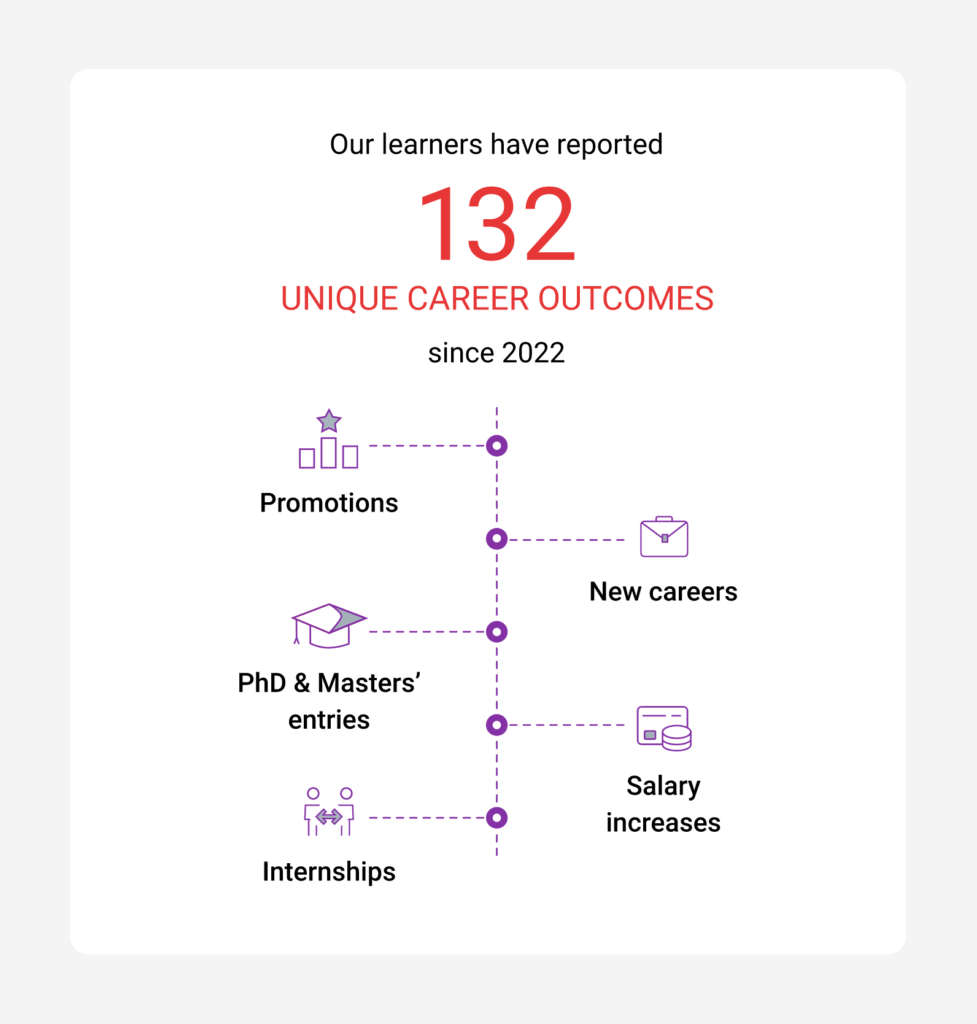
Get a glimpse of the people starting out; transitioning into new fields; getting promotions; securing salary increases, and building meaningful careers to thrive in.

Our learners join the programme because they want to:

  • transition into a data analytics role
  • gain the skills job ads ask for and fill their technical skills gap
  • boost their professional image and be more marketable in a competitive job market
  • get hands-on experience and build a portfolio that proves their skills

Most of our learners are full-time working professionals who needed a programme that was structured and supportive. They were able to fit studying into their busy schedules with the help of the asynchronous learning experience; you can study and catch up on recorded sessions when it suits you best. Plus, you have a dedicated Career Coach to help you set goals, and a Success Manager to help you keep your studies on track.

“The experience of the Career Accelerator has been great. I’ve learned so many things outside of the course content and felt supported throughout. This programme has surpassed all my expectations.”


Here’s what they’ve achieved*

*Since writing this article, our learner outcomes have grown to 239, and counting.

I changed industries

“I re-entered the job market during the pandemic after running my own business for 20 years. I had no previous data experience and was hired as a senior data engineer.” 

I got promoted

“I was happy with my job but I couldn’t help thinking, ‘What next?’ (I got) a fresh perspective and I saw how many opportunities there are working in data. My new skills helped me take on more responsibility at work and feel more fulfilled.”

The average salary increase reported by our learners since completing a Career Accelerator is 21.9%. Many of our learners were looking for a programme to help them boost their professional image and opportunities. Earning a formal qualification from LSE gives employers credible proof of what you’re capable of, and ensures the recognition – and promotions – you deserve.

I pivoted into a new role

“I was working in the training and development team, but wanted to move into data. My employer was so impressed with my progress on the Career Accelerator that they promoted me to an analyst role effective immediately.”

Highlights of the learning journey

Career coaching

“Working with my Career Coach was a real eye-opener for me. I really questioned whether it was too late to do something different at my age, and she helped me see the world of possibilities that are out there. I left my career in education after 16 years and am now thriving in my new role as a lead data scientist.” 

Structured learning

“The material is presented clearly and the online platform is easy to use. The concepts build logically throughout the course and I like all the additional support, like the live sessions and student community, that you don’t usually get on most programmes. I also like the fact that I can study at times that work for me.”

Course content

“This Career Accelerator teaches a high quality of content. It’s very interactive with good practical exercises and strong support from the programme team.”

You can learn more about the Career Accelerator structure and experience here.

Online learning

“Studying online gave me the freedom to decide my own hours. The original draw to it was that it was a part-time course where I could work on it as well as spend time for myself and work on projects. That split was very useful for my own mental health and physical health in general.”

1Based on FourthRev graduate data as of January 2024.

2 Based on FourthRev graduate data as of March 2025.

How Three Data Analytics Graduates Achieved Their Career Goals

As of January 2024, over 130 graduates of the LSE Data Analytics Career Accelerator have reported back to us about the career results they’ve achieved.

With each goal unlocked, we’ve seen how the programme meets our learners where they’re at in their careers – whether they’re starting out, changing career tracks, or wanting to advance in their current roles.

Some learners, like Elodie, have moved into data analytics after spending decades working in a completely different field. Others, like Hussein, have gone from having no experience with data to adding Python, R, Tableau and other data-related languages and technologies to their skill sets. We’ve seen other learners achieve career results like salary increases, promotions, and a rejuvenated sense of meaning and direction at work.

In this article, we dive into the stories of three graduates of the LSE Data Analytics Career Accelerator and hear first-hand how the programme helped them achieve the results they were looking for in their careers.

Hazel impressed her employer and moved into the data role she wanted

Hazel was working at a new start-up in a training and development role but had a keen interest in data. At the start of the Career Accelerator, Hazel made it her goal to move into an analyst position after she’d finished the programme.

She picked up new skills quickly while working on the coursework and, with the encouragement of her Career Coach, decided to approach her manager to discuss how she could make a career move in the future. She found out that her company was in the process of setting up an analytics team, and they were so impressed with how she’d used her new data-backed skills to automate one of her training reports that they offered her a data analytics position much sooner than she expected.

“This course gave me the confidence to push forward, and understand that whilst I might not yet know all of the code, I do know the approach to take. It was this, alongside the amazing support I’ve received throughout the programme which allowed me to have those conversations with my manager, which has resulted in my new opportunity as an analyst.”

Ash fast-tracked his career change to data analytics

After nearly two decades, Ash found himself back in the job market due to the COVID-19 pandemic. He’d been a business owner but now wanted to explore what a career in data looked like. The LSE Data Analytics Career Accelerator was the perfect springboard for this change.

The programme helped him not only update his knowledge of new industry practices and technologies but also learn new languages like R and Python and BI tools like Tableau.

Halfway through the programme, Ash found a job as a Senior Data Engineer at CityWire. The skills he’d developed in machine learning and advanced statistical modelling, combined with his past leadership experience and knowledge of business operations, set him apart from other candidates, and his employer was impressed with how he could drive results for the company.

“This course is a comprehensive instruction of all the skills and tools one needs to make it as a data analyst. It’s helped me connect different siloed bits of information and turn them into a marketable skill set for employers. The best bit about the course – the team and the support they provide! Enrolling in the course was the best career decision I have made.”

Akira unlocked new opportunities when she pivoted her career

Before she found the LSE Data Analytics Career Accelerator, Akira was at a crossroads in her career. While she enjoyed the work she was doing, she wanted bigger opportunities and to step out of her comfort zone.

Once she got started with the programme, she found the career support from her Success Manager and Career Coach to be particularly helpful. With their guidance, she was able to plot the direction she wanted to move in and build her professional image and confidence.

It wasn’t long until she had multiple opportunities to explore in the data analytics space. After completing the Career Accelerator, she was hired as a data operations support analyst at Parkinson’s UK.

“Having all the additional support alongside the lectures helped so much. My LinkedIn got very, very busy, and I didn’t have time to answer all the people in my inbox. It’s completely changed how I present myself to the working world and how the working world reacts towards me. The career coaching was a great help!”

Ready to go after your career goal?

Hazel, Ash, and Akira all started the LSE Career Accelerator with little-to-no data experience. In just six months, however, they forged new paths in one of the most in-demand and high-earning careers.

If you’re curious about how this Career Accelerator could help you achieve your career goals in 2024, download the brochure or speak to one of our Enrolment Advisors to find out more about the programme.

Opening Industry Doors With Data: Read Hussein’s Story

After 10 years as an economist in government civil service, Hussein Farook wanted a new career in a different sector. For him, that meant a career change to data analytics – but he had no idea how to get there. That was before he found the LSE Data Analytics Career Accelerator. 

I didn’t have coding skills before

“The programme was very good at being able to break things down from a practical perspective. So any problem is made up of a series of questions and then a series of answers, and how well you structure those. It doesn’t matter how good your coding skills are. If you’ve got a good framework and thought process; I found that really invaluable.”

I landed a new role four months into the programme

“I already had about four months of experience or learning under my belt [when I started my new role as an economic consultant]. And it was amazing to see that actually, the skills that I was learning in the course, could be applied in my role. So I think my first takeaway for anyone who’s interested in this is: regardless of what conceptions you have, about how you’d use these kind of practical skills, you can apply it to almost any industry, whether it’s data, and I think, given how interconnected everything is that being able to tell a story – or to scrape a website – to really understand how to segment a market has been really beneficial to my career. So in a very short space of time, I’ve been able to use those skills and it’s become an increasing part of my day to day toolkit.”

“I think part of the reason I got my new role was the fact that I enrolled on this Career Accelerator. And it was part of my interview discussion at the end. So it was definitely something they took note of.”

Elodie Hudson is another LSE Data Analytics Career Accelerator learner who has a story of great success. With her new skills, she changed her career from teacher to data analyst. Read it here.

My Success Manager kept me on track, accountable, and prepared

“I remember eight months ago when you mentioned the role of the Success Manager, I wasn’t entirely clear how well I needed to interact with them. But actually, having someone you dock in with regularly – outside of the general kind of Q&A you have about the course material, or separately about longer term career aspirations –  those weekly catch ups with my Success Manager were really helpful”.

My Career Coach helped me rethink my career

“So I think the most rewarding thing from this programme was just how manageable and bite-sized the pieces of advice were. So rather than thinking about: ‘I need to get a job in this industry by this time’, it was: ‘have you thought about what motivates you, what interests you,’ then think about where you’re most engaged or at least engaged, and then you start thinking about where those skills might be most applicable.”

I learnt how to build my brand

“Does your LinkedIn profile say what you want it to say? It was remarkable how little attention I pay to LinkedIn, and how useful that is as a marketing tool for yourself. So building my profile on that, thinking about how I sell myself, who I’d like to sell myself to, and how I reach out to people, that was really helpful.”

This is what you can expect

“If you can at the outset embed 15 to 20 hours a week, it’s really beneficial. It’s quite difficult to try and pick up a language quickly on the fly, I think it’s something you need to do constantly.”

“Because I worked full time, I would normally dial in to the 7pm [lecture] – that’s recorded. So you have a very easy to use interface where you can replay any of the lectures, they come with an online notebook as well. So you can annotate and reference questions during those lectures, which is really useful. In addition to that, I think the biggest benefit for me was the way the online learning was structured. So you have access to a website, each module is broken down into submodules with questions and practical examples, and then assignment tips and learning – you can break that up as and when it’s most convenient to you.”

When Hussein started thinking about his future opportunities, he knew he wanted a toolkit that gave him opportunities to use data – but not be pigeonholed into that role. Ultimately, he’d love to marry his passion for music with his career by working for companies like Spotify. With his new skills – and growth mindset – we have no doubt that Hussein will go further than he thought was possible. 

A career in data opens up opportunities in nearly every industry. If you’re interested in the LSE programme that helped Hussein get real career results, check out the programme page. 

From Teacher to Data Analyst: Read Elodie’s Story

Data analytics has become one of the most desirable fields to work in, with high demand and great pay – Glassdoor lists the estimated salary for a data analyst working in London in 2023 at £42,802 per year. However, without years of technical training, it doesn’t always seem accessible. This is what high school science teacher, Dr Elodie Hudson, thought before she enrolled in the LSE Data Analytics Career Accelerator.

“For someone like me, with a science background but no coding background at all, I always imagined a coder or a software developer or any sort of [analytical] tech role was just not something I could access.”

After obtaining her PhD from Imperial College London, Elodie began her career as a scientist before becoming a teacher. After more than 16 years in education, she decided to pursue a new career path: “I’d reached the stage in my career where I felt nothing was going to change. And I really wanted to try something different that would suit my skills. I’d been in an education bubble for a long time, and I wasn’t sure I had the skills to make a complete change and do something completely different.”

Having always been interested in data, Elodie began to explore studying options that would give her the skills she would need to transition into analytics.

She didn’t have to wait long. While completing the LSE Data Analytics Career Accelerator, Elodie was offered a new role as a Business Intelligence Analyst at AssessTech, a technology and training company that specialises in all areas of competence management for the railway industry. This was then followed by two promotions, first as the Lead Data Scientist and then as the Director of Development (all within the space of 11 months).

“The programme has had a massive impact on my life. I have my next job lined up, and I’ve successfully completely changed my career, so I’m really excited as to what comes next.”

We asked Elodie what she thought of the Career Accelerator and how it gave her the confidence and skills to transition into a new career.

What attracted you to this specific programme compared to others out there?

“I decided to go for the LSE Career Accelerator because of the rigour of the content and the depths to which all of the skills were explored, plus the opportunity to work on an Employer Project and get support from the career coaching and success management aspects of the course. So although it’s online, you feel like you’re part of a big cohort. There was good contact with the facilitators, and the academic standard of the content was really good. It seemed like a course that was broad enough, deep enough and rigorous enough to actually equip me with the skills that I needed for a career change.”

Did the Career Accelerator help you master new technical skills you didn’t have before?

“I really enjoy data analytics, and it’s been fantastic to learn how to code using SQL, Python and R, as well as how to use Tableau. All of these four are skills that I didn’t have at all when I started the course. It’s unbelievable how much I learned in the space of six months.”

How valuable did you find working with a Career Coach?

“It’s been a complete eye-opener for me. As someone who’d just turned 50 when I started the course, I really questioned whether it was too late for me to do something completely different. My coach completely opened my eyes to the world of possibilities that are out there. It’s never too late to start something new. I already had more skills than I thought I had from my teaching career, so the whole [career coaching] process has been an excellent add-on to the actual analytics content of the course.”

Who would you recommend this Career Accelerator to, and why?

“I would recommend this course to really two sets of people. The first would be people who want to change their careers completely and enter the world of analytics. And the second would be people already in an industry or a business where they want to stay but who want to improve their analytical skills or move into analytics within that business.”

What advice would you give someone with no technical experience who might be apprehensive about enrolling in this programme?

“I always imagined any sort of tech role was just not something I was able to access. That misconception has been completely blown out of the water. You realise that, actually, [coding, for example,] is just a skill like any other that anybody can acquire. With the right mindset and approach to hard work, all the resources on the course are there for you to succeed.”

If you’re interested in exploring a completely new career path like Elodie did, why not find out more about the LSE Data Analytics Career Accelerator? Download the programme brochure here and book a call with an Enrolment Advisor to discuss any questions you might have.

How to Become a Data Analyst in 2023

It’s been eleven years since Harvard Business Review famously labelled data science the “sexiest job of the 21st century.” The role was relatively new at the time and was most likely performed by a senior data analyst or analyst with a specific skill set. The article was inspired by the fact that, as more companies tried to make sense of big data, they realised they needed data whisperers—people who can ‘coax treasure out of messy, unstructured data.’

Fast forward to 2023, and the number and variety of roles in the field of data collection and analysis have grown and become more defined. Beyond data scientists, we now use titles such as data analysts, machine learning engineers, and data architects to more accurately describe the roles of people working with data in some form or another. 

Each year, there is increasing demand for people who can combine programming and analytics with expert visualisation skills—and data analysts are leading the pack. Statista reports that by 2025, man and machine’s activities will have created 181 zettabytes of data, so it’s no wonder The US Bureau of Labor Statistics estimates the demand for data analysts will see a 23% growth between 2021 and 2031 (5% higher than any other profession).

The good news is you don’t have to be a rocket scientist to become a data analyst. Anyone with an aptitude for mathematics, statistics and technology can enter the world of data analysis. Let’s take a closer look at some of the questions you might have if you’re looking to become a data analyst in 2023.

What does a data analyst do?

Data analysts draw on techniques from a range of disciplines— such as statistics, mathematics, and programming—to collect, organise and study data that provide businesses with valuable, actionable insights. They help business leaders find answers to complex questions and are in high demand at companies that make data-driven decisions.

A recent data analyst job posting by Jenrick Group called for someone who could ‘gather data, undertake data analysis and build dashboards to share quality visualisations and insights that the data reveals.’ The role would be central to identifying key innovation areas within the reinsurance industry.

The BBC also recently put up a job post for a data analyst who can mine various data sources—digital analytics data, the BBC’s own metadata systems and 3rd party datasets—to deliver insights that can drive the media giant’s customer engagement and strategy.

While data analysts can specialise in finance, healthcare, business, marketing or e-commerce, the basic responsibilities for the role are the same. These include:

  • Extracting and wrangling (cleaning) data from various databases and sources 
  • Analysing and interpreting data results using statistical techniques
  • Creating data dashboards that can be accessed by all departments
  • Monitoring and auditing data quality
  • Automating tasks and streamlining processes

What’s the difference between a data analyst, data scientist and other data roles?

One way to think about the difference in data roles is whether they act before or after the data is collected. Most of the work data engineers and data architects do is performed before the data is collected, whereas data analysts and data scientists are responsible for everything that happens after the data is collected. 

Simply put, data analysts are explorers who investigate data from multiple angles to draw insights about things that have happened in the past. Data scientists, on the other hand, use raw data, statistics, and deep learning to create predictions and analyse opportunities.

Where does a data analyst fit into the business structure?

In some organisations, data analytics processes are highly centralised, and you’ll have a single data team of engineers, analysts and architects serving the entire company. Other businesses will take a more decentralised approach, where each business unit, such as sales, operations or supply chain, will have access to its own data professionals, resources, and processes.

While team structure depends on a company’s size, its goals and how it leverages data, most data teams or individuals will work cross-departmentally with company management and the IT department. Ultimately, a data analyst must have enough technical acumen to be a critical bridge between business and IT, but when it comes to reporting, you’ll be closer to the business side, where you’ll collaborate with either the product manager or the company’s COO.

What salary can you expect as a data analyst?

According to Glassdoor, in London (where pay is normally a little higher), a data analyst can expect to earn around £42,665 per year. Considering benefits such as a company pension scheme, medical insurance, bonuses, profit sharing, etc., you could see an additional £3,000 per year added on top of your yearly salary.

According to Prospects, starting salaries hover around £23,000, while experienced analysts and those in high-level and consulting data analytics jobs can command £60,000 a year or more.

How can I move into a data analytics role?

There are several ways to move into the data analytics field.

If you’re looking for a reputable online programme that has seen several successful career outcomes, consider the LSE Data Analytics Career Accelerator. Co-designed by faculty from LSE and industry leaders from companies like Tableau and GitHub, the six-month online programme will equip you with the technical, business and human skills you need to secure a data analyst role.

Everything you learn is highly practical, and there are no exams. Instead, you complete an Employer Project at the end of the programme, which has been designed to give you the opportunity to work on a real-world problem set by an employer.

To register for the programme, you’ll need:

  • Previous education, such as a Bachelor’s Degree in mathematics, computer programming, economics, engineering, research, statistics or a similar field that emphasises statistical and analytical skills OR
  • Three years of professional experience with knowledge of Excel. Experience in using Pivot tables is highly advantageous

If you have neither of the above, our admissions team will do an aptitude test to determine how strong your math and statistics skills are. You can hear more about the admissions criteria from our Enrolments team here.

How is the LSE Data Analytics Career Accelerator structured?

After an Orientation period, where you meet your Success team and get comfortable with the online environment, the LSE Data Analytics Career Accelerator is comprised of three six-week courses, which all culminate in an assignment that you can include in a portfolio of evidence that showcases your skills. The courses you’ll work through are:

1) Data analytics for business

2) Data analytics using Python

3) Advanced analytics for organisational impact

In between each course, you’ll take part in a Reflection week, whereby you’ll have time to meet with your dedicated Success Manager, take stock of your progress and plan what comes next. You’ll also spend time with your Career Coach, who will help you set short- and long-term career goals to ensure your investment continues to serve you into the future.

Finally, you’ll complete the Employer Project, where you’ll work with a group to apply your learning to a live data set and solve a unique business challenge set by an Employer Partner.

What sets this Career Accelerator apart from other programmes?

  • It’s shorter than a traditional Masters programme (six months online, 15–20 hours learning time per week)
  • You’ll have access to a Career Coach and Success Manager who will help you achieve your goals
  • You’ll create a digital portfolio of evidence to showcase your skills
  • You don’t learn stuff you’ll never use
  • You’ll gain industry experience through the Employer Project
  • You’ll have access to a recruiter network 
  • You’ll get assistance with everything you need to make a career move, including your personal brand statement, CV and LinkedIn profile

Being agile and working with industry partners means the content keeps up with constant innovations in the industry, including changing platforms, tools, trends and business needs.  

The holistic career-focused approach to learning will also give you the crucial mix of technical and human skills that recruiters and HR managers are looking for. On a technical level, you’ll learn advanced Excel, SQL, Postgres, Python, R, and Tableau.

On a soft skill level, you’ll develop strong verbal and written communication, the ability to apply your analytical mind and wire it for problem-solving and the skills needed to collaborate with others as part of a team.  

You can hear more from previous learners about their experience of the programme and how it helped enhance their employability here.

Launch your career as a data analyst

Ready to dive into the world of data analytics?

Book a call with an Enrolment Advisor to learn more about the LSE Data Analytics Career Accelerator and whether it’s the right fit for you and your goals.

Hear From Our Learners – What a Career Accelerator in Data Analytics is Really Like

To give you more insight into what our Career Accelerators are really like, we’ve invited learners to share their experiences in live Q&A sessions. 

Most recently, we were joined by Eleonora Bacchi and Adrienn Szollosi, two past learners from the LSE Data Analytics Career Accelerator. They spoke to Daniel Cairns, Head of Enrolments at FourthRev, about how they found the programme, how it’s benefitted them and what their future career plans look like. 

Some of the questions they answered included:

  • How much of a technical background is needed to do well in the programme
  • Time management and balancing commitments
  • Whether the programme is suitable for people at different stages of their career
  • What it was like working with a Career Coach 
  • The structure of the Employer Project and how it enabled them to apply their new data analysis skills to a real-world problem 
  • What their career outcomes have been

Watch the full event recording here

Snippets from the Q&A webinar

Do you need prior experience with programming and the languages covered in the course? 

Adrienn: No, I didn’t have any background in Python, R or SQL. It is really about your commitment. You don’t need any knowledge going in because the course material is really well explained. There are written and video explanations to cater for different learning styles. Without any background, you can get through.
Eleonora: Yeah, I had zero previous experience. Adrienn is so much more experienced in Excel than me – I didn’t even know how to do a pivot table. You go really deep into the languages, which I personally loved. I remember the day I started programming in Python because it was my birthday. I knew nothing in the beginning, and now I do everything in Python, like easily. So from zero to the top.

Can you provide some insight into how the Employer Project works and what projects you had to choose from?

Eleonora: First you’re assigned to a team, and you discuss your roles and what you personally want to get out of the project. Like, for example, this was a very important project for me because I wanted to put it on my portfolio as a highlight. Next, you choose which employer you will work with and get more information about your project. I did a very hands-on project with Zoomo, an automotive B2B and B2C company that provides long-term rentals to delivery drivers. They gave us data to help them build a feature in their app. 

Daniel: Another project through Thoughtworks was related to the City of London Transport for London and their goal of reducing 80% of traffic within the London CBD through the use of foot, bicycle or public transport by 2041. The measurement of the progression towards that was proving challenging, so students worked with the data sets to improve that tracking. It is a really meaningful, impactful opportunity that they had.

Adrienn: I kicked my project off yesterday. I’m working with Agent3, but because we only got the information and data so recently, it’s still very new to me. We’ll be looking at mortgages in the US, which is interesting. 

How do you feel your work with a Career Coach will help you move forward in your career?

Eleonora: The coaches are equipped to help everyone. Adrien is a “career advancer”, and I am a “career changer”, meaning I made a complete switch. I’ve found the career coaching tips have been helpful. What I appreciated is you get advice that is useful to everyone, like how to set up your LinkedIn profile, how to reach out to people, worksheets, readings, and tips on how to present yourself – all sorts. But you also have the one-to-one time where you can work on what is specific to you. When you connect with the right person, this makes a real difference. 

If you’re interested in finding out more about the LSE Data Analytics Career Accelerator, please reach out to our friendly Enrolment Advisors. They’ll be able to answer any questions that you might have. You can also ask them to keep you updated about when our next learner Q&A webinar will be taking place.