Table of contents

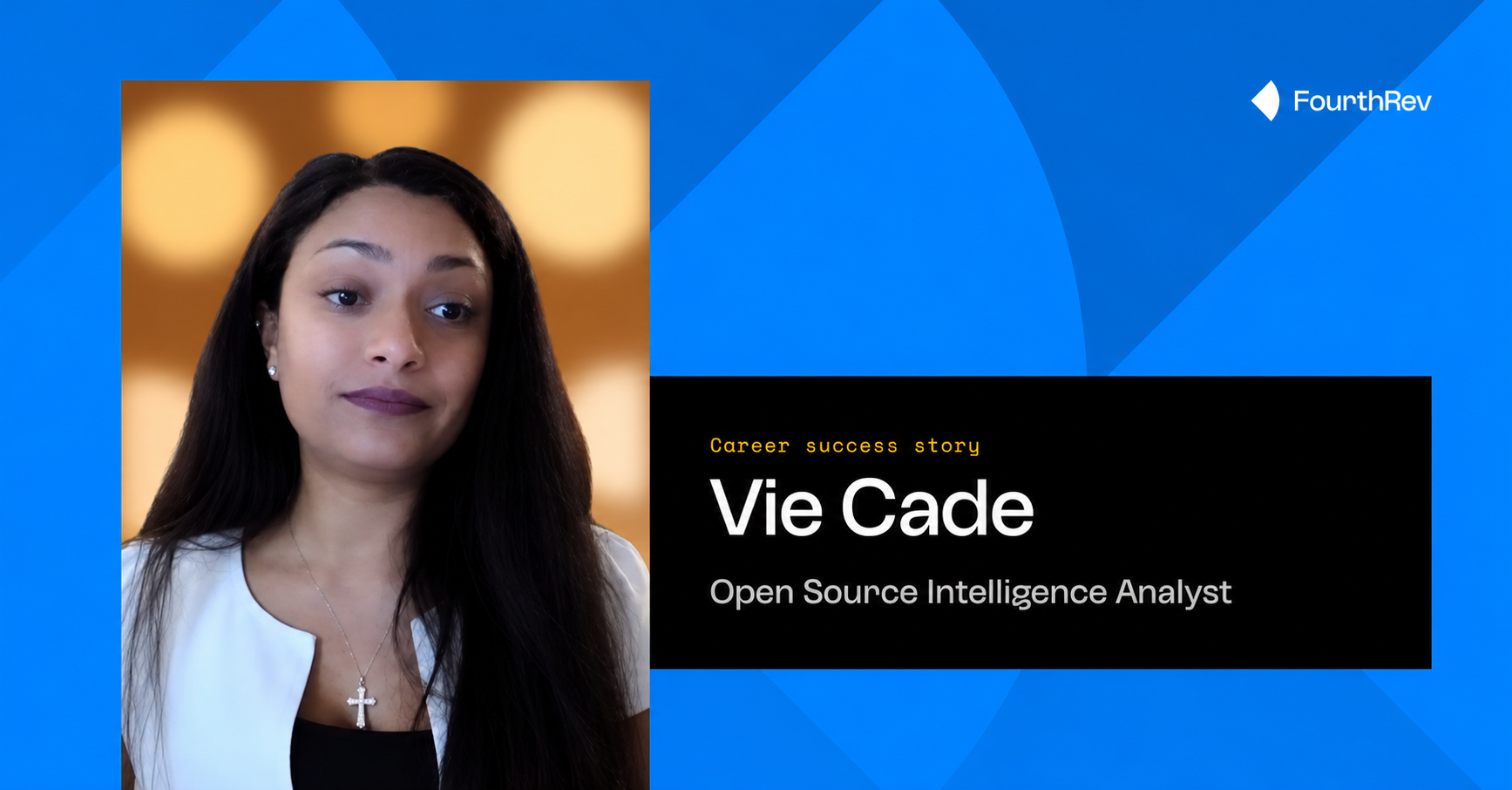
Vie Cade is an open-source intelligence analyst who works on financial crime and threat intelligence.
In an AMA webinar, Vie shares her experience on the Cybersecurity Strategy & Leadership Accelerator delivered by the University of Cambridge Professional and Continuing Education (Cambridge PACE) in collaboration with FourthRev, as someone who came to cyber leadership from outside the profession, and how it has changed the way she speaks to a board. She’s now in the capstone project, the programme’s final stage.
Feedback that pointed the way
Vie had already taken a Cambridge PACE programme, an introduction to large language models, and enjoyed it enough to look for more. Around the same time, she was passed over for a physical security role. The feedback was clear: more stakeholder management was needed.
That’s what led her to this programme.
“So this was perfect for me, really. I do find it funny how I was going for a role in physical security, and now I’ve accidentally learned about cybersecurity as well, so I feel like a triple threat.”
Learning the technical side from outside cyber
Before enrolling, Vie’s biggest worry was that the programme would be “a really, really heavy course cybersecurity-wise”, with an expectation to know “all of the jargon and the technical terms” from day one.
“However, with this course, it’s not the case. I worked through being a non-technical person by learning about the technical aspects within the course scenarios.”
She triaged each new piece of information and translated it into how the problem looked in her own field, which meant going through the material twice, “which is not a requirement, I promise you.”
No more waving at the whiteboard
Stakeholder management was the reason Vie enrolled, and it’s the part of the programme that has proved most useful, alongside the capstone project.
“And instead of waving my hands at a whiteboard going, look, this is a bad thing. Please help me pay for the solution to the bad thing. It’s a lot more coherent than that now.”
She can now anticipate the non-technical board member, someone who might come from insurance rather than security, and have answers ready if they want to go deeper. In threat intelligence, that preparation saves critical time.
Her confidence has shifted too. “People are usually confident when they know what they’re talking about. That’s what confidence is. And the knowledge in this course gives you that.”
Learning how to find the right framework
Vie works with around 60 frameworks across the fields she has worked in. The programme covers regulatory frameworks including NIS2, GDPR, DORA, and the EU AI Act, but it doesn’t hand over one framework to follow.
“This course teaches you how to find the framework that you need.”
“This programme teaches this skill really effectively, and culminates in a capstone project, so you actually have something to show for it. You essentially learn the rules of the board game, so to speak, because you will be dealing with a board.”
That capstone is a six-week crisis simulation, where learners lead the response to an organisational incident, brief executive stakeholders, and propose a strategic transformation plan.
Proof in the interview room
When asked whether the programme was worth it, Vie returned to that physical security role. Over seven interviews with the same intelligence manager, the difference showed. Before the programme, her stakeholder emails “sounded like a customer service email”. The manager noticed something other candidates hadn’t shown: that she had acted on the feedback.
“So, it has been worth it for me, because when I re-interviewed, the chap said that I would go straight to the top of the chain.”
Vie got the role. Then the company was acquired and the role was paused, so she plans to try again. “But yes, it’s opened up so many doors for me.”
AI and the people it leaves behind
In Vie’s field, AI is making it easier for crime of all kinds to happen. She sees the programme as preparation for leading through an AI-amplified threat landscape.
“So, this course has given me the tools where I know I will be able to make a great change to people’s lives in terms of protecting the vulnerable, and championing people who haven’t quite, perhaps, kept up with technology.”
The support built into the Career Accelerator
Vie is honest about the workload. There’s a lot of reading, and many learners handle incidents in their day jobs while studying, alongside family life. “But it’s not unmanageable.” Her answer was a personal tracker spreadsheet, gamified with points and gold stars for every module finished, and her one regret is not making it sooner.
Support is built into every Career Accelerator, and Vie felt it throughout. Her Success Manager, whose role is to keep each learner on track, was there whenever she needed her, and when life got busy, she could step back without losing progress. “People are there with you, they understand.”
The industry leaders behind the programme stood out too. As Vie puts it, the course “has been put together by so many industry leaders”, and she describes up to 15 contributors, including global CISOs, speaking candidly about incidents that pushed them to their limits.
The cohort is part of the design. Each Career Accelerator brings together experienced professionals from different sectors, and Vie’s group includes people who work at NATO, former CISOs, third-party suppliers, electrical engineers, and others from outside cybersecurity.
Those connections deepened over late-night conversations at the Cambridge Leadership Immersion, and now, in the middle of the capstone project, the team covers for each other whenever someone isn’t available.
What’s next
“This course has led me to ask some really important questions in my field, so I have applied for a Master’s with the University of Cambridge, so that I can answer some of those questions and help to implement change within the industry.”
“Where is the help coming from?”
For anyone in fraud, risk, compliance, or investigations wondering whether cyber leadership is for them, Vie has one question to ask yourself first: “In your field, where is the help coming from?”
“If you have a problem to solve, and the solution is a cybersecurity one, then you need to know how to speak their language, to be able to ask for the solutions that you need.”
And would she do it all again? “Absolutely.”
Ready to take the next step?
Lead cyber risk conversations at board level with this Career Accelerator.
Six months, part-time and online, with the one-day Cambridge Leadership Immersion, a crisis-leadership capstone, 12 months of 1:1 career coaching, and a Certificate of Completion from Cambridge PACE.
Download the brochure to find out more.
Share:


