


You can now build on your product management foundation with the King’s Postgraduate Certificate in Product Management. It picks up where the King’s Product Management Career Accelerator leaves off, giving you the credentials, the depth, and the network of one of the world’s most respected universities.
Since we launched the programme with King’s, the product management job market has changed considerably. Roles are more competitive, hiring managers expect proof of applied skill, and AI has reshaped what “good” looks like for a product manager. A Level 7 qualification from a Russell Group university is one of the strongest ways to show you’ve kept pace with all of it.
Here’s what Dr Mark Hedges, Head of the Department of Digital Humanities at King’s College London, said when the programme launched:
“Completing this Postgraduate Certificate in Product Management will not only equip learners with the practical skills, hard and soft, needed in the product management workplace but also provide them with the academic and critical skills needed to engage with their professional career in an informed and reflective way.” – Dr Mark Hedges, Head of Department of Digital Humanities at King’s College London
It remains the first postgraduate certificate in product management offered by a Russell Group university. Below, we’ve refreshed what a postgraduate certificate actually is, what the King’s programme covers, and how it lines up with what the UK product management market looks like in 2026.
What is a postgraduate certificate?
A postgraduate certificate is a Level 7 qualification in the UK, the same academic level as a Master’s degree, but shorter, less expensive, and focused on a specific area of study. It typically carries 60 academic credits and can count toward a full Master’s later on.
According to the UK government’s list of qualification levels, Level 7 covers Master’s degrees, integrated Master’s, and postgraduate certificates. They sit at the same tier academically. What separates them is scope and time.
How a postgraduate certificate differs from a Master’s
Credit weight: A postgraduate certificate is worth 60 academic credits. A Master’s is 180. Because the credits sit at the same level, most universities let you carry your PGCert credits into a Master’s later if you decide to keep studying.
Time: Most postgraduate certificates take three to six months of part-time study. A Master’s usually takes at least a year full-time, or two years part-time.
Cost: A PGCert is typically a fraction of the cost of a full Master’s, which makes it a lower-risk way to earn a Russell Group credential.
A closer look at the King’s Postgraduate Certificate in Product Management
The postgraduate certificate is a direct continuation of the King’s Product Management Career Accelerator. It’s designed for graduates of the Career Accelerator who want to go deeper into a chosen area of product management and walk away with a globally recognised, credit-bearing qualification from King’s.
Over four months, you’ll produce a comprehensive portfolio and a research-based written dissertation. Both draw on your Career Accelerator work, but this time you choose the topic and specialise. Working with a King’s academic supervisor gives you the space to zoom in on one area of product management and become a specialist. That kind of focused expertise is what hiring managers actually pay attention to when they shortlist for senior roles.
What the programme includes
- Two to three one-on-one sessions with a King’s academic supervisor
- Regular check-ins with an industry mentor working in product
- A structured, self-directed research and portfolio project spanning four months
- Access to the King’s campus and library
- An in-person graduation ceremony on campus
- Full alumni network membership once you graduate
Building a working relationship with an academic supervisor and an industry mentor is one of the more underrated parts of the programme. Those are the connections that lead to introductions, invitations, and job leads long after you’ve submitted your dissertation. Between 75 and 100 Career Accelerator graduates have gone on to take the postgraduate certificate so far, and that number continues to grow with each intake.
Your path to becoming a product management expert
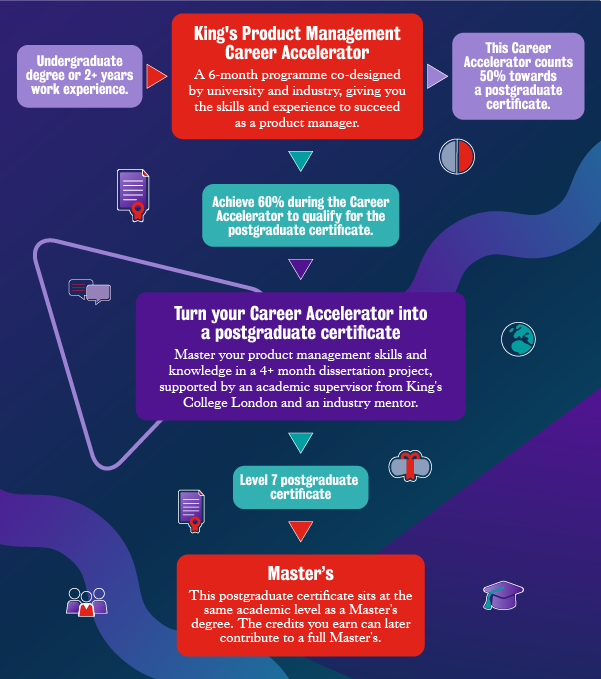
Right now, the postgraduate certificate is open to current and past learners of the King’s Product Management Career Accelerator who achieved an average of 60% or above on the Career Accelerator.
To enrol on the Career Accelerator itself, you need an undergraduate degree or at least two years of professional work experience.
Your Career Accelerator work counts toward the postgraduate certificate directly: 50% of the academic credits you need to complete the PGCert come from the Career Accelerator you’ve already done. In other words, the two are stacked by design, so the time and money you’ve already put in continues to compound.
Once you finish the PGCert, you’ll hold a Level 7 qualification from a Russell Group university. If you decide to go further and complete a Master’s later, the credits from this programme can count toward that degree too. This is what continued learning across a career is supposed to look like: modular, credit-bearing, and additive.
Who this programme is for
- Career Accelerator graduates who want a specialist edge in one area of product
- Product managers looking for a credit-bearing qualification to support a promotion or a senior job move
- Anyone considering a future Master’s who wants to test the water at Level 7 first
- Career changers who want a Russell Group credential on their CV without committing 1–2 years to a full Master’s
Why this matters in the 2026 product management market
Product management remains one of the strongest-paying and most competitive roles in UK tech, but the bar has moved.
The average UK product manager now earns around £62,953 a year from Glassdoor UK, June 2026. In London, the average sits at £69,447. Senior product managers earn a UK average of £86,124, rising to £91,262 in London.
AI has changed what employers ask for. 61% of product manager job postings now require AI experience, and AI-focused product roles in the UK have grown around 32% year on year in 2026. AI product managers command a 25–35% salary premium over generalist PM roles, with senior specialists in London regularly clearing £120,000.
There are now more product manager job openings than ever, but the roles that pay well and progress fastest now expect a mix of academic rigour, applied experience, and current AI literacy. A generalist CV without depth in any of the three is a harder sell than it was in 2024.
The postgraduate certificate speaks directly to those three demands. It gives you the depth of a specialised research project, the academic rigour of a Russell Group Level 7 qualification, and the freedom to focus your dissertation on a modern PM problem area, whether that’s AI product strategy, applied LLMs, platform product management, or something else you want to stand out for.
Is a postgraduate certificate worth it?
The honest answer is it depends on what you do with it.
Employers rarely hire on the strength of a certificate alone. What they hire on is what a certificate helps you demonstrate: relevant, recent skills, applied experience, and a credible institution behind the credential. Our guide to how employers actually evaluate university certificates goes deeper on that.
If you’re weighing up whether the extra four months is worth the fee, our framework for measuring ROI on a career programme is a useful starting point.
Salary bump is one measure. Confidence, portfolio depth, career trajectory, and proof of applied skill are the others that actually shift what happens in the next interview.
The Career Accelerator lays the foundation you need to build your knowledge and confidence to go further in your product management career. The postgraduate certificate builds on this and helps you further develop your skills. The two are interlinked, and it makes sense that your investment in the first part of the journey continues to pay off as you progress.
Frequently asked questions
Is a King’s postgraduate certificate the same as a Master’s?
No. Both are Level 7 qualifications, so they sit at the same academic tier, but a postgraduate certificate is worth 60 academic credits while a Master’s is worth 180. A PGCert is shorter, more focused, and typically much cheaper. The credits you earn on a King’s PGCert can count toward a Master’s later if you decide to continue.
Who can apply for the King’s Postgraduate Certificate in Product Management?
The programme is open to current and past learners of the King’s Product Management Career Accelerator who achieved an average of 60% or higher. To be eligible for the Career Accelerator in the first place, you need an undergraduate degree or at least two years of professional work experience.
How long does the King’s PGCert take to complete?
The postgraduate certificate takes around four months of self-directed study. Over that time you’ll produce a portfolio and a written dissertation, supported by two to three sessions with a King’s academic supervisor and regular check-ins with an industry mentor.
How much does the King’s Postgraduate Certificate in Product Management cost?
£2,000
Will UK employers recognise a postgraduate certificate?
Yes. A postgraduate certificate from a Russell Group university carries genuine weight with UK employers, particularly when the credential is combined with a portfolio of applied work. In competitive fields like product management, employers value depth of expertise, credibility of the institution, and evidence of ongoing learning. A King’s PGCert covers all three.
Can I go from the Career Accelerator to the PGCert to a Master’s?
Yes, and that’s exactly how the programme is designed. Your Career Accelerator work contributes 50% of the credits needed for the postgraduate certificate. The full PGCert then gives you 60 Level 7 credits, which can count toward a Master’s degree later on. Each stage builds on the last.
When does the next intake start?
King’s runs two intakes a year for this programme. Check the programme brochure for the next start date.
Take your career further, faster
Product management continues to offer competitive salaries, meaningful work and opportunities across high-growth sectors including fintech, healthtech and AI. What’s changing is what employers expect. Today’s product professionals need deeper expertise, practical experience and credentials that demonstrate they can deliver impact.
The King’s Postgraduate Certificate in Product Management is designed to help you meet those expectations. You’ll gain a respected Russell Group credential, complete an applied research project you can showcase, and join a network of academic and industry experts who can support your career long after you graduate.
Read the programme brochure and, when you’re ready, start your application.
To enrol in the Career Accelerator, you need to have an undergraduate degree or at least two years of work experience. You can find out more about the application requirements here.
Once you’ve completed the Career Accelerator with the pass mark required, you’ll be on track to begin the postgraduate certificate. Your work on the Career Accelerator will contribute 50% of the academic credits needed to complete the postgraduate certificate successfully.
With your postgraduate certificate in hand, you’ll have earned yourself a Level 7 qualification. Recognised by employers as a valuable indication of your expertise, this boosts your employment prospects and long-term opportunities. If you choose to continue your learning journey in the future and pursue a Master’s, the credits you earned from the postgraduate certificate can contribute towards this degree.
Take your career further, faster
Pursuing a career in product management is exciting, with so many avenues and opportunities to explore. Rated as one of the best jobs in the UK, it’s in high demand and offers great job satisfaction and good pay. With a solid set of skills established on the Career Accelerator, you now have the opportunity to enhance your career potential by becoming an expert in your chosen area of product management.
If you’re interested in hearing more about how the postgraduate certificate can give you an extra edge as a product manager, grab a time to connect with your Enrolment Advisor.