The data science talent shortage continues to shape the future of work.
According to the World Economic Forum’s Future of Jobs Report 2025, AI and big data represent the fastest-growing capability globally, with 11 million new roles expected by 2030. Yet 63% of employers say skills shortages remain the biggest barrier to business transformation. In the UK alone, more than 178,000 specialist data roles remain unfilled.
For professionals looking to become data scientists, this presents a significant opportunity. But success depends on more than technical expertise. Employers now want professionals who can connect data science to business value, build production-ready solutions and make confident, evidence-based decisions.
Business problem-solvers, not homework problem-solvers
Robert Hardman opened with a perspective that framed the entire discussion.
“We’re not here to solve homework problems, we’re here to solve business problems.”
Today’s employers want to know:
Can you identify the right business problem?
Can you explain why your model matters?
Can you communicate recommendations that influence decisions?
Can you defend your conclusions with evidence?
As Hardman observed:
“Processes are a straitjacket to innovation.”
These are the skills that set top data scientists apart today.
Hardman also challenged the way many organisations think about AI.
“AI is not about automating the past, it’s about reimagining the future.”
For organisations adopting AI, success comes from challenging old ways of working, spotting new opportunities and using data to make better decisions.
Kate McDermott sees the same pattern from the hiring side.
Technical competence gets you noticed, but commercial awareness and the ability to deliver measurable business impact set top candidates apart.
As she explained:
“If I’m looking at a CV and it’s littered with commercial results and improvements and an understanding of the context of what you’re doing, that is what makes me stop in my tracks and pick up the phone and call that person.”
For candidates, that means showing examples of how their work helped a business to grow. That emphasis on business application is increasingly reflected in how leading programmes are designed, with learners expected to solve real organisational challenges rather than purely academic exercises.
Productionisation has become the new hiring benchmark
Today, employers want people who can take an idea beyond a proof of concept and turn it into something the business actually uses. It’s not enough to build a model in isolation. Employers want to see that you can deploy it, scale it and deliver value in a real-world setting.
Kate McDermott explained:
“The green flags that I’m looking for… is the productionisation capability…The businesses that we tend to work with are those that are particularly agile and want to scale quickly and build products and take them to market, and so we need people that can demonstrate they have built production-grade systems and frameworks.”
As AI tools become more accessible, the value of deep expertise continues to grow.
Robert Hardman described AI as a force multiplier.
“AI is a force multiplier. It will make somebody who is highly skilled and experienced 20, 50, a hundred times more productive, more effective. At the same time… it will make somebody who isn’t as talented think they are talented, and make them two to three hundred times more risky for an organisation.”
Professionals with strong analytical skills and good business judgement get even more out of AI because it helps them work faster and more effectively. They know how to question the results, spot what matters and make confident decisions.
Hardman’s own approach reflects this mindset.
“Never ask AI for an answer. Ever. I always ask AI, how do I find the answer? What should I be looking for?”
Recruitment processes are evolving in parallel.
Kate McDermott noted that technical assessments have become a central part of hiring.
“The technical screenings are back. They kind of disappeared for a while. They are back, and they are rigorous.”
Employers expect candidates to be confident using AI tools, while also understanding the statistics and reasoning behind the results. They want people who know when to trust AI, when to question it and how to explain their decisions.
What this means for aspiring data scientists
The hiring code emerging from the discussion is remarkably consistent.
Employers want to hire professionals who can:
Connect technical work to measurable business outcomes.
Explain and defend model decisions with statistical confidence.
Communicate effectively with both technical and non-technical stakeholders.
Show curiosity, adaptability and a commitment to continuous learning.
McDermott also highlighted an encouraging trend for professionals entering the field: organisations are increasingly hiring for potential. They know AI is changing quickly, so they value people who can adapt, learn fast and understand the business.
As she explained:
“Companies know that they can’t go and find 10 unicorns… people will more often than not hire growth.”
The strongest CVs do the same. They show the business impact of your work, highlighting the results you achieved, the problems you solved and the role data played before listing the tools you used.
Preparing for the hiring market ahead
The message from employers was clear. The strongest candidates combine technical skills with business understanding, practical problem-solving and the confidence to communicate their thinking.
The Cambridge PACE Data Science Career Accelerator is designed around these same priorities. Through more than 20 practical projects and a live Employer Project, learners tackle real business challenges and present their recommendations in a consultancy-style pitch. By the end of the programme, they have a portfolio that showcases both technical skills and commercial thinking.
Ready to build the skills employers are looking for?Download the brochure to learn more about the curriculum, employer projects, learning experience and career support in more detail.
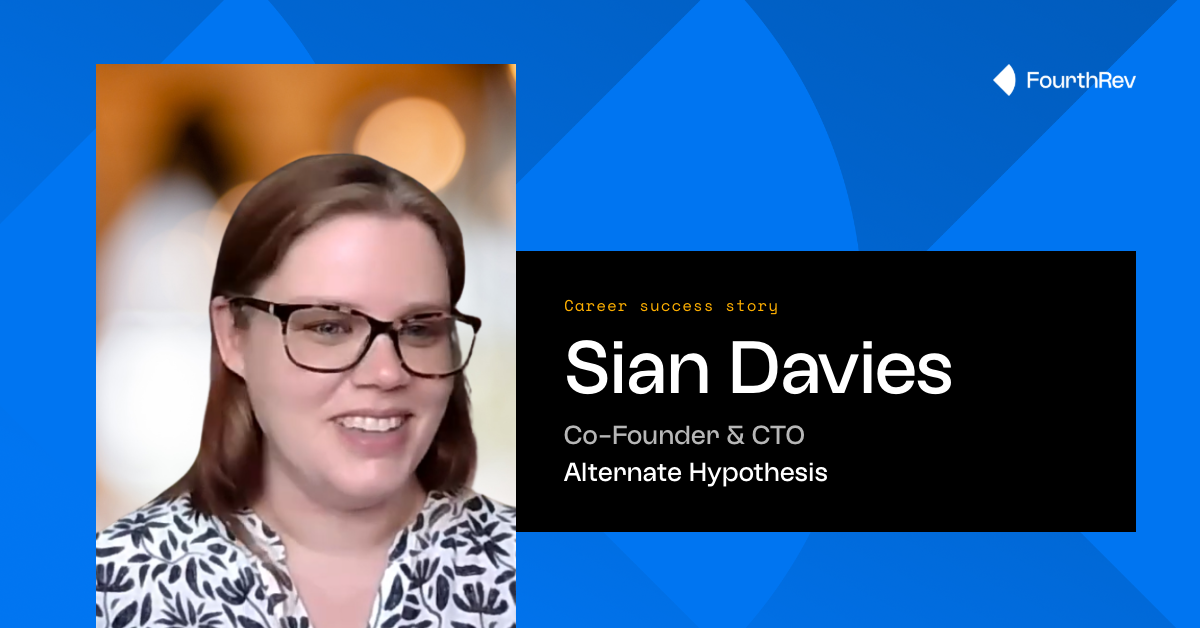
After more than eight years in genetics research, Sian Davies retrained in data science and AI and went on to co-found an AI startup. This is her career change story, told in her own words.
“Don’t worry if you’re a career changer, you can do it. I did it,” says Sian.
She joined an Ask Me Anything webinar hosted alongside FourthRev to talk through that transition in detail, from her early days in the lab through to co-founding Alternate Hypothesis, a startup that uses AI to automate statistical testing.
Making the leap
Rather than a sudden change of direction, Sian’s move into data science built gradually, out of the data analysis she was already doing in her research role and a self-taught grasp of Python that had started to hit a ceiling.
“I’d reached the limit of what I could do with my current knowledge in terms of setting up automations and coding and analysis. So I really needed to take another step.”
Before committing, she joined one of the programme’s own information webinars to learn more. What convinced her to sign up was the practical, project-based way the programme was run, rather than a purely theoretical one.
“I think I liked the detail that this [programme] was going to go into, and the fact that you had projects. So you were doing practical application of the skills. It wasn’t just learning, you were actually applying.”
Putting the learning into practice
She credits the programme’s structure, in particular an early time-audit exercise, with helping her balance roughly 20 hours of study a week on top of everything else going on in her life.
“One of the things that they did with us in the beginning was getting us to set up time audits, which I found quite helpful. So I was keeping a weekly calendar, blocking off specific hours that I would be working on this.”
None of it stayed abstract for long. The statistics module, in particular, laid the groundwork for the business she has since built.
“The skills that we learned are very applicable, because you’re actually writing the code and building things and testing it within the course.”
The area she came away most confident in was large language models and fine-tuning, skills she now uses directly in her day-to-day work.
“The thing that I’ve really gained confidence in is probably the LLMs and things like fine-tuning, properly testing models and improving them. And that’s the thing that I’ve really carried on from the course into what I’m doing now.”
No coding background? That’s fine
She began the programme having only self-taught a little Python and done some Excel analysis. She had never built a model before.
She credits her career coach and her fellow learners, as much as the curriculum itself, with getting her to where she is now.
“I just self-taught a little bit of Python before…and I’d done some Excel analysis and things like that. I hadn’t built any models.”
Her message to anyone worried they aren’t technical enough:
“For me, it wasn’t too much of a problem… if you’re already working with computers, and you’ve already experimented a bit, and you’re already interested in coding… I think it’ll be fine.”
More than just the coursework
Sian points to the career coach and the cohort community as central to her progress, not just the curriculum.
“Mine was really helpful…and encouraging, and she helped a lot…through asking lots of questions, getting me to think about what I wanted.”
Her cohort turned into a long-term support network too, and it’s where she eventually met her Alternate Hypothesis co-founder, Indra Mayengbam, in person.
“In our cohort, we all kind of knew each other. We had WhatsApp groups, and that support was really invaluable as well.”
“I think you shouldn’t feel isolated doing it. In my experience, I didn’t. There was a very strong sense of community… You definitely feel like you’re part of a group.”
The Bank of England project
On the programme’s live employer project with the Bank of England, Sian and her team spent several weeks tackling a genuine, open-ended business problem, sharing leadership of the project as they went.
“In our team, we actually took turns leading… so we’d all get to experience it, because it was over a period of weeks.”
“It was really nice to see what we could achieve together of everything we’d learnt and we kind of had reasonably free rein about what to what techniques to employ to do the project. And, yeah, it’s good.”
Taking the lead in the final presentation and hand-in week stretched more than her technical ability.
“I hadn’t done much online work before starting this course. I certainly hadn’t given presentations online or spoken online before. So that was something that was very new to me. Giving a presentation online, on video.”
Asked what she found hardest across the whole Career Accelerator
“Every project was the hardest challenge until the next project came along.”
“Probably it would have been the final Employer Project, just because the scope of it was probably the biggest challenge.”
Where she is now
Sian now co-runs Alternate Hypothesis, a company applying AI to automate statistical testing and make it more accessible to businesses.
She’s clear that the programme played a major part in getting her there, and likely a much faster one than she would have managed alone. She’s still relying on what she learned on a day-to-day basis.
What gave her the confidence to actually start a company? She puts it down to a mix of things: her coach’s support and the confidence she built over the programme itself, in roughly equal measure.
As for whether the programme was worth what it cost, her view was simple: if it gets you where you want to go, it’s worth it.”
Her advice to the next cohort
“You get out what you put in…”
“You will learn all the foundations, but then it’s kind of up to you to take the extra step and pick the ones you want, and really dig into them, if you want to continue this afterwards..”
The data industry has never been more accessible or more rewarding. Whether you are considering a career change into data analytics, exploring data science as a first career, or looking to upskill in a data-related role, the timing could not be better.
As data continues to become more important to businesses, organisations, and society as a whole, the need for data scientists, analysts, engineers, and other data-related roles has increased significantly.
The areas where data and analytics can be applied have expanded rapidly, and new tools and methods are continuously being developed to extract more complex and relevant information.
We look at the current state of data-related jobs, the demand, salaries, specialisations, and why now is the best time to pursue a career in data.
What you’ll learn in this guide
The current demand for data professionals and the global talent shortage
Five compelling reasons to become a data scientist or analyst
Real-world applications of data skills across industries
How to tell different data roles apart (analyst vs. scientist vs. engineer)
Data professional salaries in the UK
Career progression paths and how to get started
Key technical and business skills employers look for
The current demand for data professionals
In 2019 the World Economic Forum (WEF) called data the “new oil” of the global economy and data professionals the “talent that provides the ability to extract, refine, and deploy this new source of value.” Since then, data science has been listed among the best jobs based on salary, career opportunities, and job satisfaction.
A data career also has significant long-term growth and opportunity; the latest Future of Jobs Report 2023 found that the roles of data analysts and data scientists are among the 10 jobs expected to grow the fastest between 2023 and 2027.
Yet, there is a dire data talent shortage across the world. The UK government’s Quantifying the UK Data Skills Gap report found almost half of the businesses were recruiting for roles that require hard data skills (programming, analysis, data visualisation, machine learning (ML), data communication, knowledge of emerging technologies and solutions), but almost just as many struggled to recruit for these roles. At the time of this research in 2021, there were between 178,000 and 234,000 ads for people with hard data skills.
Global hiring platforms continue to report steady year-on-year growth in demand for analytics, artificial intelligence and machine learning roles. Organisations across finance, healthcare, retail, logistics and government are putting data at the centre of how they operate and compete. The shift is broad and sustained. For professionals entering the field today, that points to long-term career resilience rather than a passing trend.
According to the U.S. Bureau of Labor Statistics, employment for data scientists is projected to grow 35% from 2022 to 2032 – significantly faster than the average for all occupations. In the UK, data-related job postings have grown by over 200% since 2015, with demand accelerating further as organisations invest in artificial intelligence (AI) and machine learning infrastructure. This makes a career in data analytics one of the most future-proof choices available today.
This industry snapshot reveals multiple reasons why you should pursue a career in data science and analytics. Now, let’s focus on the career itself and what it can offer you – both professionally and personally.
5 Reasons to become a data scientist or analyst
We’ve listed our top five reasons why data science or analysis is a good career for you in 2024:
Social impact: You can positively impact your company or the planet by solving real-world problems through data. From predicting disease outbreaks to optimising renewable energy distribution, data professionals are at the forefront of solving humanity’s biggest challenges. Organisations like the United Nations and the World Health Organisation actively recruit data talent to support sustainable development goals.
High salary: With a shortage of talent, businesses are willing to pay for the right people with the right skills. In the UK, entry-level data analysts can expect to earn between £38,000 and £53,000, while experienced data scientists and engineers regularly command salaries exceeding £80,000. In competitive markets like London, senior data roles can reach six figures, making it one of the highest-paying career paths in tech.
Future-proofing: Data is an ever-evolving field, allowing you to stay at the forefront of industries, trends, and innovation. As AI and automation reshape the workplace, data literacy is becoming a baseline requirement across virtually every role. If you build your career in data science now, you will be well placed to lead the next wave of digital transformation.
Business diversity: You aren’t siloed to a particular business or sector, almost every business is moving towards data-driven operations. Data professionals are in demand across industries from healthcare and fintech to entertainment and government, which means you can move between sectors over time without having to retrain from scratch.
Global opportunity: Data skills are in demand worldwide, so you could work remotely on international projects or pursue opportunities in different countries.
Unique ways to put your data skills to use
To some, data may seem like a lot of numbers, systems, and processes. But these techniques are being applied to some of the most relevant and urgent challenges we face as a society. These are just some of the solutions you could work on:
If you’re passionate about fighting climate change, you could build climate models and weather prediction technology, helping to save lives affected by floods, drought, and other extreme weather phenomena. You could also work on cutting-edge public transportation projects that help reduce CO2 emissions.
If health is your domain, you could work on fighting cancer by using AI to develop new medicines and medical technologies or to identify patterns from imaging scans not easily detected by humans.
If good governance and development is your passion, you can use data to combat corruption, increase citizen engagement, or drive budget transparency and decision-making. In the developing world, it can be used to develop solutions to local problems around safety, women’s health, education, and economic empowerment.
If you’re interested in combating misinformation and preventing cyber hacks, you can use the formidable set of tools and techniques available to predict risks and prevent the spread of fake news.
If you’re business-minded, you can help companies drive efficiencies, glean deep operational insights, and generate more revenue.
Untangling the different roles in data
The broad scope and overlap between roles have led to confusion around the tasks and responsibilities of data professionals. Recruiters often use the term ‘data analyst’ loosely, with some jobs advertising for ‘data unicorns’ – those rare people simultaneously skilled in statistics, analysis, data engineering, systems development, people management, interfacing with business and tech stakeholders, and developing and deploying algorithms…
From here, more specialised or domain-specific roles can be established, e.g., ML and AI engineer, big data analyst or engineer, analytics and AI translators, data-oriented product managers, and insights interpreters.
For those who are just starting in their careers or transitioning into data from another field, a data analyst role gives you the core foundation and experience you need, before you decide to specialise.
Data Analyst vs. Data Scientist vs. Data Engineer: The key differences
Data Analyst
Data Scientist
Data Engineer
Primary focus
Interpreting data to inform decisions
Building predictive models and algorithms
Designing data infrastructure and pipelines
Key tools
SQL, Excel, Tableau, Power BI
Python, R, TensorFlow, Jupyter
Spark, Hadoop, AWS, Airflow
Typical rntry path
Career Accelerator or bootcamp
Advanced degree or specialised programme
Software engineering background
UK salary range
£38k – £53k
£58k – £74k
£52k – £82k
Many of our learners on the LSE Data Analytics Career Accelerator started the programme with little-to-no data experience. Our Career Coaches play a key role in preparing our learners for their new careers, like plotting development plans and preparing for interviews.
How much can you earn as a data professional?
Data science is one of the highest-paying jobs in tech right now. Data analysts tend to earn slightly less, and data engineers and specialists a little more. Those working as a consultant or who are paid project-to-project can command considerable fees.
As you build experience and specialise, earning potential in data increases – particularly for professionals who combine technical skills with domain expertise like finance or healthcare.
Salaries vary significantly by location, with London-based data roles typically paying 15–25% more than equivalent positions elsewhere in the UK. Remote roles with international companies can also offer competitive compensation regardless of where you are based.
Generally, there are three main data paths to explore. You could choose the business analytics and intelligence route, where you’ll use data to make business decisions and help solve problems.
Alternatively, you could focus on the technological theory of data science and specialise in algorithms and big data infrastructure. Or, you could go into data engineering and warehousing, designing and managing big data warehouses and optimising data collection, processing, and analysing.
When it comes to career progression in data, you can start as an analyst and move up to become a senior or principal analyst, data scientist, or engineer, and eventually a chief data officer. Other options are in academic research and teaching or working as a data consultant.
Data expertise is not confined to analyst roles. It increasingly serves as a gateway to more strategic positions: analytics leadership, AI product management and digital transformation consulting. In these roles, technical fluency becomes a platform for influence. Data informs capital allocation, shapes product strategy and underpins executive decision-making.
For those who combine analytical depth with commercial judgement, the trajectory can extend well beyond execution into leadership.
Typical data career progression path
Entry Level (0–2 years): Junior Data Analyst → Data Analyst → Senior Data Analyst
Mid Level (3–5 years): Lead Analyst → Data Scientist → Data Engineer → ML Engineer
Senior Level (5–10 years): Principal Data Scientist → Head of Analytics → Director of Data
Executive Level (10+ years): VP of Data → Chief Data Officer → Chief Analytics Officer
How to start a career as a data professional
Breaking into data does not demand a traditional technical background. It does, however, require rigour: structured learning, applied practice and evidence of capability. A disciplined path tends to include five steps.
Learn the fundamentals
Build a working grasp of statistics, data literacy, spreadsheets and core programming concepts. Fluency in first principles underpins everything that follows.
Free resources such as Khan Academy (statistics), Google’s Data Analytics Certificate, and freeCodeCamp (Python basics) are excellent starting points. Dedicate at least 5–10 hours per week to build a consistent learning habit before moving to more advanced material.
Develop technical skills
Focus on tools such as SQL, Python, R, Power BI, and Tableau. SQL is the single most in-demand skill in data analyst job listings. Pair it with Python for data manipulation (using pandas and NumPy) and a visualisation tool like Tableau or Power BI to cover the core technical requirements of most entry-level data roles.
Build a credible portfolio
Produce end-to-end projects using real datasets. A strong portfolio signals readiness more convincingly than certificates alone. Host your projects on GitHub and create a simple portfolio website. Focus on 3–5 well-documented projects that demonstrate different skills: data cleaning, exploratory analysis, visualisation, and a predictive modelling project. Use publicly available datasets from Kaggle, the UK Data Service, or Google Dataset Search.
Gain practical experience
Internships, freelance work, and employer-driven learning programmes help strengthen employability. Volunteering your data skills for non-profits through platforms like DataKind or Statistics Without Borders is another way to gain real-world experience. Many employers value this kind of applied, impact-driven project work alongside traditional internships.
Apply for entry-level roles
Junior analyst or reporting analyst roles are strong entry points into the field. When applying, tailor your CV to each role by mirroring the language used in the job description. Highlight specific tools (SQL, Python, Tableau) and quantifiable outcomes from your portfolio projects. Many hiring managers scan for keywords before reading in detail, so make your technical skills immediately visible.
Key Skills Employers Look for in Data Professionals
Technical skills
SQL and database querying
Python or R programming
Data visualisation tools
Excel modelling
Machine learning fundamentals
Cloud platforms (AWS, Google Cloud, Azure) – increasingly required for mid-level and senior role
Version control with Git – essential for collaborative data projects
Business skills
Problem-solving and critical thinking
Data storytelling
Understanding KPIs and business metrics
Stakeholder management
Soft skills
Communication
Collaboration
Strategic thinking
Intellectual curiosity – the best data professionals constantly ask “why?” and explore data beyond the brief
Adaptability – tools and technologies evolve rapidly. Showing a willingness to learn continuously is critical.
As a data professional, you’ll be navigating technical problems that need strategic thinking and collaborative problem-solving. Because it’s a highly practical job that has the potential to truly impact a business, employers will want proof that you’re capable of doing the work.
Our data-focused Career Accelerators give you the university recognition and practical experience that employers are looking for. While each programme is unique, they all focus on applying the skills to practical projects.
In the end, you walk away with a portfolio of work and a globally-recognised university certificate that assures employers you’re ready for a new career.
Frequently Asked Questions About Careers in Data
Is a career in data analytics a good choice? Yes. Data careers offer strong salary growth, long-term job security, and opportunities across nearly every industry. Data analytics has been ranked among the top 10 most in-demand careers globally for four consecutive years. With organisations investing billions in data infrastructure, the demand for skilled analysts is expected to remain strong well into the 2030s.
Do you need a degree to become a data analyst? Many employers prioritise practical skills and portfolio experience over traditional degrees. Programmes like the LSE Data Analytics Career Accelerator are designed to give career changers the practical skills and recognised credentials to break into data without a traditional computer science degree. Employers increasingly value demonstrated ability over academic background.
How long does it take to transition into a data career? Many professionals become job-ready within 6–12 months with structured learning. The timeline depends on your starting point and time commitment. Those with some analytical background (e.g. finance, marketing, research) can often transition faster, while complete beginners typically need 9–12 months of focused study and portfolio-building.
Which industries hire data professionals? Finance, healthcare, retail, logistics, technology, and government sectors all employ data specialists.
What is the difference between data science and data analytics?
Data analytics focuses on examining existing data to identify trends and inform decisions, typically using tools like SQL, Excel, and Tableau. Data science goes further by building predictive models and algorithms using programming languages like Python and R. Both are valuable career paths, but data science generally requires more advanced statistical and machine learning knowledge.
Why data careers are growing faster than ever
The global economy is now decisively data-driven. Organisations are investing heavily in artificial intelligence, predictive analytics and automation to sharpen decisions and stay competitive. As a result, professionals who can interpret, manage and operationalise data are no longer niche specialists – they are central to performance across sectors.
Entering the field today places you at the heart of this shift. Demand for applied analytics capability continues to grow, offering durable career prospects, strong earning potential and the opportunity to tackle complex commercial and societal challenges with evidence rather than instinct.
Whether you are looking to become a data analyst in the UK, transition into data science from another career, or simply future-proof your skill set, there has never been a better time to start. The combination of high demand, competitive salaries, flexible working, and meaningful impact makes a career in data one of the smartest professional investments you can make in 2024 and beyond.
To learn advanced data science skills and tools, such as machine learning concepts, deep learning, and NLP, download the brochure for the Data Science Career Accelerator.
When Sanya Setia joined the Cambridge PACE Data Science with Machine Learning & AI Career Accelerator, she wasn’t simply aiming to earn another qualification. Her goal was much bigger: strengthen her technical abilities, grow her confidence, and stay relevant in a world where data and AI were rapidly transforming how organisations operate.
At the time, Sanya was working in Cambridge as a Business Intelligence Developer at a healthcare technology scale-up. Around her, conversations about automation, machine learning and artificial intelligence were becoming more frequent — and she wanted to be part of that shift.
“It was almost criminal not to know what’s happening around me.”
Over the next seven months on the Career Accelerator, Sanya built a portfolio of practical projects and developed a deeper technical skill set. Soon after graduating, that experience helped her secure a new opportunity at John Laing, a leading infrastructure investment company in London. She joined the firm as a Business Information Analyst, doubling her previous salary in the process.
We spoke with Sanya during a recent Ask Me Anything event hosted by Cambridge PACE and FourthRev, where she shared insights about balancing study with work and how the programme helped her progress into a new role.
Before the programme: Building credibility in data science
Sanya already had experience working with data, but she wanted to deepen her understanding and stay ahead of developments in AI and machine learning.
“I wanted to disrupt my workplace using the cutting-edge.”
Her search focused on finding a programme that combined academic credibility with hands-on learning. She wanted something rigorous enough to explore data science in depth, while still grounded in practical applications.
“I decided to do a programme that was backed by a university that’s well-renowned and also was long enough to go into the depths of the topic itself.”
Learning by doing: Projects that accelerate real growth
From the outset, Sanya expected the programme to be challenging — but she welcomed that challenge.
Balancing full-time work, personal commitments and study required careful time management. Scheduling dedicated study sessions helped her stay consistent throughout the programme.
“I had dedicated time slots in my calendar for self-study and classes…I used it extensively, and this kept my expectations set.”
A key element of the learning experience was the project-based structure of the curriculum. Each week introduced new concepts that learners could immediately apply, reinforcing their understanding through hands-on work.
“…we were learning on the go and applying on the go, which meant everything I learned was solidified.”
As her skills progressed, Sanya began experimenting with advanced tools and models such as Hugging Face and FinBERT, building small applications she could refine independently. “My achievements were my projects that I was doing week in and week out because I could always go back to them and see how I approached a problem and how I could solve it and make it fit into my new project,” says Sanya.
Creating a portfolio that demonstrates real skills
Over the seven-month programme, Sanya’s weekly work evolved into something far more valuable: a comprehensive portfolio of data science projects.
By the time she graduated, she had developed a substantial GitHub repository featuring data visualisations, machine learning models and AI-driven solutions. These projects became powerful evidence of her technical ability and problem-solving skills.
“This programme gave me an immense portfolio of projects on every machine learning topic that I have, and to put that on my GitHub, to put that on my website, and to be able to showcase that to my new employers.”
From uncertainty to confidence in Python and AI
Beyond technical skills, the programme also helped Sanya develop greater confidence in her abilities.
“I definitely feel more confident in Python programming.”
Before starting the course, she wondered whether someone without a traditional computer science background could succeed in such a technical field. However, the combination of mentorship, community support and structured learning helped change that perception.
She credits much of her growth to the support system around her — including tutors, industry mentors, success managers and fellow learners. “They never made you feel like there is a bad question, or what you’re asking is too basic,” says Sanya.
By the end of the programme, Sanya felt far more comfortable navigating the world of AI and data science.
“The programme gave me an upper hand and the self-confidence to know that knowledge about AI and technology isn’t out of reach anymore.”
A new opportunity at John Laing
During the programme, Sanya made the bold decision to leave her previous role after realising it no longer offered enough progression.
Working closely with her FourthRev Career Coach and Cambridge PACE industry mentor, she refined her CV, strengthened her LinkedIn profile and learned how to present her project portfolio effectively to employers.
This preparation paid off.
“As a result of that, I did get placed in a job right after my course. A big part of it, in terms of my CV and my confidence, was having done this course, where I knew what I was talking about.”
Shortly after completing the Career Accelerator, Sanya accepted an offer from John Laing, stepping into a new role with significantly increased responsibility and double her previous salary.
Advice for future learners
Looking back on her journey, Sanya encourages prospective learners to approach the programme with curiosity and commitment.
“…my recommendation is to prepare well, prepare in advance, know what you’re getting into, and go in with… the learning mindset.”
For her, the key is focusing on genuine understanding rather than simply completing the course. “Don’t do it for the sake of finishing. Do it for the sake of learning something new,” says Sanya.
And for those feeling stuck in their careers or unsure about the next step, she offers this perspective: “…I would recommend it to someone who is stuck somewhere, or feels saturated somewhere, and wants to make that leap to implementing machine learning or AI solutions.”
Explore how the Cambridge PACE Data Science Career Accelerator can help you take the next confident step in your career – just as it did for Sanya.
This isn’t a boot camp. It’s where you learn to connect advanced AI techniques with commercial value, producing industry-relevant data science portfolio projects that demonstrate your capability for employers.
In this case study, you’ll explore how five Career Accelerator learners turned knowledge into real-world proof — through portfolio projects that put data science into practice across finance, education, and industry. Each story reveals how applied learning can lead to real career outcomes and business transformation.
Learning that proves itself
The Data Science Career Accelerator is shaped by a guiding principle: learning creates the greatest impact when it’s applied to real-world challenges.
Learners spend seven months developing advanced techniques — from NLP and time-series forecasting to generative AI and large-language models — guided by Cambridge academics and industry mentors from organisations such as the Bank of England, PureGym, StudyGroup and Inchcape.
Across 20+ portfolio projects and a final six-week Employer Project, every learner produces tangible work: code notebooks, AI pipelines, dashboards, and reports. By the time they finish, they have evidence of what they can achieve.
“It’s not just about algorithms or machine learning techniques; it’s about generating meaningful, actionable insights that can challenge conventional wisdom and enable commercial success.” — Dr Ali Al-Sherbaz, Academic Director for Digital Skills, University of Cambridge PACE
Sanya Setia — Building a portfolio that opens doors
Sanya came to the programme seeking depth backed by institutional credibility.
“I decided to do a programme that was backed by a university that’s well-renowned and also was long enough to go into the depths of the topic itself.”
Week after week, her portfolio grew; each project became reference material for the next challenge.
“My achievements were my projects that I was doing week in and week out because I could always go back to them and see how I approached a problem and how I could solve it and make it fit into my new project.”
That iterative approach built a data science portfolio spanning the full spectrum of machine learning applications.
“This programme gave me an immense portfolio of projects on every machine learning topic that I have, and be able to put that on my GitHub and website, and to showcase that to my new employers.”
The outcome: Sanya secured a job at John Laing as a Business Information Analyst immediately after completing the programme.
“I did get placed in a job right after my course, and I have to say a big part of it in terms of my CV and confidence came from having done this course where I knew what I was talking about.”
Sheldon Kemper — When data engineering meets AI
When Sheldon began the Data Science Career Accelerator, he had a clear vision: he wasn’t looking to change direction entirely — he wanted to bridge AI with data engineering, creating a role that blends intelligent automation with scalable infrastructure.
With a strong foundation in data pipelines and cloud computing, Sheldon recognised that AI wasn’t just an add-on — it was transforming his field. Self-study had taken him so far, but integrating AI at scale required structured training.
“I quickly realised that building AI solutions required a different mindset than traditional data engineering.”
Through the Cambridge PACE programme, that mindset shift evolved into practical capability, reflected in a data science portfolio that combines engineering rigour with AI innovation.
Portfolio highlight: Predicting student dropout rates with machine learning
Goal: Help educational institutions identify at-risk students early.
Approach: Compared XGBoost and neural networks using SHAP analysis to evaluate feature importance.
Outcome: Achieved over 97% accuracy in identifying at-risk students, demonstrating the ability to translate technical work into social impact.
Towards the end of the programme, Sheldon was headhunted by Capgemini for a new role as a Data Engineer, with a salary increase and a more AI-driven focus.
“Thinking back to my early journey into data science, I started by exploring theory and small-scale projects, but this programme helped me apply AI in a business-critical environment. Cambridge PACE gave me the technical expertise, leadership experience, and problem-solving skills to bridge the gap between data engineering and AI-driven decision-making.”
Juan Pablo Salazar — From public health researcher to AI-driven analyst
When Juan joined the programme, he brought a background in public-health research, but not computer science. Initially, he worried about his lack of Python experience, but that concern quickly lessened with the help of ChatGPT and drawing on his transferable skills.
“I’m not an expert in Python, so that was challenging. But with ChatGPT, you can work around that…. if you know your maths and stats and understand what you’re doing, you can complete projects without being a Python expert.”
Across his portfolio, Juan demonstrates how AI can drive smarter decision-making in regulated industries.
Portfolio highlight: AI-driven risk insights from public financial disclosures
Goal: Explore how NLP and generative AI could support the Bank of England’s supervisory monitoring of major banks.
Approach: Developed a multi-stage pipeline extracting risk and sentiment signals from earnings calls and strategic reports, using FinBERT, BERTopic, and Phi-4.0.
Outcome: A retrieval-augmented generation system surfacing sentiment drift and regulatory risk — replicating human analyst work with transparency and speed.
The Bank of England gave Juan strong feedback on his project:“This is an excellent submission demonstrating clear understanding of the regulatory problem and the potential of advanced NLP and generative models for supervisory monitoring.”
Sian Davies — Detecting anomalies before they become failures
As part of the coursework, Sian applied AI to a new context — ship engine performance — exploring how machine learning could detect anomalies in complex mechanical systems before failures occur. Even minor deviations in engine behaviour can lead to costly downtime or safety risks, making this an ideal problem for applied data science.
“Applying machine learning to this real-world anomaly detection problem was both fascinating and challenging, and underscored the practical value of the skills we were learning. It strongly highlighted the importance of careful assessment of the data…as well as considering the context of the problem to be addressed, i.e. what would be useful information for the client and how real-world confounding factors could impact the interpretation of results.”
Portfolio highlight: Anomaly detection for ship engine performance
Goal: Build a machine learning system to identify abnormal engine behaviour and enable proactive maintenance before faults occur.
Approach: Applied unsupervised learning methods, including Isolation Forest and One-Class SVM, to six key operational metrics: engine RPM, fuel and lubrication pressure, coolant temperature and pressure, and oil temperature.
Outcome: Delivered an intelligent anomaly-detection pipeline capable of flagging early warning signs in large-scale operational data, demonstrating how AI can translate raw performance data into actionable insights for safety and efficiency.
We asked Sian how building a portfolio impacted her readiness for the data science industry:
“Building a portfolio across multiple projects really helped grow my confidence in my own capabilities. Each project added depth to my understanding, as concepts learned separately were drawn together into a cohesive strategy for tackling real data science problems. These projects gave me invaluable experience in handling nuanced scenarios and messy real-world data, which I am carrying into my future work.”
Looking back on her work, Sian sees her portfolio as a record of growth and a clear direction for where she wants to take her career next.
“My portfolio is a great representation of my growth as a data scientist throughout the course — from the early projects focused on specific data science skills, through to the Employer Project with the Bank of England, which covered a wide range of skills and knowledge I’d gained, applied to a live business context. The project allowed us to choose the direction of the work, reinforcing skills essential for industry work, such as initiative, technical acuity, and the ability to define a problem and communicate the solution effectively.”
What current learners are working on
Dr Arunima Bhattacharya came to the Cambridge PACE Data Science Career Accelerator from a background in particle physics — used to handling complex data and building models, but keen to see how her skills could make an impact beyond academia.
Through the programme, she’s learning to translate technical depth into practical, business-relevant solutions.
“Being part of the Career Accelerator has been genuinely transformative. Coming from a research background in particle physics, I was used to handling complex data and building models, but had little experience applying those skills beyond academia. This programme has shown me how my technical expertise can make a real impact on practical problems.”
Balancing research, learning, and career development, Arunima says she’s embracing both the challenge and the reward of applied learning while working full-time.
“Above all, the programme has built my confidence and helped me grow not only as a scientist, but as someone who can bridge technology and human understanding in any context.”
Behind every project lies a team of mentors and tutors who make learning personal. Weekly industry-focused sessions connect theory to practice, while live mentoring ensures every project aligns with real-world expectations.
“Mentorship played a huge role in helping us stay on track and refine our approach. Regular feedback sessions made sure we weren’t just building something for the sake of it, but aligning with real-world outcomes.” — Sheldon Kemper
From Dr Ali Al-Sherbaz’s academic guidance to the expertise of industry mentors and tutors, this programme blends the University of Cambridge’s academic tradition with business-ready application.
Outcomes that speak louder than words
These learner stories show how Career Accelerator alumni don’t just finish with a qualification from a world-renowned institution — they finish with proof of what they can do.
It’s also one of the reasons why 88% of Career Accelerator graduates achieve their desired career goal within six months of completion.
“For data engineers, [the programme is] the perfect way to expand into AI while keeping a strong engineering foundation. The experience of working on an industry-led project is invaluable, and the skills you gain — AI integration, retrieval-based models, and structured problem-solving — are exactly what companies are looking for.” — Sheldon Kemper
Your turn to build proof that gets noticed
Every learner’s story began with a question: What could I do with the right structure, guidance, and tools?
The Cambridge PACE Data Science Career Accelerator gives you all three.
You’ll gain hands-on experience with the tools shaping the future of data science, work on projects that test your skills in real business environments, and graduate with a portfolio that proves your capability.
All portfolio projects featured in this case study were completed as part of the Cambridge PACE Data Science Career Accelerator. Learners’ personal portfolios may also include additional independent or prior work beyond the programme.
When we asked what motivated him to pursue advanced data skills, Thijs said he knew it was time to deepen his technical capabilities:
“Working closely with emerging tech and tech hubs, I saw the impact that AI, but also data, was making. I knew this was going to be a big part of any future role and project I would work on.”
And not having much experience in the field didn’t deter him:
“I did not have any technical skills prior to the Data Science Career Accelerator. I had once tried HTML for one or two weeks, but nothing more than that. All technical skills and code writing were completely new to me.”
So, what changed? Two things: a structured way to build the basics, and a mindset shift about what Python really is.
Like many others, Thijs did a Python preparation course to build confidence in the prerequisite skills before starting the Career Accelerator.
“It mainly took away the concern that Python is difficult to learn. The language actually makes a lot of sense and the basics are quite easy to understand.”
From day one to first wins
When Thijs joined the Career Accelerator, he shared a common concern among non-technical learners — that “starting from zero” might slow him down. Instead, his early momentum came quickly:
“After the first 2–3 weeks into the programme, I started to enjoy exploring data sets and being able to uncover simple insights. That was the moment I knew that I wanted to learn this more in-depth.”
That confidence mattered. He didn’t need to be a full-time data scientist to get real value from the skills he was learning; he needed enough fluency to ask better questions, test ideas, and communicate evidence with stakeholders.
The Data Science Career Accelerator from the University of Cambridge Professional and Continuing Education (PACE) is designed to build both the deep technical expertise and the commercial understanding needed to use data science effectively in real-world settings.
Applying data in the real world
For Thijs, the goal of the Cambridge PACE Data Science Career Accelerator wasn’t about changing careers to data science — it was about deepening the way he applied data in his existing work.
“Working with LLMs and extracting insights from text data — I’ve just done this in a research project I did for my MBA, and I never would have imagined I could even think about adding this.”
That’s the goal of the programme: to help professionals from all backgrounds develop the ability to apply data science techniques to real-world challenges — whether that means analysing trends, improving decision-making, or unlocking new opportunities in their field.
For learners starting with little or no Python skills
Many professionals begin this journey just like Thijs: motivated, but unsure where to start with coding. That’s why we offer our own free Python Preparatory Course, a short, self-paced introduction that builds confidence before starting the programme.
You’ll cover all the essential programming concepts required, practise writing Python through structured exercises, and get guidance from your Enrolment Advisor throughout the process — so you know exactly what to do and when.
Once you’ve completed your preparatory Python studies, your journey on the Data Science with Machine Learning & AI Career Accelerator begins with a short technical assessment (which only takes about an hour to complete). This step helps ensure every learner starts the programme ready to thrive in the first technical modules.
Is this programme still ideal for people who already code?
Absolutely. Many learners enter the Career Accelerator with strong Python experience and use it to deepen their expertise in areas such as supervised learning, natural language processing, and time-series analysis.
The combination of Cambridge PACE academics, industry mentors, and a live Employer Project ensures that even experienced technical professionals sharpen how they apply data science — not just how they code.
Building confidence without pretending it’s easy
We’ll never tell you it’s effortless — both the preparatory Python course and the programme itself require time and persistence. Basic programming skills are a prerequisite before enrolling, and there’s real work involved if you’re new to Python. Thijs’s preparation ahead of the programme paid off:
“Coding is less intimidating than it sounds… the best way to learn it is to just start doing it.”
Importantly, he also found that a non-technical background isn’t a weakness — it’s part of your edge:
“Sometimes I did feel behind… however, I also had a wide range of other skills and knowledge my peers did not have and therefore we could learn a lot from each other.”
That sense of collaboration is central to the programme. Learners come from diverse industries and backgrounds, creating a peer network where technical specialists and domain experts learn side by side — sharing insights, tackling projects together, and building confidence as a community.
Thijs’s advice if you’re hesitating
Thijs’s journey is proof that with focus and the right preparation, the programme is completely achievable, even for those who start with no Python experience.
“Think about what you would like to achieve, and also what other great skills you already have. The most important thing is just do it, a lot, and not be afraid to make mistakes.”
That mindset — curious, consistent, and outcome-focused — is exactly what turns non-coders into confident data practitioners.
What’s next?
In just two years, Thijs built an advanced data science skillset, launched his business while completing the programme, and finished his MBA in International Sports and Entertainment at LALIGA Business School in October 2025.
“I’ve been able to add and expand both my data science and analytical skills, and add deep knowledge about the sports industry to my skill set in just two years. This helps me to become a versatile business leader.”
Now, he’s focused on growing Angle of Impact, uniting the sports and music sectors to develop business solutions that help shape the future of both industries.
Ready to see your next step?
Download the programme brochureto start mapping your Python starting point and the shortest route to data science readiness.
When Sheldon Lee Kemper joined the Data Science with Machine Learning & AI Career Accelerator, he wasn’t looking to change direction – he was ready to take the next step. With a strong background in data engineering, Sheldon recognised that the future of his field would be shaped by AI and machine learning. He needed a programme that could bridge that gap – providing advanced, applied training in AI while maintaining a strong foundation in practical data science.
The Career Accelerator delivered. Towards the end of the programme, Sheldon was headhunted by Capgemini for a new role as a Data Engineer – one that came with a salary increase and a more AI-driven focus. His story is a powerful example of how experienced professionals are using the programme to deepen their expertise, expand their impact, and lead in an evolving data landscape.
In his own words, here’s Sheldon’s journey – from structured pipelines to intelligent automation, and everything in between.
A few years ago, I wouldn’t have predicted that I’d be diving deep into AI and machine learning. My background was in data engineering, and I was comfortable working with big data pipelines, ETL processes, and cloud computing. But as I watched the industry evolve, it became clear – AI wasn’t just an add-on; it was transforming how data was processed, interpreted, and used for decision-making.
That realisation led me to upskill. At first, I explored machine learning through self-study, online courses, and small projects. But I knew that to truly integrate AI with data engineering, I needed a structured, hands-on programme. That’s what drew me to the Data Science with Machine Learning & AI Career Accelerator from the University of Cambridge Professional and Continuing Education (PACE) – a seven-month immersive experience focused on real-world applications.
I wasn’t looking to transition into data science entirely – I wanted to create a new role that blends AI with data engineering, bridging the gap between intelligent automation and scalable data infrastructure.
Getting into the deep end: A crash course in AI and ML
The first few months of the programme were intense. We covered everything from machine learning fundamentals to neural networks, NLP, and time series forecasting. Even with my technical background, I quickly realised that building AI solutions required a different mindset than traditional data engineering.
Some of the key areas I focused on included:
Neural networks and deep learning – Manually working through forward and backward propagation to understand how models learn.
Optimisation and regularisation – Implementing dropout, L2 regularisation, and hyperparameter tuning to improve model performance.
Natural language processing (NLP) – Exploring sentiment analysis, topic modelling, and transformer models like BERT and T5.
Time series forecasting – Comparing ARIMA, exponential smoothing, and machine learning approaches to predict trends.
One of the most challenging yet rewarding aspects was transitioning from structured, relational data processing to working with messy, unstructured data – especially in NLP.
The Employer Project: Bringing AI into financial risk analysis
Midway through the programme, we were introduced to our Employer Project with the Bank of England. The challenge was to extract insights from quarterly earnings call transcripts from Global Systemically Important Banks (G-SIBs). These transcripts contained valuable but unstructured financial data, making it difficult for analysts to efficiently interpret key insights.
Our goal was to develop an AI-powered NLP pipeline that could automate financial analysis. The team built:
Sentiment analysis (FinBERT) – To determine the tone of statements made in earnings calls.
Topic modelling (BERTopic, LDA) – To extract key themes and discussions from the transcripts.
Abstractive summarisation (T5, BART) – To generate concise summaries for analysts.
Retrieval-augmented generation (RAG) chatbot – To allow users to query transcripts and retrieve relevant insights.
I focused on developing the RAG chatbot, ensuring that it could retrieve, summarise, and interpret financial insights in real time.
The challenges we faced (and how we solved them)
The messy data problem
Financial transcripts are long, inconsistent, and full of irrelevant content. Speaker labels weren’t standardised, and important insights were buried in corporate language.
Solution: We built a robust preprocessing pipeline to clean and structure the data before feeding it into our models.
Siloed workstreams led to disjointed outputs
Initially, team members worked on separate models independently, which caused issues when trying to integrate everything.
Solution: We introduced clear dependencies between components, aligned outputs, and used regular checkpoints to ensure all models worked together seamlessly.
Summarisation wasn’t quite working
Our summarisation models were producing generic responses because the input formatting was inconsistent.
Solution: We refined our data inputs and prompting techniques, improving the ROUGE scores and ensuring more meaningful summaries.
Adapting when models were incomplete
Some models weren’t ready on time, which could have delayed the pipeline’s progress.
Solution: We found alternative data sources and models to continue testing while waiting for finalised components.
The moment it all came together
The real turning point came when the team shifted from working in silos to working as a unit. Instead of just focusing on our own components, we started thinking about how they interacted.
One of the best moments was getting the retrieval chatbot to work smoothly – it was incredibly rewarding to query a transcript and instantly receive a meaningful, summarised financial insight. It was no longer just an academic exercise; it was something that could have real-world applications.
Lessons learned: More than just AI
This experience taught me far more than just technical skills.
AI isn’t just about accuracy, it’s about usability. Our models needed to work in a way that made sense for financial analysts, not just data scientists.
Collaboration is everything. The best AI models are useless if they don’t integrate well with the full system. Aligning workflows was critical.
Being adaptable is a necessity. AI projects never go 100% as planned, and the ability to pivot and refine is what makes them successful.
AI and data engineering are converging. The future isn’t just about building better AI models, it’s about integrating them into scalable, automated data pipelines.
Full circle: From early interest to real-world AI implementation
Thinking back to my early journey into data science, I started by exploring theory and small-scale projects, but this programme helped me apply AI in a business-critical environment. The Cambridge PACE Career Accelerator provided me with the technical expertise, leadership experience, and problem-solving skills to bridge the gap between data engineering and AI-driven decision-making.
For anyone considering this programme, my advice is simple: if you want to go beyond theory and work on AI that actually solves problems, this is the right place.
The experience has given me the confidence and capability to integrate AI into real-world data workflows, and I know that this is just the beginning of the next phase in my career.
Sheldon’s story is just one example of how the Data Science with Machine Learning & AI Career Accelerator is equipping learners to solve real business problems, lead cross-functional projects, and step confidently into the next chapter of their careers. Whether you’re a career changer, an early career professional or, like Sheldon, an experienced practitioner aiming to expand your impact – the programme provides the technical depth, industry exposure and career coaching to help you get there.
Download the brochure to learn more about how this programme can accelerate your career in data science.
On 1 July 2025, the Institute of Continuing Education became the University of Cambridge Professional and Continuing Education (PACE). As part of this transition, you may still encounter some materials or communications bearing the previous ICE branding. Please be assured that while the name and identity are evolving, the learning experience and programme outcomes of the Career Accelerator remain unchanged — with Cambridge academics continuing to deliver world-class education.
The Data Science With Machine Learning & AI Career Accelerator empowers learners to bridge the gap between theory and practice through its transformative final six-week Employer Project. Designed in collaboration with industry leaders such as StudyGroup, Pure Gym, Nielsen BookData and the Bank of England, this live business project gives Career Accelerator learners the opportunity to apply their newly gained data science knowledge to a real-world business scenario, tackling critical, impactful problems within industries.
As a learner on the programme, this experience is far more than a capstone project. It fast-tracks your career growth, equipping you with practical expertise, a portfolio of real-world achievements, and the confidence to excel in high-demand data science roles. Whether transitioning careers, advancing your expertise, or entering the field for the first time, you’ll leave the Career Accelerator with a portfolio of industry-relevant work that showcases your ability to solve real business challenges and positions you as a standout candidate in the job market.
For Sheldon Kemper, that standout factor translated into real-world success while still completing the programme. During the Employer Project, he was headhunted for a new role as a Data Engineer at Capgemini, securing a salary increase and a step forward in his AI-focused data career.
“I’ve actually had feedback from the recruiter: they were very impressed with my competitive knowledge and technical capabilities, particularly noting the value of my AI/ML course at Cambridge. They highlighted that as very specific as to why they’ve taken me on.” – Sheldon Kemper, Career Accelerator Alumnus
Sheldon’s outcome illustrates the real-world credibility and career acceleration that the programme unlocks. It’s also a result of the programme’s deep integration with leading employers – such as the Bank of England.
Industry impact on the Employer Project
Imagine working alongside one of the most prestigious institutions in the UK, tackling real-world challenges that directly shape the financial stability of an entire nation.
This was the exact experience on the Employer Project for the 2024 cohort of the Data Science With Machine Learning & AI Career Accelerator, which was designed and led by the Bank of England.
“We are thrilled to be collaborating on the Employer Project to not only provide the learners with the unique opportunities to practice data science on offer at the Bank of England, but to also give us the opportunity to reach a broader pool of potential talent from diverse backgrounds and experience who we know have the skills we need to help us achieve our mission.”– James Benford, Executive Director for Data & Analytics Transformation and Chief Data Officer, Bank of England
The Employer Project started with a kickoff session hosted by the team from the Bank of England’s RegTech, Data, and Innovation department. Over six weeks, learners worked collaboratively in small teams to analyse complex, unstructured financial data, such as quarterly announcements from global systemically important banks (G-SIBs).
Guided by mentors from the University of Cambridge Professional and Continuing Education (PACE), our learners utilised cutting-edge technologies like Large Language Models (LLMs) and Natural Language Processing (NLP) to deliver innovative solutions to the Bank’s team in the final presentation pitch.
Rather than setting a fictional academic exercise, this final six-week project gave the cohort a chance to step into a high-impact role and team, working on live data challenges while building the skills and confidence they’ll need to enter and progress in the data science field.
The brief: Tackling real-world challenges in financial stability
The Employer Project focused on a challenge faced by the majority of financial regulators: analysing quarterly announcements from globally systemically important banks (G-SIBs) to uncover insights that could improve the Bank of England’s risk assessment processes.
Key questions include:
Can natural language processing (NLP) tools like FinBERT and BERTopic extract meaningful themes and sentiment from financial transcripts?
How can summarisation techniques provide a clearer picture of industry trends and firm performance?
What innovative methods can benchmark financial institutions against their peers?
Project deliverables
Learners used LLMs and NLP techniques to perform text analysis and deliver a consultancy-style presentation to a team of stakeholders from the Bank of England. The solutions had to address real-world complexities while demonstrating tangible business value.
Outcome example One standout team explored the use of multiple AI-driven components to simulate different roles within a regulatory process – demonstrating how automation and critical reasoning can be integrated into complex decision-making systems.
“What stood out for this Career Accelerator over other programmes I looked at was the Employer Project. Being able to experience what it’s like working in an industry and being teamed up with an employer. I knew that I’d be getting taught skills that employers would really value, and a company like the Bank of England is really big.” – Zarif Shafiei, Career Accelerator Alumnus
Read Zarif’s full Career Accelerator review in this blog.
Learning through mentorship and collaboration
The Employer Project simulates a professional data science environment, where you’ll collaborate in small, diverse teams to solve complex, real-world challenges. Throughout the project, you’ll receive ongoing academic support and feedback from your Cambridge PACE tutor. The experience culminates in a final presentation to the industry partner, such as the Bank of England, who will provide feedback on your team’s solution.
Mentorship in action
Weekly sessions with Cambridge PACE tutors and Course Facilitators provide critical insights, helping you refine your analyses and align solutions with real-world expectations. Cambridge PACE faculty support ensures that you understand the technical and theoretical underpinnings of your work as it evolves. To help keep you on track and accountable with your weekly tasks, you’ll have the regular support of your Success Manager.
Mitch Da Silva, a Career Accelerator alumnus, described the mentorship and support as “engaging” and “interactive”. He said, “I’m not trying to upsell what this is but it certainly goes above and beyond my expectations, and that’s why I’m here.”
Sheldon echoed this sentiment, adding that regular feedback from mentors helped his team stay aligned with real-world expectations – not just technical milestones.
“Regular feedback sessions made sure we weren’t just building something for the sake of it but were aligning with real-world expectations.” – Sheldon Kemper, Career Accelerator Alumnus
Bridging the gap between theory and practice
As the final Course 4 on the Career Accelerator, the Employer Project enables learners to apply everything they’ve learned from prior courses such as statistics, supervised learning, and advanced machine learning techniques, to one comprehensive project.
For learner Sheldon Kemper, this progression from core statistical techniques to advanced AI applications was a defining strength of the programme. He found that building a solid foundation early on gave him a deeper understanding of how large language models operate– not just how to run them, but why they behave the way they do. This foundational grounding made the transition into advanced NLP and AI techniques feel not only manageable but meaningful.
“Earlier this year, I really did not expect that by [the end] I would be able to build anomaly detection models, perform customer segmentation with clustering methods, make predictions with neural networks and decision trees, and even build NLP models for emotion analysis and topic modelling. And I absolutely love it.” – Kasia, Career Accelerator Alumna
Real-world impact and career outcomes
Unlike other online programmes and certificate courses that rely solely on hypothetical case studies, this Career Accelerator offers you the opportunity to make a meaningful, tangible impact – and leave a lasting impression – with leading industry businesses. This hands-on experience becomes a powerful career milestone, one you can proudly reference throughout your professional journey.
Our industry partners also gain valuable insights. For instance, the learners’ project outcomes can directly influence the Bank’s regulatory practices. Most importantly, this practical experience provides learners with real-world career advantages, equipping them with problem-solving skills and frameworks to approach any data science challenge confidently.
A springboard for career success
For many learners, the Employer Project is more than a final assignment – it’s a professional turning point. From behavioural science innovations to real career growth breakthroughs, learners are putting their skills into action in ways that truly matter.
Take Rean Da Costa, for example. Drawing on his prior experience, Rean developed a behavioural science-based approach that impressed the Bank of England for its originality and practical relevance. He now plans to evolve this concept into a robust theoretical framework that can be applied to future scenarios.
For Sheldon Kemper, the project was a chance to grow not only as a data scientist but as a leader. “The project really solidified my ability to lead AI initiatives while ensuring the technology serves a real-world purpose,” he shared.
He also reflected on how the project captured the pressure, challenges and rewards of working in a real-world data science team:
“The most rewarding part was seeing the team come together to solve challenges collaboratively. Through iterative problem-solving, we turned something that wasn’t quite working into a practical and usable tool.”
“I have done other data science education opportunities, but none of them helped me to actually solve a business problem the way FourthRev and the University of Cambridge Professional and Continuing Education (PACE) have helped.” – Arijit Mitra, Career Accelerator Alumnus using the programme to advance his career as an SAP architect
What sets the Cambridge PACE Data Science Career Accelerator apart?
The Employer Project sets this programme apart by combining academic rigour with real-world industry application. Unlike traditional capstone projects, this initiative immerses you in live business challenges, offering:
Hands-on experience solving real-world, high-stakes challenges across impactful domains like financial markets, macroeconomics and prudential policy.
Practical opportunities to use data science for driving decisions at prominent companies and influential institutions.
A competitive edge in the job market with skills shaped by direct industry engagement and exposure to real business challenges.
As James Benford, Executive Director for Data & Analytics Transformation and Chief Data Officer at the Bank of England, explains:
“With every area deeply involved in data and analysis in some way, there are opportunities at the Bank to partner with experts in financial markets, in supervision, prudential policy and financial stability, in macroeconomics, in finance and human resources, and to deploy data science to inform data-driven decisions made in the public interest.” – James Benford, Executive Director for Data & Analytics Transformation and Chief Data Officer, Bank of England
Conclusion
The Employer Project on the Data Science Career Accelerator is more than just a study exercise – it’s a transformative experience that bridges the gap between education and industry. For our recent cohort of learners, it provided not only the skills and confidence to excel in data science but also the opportunity to make meaningful contributions to one of the UK’s most respected institutions.
Whether you’re a career changer, an advancer, or a starter, this Career Accelerator is your gateway to building expertise, expanding your professional network, and stepping confidently into the world of data science.
On 1 July 2025, the Institute of Continuing Education became the University of Cambridge Professional and Continuing Education (PACE). As part of this transition, you may still encounter some materials or communications bearing the previous ICE branding. Please be assured that while the name and identity are evolving, the learning experience and programme outcomes of the Career Accelerator remain unchanged — with Cambridge academics continuing to deliver world-class education.
When Zarif Shafiei was searching for the best data science courses available, he knew he wanted more than just theory. Like many aspiring data scientists, he wanted a programme that offered hands-on training – something that would prepare him for the challenges of working in the industry. After exploring various options, one feature of the Data Science With Machine Learning & AI Career Accelerator was unique: the Employer Project with the Bank of England.
“What stood out for this Career Accelerator over other programmes I looked at was the Employer Project. Being able to experience what it’s like working in an industry and being teamed up with an employer. I knew that I’d be getting taught skills that employers would really value, and a company like the Bank of England is really big.“
Zarif’s words reflect the reality that many learners face today. Theoretical knowledge alone is no longer enough. With the data job market becoming increasingly competitive, employers value practical experience through real datascience projectsthat focus onsolving business challenges.
That’s why the Career Accelerator from the University of Cambridge Professional and Continuing Education (PACE) offers a unique employer-led data science project as part of its curriculum. With the Career Accelerator model, you’ll get to experience the best of university education, built in collaboration with tech industry leaders, and guided by Employer Partners.
This project not only bridges the gap between theory and practice but also gives learners the data science portfolio and confidence they need to stand out in their job search.
A message from the Bank of England
James Benford is the Bank of England’s Chief Data Officer and is part of the expert team that is overseeing the programme’s Employer Project.
You can get a glimpse into some of the work that past learners have done in the video below.
How the Employer Project works
The six-week Employer Project is at the very end of the seven-month Career Accelerator. By this point, you’ll have acquired a strong understanding of core data science techniques, machine learning and advanced skills in natural language processing (NLP) and time series analysis.
The capstone project brings all of this learning into focus. Working within a team and supported by mentors from both academia and industry, you’ll dive deep into the data, apply your skills, and craft innovative solutions to the business challenge at hand. At the end of the project, you’ll present your findings back to the business and receive feedback, simulating a real-world consultancy experience.
This process not only enhances your technical skills but also allows you to build confidence in your ability to communicate complex data insights – a crucial skill for every data scientist. As learner Zarif highlights, the real-world application of these skills, coupled with the guidance of senior professionals, is what makes this programme so valuable.
Boost your credibility and employability with hands-on experience
Our research shows that learners are increasingly looking for programmes that combine theory with practice. In fact, many aspiring data scientists feel their biggest challenge is applying the technical skills they’ve learned in real-world settings.
The Employer Project offers a true-to-life experience, allowing you to understand what it’s like to be part of a data science team working on high-stakes issues. You also get the opportunity to work with renowned and established businesses, which adds a layer of credibility to your experience, enhancing the value of your portfolio and significantly boosting your employability. Zarif speaks to this directly:
“There are loads of courses that you can do and bootcamps on software engineering and programming, but this was the only one that I saw that actually did an Employer Project. I felt that was the key differentiator. Because when you start applying for roles, a lot of companies ask, ‘What experiences have you had that relate to this role?’, and you immediately have the Employer Project you can talk about.”
If you’d like to hear more about Zarif’s Career Accelerator experience outside of just the Employer Project, watch the full Q&A below:
Build a portfolio that employers want to see
One of the most important outcomes of the Career Accelerator and the Employer Project is the portfolio that each learner builds. For those transitioning into data science or looking to advance their careers, having real-world projects to showcase is critical.
During the programme, you’ll work on 20+ industry-relevant projects set by companies such as PureGym, Study Group and Nielsen BookData. The hands-on data science training you get in the courses, coupled with the final six-week Employer Project, ensure you walk away with an impressive portfolio of work.
A practical portfolio, and a Certificate of Completion from Cambridge PACE, will signal to employers that you’re ready to contribute from day one. Whether applying for a first data science role or aiming to advance in your current career, you’ll have a powerful proof point that you can refer to during interviews as well as salary and promotion negotiations.
Ready to experience real-world learning?
For Zarif and his peers, the Employer Project was more than just a learning opportunity – it was a way to prove their skills in a setting that mirrors the environments they will soon enter as professional data scientists.
The Data Science With Machine Learning & AI Career Accelerator is designed for learners who want more than just a boot camp. If you’re looking to gain hands-on experience, work with leading industry experts, and build a portfolio that will set you apart in the job market, this is the programme for you.
Download the brochure here to learn more about how the Employer Project can accelerate your data science career.
On 1 July 2025, the Institute of Continuing Education became the University of Cambridge Professional and Continuing Education (PACE). As part of this transition, you may still encounter some materials or communications bearing the previous ICE branding. Please be assured that while the name and identity are evolving, the learning experience and programme outcomes of the Career Accelerator remain unchanged — with Cambridge academics continuing to deliver world-class education.