
How to Transition into Product Management (From Ops, Marketing or Customer Success)

Every product manager starts somewhere. Many professionals reach a point where they feel ready for greater ownership, closer collaboration with customers and stronger influence over the products and services they help create. 

At the same time, many product management roles ask for previous product experience, which creates a challenge for aspiring candidates.

The encouraging reality is that professionals working in operations, marketing or customer success already use many of the same skills that successful product managers rely on every day. The opportunity comes from recognising those transferable skills, strengthening product-specific knowledge and building clear evidence that demonstrates your experience. 

If you’re exploring how to become a product manager, this guide shows how your experience, transferable skills and practical steps can help you land your first product role. 

Read our complete guide on how to become a product manager for a broader overview of the profession.

Is product management a good career to move into?

Product management attracts professionals from a wide range of industries because it combines strategic thinking, customer understanding, business impact and collaboration. Product managers guide products from concept through delivery, working with engineering, design, marketing, sales and leadership teams to solve meaningful customer problems.

Across the UK, product managers enjoy competitive salaries and strong opportunities for progression into senior leadership and strategy roles. As organisations continue investing in digital products, demand remains high for professionals who understand customers and deliver value.

Competition for entry-level roles is strong. Professionals from adjacent careers bring a valuable advantage through their experience in business operations, customer insight or commercial strategy, creating a strong foundation for a successful transition into product management.

If you would like a closer look at what a product manager actually does day-to-day, our guide explores the role in greater detail.

Why Operations, Marketing and Customer Success are natural launchpads into product management

Many aspiring product managers underestimate the value of their current experience. Every function develops skills that product teams rely on.

The key lies in translating your experience into product language and connecting your achievements with customer outcomes, collaboration and measurable business impact.

You can learn more about why transferable skills are the key to success as you prepare for your transition.

From Operations to Product Management

Operations professionals excel at creating efficient systems, improving processes and coordinating teams across complex environments.

These experiences align closely with product management because successful products rely on clear execution, thoughtful prioritisation and strong collaboration.

Operations professionals often bring strengths such as:

  • Process improvement
  • Cross-functional collaboration
  • Project coordination
  • Data analysis
  • Resource planning
  • Prioritisation under changing business needs
  • Stakeholder management

Product management builds on these skills by placing customer outcomes at the centre of every decision. Product managers identify customer problems, evaluate opportunities and balance business priorities with user value. 

From Marketing to Product Management

Marketing professionals spend their careers understanding audiences, developing messaging and measuring campaign performance.

These skills translate naturally into product management because successful products begin with a deep understanding of customer needs and market opportunities. 

Marketing professionals typically arrive with experience in:

  • Customer research
  • Market analysis
  • Positioning
  • Messaging
  • Experimentation
  • Analytics
  • Commercial thinking

Product management expands these strengths through closer collaboration with engineering and design teams, product discovery and technical decision-making.

From Customer Success or Customer Support to Product Management

Customer success professionals develop one of the strongest foundations for product management because they spend every day listening to customers.

They understand recurring pain points, recognise patterns across customer feedback and advocate for better experiences.

These professionals often bring valuable experience in:

  • Customer interviews
  • Relationship management
  • Stakeholder communication
  • Problem solving
  • Product feedback
  • Customer education
  • User advocacy

Product management broadens these strengths through roadmap planning, prioritisation and balancing customer requests with wider business goals.

What does a product manager actually do?

Product managers connect customer needs with business goals and technical delivery.

Every organisation defines the role slightly differently, although several responsibilities appear consistently across industries.

Product discovery

Product managers research customer needs through interviews, surveys, analytics and market research. They identify meaningful problems and evaluate opportunities that create value for customers and the business. 

Prioritisation

Every organisation has more ideas than available time and resources.

Product managers evaluate opportunities, assess impact and prioritise initiatives that deliver the greatest value.

Roadmapping

Product roadmaps communicate where a product is heading and why. Product managers align stakeholders around shared priorities while creating visibility across teams.

Writing product requirements

Product managers communicate product direction through clear documentation. This includes user stories, product requirements and success metrics that help engineering and design teams deliver effectively.

Measuring success

Every product decision creates measurable outcomes.

Product managers track product performance using metrics such as adoption, retention, engagement, conversion and customer satisfaction. These insights guide future decisions and continuous improvement.

Collaborating across teams

Product managers spend a significant portion of their time working with engineers, designers, marketers, customer success teams and business leaders.

Influence, communication and collaboration often create greater impact than formal authority.

Check out the core skills that make you stand out as a product manager for a deeper breakdown of the capabilities employers value most.

How to get into product management without a product title

Many aspiring product managers wonder how to get into product management when their current job title sits outside product.

Several pathways create opportunities: 

Internal mobility

Many organisations encourage employees to move between functions. Existing knowledge of customers, products and internal processes creates a strong foundation for product roles.

Associate Product Manager roles

The Associate Product Manager route offers one of the strongest entry points into the profession.

These roles provide structured development while allowing new product managers to learn alongside experienced mentors.

Product adjacent roles

Business analysts, implementation specialists, operations managers, marketing managers, project managers and customer success managers often move into product management after building relevant experience.

Build evidence before the title

Hiring managers value demonstrated capability. Leading customer research, improving internal products, running experiments or writing product requirements within your current role helps create meaningful evidence that showcases your readiness.

Our guides on your guide to switching career paths, overcoming imposter syndrome in a career change and product management FAQs answered by experts provide further support as you prepare for your transition.

The transition roadmap

A successful move into product management follows a series of practical steps. Each stage builds confidence, capability and evidence that hiring managers value.

Step 1: Audit and reframe your transferable skills

Start by reviewing your current responsibilities. Look for examples where you improved customer experiences, collaborated across teams, analysed data, influenced stakeholders or delivered measurable business outcomes.

Then rewrite these experiences using product language.

Focus on customer impact, measurable results, business outcomes and collaboration.

Review why transferable skills are the key to success for additional guidance.

Step 2: Close the core product management skill gaps

Build practical knowledge across:

  • Product discovery
  • User research
  • Prioritisation frameworks
  • Roadmapping
  • Product metrics
  • Writing product requirements
  • Working with engineering and design teams

The best way to learn is by putting your skills into practice. 

Step 3: Start doing product management work in your current role

One of the fastest ways to strengthen your transition into product management is by creating opportunities within your current role. Every organisation has products, services or internal processes that benefit from stronger customer insight and structured decision-making.

Look for opportunities to:

  • Run customer interviews to understand user needs
  • Write a product requirements document for a proposed improvement
  • Lead a discovery workshop
  • Analyse product or customer data
  • Recommend improvements based on customer feedback
  • Collaborate with engineering or design teams
  • Present recommendations to stakeholders

These experiences create valuable examples for your CV, LinkedIn profile and future interviews. They also help you develop confidence through practical application.

Step 4: Build proof through a real product project

Hiring managers look for evidence that demonstrates product thinking in action.

A portfolio project allows you to show how you identify customer problems, evaluate opportunities, prioritise solutions and measure success. Strong projects also demonstrate your ability to communicate clearly and collaborate effectively.

Personal projects can provide useful experience. Projects completed alongside employers create an even stronger level of credibility because they reflect genuine business challenges, stakeholder collaboration and measurable outcomes.

Learn more about how project-based learning accelerates your career, and here’s an example of solving a real business problem on the King’s Product Management Career Accelerator.

Step 5: Build credibility through structured learning

Many aspiring product managers choose a structured learning pathway because it brings together expert guidance, practical experience and recognised credentials.

A high-quality programme helps you:

  • Develop core product management skills
  • Learn directly from experienced practitioners
  • Complete employer-led projects
  • Receive personalised feedback
  • Build a portfolio of work
  • Earn a respected university-backed credential
  • Join a professional community of peers and mentors

A structured programme also creates momentum through clear milestones and practical application.

Read more about the King’s Product Management Career Accelerator to see how this approach supports career changers.

You can also learn more about the King’s PM postgraduate certificate.

Step 6: Rebuild your CV and LinkedIn profile

Your experience already tells an impressive story. The next step involves presenting that experience through the lens of product management.

Focus every achievement around outcomes rather than responsibilities.

Instead of listing tasks, describe the impact you created.

Examples include:

  • Increased customer satisfaction through process improvements
  • Improved adoption by introducing customer-informed changes
  • Reduced delivery time through stronger collaboration
  • Improved conversion through experimentation and analysis

Employers value measurable business impact, customer understanding and collaborative leadership.

Your LinkedIn profile should also reflect your product aspirations. Share insights about product management, engage with the product community and highlight projects that demonstrate your experience. 

Read these CV tips from a product management recruiter before submitting applications.

Step 7: Prepare for product management interviews

Product interviews look at how you think, communicate and solve problems.

Common interview themes include:

Product sense

Interviewers want to know how you identify customer needs and develop valuable solutions.

Execution

These conversations focus on prioritisation, decision-making and delivering successful outcomes.

Metrics

Expect discussions around measuring success, selecting meaningful metrics and interpreting product performance.

Behavioural questions

Employers also want to understand how you collaborate, influence stakeholders and navigate challenges.

Your transition story plays an important role throughout the interview process.

Frame your previous experience as preparation for product management by connecting transferable skills with measurable business outcomes.

Read more:  12 tips to ace your next interview and learn how to negotiate your salary as you approach your first offer.

How to build product management skills

Every aspiring product manager follows a slightly different path – there is no one right way. 

Self study

Books, podcasts, articles and online resources provide an accessible introduction to product management concepts.

This route offers flexibility and supports independent learners who enjoy building knowledge at their own pace.

Online courses

Courses provide structured learning, guided exercises and practical frameworks that strengthen core product skills.

Career Accelerators

Career Accelerators combine structured learning with practical projects, mentorship and recognised university credentials.

For career changers, this combination creates a compelling balance of knowledge, practical experience and professional credibility.

Most learners reach a job-ready position within six to twelve months, depending on their starting point, previous experience and level of commitment.

See what a Career Accelerator in product management is, compare cohort-based versus self-paced learning, discover how to choose a credible online programme and understand the difference between a university certificate, certification and diploma.

You can also look at which Career Accelerator suits your goals and discover how the FourthRev learning model works.

Real people who transitioned into product management

Career transitions become easier to imagine when you see professionals who have already completed the journey.

  • Mike used the programme as a springboard from sales into entrepreneurship. His experience demonstrates how product thinking supports innovation and business leadership.

Read Mike’s story from sales to startup CEO through the King’s Product Management Career Accelerator.

  • Polly strengthened her strategic impact by developing deeper product management expertise and applying new approaches within her career.

Read more about Polly’s journey from tactical to strategic product leadership.

Also read how a King’s alumnus landed a major product role or browse additional FourthRev impact stories.

Frequently asked questions

Can I become a product manager with experience from another career?

Yes. Many successful product managers begin their careers in operations, marketing, customer success, consulting, project management and other customer-focused roles. Transferable skills provide a valuable foundation, while practical product experience and structured learning strengthen your readiness for product roles.

How do I move from marketing, operations or customer success into product management?

Start by identifying your transferable skills, build product-specific knowledge, complete practical projects, strengthen your CV and apply for Associate Product Manager or junior product opportunities.

How long does it take to transition into product management?

Many professionals become job-ready within six to twelve months. Your timeline depends on your previous experience, learning pathway and the amount of practical evidence you build along the way.

What skills do I need to become a product manager?

Successful product managers combine customer research, prioritisation, product strategy, roadmapping, communication, stakeholder management, data analysis and collaborative leadership.

Should I apply for an Associate Product Manager role first?

Associate Product Manager positions provide an excellent starting point for professionals entering product management because they combine structured development with practical experience.

Do I need a technical background?

A technical background can support product management in some environments. Customer understanding, commercial thinking, communication and strategic decision-making create value across every product team.

Your current experience can become your greatest advantage

Every successful product manager builds on previous experience. Whether you work in operations, marketing or customer success, your skills provide a strong foundation for a product career.

Build on those strengths with product management skills, practical project experience and credible evidence to create a profile that stands out to employers.

Learn more about the King’s Product Management Career Accelerator and discover how employer projects, expert mentorship and a university-backed qualification can help you build the confidence, skills and proof that employers value.

You can also browse all Career Accelerators to explore programmes aligned with your career goals.

Become a Product Management Expert with a Postgraduate Certificate from King’s

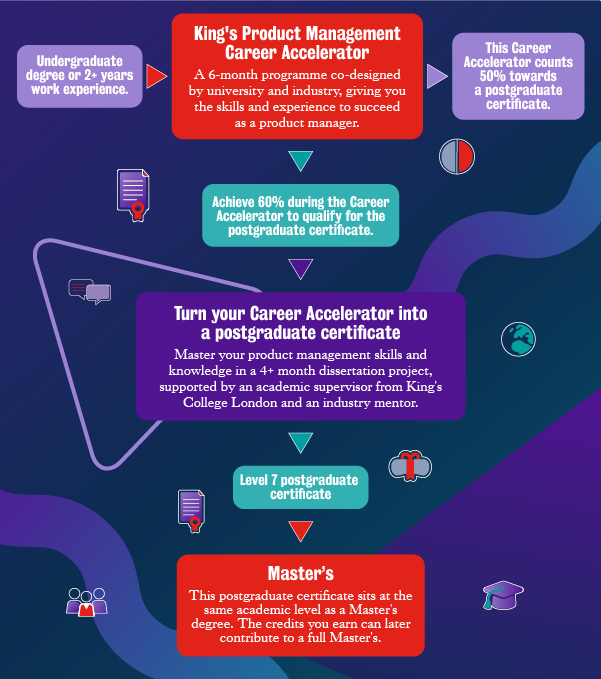
You can now build on your product management foundation with the King’s Postgraduate Certificate in Product Management. It picks up where the King’s Product Management Career Accelerator leaves off, giving you the credentials, the depth, and the network of one of the world’s most respected universities.

Since we launched the programme with King’s, the product management job market has changed considerably. Roles are more competitive, hiring managers expect proof of applied skill, and AI has reshaped what “good” looks like for a product manager. A Level 7 qualification from a Russell Group university is one of the strongest ways to show you’ve kept pace with all of it.

Here’s what Dr Mark Hedges, Head of the Department of Digital Humanities at King’s College London, said when the programme launched:

“Completing this Postgraduate Certificate in Product Management will not only equip learners with the practical skills, hard and soft, needed in the product management workplace but also provide them with the academic and critical skills needed to engage with their professional career in an informed and reflective way.” – Dr Mark Hedges, Head of Department of Digital Humanities at King’s College London

It remains the first postgraduate certificate in product management offered by a Russell Group university. Below, we’ve refreshed what a postgraduate certificate actually is, what the King’s programme covers, and how it lines up with what the UK product management market looks like in 2026.

What is a postgraduate certificate?

A postgraduate certificate is a Level 7 qualification in the UK, the same academic level as a Master’s degree, but shorter, less expensive, and focused on a specific area of study. It typically carries 60 academic credits and can count toward a full Master’s later on.

According to the UK government’s list of qualification levels, Level 7 covers Master’s degrees, integrated Master’s, and postgraduate certificates. They sit at the same tier academically. What separates them is scope and time.

How a postgraduate certificate differs from a Master’s

Credit weight: A postgraduate certificate is worth 60 academic credits. A Master’s is 180. Because the credits sit at the same level, most universities let you carry your PGCert credits into a Master’s later if you decide to keep studying.

Time: Most postgraduate certificates take three to six months of part-time study. A Master’s usually takes at least a year full-time, or two years part-time. 

Cost: A PGCert is typically a fraction of the cost of a full Master’s, which makes it a lower-risk way to earn a Russell Group credential.

A closer look at the King’s Postgraduate Certificate in Product Management

The postgraduate certificate is a direct continuation of the King’s Product Management Career Accelerator. It’s designed for graduates of the Career Accelerator who want to go deeper into a chosen area of product management and walk away with a globally recognised, credit-bearing qualification from King’s.

Over four months, you’ll produce a comprehensive portfolio and a research-based written dissertation. Both draw on your Career Accelerator work, but this time you choose the topic and specialise. Working with a King’s academic supervisor gives you the space to zoom in on one area of product management and become a specialist. That kind of focused expertise is what hiring managers actually pay attention to when they shortlist for senior roles.

What the programme includes

  • Two to three one-on-one sessions with a King’s academic supervisor
  • Regular check-ins with an industry mentor working in product
  • A structured, self-directed research and portfolio project spanning four months
  • Access to the King’s campus and library 
  • An in-person graduation ceremony on campus 
  • Full alumni network membership once you graduate

Building a working relationship with an academic supervisor and an industry mentor is one of the more underrated parts of the programme. Those are the connections that lead to introductions, invitations, and job leads long after you’ve submitted your dissertation. Between 75 and 100 Career Accelerator graduates have gone on to take the postgraduate certificate so far, and that number continues to grow with each intake.

Your path to becoming a product management expert

Right now, the postgraduate certificate is open to current and past learners of the King’s Product Management Career Accelerator who achieved an average of 60% or above on the Career Accelerator.

To enrol on the Career Accelerator itself, you need an undergraduate degree or at least two years of professional work experience.

Your Career Accelerator work counts toward the postgraduate certificate directly: 50% of the academic credits you need to complete the PGCert come from the Career Accelerator you’ve already done. In other words, the two are stacked by design, so the time and money you’ve already put in continues to compound.

Once you finish the PGCert, you’ll hold a Level 7 qualification from a Russell Group university. If you decide to go further and complete a Master’s later, the credits from this programme can count toward that degree too. This is what continued learning across a career is supposed to look like: modular, credit-bearing, and additive.

Who this programme is for

  • Career Accelerator graduates who want a specialist edge in one area of product
  • Product managers looking for a credit-bearing qualification to support a promotion or a senior job move
  •  Anyone considering a future Master’s who wants to test the water at Level 7 first
  • Career changers who want a Russell Group credential on their CV without committing 1–2 years to a full Master’s

Why this matters in the 2026 product management market

Product management remains one of the strongest-paying and most competitive roles in UK tech, but the bar has moved.

The average UK product manager now earns around £62,953 a year from Glassdoor UK, June 2026. In London, the average sits at £69,447. Senior product managers earn a UK average of £86,124, rising to £91,262 in London.

AI has changed what employers ask for. 61% of product manager job postings now require AI experience, and AI-focused product roles in the UK have grown around 32% year on year in 2026. AI product managers command a 25–35% salary premium over generalist PM roles, with senior specialists in London regularly clearing £120,000.

There are now more product manager job openings than ever, but the roles that pay well and progress fastest now expect a mix of academic rigour, applied experience, and current AI literacy. A generalist CV without depth in any of the three is a harder sell than it was in 2024.

The postgraduate certificate speaks directly to those three demands. It gives you the depth of a specialised research project, the academic rigour of a Russell Group Level 7 qualification, and the freedom to focus your dissertation on a modern PM problem area, whether that’s AI product strategy, applied LLMs, platform product management, or something else you want to stand out for.

Is a postgraduate certificate worth it?

The honest answer is it depends on what you do with it.

Employers rarely hire on the strength of a certificate alone. What they hire on is what a certificate helps you demonstrate: relevant, recent skills, applied experience, and a credible institution behind the credential. Our guide to how employers actually evaluate university certificates goes deeper on that.

If you’re weighing up whether the extra four months is worth the fee, our framework for measuring ROI on a career programme is a useful starting point. 

Salary bump is one measure. Confidence, portfolio depth, career trajectory, and proof of applied skill are the others that actually shift what happens in the next interview.

The Career Accelerator lays the foundation you need to build your knowledge and confidence to go further in your product management career. The postgraduate certificate builds on this and helps you further develop your skills. The two are interlinked, and it makes sense that your investment in the first part of the journey continues to pay off as you progress.

Frequently asked questions

Is a King’s postgraduate certificate the same as a Master’s?

No. Both are Level 7 qualifications, so they sit at the same academic tier, but a postgraduate certificate is worth 60 academic credits while a Master’s is worth 180. A PGCert is shorter, more focused, and typically much cheaper. The credits you earn on a King’s PGCert can count toward a Master’s later if you decide to continue.

Who can apply for the King’s Postgraduate Certificate in Product Management?

The programme is open to current and past learners of the King’s Product Management Career Accelerator who achieved an average of 60% or higher. To be eligible for the Career Accelerator in the first place, you need an undergraduate degree or at least two years of professional work experience.

How long does the King’s PGCert take to complete?

The postgraduate certificate takes around four months of self-directed study. Over that time you’ll produce a portfolio and a written dissertation, supported by two to three sessions with a King’s academic supervisor and regular check-ins with an industry mentor.

How much does the King’s Postgraduate Certificate in Product Management cost?

£2,000 

Will UK employers recognise a postgraduate certificate?

Yes. A postgraduate certificate from a Russell Group university carries genuine weight with UK employers, particularly when the credential is combined with a portfolio of applied work. In competitive fields like product management, employers value depth of expertise, credibility of the institution, and evidence of ongoing learning. A King’s PGCert covers all three.

Can I go from the Career Accelerator to the PGCert to a Master’s?

Yes, and that’s exactly how the programme is designed. Your Career Accelerator work contributes 50% of the credits needed for the postgraduate certificate. The full PGCert then gives you 60 Level 7 credits, which can count toward a Master’s degree later on. Each stage builds on the last.

When does the next intake start?

King’s runs two intakes a year for this programme. Check the programme brochure for the next start date.

Take your career further, faster

Product management continues to offer competitive salaries, meaningful work and opportunities across high-growth sectors including fintech, healthtech and AI. What’s changing is what employers expect. Today’s product professionals need deeper expertise, practical experience and credentials that demonstrate they can deliver impact.

The King’s Postgraduate Certificate in Product Management is designed to help you meet those expectations. You’ll gain a respected Russell Group credential, complete an applied research project you can showcase, and join a network of academic and industry experts who can support your career long after you graduate.

Read the programme brochure and, when you’re ready, start your application.

To enrol in the Career Accelerator, you need to have an undergraduate degree or at least two years of work experience. You can find out more about the application requirements here.

Once you’ve completed the Career Accelerator with the pass mark required, you’ll be on track to begin the postgraduate certificate. Your work on the Career Accelerator will contribute 50% of the academic credits needed to complete the postgraduate certificate successfully.

With your postgraduate certificate in hand, you’ll have earned yourself a Level 7 qualification. Recognised by employers as a valuable indication of your expertise, this boosts your employment prospects and long-term opportunities. If you choose to continue your learning journey in the future and pursue a Master’s, the credits you earned from the postgraduate certificate can contribute towards this degree. 

Take your career further, faster

Pursuing a career in product management is exciting, with so many avenues and opportunities to explore. Rated as one of the best jobs in the UK, it’s in high demand and offers great job satisfaction and good pay. With a solid set of skills established on the Career Accelerator, you now have the opportunity to enhance your career potential by becoming an expert in your chosen area of product management. 

If you’re interested in hearing more about how the postgraduate certificate can give you an extra edge as a product manager, grab a time to connect with your Enrolment Advisor.

An Introductory Guide to GenAI for Product Managers

Generative AI has moved from buzzword to baseline skill for product managers. Here’s how PMs are using AI tools in 2026, the productivity payoffs, and how to become an AI-literate product manager.

Generative AI is no longer an emerging trend – it’s embedded in how modern product teams work. In 2026, 91% of businesses use AI in at least one capacity, up from 78% in 2024 and 55% in 2023. For product managers specifically, adoption has been even faster: a 2025 Productboard survey found that 94% of enterprise product professionals rely on AI tools daily.

The productivity payoffs are real and measurable:

  • Workers using GenAI save an average of 5.4% of their work hours weekly. Product managers report saving an average of four hours per task on functions like drafting PRDs, competitive analysis, and building roadmaps.
  • Businesses report an average 24.69% increase in productivity and 15.7% in cost savings from AI adoption.
  • Chief AI Officer roles are now present in 61% of enterprises – a signal that AI strategy sits at the leadership table.

The question for product managers is no longer “should I learn this?” but “how do I use this effectively?” To help you answer that, the King’s Product Management Career Accelerator now features a dedicated AI and Product Management Learning Track.

Become an AI-literate product manager

To give you a glimpse into the series that learners get full access to, you can watch the first Masterclass hosted by AI expert Alexander Cohen. You’ll learn about the foundations of AI and LLMs and the implications of AI on product management.

When Alex presented this Masterclass, he predicted a fundamental shift in how products get built. That prediction has proven remarkably accurate:

“Within five years, AI is going to make a fundamental change in the way that we produce products. One of those fundamental changes is that AI will in many respects replace human engineers. As such, we’ll get to a place where product managers are going to be responsible for defining what goes into a product and what it should do, and then an AI will execute on that.”– Alexander Cohen

In 2026, this is already happening. AI-assisted coding (“vibe coding”) has made building software dramatically cheaper and faster. The most expensive thing a team can do now is build the wrong thing, which puts the product manager squarely at the centre of the business.

Cheat sheet: An intro to GenAI

Following the Masterclass, Alex has created a guide to AI that you can refer to on the job and with your colleagues to help you understand what AI is, why it’s important, and how to use it in your product management career.

Tokens

What it is

Tokens are the fragments of text that AI models use to analyse and generate language. For example, the sentence “Artificial intelligence is fascinating” might be broken down into tokens like [“Artificial”, “intelligence”, “is”, “fascinating”].

Why it’s important

  • The way text is tokenised influences the model’s ability to understand and respond accurately. Proper tokenisation ensures the model captures the nuances of language, which is vital for applications like chatbots, translation services, and content creation.
  • For product managers, understanding tokens helps in designing AI applications that require precise language processing, ensuring that the outputs are relevant and coherent.
  • Token limits have expanded dramatically since 2024. GPT-4o now supports 128k token context windows. Claude supports 200k tokens. Google’s Gemini 1.5 Pro supports up to 1 million tokens. This changes what’s possible for PMs working with long documents, product specs, and research.

Try it yourself

Context windows

What it is

A context window is the span of text an AI model can consider at once. In 2024, a typical context window was 4,000–8,000 tokens. In 2026, leading models have expanded this dramatically:

  • GPT-4o: 128,000 tokens
  • Claude (Anthropic): 200,000 tokens
  • Gemini 1.5 Pro (Google): up to 1,000,000 tokens

To put this in perspective, 200,000 tokens is roughly equivalent to a 500-page book. You can now feed an entire product specification, user research report, or competitor analysis into an LLM and get structured output in a single pass. This was impossible two years ago.

Why it’s important

  • Larger context windows are crucial for maintaining coherence in long-form work. For product managers, this means you can use AI for tasks like summarising extensive user research, analysing full product backlogs, reviewing entire codebases, or processing hours of meeting transcripts – all without losing context.
  • When selecting AI tools for your workflow, understanding context window size helps you choose the right model for the task. A quick competitive question might only need a small window, but reviewing a 60-page product brief requires a large one.

The implications of AI on product management

AI isn’t just playing a supporting role in product management, it’s reshaping the discipline. Over 73% of product managers now use at least one AI-powered tool in their daily workflow, nearly double the 45% adoption rate in 2024. For PMs, AI won’t take away your job, but it is fundamentally redefining what’s achievable in your work.

Use AI for market insights and opportunities

  • AI-driven analytics provide deep insights into market trends and customer behaviours, enabling data-informed decision-making. This helps in crafting precise value propositions and aligning product vision with market needs.
  • Predictive analytics and machine learning models assist in anticipating customer needs and identifying opportunities for innovation, enhancing strategic planning and competitive positioning.

Use AI for routine and repetitive tasks

  • AI automates routine tasks like scoping, documentation, and backlog management, improving efficiency and accuracy. Natural language processing (NLP) tools can generate detailed reports and documentation based on minimal input.
  • With AI handling repetitive tasks, product managers can focus on their softer skills, such as effective communication, stakeholder management, and team leadership, fostering better collaboration and aligning teams towards common goals.

“As AI starts to take over the heavy lifting of how products get built, we’re going to start to see this onus coming back to product managers on what actually goes into a product.”– Alexander Cohen

AI tools product managers are using in 2026

The AI tool landscape for product managers has matured significantly. Here are the categories and tools PMs are using most in 2026:

CategoryToolsWhat it does
PRD and documentationChatPRD, Notion AI, ChatGPTPMs report saving 4+ hours per PRD by using AI to draft, structure, and refine product requirements documents.
User research and feedback analysisZeda.io, Dovetail, BuildBetterAI-powered tagging, categorising, and synthesising qualitative user feedback. Turns hours of interview transcripts into structured insights in minutes.
Roadmapping and prioritisationProductboard AI, Airfocus, Aha!AI-assisted feature scoring, opportunity assessment, and roadmap generation based on data rather than gut feel.
Competitive intelligenceCrayon, KlueAutomated competitor tracking, pricing analysis, and market movement alerts.
Analytics and data queryingJulius, Amplitude AINatural language querying of product data. Ask a question in plain English, get a chart or insight back.

The key takeaway: AI isn’t a single tool you adopt. It’s a layer across your entire workflow. The most effective PMs in 2026 use AI at every stage of the product lifecycle – from discovery and research through to delivery and measurement.

The rise of AI agents and what it means for PMs

The biggest change since this article was first published in 2024 is the rise of agentic AI – AI systems that don’t just respond to prompts but take autonomous, multi-step actions to complete tasks.

The numbers tell the story:

  • Gartner projects that 40% of enterprise applications will embed task-specific AI agents by the end of 2026, up from less than 5% in 2025.
  • 80% of enterprises deploying AI agents report measurable economic benefits, including increased throughput, lower operational costs, and faster product release cycles.
  • A February 2026 Harvard Business Review article argued that product management skills are now central to successful AI deployment across organisations.

For product managers, this creates a new set of responsibilities:

  • Defining what AI agents should and shouldn’t do (guardrails and scope)
  • Designing human-in-the-loop controls for high-stakes decisions
  • Managing the behaviour of AI features within your product
  • Understanding how agentic workflows change user expectations

If you’re building products in 2026, you’re almost certainly building products that include AI agents. Understanding how they work isn’t optional – it’s core to the PM role.

From coordination to strategy

AI-assisted coding tools like Cursor and GitHub Copilot have dramatically reduced the cost of building software. When it’s cheap to build, the most expensive thing you can do is build the wrong thing.

This puts the PM at the centre of the business. The role is shifting from coordination (“managing the backlog, running standups, writing tickets”) to strategy (“determining what to build, for whom, and why it’s important”). AI handles more of the execution and PMs focus on customer understanding, strategic judgement, and ensuring the right outcomes.

“We’re going to see that subject matter expertise, that domain knowledge, that real-world understanding of how things actually happen for real people, that’s going to be incredibly valuable and a real, great differentiator.”– Alexander Cohen

What is an AI product manager?

As AI becomes embedded in more products, a distinct role is emerging: the AI product manager. While every PM now needs AI literacy, an AI PM specialises in building and managing products where AI is the core capability – not just a feature.

How an AI PM differs from a traditional PM

  • A traditional PM defines features and user flows. An AI PM also manages model behaviour, data quality, and output reliability.
  • A traditional PM writes acceptance criteria. An AI PM also defines what “good” looks like for probabilistic outputs that may vary each time.
  • A traditional PM manages a development roadmap. An AI PM also manages model retraining cycles, bias monitoring, and ethical considerations.

Skills unique to AI product managers

  • Understanding how LLMs work (tokens, context windows, fine-tuning, RAG)
  • Prompt engineering and evaluation
  • Data quality assessment and pipeline awareness
  • AI ethics: bias, fairness, transparency, and explainability
  • Managing AI agent behaviour and guardrails

The career path

Traditional PM → AI-literate PM (uses AI tools in daily work) → AI Product Manager (builds AI-powered products).

The King’s Product Management Career Accelerator, with its dedicated AI Learning Track, is designed to help you take that first step from traditional PM to AI-literate PM.

Get hands-on with the concepts

Train a neural network: TensorFlow Playground

TensorFlow Playground is an interactive web-based tool designed to help users understand the basics of neural networks. It provides a visual and hands-on way to experiment with different neural network architectures and parameters.

Features

  • Interactive visualisation: Allows users to see how neural networks learn and adjust weights in real-time.
  • Adjustable parameters: Users can modify parameters such as learning rate, number of neurons, and activation functions to observe their impact on the model’s performance.
  • Educational tool: Ideal for beginners to get a grasp of fundamental concepts in machine learning and neural networks without requiring any programming knowledge.

Why it’s important

Understanding how neural networks work at a basic level helps product managers and developers make informed decisions about integrating AI into their products. It demystifies the learning process of AI models and provides a foundation for more advanced AI concepts.

Try it yourself

Play around with TensorFlow Playground right now.

Run a custom LLM model: Ollama

Ollama is a platform that allows users to run open-source AI models locally on their own hardware. Since this article was first published, Ollama has grown to support a much wider range of models – including Llama 3, Mistral, Phi-3, Gemma, and dozens of others – making it the go-to tool for running local LLMs.

Features

  • Local model deployment: Users can deploy and run AI models directly on their machines, ensuring data privacy and security.
  • Support for a wide range of models: Compatible with the latest open-source models, enabling users to choose the best fit for their needs.
  • Customisability: Users can experiment with different model configurations and parameters to tailor the AI’s performance to specific tasks.

Why it’s important

Running AI models locally with Ollama empowers product managers and developers to have full control over their AI applications. It enhances data privacy, reduces dependency on cloud services, and allows for more experimentation and customisation of AI models. In 2026, with enterprise data sensitivity at an all-time high, local deployment is increasingly attractive.

Try it yourself

Download Ollama here to create and customise your own LLM.

Talk to an LLM with emotions: Hume.ai

Hume.ai is a platform focused on creating empathic voice interfaces that can understand and respond to human emotions. Since the original article was published, Hume has released EVI 2 and EVI 3 – their latest voice-to-voice foundation model that responds in under 300 milliseconds with advanced personality mimicry.

Features

  • Emotion recognition: Uses AI to detect and interpret a wide range of human emotions from voice inputs, analysing vocal modulations including tune, rhythm, and timbre.
  • Empathic responses: Generates responses that are emotionally appropriate, enhancing user engagement and satisfaction.
  • Ultra-low latency: EVI 3 responds faster than most humans do in real conversation.
  • Full SDK support: Developers can integrate EVI into applications with just a few lines of code (React, TypeScript, Python, .NET, Swift, and more).

Why it’s important

Understanding and responding to human emotions is crucial for creating engaging and effective AI-driven interactions. Hume.ai enables product managers to develop more intuitive and empathetic user interfaces, improving customer experiences in areas like customer service, virtual assistants, healthcare, and interactive entertainment.

Try it yourself

Start a conversation with Hume’s Empathic Voice Interface.

Draft a product requirements document: ChatPRD

ChatPRD acts as an on-demand Chief Product Officer, helping product managers draft detailed product requirements documents that meet high-quality standards. It’s one of the most popular PM-specific AI tools in 2026.

Features

  • PRD generation: Produce structured, detailed PRDs from a brief description or conversation.
  • Strategy coaching: Get AI-powered feedback on your product thinking, assumptions, and priorities.
  • Template flexibility: Works with your existing PRD structure or suggests best-practice formats.

Why it’s important

Writing PRDs is one of the most time-consuming parts of a PM’s job. ChatPRD reduces drafting time significantly while maintaining quality, freeing you to spend more time on strategy, research, and stakeholder alignment.

Try it yourself

Try ChatPRD.

Analyse long documents and research: Claude

Claude by Anthropic is a large language model with a 200,000-token context window – one of the largest available. This makes it exceptionally useful for product managers who need to process, analyse, and synthesise large volumes of information.

Features

  • Extended context: Process entire product specs, user research reports, or competitive analyses in a single pass.
  • Structured output: Ask Claude to summarise, extract themes, identify risks, or create action items from lengthy documents.
  • Nuanced reasoning: Particularly strong at tasks requiring careful analysis and balanced judgement.

Why it’s important

PMs deal with information overload daily. Claude’s ability to ingest and reason over very long documents means you can go from “60-page research report” to “structured brief with key insights” in minutes rather than hours.

Try it yourself

Try Claude at claude.ai.

Understand (or write) code as a PM: Cursor

Cursor is an AI-powered code editor that has become popular among non-technical product people exploring what’s being called “vibe coding” – using natural language to build prototypes and understand codebases without being an engineer.

Features

  • Natural language coding: Describe what you want to build in plain English and Cursor generates the code.
  • Codebase understanding: Ask questions about an existing codebase and get plain-language explanations.
  • Rapid prototyping: Build quick proofs-of-concept to validate ideas before involving engineering.

Why it’s important

In 2026, the line between “technical” and “non-technical” PMs is blurring. Tools like Cursor let product managers prototype ideas, understand technical constraints, and have more informed conversations with engineers – without needing to become developers themselves.

Try it yourself

Download Cursor.

Prompt engineering basics for product managers

Knowing that AI tools exist is one thing. Getting great outputs from them is another. Here are practical prompting techniques PMs can use immediately:

Drafting a PRD

Instead of: “Write a PRD for a notification feature.”

Try: “You are a senior product manager at a B2B SaaS company. Draft a PRD for an in-app notification system. Include: user problem, success metrics, scope (in and out), user stories, and technical considerations. The audience for this PRD is the engineering team and the VP of Product.”

Why it works: Giving the AI a role, context, structure, and audience produces dramatically better output.

Analysing user feedback

Try: “Here are 50 pieces of user feedback from our NPS survey. Group them into themes, rank the themes by frequency, and for each theme suggest one potential product improvement. Present the output as a table.”

Why it works: Structured instructions produce structured output. Specifying the format (table) prevents vague paragraph responses.

Running competitive analysis

Try: “Compare [Competitor A] and [Competitor B] across these dimensions: target audience, pricing model, key features, recent launches, and market positioning. Present as a comparison table. Then suggest three opportunities where our product could differentiate.”

Why it works: Breaking a complex task into dimensions and asking for a specific format gives you an output you can actually use in a strategy deck.

Common mistakes to avoid

  • Being too vague (“help me with my product”) – always provide context, role, and desired format.
  • Not iterating – treat AI like a collaborative partner, not a one-shot oracle. Refine your prompt based on the first output.
  • Trusting outputs without verification – AI can hallucinate facts, especially about competitors and market data. Always verify.
  • Ignoring your own expertise – AI is a tool to accelerate your thinking, not replace it.

Experience the full AI Learning Track

Learners on the King’s Product Management Career Accelerator get full access to the AI and Product Management Learning Track, which features expert-led live Masterclasses designed to keep pace with how AI is evolving.

The Learning Track is designed to enhance the Career Accelerator’s curriculum and adapt as technology evolves, giving learners the latest tips and techniques to apply AI to their product management work. You’ll also earn a LinkedIn digital badge to showcase your AI literacy to employers and your professional network.

To find out more about the Career Accelerator and Learning Track, download the programme brochure.

Frequently Asked Questions

What is generative AI in product management?

Generative AI in product management refers to using large language models and AI tools to enhance product strategy, research, documentation, and decision-making. This includes drafting PRDs, synthesising user feedback, running competitive analysis, and building prototypes.

How do product managers use AI?

PMs use AI across the product lifecycle: for discovery (research synthesis, competitive analysis), definition (PRD drafting, user story generation), delivery (sprint planning, code review), and measurement (data querying, experiment analysis). Over 73% of PMs use at least one AI tool daily.

What are the best AI tools for product managers in 2026?

Popular tools include ChatPRD (PRD drafting), Claude and ChatGPT (document analysis and research), Productboard AI (roadmapping), Dovetail and Zeda.io (feedback analysis), Julius (data querying), and Cursor (prototyping and code understanding).

Do product managers need to learn to code to use AI?

No, but understanding how LLMs work, how to write effective prompts, and how to evaluate AI outputs is increasingly expected. Tools like Cursor make it possible to prototype with code using natural language, blurring the line between technical and non-technical PMs.

What is an AI product manager?

An AI product manager specialises in building and managing products where AI is the core capability. This requires understanding model behaviour, data quality, prompt engineering, and ethical AI – in addition to traditional PM skills.

Is AI going to replace product managers?

No – but it’s redefining the role. AI handles more execution and routine tasks; product managers focus on strategy, customer understanding, stakeholder alignment, and deciding what to build. The PMs who thrive in 2026 are those who use AI as a force multiplier.

What AI skills should product managers learn?

Start with prompt engineering, understanding tokens and context windows, and familiarity with the major LLMs (GPT-4, Claude, Gemini). Then build toward AI ethics, agent design, and tool evaluation. Programmes like the King’s Product Management Career Accelerator include a dedicated AI Learning Track to build these skills.

From Tactical to Strategic: How Polly Scaled Her Impact in Product

As Chief Operating Officer at Enterprise Nation, and formerly Head of Product, Polly had already achieved what many product professionals aspire to.  She’d helped scale the organisation from four people to 50, shaped new features, and led its transition from in-person delivery to a digital platform.

She had the experience. She had the credibility.

But she also recognised a gap.

The reason why I came on the course was because I didn’t go to university to study product. I was like, surely I’m missing frameworks, theory, stuff that big corporates do and bigger products and platforms do that I don’t know about.”

The idea was never to change jobs, but rather to strengthen her foundations and lead with more intention.

In a recent Ask Me Anything webinar, Polly shared how the King’s Product Management Career Accelerator helped her move from capable operator to deliberate, strategic leader.

“I kind of did things a bit backwards”

Polly didn’t come to the programme as a beginner or someone trying to “break into” product. She’d led teams, shaped platforms, and helped scale the company. 

On paper, she’d made it.

In reality, she felt something experienced PMs rarely admit: there were gaps she could feel, but couldn’t quite name.

Her product career had been built the way many mid-career PMs learn, through doing. Trial, error, iteration. It worked, but instinct alone wasn’t enough anymore. She was ready to operate more strategically.

I think I kind of did things a bit backwards. I got the experience first and then I thought I need to look for a product course as well.”

Polly wanted to validate what she already knew and build a more structured toolkit to support the next stage of her career. She wasn’t stuck – she just wanted to sharpen her thinking and step into a more strategic way of operating.

Why thinking like a team made all the difference

For Polly, the most valuable parts of the programme weren’t the frameworks or tools – it was the shift in how she approached problems, and how she learned to think alongside others.

This shift happened not just through theory, but through deliberate practice, especially in the group sessions. 

A lot of my role is just me working with a CEO, so my role as a COO and Head of Product before was solving problems, and you have to get comfortable with solving problems and failing. For me, the practical side of doing the breakout rooms every single week was really good.”

Each session blended a framework with immediate application.

Our course facilitator would do a session around, let’s say, a particular SWOT analysis framework, and then you would take it, and he would say, ‘Okay, here’s a made-up situation – how would you solve this problem?“

For Polly, this was a turning point. After years of making decisions alone, collaborating with others in a structured environment stretched her thinking in new ways.

And that, for me, was really good because it felt like for a long time I’ve just been solving problems solo. And that’s okay, but it’s nice to get a group environment as well.”

Not only did she love collaborating with her peers in these sessions, but she also noted that working as part of a team on other projects was “really impactful.”

Yes, it fits into a full-time job

If you’re looking to upskill and further your career, you probably share the most legitimate concern of all: Will I have enough time to fit this intensive course into my day-to-day?

Polly felt the same. As a COO, her plate was already full: leadership responsibilities, board roles, speaking and mentoring commitments, plus running a not-for-profit on the side.

She went into the programme assuming the time commitment might be exaggerated. It wasn’t.

It’s intensive but incredibly rewarding. When someone said it’s intensive, I was like, ‘20 hours a week is for those who read quite slow’ and I was like I’ll be able to do that in 10 hours. But it really is 20 hours a week.“

The key difference? She designed for it: “I changed my whole work day to accommodate this course, to make sure I was doing two hours of learning every day, and my main goal of the course was that I wanted a first.”

She also used tools like Trello/Notion to keep herself on track. 

If you have the urge in you, you will have enough time to learn it and take it forward.”

Connecting the dots in the Employer Project

That balance between structure and flexibility also gave Polly the chance to apply her learning in the real world through the Employer Project  – a six-week live brief with an industry partner where everything she’d learned came together.

We worked with Sky. We were talking to their product team as well, and that’s exposure that I’ve never had before in a real-time setting.”

She really liked how organised her group was. They worked across time zones, met regularly and shared the workload in a way that played to everyone’s strengths. Together, they built a clear, strategic presentation for Sky’s product team.

For Polly, this wasn’t about gaining basic product experience. She already had plenty. It was about making her thinking visible, seeing how a major corporate product team operates and testing her approach with real stakeholders.

And the impact was immediate. She began framing decisions more clearly and stepping more fully into the strategic leader she wanted to be.

The “secret weapon” she didn’t expect: career coaching

Interestingly, the element Polly describes as “probably the most impactful part” of the programme wasn’t a module or assignment. It was career coaching. 

She’d never worked with a career coach before, and was initially expecting a “light therapy session”. But as a senior leader, having a dedicated space to think out loud, plan her next moves and problem-solve proved invaluable.

Career coaching was probably the highlight of me doing this course.”

Coaching helped her navigate challenges in her COO role, get honest about what she wanted next, and move from vague ideas – like “I’d like to consult one day” or going all-in on her startup, Life in Product – to concrete plans. 

That clarity paid off: she signed her first three clients in January.

For her, the coaching came “just at the right time” and supported her both in her day-to-day role and throughout the course. It pushed her to scale her impact in product, both inside her organisation and on her own side projects and businesses.

You don’t always need a new job to reignite your purpose

Polly didn’t switch companies or roles after finishing the programme, but how she approached her work changed dramatically. She reconnected with a sense of purpose and possibility that had been dulled by routine.

I loved every week of learning. I felt like I had this regained purpose, which sometimes, when you work day-to-day in a nine to five, it’s really hard to find.”

Polly’s journey shows that you don’t need to change jobs to experience real career progression. Sometimes, the biggest shift comes from how you grow, how you show up and how you think. 

Ready to explore your next level in product? The King’s Product Management Career Accelerator helps experienced product professionals like Polly move from capable to truly strategic – with flexible learning, real-world projects and dedicated career coaching designed for working PMs.


Solving Real-World Problems With a Global News Company on the King’s Product Management Career Accelerator

For learners on the King’s Product Management Career Accelerator, the final phase of the programme is where everything comes together.

Across six months, learners gain a strong foundation in product thinking, from market research and stakeholder alignment to product design, development, and delivery. Each course builds practical capability while strengthening our learner’s confidence and career clarity.

The final six weeks of the Career Accelerator are designed to put this learning into action through the Employer Project: a live six-week real-world project set by a real industry company. Learners work in cross-functional teams to solve real business problems, collaborate remotely, and present their solutions to the company stakeholders.

This is where theory meets practice, and where learners prove they’re ready to move with confidence, whether that’s pivoting into product management, levelling up in their current role, or exploring new possibilities they hadn’t seen before.

We interviewed three learners who completed the Employer Project with a world-renowned news services company to give you a direct view of what that experience is really like.

A brief with global relevance

Closed captioning has long served as a tool for accessibility, but changing user behaviours and regulations across different markets have made it a critical product feature.

For a recent programme cohort, the business challenge set by the Employer Partner asked learners to explore how closed captions could be made more inclusive and compliant – without sacrificing usability. From regulatory frameworks (like Ofcom and the FCC) to use cases like silent viewing, non-native speakers and public settings, learners were tasked with enhancing the experience across multiple dimensions.

“We had the challenge of making closed captions for the company more inclusive, and aligned to compliance and regulations. It felt real in that way – it was not a performative activity.”

— Rubi Rodriguez, Career Accelerator Alumna

Turning theory into tangible solutions

The Employer Project on the King’s Product Management Career Accelerator marks the culmination of a curriculum shaped by industry experts, academic leaders, and real-world employer insight. Learners bring together months of study across product strategy, customer discovery, Agile methodology, UX principles, and stakeholder management.

This final six-week business challenge is about application – taking frameworks from the ‘classroom’ and using them in a real-world, collaborative product environment. Teams use tools like Miro, Figma, and Google Suite to research, ideate, prototype, and validate.

“We used a mix of tools and frameworks from the course. We started with user research to really understand the problem, then moved into ideation using tools like the opportunity solution tree and ‘How Might We’ questions. We prioritised solutions, identified assumptions using the riskiest assumption test, and used tools like Figma and Miro to prototype and collaborate. It was a great way to reinforce the learnings.”

— Max Brind, Career Accelerator Alumnus

The project mirrors the end-to-end product lifecycle, making it an authentic, career-building experience.

Industry exposure that builds confidence

Learners kick off the project with a live briefing session from the Employer Partner and close the experience by presenting their solution directly to company stakeholders.

This exposure helps learners understand how product teams operate within large, global organisations – and how their ideas can add value. As Max said, “Knowing that what we’d created could actually be used was incredibly rewarding.”

“It felt like we were colleagues and they were supporting us and our learning process. They were open to all of the questions… really warm and clear and also very honest.”

— Rubi Rodriguez, Career Accelerator Alumna

Support that keeps you on track

While the project is designed to challenge learners, it’s also built to support them. Facilitators with industry backgrounds provide structured feedback, ask critical questions, and help teams stay aligned to product best practice.

“One of the biggest challenges was ensuring the robustness of our validation process. I felt that our approach was prone to confirmation bias, and I was critical of the fact that we didn’t implement A/B testing from the outset. While this was a point of concern for me, Facilitator feedback helped us refine our validation strategy.” — Oluwabusuyi Adebiyi, Career Accelerator Alumnus

“Having Ged as a Facilitator made a huge difference – he’s an industry expert, gives great feedback, and has a very clear understanding of product and the whole cycle. The standout for the course is having those industry experts.” — Max Brind, Career Accelerator Alumnus

Career coaches work behind the scenes to help learners frame their work for future applications, building CVs, portfolios, and storytelling confidence.

This ongoing support reflects a broader theme across the Career Accelerator: personalised guidance tailored to where each learner is starting from, and where they want to go.

A career-ready outcome

The Employer Project gives learners the opportunity to talk about their skills in a credible, real-world context. Many learners use this portfolio-ready case study to demonstrate their skills cand often credit it as a key differentiator in job interviews and applications.

“The project provided a tangible case study that I can showcase in my portfolio and job applications. The structured approach we took – from problem identification, user, market and competitor research to ideation, prototype development and validation – demonstrates my ability to work through real-world product challenges.”

—  Oluwabusuyi Adebiyi, Career Accelerator Alumnus

“Working on the employer project – it had a huge positive impact on my imposter syndrome. It made me realise I have so many skills and that my experience is a big value.”

— Rubi Rodriguez, Career Accelerator Alumna 

“It’s a great addition to my CV. King’s College London carries weight, and having that project experience shows I’ve invested in my own development. In interviews, I now have real examples to draw on, frameworks I can talk about, and a better understanding of what hiring managers are looking for.”

 —  Max Brind, Career Accelerator Alumnus

With King’s College London on their CV, a product portfolio project grounded in real industry needs, and the ability to articulate their value, learners finish with both the skills and the confidence to step into product roles.

And the support doesn’t end there. With access to an alumni network, career services, and AI training, learners are equipped for long-term success in the field.

🎯 Recent learner outcomes:

  • 🪙 Rory changed careers from talent manager, landing a role as an assistant product manager at 7IM just three weeks after completing the King’s Product Management Carer Accelerator. Watch his interview.
  • 🚀 Mike completed the Career Accelerator and went on to launch his own startup and digital product, SensePilot. Read his story.
  • 👩‍💻 After 15 years as a personal assistant, Amy pivoted her career and landed a product role whilst on the Employer Project. Hear her review.

“The day that I actually did my final presentation for the Employer Project with my team, I had my final interview for my product manager role in the afternoon, so that was a day that I will never forget. I found out that afternoon that I’d actually gotten the role as a Product Manager Executive. It’s been brilliant.” 

– Amy Eastall, Career Accelerator Alumna

A catalyst for confidence, career clarity, and real-world capability

Though the Employer Project marks the end of the King’s Product Management Career Acccelerator, it’s the beginning of a new chapter for learners. The project empowers learners to see themselves as product managers, contribute meaningfully to real business challenges, and position themselves for their next role with clarity and confidence.

It’s proof of potential and a springboard into a career in product management.

Download the programme brochure to find out more about the full curriculum, the real-world project experience, and how the King’s Career Accelerator can fast-track your career.

From Sales to Startup CEO: How Mike Used the King’s Product Management Career Accelerator to Launch a Business

Mike Hazlewood spent nearly two years deciding on the right way to build his product management skills before committing to the King’s Product Management Career Accelerator. Since completing, he’s used what he learned to launch SensePilot – a company making digital navigation effortless for people with limited mobility.

At a recent Ask-Me-Anything (AMA) event, Mike shared his journey: from working in sales and engineering to co-founding a purpose-driven tech business. His story is proof that the King’s Career Accelerator doesn’t just prepare you for a new role – it equips you to drive your own product vision. You can hear Mike’s full Career Accelerator review below:

The search for practical, credible product management skills

Mike wasn’t starting from scratch – he wanted to sharpen his skills and build something of his own.

After more than a decade in technical sales – working across aerospace and medical sectors – Mike wanted to shift into tech and launch his own business. But with a newborn at home and a demanding job, he knew he needed a learning experience that was flexible, credible and focused on real-world application.

“I spent a lot of time thinking about: Is this the right course for me? What that involved was just reading up more on product management… when I used to walk into the office, I’d have to drop my son off to nursery first, I would be listening to product podcasts… just trying to get more of an insight of: Is this the right path for me?”​

Choosing the King’s Product Management Career Accelerator

For Mike, the programme’s mix of academic rigour, practical experience and career coaching was a game-changer.

“The whole format and structure of the programme was what really piqued my interest. You’re essentially following a product journey from ideation through to go-to-market… before you do the Employer Project.”​

What makes the programme stand out

Mike’s experience reflects many of the key strengths of the King’s Product Management Career Accelerator – especially for those balancing learning with other life commitments. Here’s what set it apart for him:

  • Asynchronous, flexible learning – The majority of the content is asynchronous with some structured deadlines, making it possible to learn while working full-time or managing family life.
  • Live sessions with experts – Weekly live classes with industry-experienced facilitators help bring concepts to life. Can’t make it? They’re recorded and available anytime.
  • A curriculum built around real product work – You’ll move from product strategy and design, through to development and go-to-market planning – the full product lifecycle.
  • Employer project with a major brand – Learners work in a team to solve a real-world challenge set by a global organisation (Mike’s cohort worked with DocuSign), gaining tangible experience and a portfolio project to showcase.

The ability to study flexibly was essential for Mike. At the time, he was adjusting to life with a newborn and managing a demanding full-time role with regular work travel. He knew time was going to be tight – so being able to fit study around his schedule, rather than the other way around, was a key factor in his decision.

He made the most of the programme’s asynchronous structure by planning his week in advance. Mike would get ahead with reading and video content over the weekend and then attend one of the two live classes – using those sessions to ask questions and consolidate his understanding.

Real employer projects that build your confidence

Mike also spoke highly of the Employer Project, which closes out the programme and offers learners the chance to tackle a real-world challenge from a global brand:

“We worked with DocuSign on a real-world problem. They gave us an initial kickoff and set the challenge. From there, we had to figure out how to work as a team – how to assign roles, keep each other accountable, lead different weeks. You’d check in weekly with course facilitators and present your thinking back to them. At the end, we presented our final idea to the team at DocuSign.”

This wasn’t just theory – it was practical consulting experience that tested Mike’s communication, leadership and product strategy skills in a collaborative setting. As he shared, presenting directly to product leaders at a brand like DocuSign (and getting their feedback) added serious credibility to the learning journey.

Putting learning into practice: launching SensePilot

After completing the programme, Mike co-founded SensePilot – a company that helps people with limited hand and arm mobility navigate technology using just facial gestures and head movement – making digital inclusion more accessible.

“We use standard webcams. So we’re trying to lower the cost barriers to people to access this sort of tech. So when you move your head around, the cursor will move around the screen, and then you can map out clicking and keyboard actions to facial gestures.”​

While the idea for SensePilot had been forming before the programme, Mike shared that many of the concepts he now applies day-to-day – like mapping out product journeys, thinking through go-to-market strategies, and iterating based on user needs – were shaped and solidified through the programme’s real-world curriculum. From learning how to work cross-functionally to better understanding stakeholder communication, the course gave him the language, frameworks and confidence to move forward.

Advice to others: don’t wait for perfect conditions

Mike knows how hard it is to balance life, work and the desire for growth. For him, the King’s Product Management Career Accelerator was a way to get clarity, structure and momentum.

Although it took him a while to enrol, he credits the programme with helping him take action. By working through real projects, collaborating with peers from diverse backgrounds, and learning from industry-experienced experts, he validated his direction and turned long-held ambitions into a tangible venture.

He also highlighted that product management isn’t just for those seeking a new job title – it’s a highly transferable skill set that enables you to solve meaningful problems, lead cross-functional teams, and think strategically. Whether you want to build a business, step into leadership, or switch sectors, the course gives you a strong foundation for doing so.

Inspired by Mike’s story?

Whether you’re looking to grow in your current role, pivot into product management, or build something of your own, the King’s Product Management Career Accelerator can help you get there.

Download the Programme Brochure here.

Starting Over as a Product Manager: Read Iryna’s Story

Iryna moved to the UK from Ukraine four years ago. She was the CEO of her own fashion brand founded in Ukraine, but after the challenges brought about by the COVID-19 pandemic and the devastating effects of the war in her home country, she decided she needed to look at new career options. “I just realised that I couldn’t keep going, running my own business, and I needed to make some changes in my life,” she shares. 

After doing some research, she decided that she wanted to find a job that was in demand and would pay her well. Product management emerged as a good option for her, and that’s when she found the King’s Product Management Career Accelerator. 

The programme was very practical

“What I liked the most is after the lessons, you have an opportunity to finish a practical task. At every stage, you have the ability to practise on a real example. So, it was very practical. We also had the option to use multiple tools to complete the challenges – you don’t have to stick to just one. We had the opportunity to choose how we wanted to approach tasks, and this was a nice way to learn more.”

You are in control of your learning experience

“It took some time to adjust my schedule. I found it particularly important to book my time because it was easy to be distracted by other things in my head. I dedicated one day on a weekend and at least one and a half hours in the evenings. How much time you give depends on your current experience – do you need to dig into small details? I wanted to have additional knowledge, so I was watching videos, Googling, and reading the additional materials. Booking your time and dedicating particular hours in your diary so you can deep dive is very important.”

You get to understand the role better by engaging with product managers in live sessions

“When you’re talking with the person who has been doing product management for years, and hearing all these real stories – for example, how they make a decision, or how they approach the situation without knowing a lot, or just having some concerns about situations, it was very nice to hear. It showed me how much I need to know and learn over time.”

I really felt like I could lean on my Success Manager like a friend

“I found working with a Success Manager very valuable. Every session, I felt like I was sharing things with a friend. Imagine – you have this person that you can talk to each week about all your ups and downs. It was nice to have the opportunity to tell someone how you feel. Sometimes, they could help with just a simple answer – something you hadn’t thought of. It was good to learn from his experience and interesting to get his opinion on things.”

A man smiling in a blue business suit and tie | FourthRev

Hussein, a learner on the LSE Data Analytics Career Accelerator, also feels like he benefited enormously from the support of his Success Manager. “Having someone you dock in with regularly – outside of the general kind of Q&A you have about the course material, or separately about longer-term career aspirations, was really helpful.” Read about how he shifted his career after 10 years of working in the same industry here.

My Career Coach helped boost my confidence

“I remember my first session was a goal-setting session. I said three months after the course, I wanted to apply for an intern product manager position. My coach asked me all these questions about myself and my experience, and at the end, I realised I didn’t want to be an intern. I felt more confident after she highlighted my experience and transferable skills. Just this one hour was so important for me because she boosted my confidence so much.”

“It’s great because the Career Coaches don’t have a particular plan – like session one, we talk about this; session two, we talk about that. They study your needs and explore your background. After that, they offer you the best plan for you.”

I found a product manager job in the last two weeks of the programme

“I had a few conversations with my Success Manager and Career Coach because I was struggling with my job search. People around me were sharing their experiences of applying for 200 jobs without getting answers, and I thought I had to go through that same journey.”

“They encouraged me not to compare myself to other people. You never know how your own journey will look.”

“My Career Coach helped a lot with my CV. When it was done, I started applying for jobs and my opportunity came unexpectedly. I’d told everyone I met, like my husband’s friends and people at my sports club, that I wanted to be a product manager, I’m doing this course, and I want to make a career change. Someone introduced me to someone and I went through the interview process, and now I have the job that I wanted.”

What I learnt during the Career Accelerator is helping me in my new role

“I’m coming back to the course a lot. It’s a small startup where I’m working, and because I don’t have an experienced product manager in the team, everything is on me. I’m using all the tools we studied, and I’m not scared of things like user research or usability testing, even though I’ve never done it in a job, because we covered it in the course. I know where to find the information. Also, I have a great community with the other learners, and I can ask them questions.”

Completing a programme from King’s College London was a ‘big tick’ for my employer

“When I was interviewing for my role, they were impressed that I had completed two courses on this Career Accelerator at that point. It was important for them that I had this experience because of the challenges I would be working on.”

“For them, having a certificate from King’s was like having a big tick on my CV and played a big role in them making the decision to hire me.”

If you’re interested in exploring how the King’s Product Management Career Accelerator can help you unlock your potential, take a look at the programme page.

King’s College London and FourthRev Launch Postgraduate Certificate in Product Management

Are you ready to fast-track your career with a globally recognised, credit-bearing qualification in product management? You now have that option with King’s College London and FourthRev.

We’re excited to announce the launch of the Postgraduate Certificate in Product Management, designed to empower learners to build on the product management expertise obtained during the King’s Product Management Career Accelerator. Your work will encompass both the development and delivery of a comprehensive portfolio, as well as a written dissertation. Both elements are inspired by your prior experience in the Career Accelerator learning area.

Here’s what Dr Mark Hedges, Head of the Department of Digital Humanities at King’s College London, has to say:

“Completing this postgraduate certificate will not only equip learners with the practical skills, hard and soft, needed in the product management workplace but also provide them with the academic and critical skills needed to engage with their professional career in an informed and reflective way.”

Who can take this programme?

As we launch this programme, we invite current King’s Product Management Career Accelerator learners and alumni to enrol. Going forward, any new learners who embark on the Career Accelerator will have the option to join the Postgraduate Certification Programme.

Learners must achieve 60% or above during the Career Accelerator in product management to qualify for this prestigious programme.

The time you invest in the Career Accelerator will be converted into academic credits, contributing to the completion of the postgraduate certificate.

How is the programme structured?

Set at Level 7, this programme is a Master’s level equivalent. It’s self-guided and spans over 4+ months.

During this time, you’ll have two to three supervision sessions with a King’s academic supervisor and check-ins with an industry mentor.

What benefits do I get from it?

As a learner, you’ll become part of the prestigious King’s alumni community, which gives you access to the campus and library. When you’ve completed the programme, you’ll receive your postgraduate certification at a graduation ceremony.

How much does it cost?

The programme fee is £2,000, including VAT.

When does it start?

The first intake will begin in June 2024, and places will be limited.

Register now for the King’s Product Management Career Accelerator and get the chance to upgrade to a postgraduate certificate upon successful programme completion.

Your Toolkit to Stand Out as a Product Manager: Advice from Experts

Many people are considering a career change to product management. Why? It’s a role that people are highly satisfied in, it pays well, and, maybe best of all, anyone can access it.

“There are many pathways in, and there are many ways to be a product manager.”

Simon Elder, Principal Group Product Lead

We recently hosted a webinar with product management leaders from across the UK to discuss what the current hiring market looks like and what you can do to stand out to potential employers. 

During the 60-minute session, our panel of experts shared valuable tips and insights, such as:

  • The difference between product and project management
  • The technical skills you need as a product manager
  • How to shift careers and what transferable skills matter most

You can watch the full recording here:

Below, we’ve listed a few of the event’s top takeaways. We also reached out to our panel to get their answers to the questions we didn’t have time to cover, and asked them to share their go-to product management resource right now.

Product managers are not project managers

“It’s definitely not a one-size-fits-all [role]. The voices in the industry that I think are unhelpful are the ones that try and pigeonhole product management as just a tweak on project management. Being a product manager does not mean owning a backlog. It does not mean writing JIRA tickets. You’re a facilitator or a dock connector. You’re an enabler. We need to move away from a PM simply owning a backlog going towards a PM bringing a cohesive team of experts together to solve meaningful problems..” – Nick Jemetta, PM Advisor and Coach at Stories Matter

Your previous experience is your superpower

“There are people from all different avenues going into product, which I think creates a very rich source of different types of background around product management, and it’s only something that I see growing.” – Emma van Dijkum, previous Vice President of Product at Multiverse

“I think most Heads of Product are looking to build a cognitive diversity – they don’t want cookie cutter people. When you build a team, you’re going to automatically look for different profiles – you don’t want the same, and so, as a candidate, I think you should never be afraid of accentuating your angle. It’s certainly a plus to be different. So, you know, it doesn’t matter where you come from.” – Charles Roels, Chief Product Officer at SO-SURE

Take Malavika for example. She’s not a traditional product manager, but the King’s Career Accelerator still gave her new frameworks to apply to her work – and career.

You don’t need to be technical to work as a product manager

“I would describe myself as a technology geek. But I’m not sure I’m technical. I have an interest, I have a passion. I love what technology can do in terms of creating customer experiences. But I’m not a technical person. I think we need to debunk the myth that to be a great PM, you’ve got to be technical. For me, the more important skill is having an interest in it and just being curious. You can meet technical people in the middle without having to be overly technical.” – Nick Jemetta

“It’s much more about the EQ of bringing [people] together. The ability to [manage] that synthesis is the core skill [of product management], not technological understanding, because you’ve got a brilliant architect, and you’ve hopefully got a brilliant delivery team behind them as well. You can lean into them – that’s what they’re there for. You’re synthesising their expertise into the overall product experience.” – Simon Elder

Employability is at the core of Career Accelerators. We partner with tech and employer partners, such as Atlassian and Dropbox, to ensure you gain the skills and practical experience to get you hired as a product manager.

Watch the King’s Product Management Career Accelerator video to find out more about the programme.

Audience questions answered by product experts

How easy is the transition from project manager to product manager? Are there transferable skills in both?

Emma: As someone who made this transition myself, there are definitely transferable skills that apply to both:

  • Influencing without authority
  • Stakeholder management
  • Prioritisation
  • Making stuff happen
  • Making sense of complexity

What you might then need to learn is adapting to agile methodologies and defining and leading strategy.

If a product manager is not a one-size-fits-all, how can you move within different industries?

Nick: Build the core product management skill set – uncovering problems and opportunities that have digital solutions to create customer value and business impact. You do this by being curious, focusing on difficult problems, learning how to get the best from your engineering and design partners, and collaborating with stakeholders. These skills transfer across every industry.

For those who have social science backgrounds, which path or focus makes the most sense if I’m keen to move into PM?

Simon: I’d flip this and ask: What is it about product management that appeals to you? Is it more the user research and experience, or are you interested in developing your skills elsewhere? This should help you refine what type of product role and/or organisation you’re interested in working in.

With only one year of experience as a product owner, is a transition into a PM role feasible, given that you require X amount of years in product to be considered?

Emma: You can be a product manager off the bat (with any working experience to draw from). Great companies don’t distinguish between product owner and product manager roles. Ideally, there is no difference.

I’m currently a PM and have been sceptical about the movements in this area, mainly after Airbnb spoke about ending the PM position (some companies are already following) and merging into marketing. What is the main focus after that?

Simon: In the Airbnb scenario, the functions of product management don’t fall away; they’re re-named or taken on elsewhere in the organisation. It’s the skillset that remains vital to an organisation. Product management within a marketing function is still product management. In my own career, I was filling what would now be PM functions when in an editorial role. Likewise, my role now requires me to have solid operational and editorial knowledge to ensure that the product features I’m leading on ‘work’ within the business.

I have a tech background with an MBA. What kind of roles can I target in PM?

Nick: Whatever you’re interested in! With your MBA, you don’t need to pigeonhole yourself into deep tech roles.

Product management is a fairly broad field of activity. Could you explain what hard skills are needed if you want to become a product manager from the side of product analytics and digital marketing?

Emma: It depends on the role, but you should know the basics behind agile software development, know your way around a spreadsheet so you can analyse data, and ideally wrap your head around using behavioural analytics tools. A lot of this you can learn on the job.

How do I network with people and actually get a response from people ready to help and guide me/ mentor to switch to a PM role?

Emma: Don’t see networking as transactional but as a way to meet interesting people and build connections. Try and stand out by offering something different to others, like a free promotion or a coffee. Think of what you can give before expecting something in return.

Do you have advice for someone in a product role but in a non-product-orientated business?

Simon: This can be very specific to an organisation, but I’d start by thinking about how you articulate business value: what is it that your understanding of and engagement with the customer as a product manager delivers for the business in terms of insight and potential for customer growth/retention/value? Within the King’s Product Management Career Accelerator, there is a focus on engaging with and managing internal stakeholders that really helps with this. I’d also consider who within the business is a strong communicator who could help you with your messaging (even if they’re not in a product role).

Bonus: What’s your go-to product management resource right now?

Emma: Marty Cagan, Productplan, The Economist articles, LinkedIn, Product Leadership networks.

Nick: There are so many! I love Nacho Bassino’s book, Product Direction, and Teresa Torres’s book, Continuous Discovery Habits. My top web tip is a curation of the best product content by Simon Waldman, Product Director at RAC.

Charles: The weekly Matt Lerner email is always interesting. Something new: Hustle Badger, an ed-tech startup that wants to provide people in the tech industry with the skills they need to succeed. Otherwise, I’m very much into behavioural economics and decision-making.

Simon: People. And the people I work with in particular. We have some great experience and diversity of thought in the organisation.

Feel inspired by this advice? The King’s Product Management Career Accelerator is designed to kickstart your career as a product manager. Download the brochure.