Table of contents

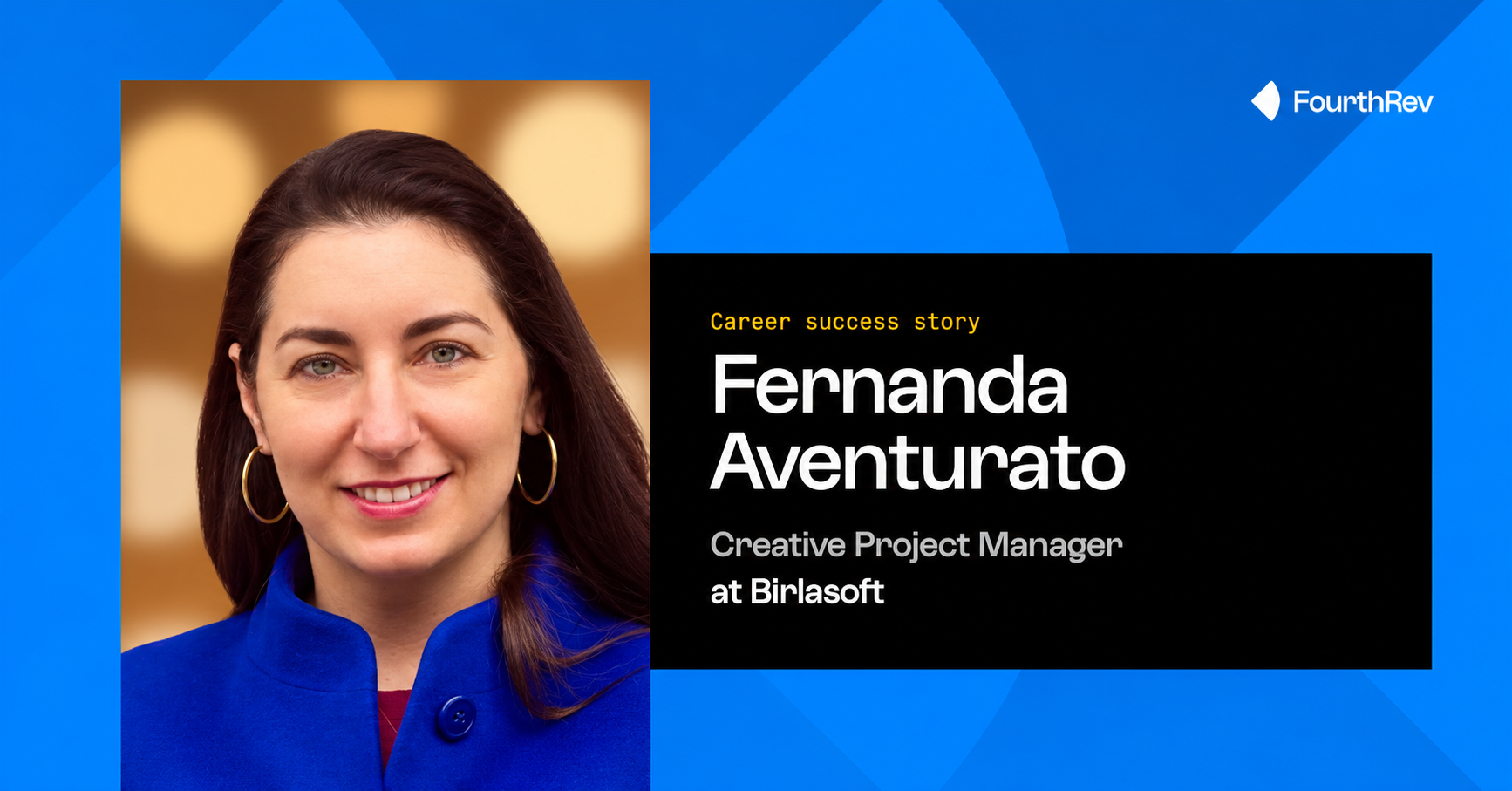
Fernanda Aventurato, Creative Project Manager at Birlasoft, built the early part of her career in broadcast and TV production before moving into a corporate B2B tech role, where, at the time of the AMA, she worked across partnerships and marketing.
In an AMA webinar, Fernanda shares why she returned for a second Career Accelerator and what it took to study the LSE Digital Marketing Strategy & Analytics Career Accelerator alongside a full-time job.
She had studied digital marketing before, back in 2016. But as she explained, that no longer felt like enough: “the market is completely different.”
“I really felt this gap”
Fernanda already knew a little about go-to-market strategy, and she wanted to go deeper. Her first step was the King’s Product Management Career Accelerator, delivered with King’s College London. She calls it “amazing”, and its final course was on go-to-market strategy. As she puts it, “it stayed on me.”
A year later, she decided to do a second Career Accelerator. This time, she knew what she was signing up for: “I knew already what was happening with me, the learning curve and everything, so that’s why I decided to apply again.”
Her goal was clear. She wanted the most current skills, and she says she “needed to feel confident in order to show up to the market and say, look, I’m capable to do that.”
When she read through the programme details, delivered with the London School of Economics and Political Science (LSE), it covered what she was looking for: strategy, how to apply it, some leadership, and an Employer Project.
Applying it at work, one assignment at a time
For Fernanda, the programme felt practical because every assignment was built around a real-world challenge. She didn’t wait until the end of the programme to use what she was learning.
“I had an assignment, and I felt so confident after that that I did the same for my company. I said, ‘Oh, you know that I can do that.’ And that was the first thing that they told me: ‘You are doing really well here,’ because before we were hiring a really expensive third company to do that… and I’m able to get there.”
The second course raised the stakes. Her assignment asked her to plan a campaign with a much bigger budget and prove she could deliver results. That meant learning to analyse data properly, and it gave her the confidence to go to her company and say, “Look, we can deliver ROI because of this, this, and that.”
Before the programme, she says, vanity metrics made it hard to know what really mattered. Learning to read and interpret data changed that. Her summary is simple: “Without data, you are blind.”
“Things are evolving so fast with AI,” Fernanda says, and she saw that change up close in the Masterclasses with practitioners, moving from looking beyond SEO to GEO (generative engine optimisation) to using AI for her own benefit. In her words, “it opened your eyes to what is happening at the moment.” In the data analytics course, she also used AI to run a cluster analysis of her target audience.
A different way of seeing the work
The third course, on leadership and innovation, shifted how Fernanda thinks about her role. For her, leadership isn’t only about managing people. It’s about stepping outside your own tasks and seeing how a workflow could improve.
She took the leadership project she completed on the programme and built it for her own company. At the time of the AMA, she did it with her manager, and she hoped it would go further. The change was visible day to day, too:
“Even inside of my company today it was very clear how I grew in the meetings, challenging some results that I think could be better, so I’m much more capable to add value [to] my company for sure.”
A live brief, and a reason to stay involved
The programme ends with a six-week Employer Project, a live brief from a real organisation. Fernanda’s team worked with Cancer Support Netherlands, a volunteer-led charity, to build its digital marketing strategy.
“The employer project for me was very challenging, but I loved every second, and the strategy that we delivered to them was very good. I’m very proud of what my team delivered, and after that I was so interested to see that happen… that now I’m volunteering for them.”
When she spoke at the AMA, two peers from her cohort had joined her as volunteers, one based in the Netherlands and one “completely on the other side of the world”.
Support for the days that aren’t good ones
Fernanda describes herself as shy. Her Career Coach was part of the reason she agreed to speak at the AMA at all.
“The fact that I’m being here today speaking with you, because I’m very shy, it’s a work that I had with one of the career coaches that said to me, ‘you need to challenge yourself’.”
She worked with a different Career Coach on each of her Career Accelerators: “They were very different, and they helped me in different ways.”
Coaching also helped her position herself by helping her understand her mix of skills and how to present them.
She found the same steadiness in her Success Manager because, as she put it, “it’s not every day that’s a good day, to be very honest.” On the harder days, the success team helped her stay on track.
Studying after hours, with a few days off at deadlines
The programme asks for around 16–20 hours a week, and Fernanda is clear that it takes planning. Her biggest challenge was time, along with overthinking her first assignment because she wanted to do her best. Looking back, her advice is to lean on the Course Facilitator and success team rather than carry the stress alone.
She studied after work and some weekends, and arranged a few days off around assignment deadlines with her manager, something she hadn’t done on her first Career Accelerator. Her view: “It’s doable, you can do it, but you need to know that there is dedication.”
She’s just as direct about the LSE name: “If you’re looking for something easier, don’t look for LSE. But there is a guarantee that you’re going to learn.”
Taking charge of her next move
At the time of the AMA, Fernanda’s goal was to move fully into marketing, and she wasn’t waiting for it to happen to her:
“I just finished… and I’m getting answers for the applications I’m doing, and I’m feeling confident in the interview, so this is amazing. This is already a big step because before, I didn’t even have replies, and now I know exactly what my strengths are.”
One lesson from coaching stuck with her: “You are responsible for your career.”
Asked whether it was worth the investment, she pointed to the fact that she has made it twice: “considering that this is the second time that I do this investment, it’s obviously that it’s worth, right?”
Her advice to anyone considering the programme is just as direct. Use everything it offers, from the Masterclasses to your coach and the success team, and “enjoy the journey and get the most of that.” If you want to bring your marketing skills up to date, backed by strategy and data analysis, explore the LSE Digital Marketing Strategy & Analytics Career Accelerator: six months online and part-time, with up to 12 months of 1:1 career coaching.
Share:


