Table of contents

For many senior executives, periods between leadership roles become opportunities to reassess direction, sharpen focus and invest in the capabilities that will define the next phase of their career. For Olena Bilan, that investment centred on AI leadership.
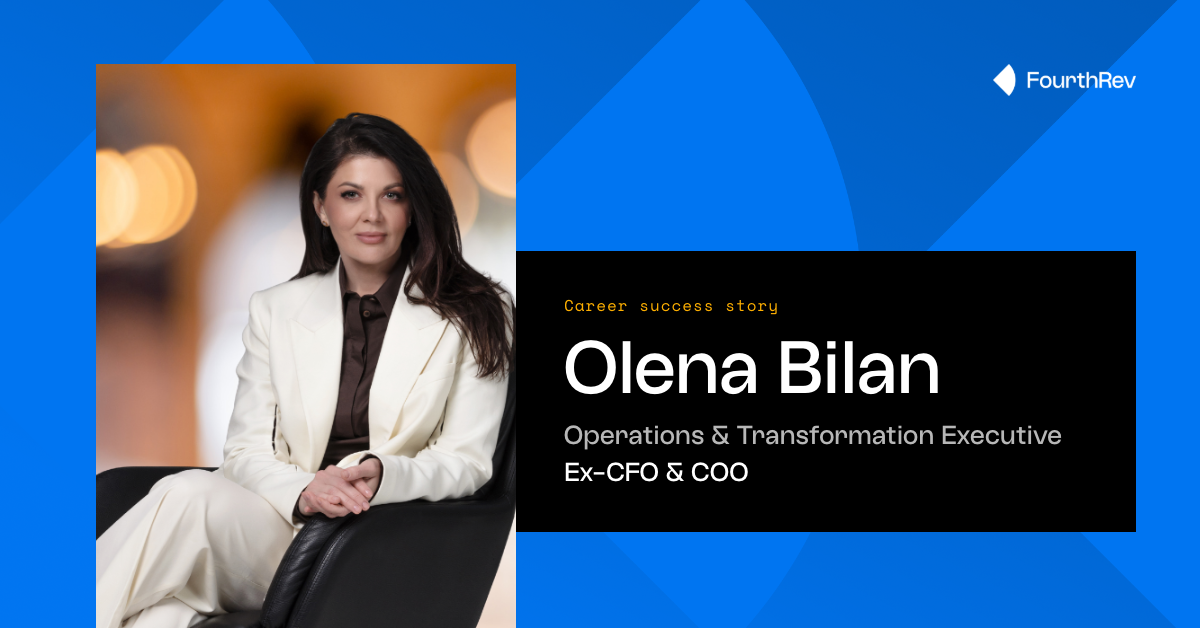
An operations and transformation executive with more than 15 years of experience, Olena has worked across finance, operations and AI-enabled transformation. She has held Group CFO and COO roles and worked at the intersection of enterprise analytics and AI adoption.
Following her relocation to the UK and between executive roles, she made a deliberate investment in her next chapter – building sharper executive judgement around AI adoption, governance and business value before returning to a senior role.
That investment included the LSE AI Leadership Accelerator. Her goal was to build executive-grade judgement in a field where clarity and discipline matter.
“Before, I evaluated AI as an interested executive. The programme equipped me to lead it as an accountable one.”
A strategic investment in AI leadership skills
Before joining the LSE Accelerator, Olena had already seen the gap between AI ambition and organisational reality playing out first-hand:
“AI capability is advancing rapidly, but in many organisations, the ability to translate that capability into operating reality is moving much more slowly. That gap is not closing. In many cases, it’s widening.”
Recognising this gap, she made a focused decision about the kind of learning she needed.
“I was not looking for an AI course at the level of curiosity, trend awareness, or tool familiarity. I was looking for a structured executive framework that could help me understand how to approach AI more seriously, form my own judgement around it, understand how it becomes business value, why it so often does not, and what has to change inside an organisation for adoption to become real.”
With the LSE AI Leadership Accelerator, she set out to build sharper executive judgement for evaluating, prioritising and leading AI initiatives.
The reframe that changed how she diagnoses organisations
One of the most important shifts in Olena’s thinking came early on the programme:
“Most organisations are still treating AI adoption as a technology rollout, when in reality it’s an operating model problem that happens to involve technology.”
This distinction changes how leaders understand and diagnose organisational failure.
“Before the programme, what concerned me was how often AI decisions are delegated by leadership to technical teams, who then become, in practice, vendor selectors. That is the wrong ownership model. AI decisions sit at the intersection of value, risk, governance and operating design – they are leadership decisions, not procurement decisions.”
Rather than asking whether the organisation has access to AI, the more relevant question becomes whether decision flows, incentives, governance and workflows are aligned to support it.
The LSE Accelerator builds exactly this capability – equipping leaders to assess organisational readiness, map AI to business value, and design the governance and change frameworks that determine whether adoption becomes real.
The moment it clicked
For Olena, the most tangible moment on the Accelerator came not from theory, but from a peer discussion.
A fellow participant described being tasked by her boss to implement AI everywhere. It’s a familiar directive in many organisations.
What clicked for Olena was not a critique of the directive, but a clearer view of where AI initiatives actually succeed or fail:
“In most organisations, the leader issuing an AI directive is also the sponsor of the change – they hold the budget, shape the brief, and decide where people’s time and focus go. The quality of those decisions depends on how well that leader understands what AI can and cannot do, and on their ability to translate that into the right task for the right person, framed in a way that person can actually act on. Without it, you get unrealistic tasks, badly scoped problems, or spend driven by trend rather than value.”
The wider point, for her, is about how leaders work with their teams:
“Part of the job is to facilitate the expertise already in the team – to recognise who is best placed to take which question, in what form, and with what context. The more people across a team understand the capabilities, limits and interdependencies of AI, the better that work becomes. That is a leadership skill in its own right: navigating the noise, framing the work clearly, and reading what is realistic against the people and the technology in front of you.”
AI adoption, in that sense, is not only about choosing the right tools. It is about whether the people sponsoring, leading and executing the work understand enough to make good decisions together.
“For me, cutting through AI hype is not scepticism. It is a leadership responsibility. If senior leaders are making investment, operating-model and people decisions around AI, they need enough fluency and judgement to understand where AI creates value, where it creates risk, and where it is simply noise. That judgement is no longer an optional add-on to executive work – it is part of it.”
What shifted in practice
Following the programme, Olena’s approach to AI became more precise and more financially grounded.
“I think much more explicitly now about where AI genuinely moves the needle on margin rather than where it merely looks interesting.”
In other words: Will it deliver real financial impact?
“The programme materially strengthened my ability to articulate AI value to different stakeholder groups – not as a technology story, but as a business transformation story tied to ROI, governance, stakeholder alignment and implementation realities.”
She also describes how the Accelerator taught her deeper integration between technical capability and organisational reality:
“I now have a much more integrated view of AI and organisational change. Before, I saw the familiar components. Now I see much more clearly the structural gap between technical capability and organisational adoption, and why that gap persists.”
Olena is equally clear about what this means for her professional positioning going forward:
“I connect technical teams to business value, translating capability into operating reality and commercial outcomes, without losing either side in the process. That includes the discipline to evaluate vendor claims, implementation proposals, and adoption signals against the actual problem we are trying to solve. Cutting through the noise is not a defensive posture – it’s a board-level skill, and arguably one of the most useful executive contributions to AI adoption right now.”
What the learning actually felt like
Olena had high expectations of the programme and a quiet uncertainty: would it match the level of rigour her background demanded, and would her commercial and operating experience translate naturally into an AI leadership environment?
“I was deliberate about which programme I chose. I needed executive depth, not trend awareness, and I wanted to verify that before investing time in it. My career has been built in finance, operations, and the commercial side of business, and I was looking for a programme built for executive decision-makers – for leaders who also have to drive the projects, teams and partnerships that turn AI ambition into real, sustained business change, rather than a tool tour.”
The programme addressed both. On depth, her curriculum assessment was direct:
“The course is very content-heavy, but the material remains accessible without becoming simplistic. It gives enough structure to make the subject intelligible for business leaders, while still preserving the complexity of what implementation actually involves.”
She also highlights the importance of the programme’s expert industry practitioner input:
“I also found the Masterclasses especially valuable. Hearing from industry experts and facilitators with real business experience added an important practical dimension to the programme.”
From awareness to judgement
“I no longer react to AI. I evaluate it – and judgement now includes deciding what to act on, what to wait on, and what to leave alone.”
This is not about fluency in tools or terminology. It’s about judgement under uncertainty – the core capability required of senior leaders navigating AI.
She reinforces this further:
“That is a real strength of the programme, and I believe it’s part of its uniqueness: it equips people with a practical way to approach AI and related issues, think clearly, navigate complexity, exercise judgement, lead, and act.”
A broader lens on change
Another important dimension of Olena’s LSE Accelerator experience is the human side of transformation.
She notes that team and individual resistance is rarely about tools:
“Resistance is rooted in fear: fear of losing relevance, losing competence, losing control, losing status, or being exposed in areas where confidence is still fragile.”
Understanding this changes how leaders approach AI implementation, requiring empathy, communication and alignment across stakeholders.
This is where many initiatives stall, even when the underlying technology is sound.
Who this is programme for
She’s clear about who will benefit most from the LSE AI Leadership Accelerator:
“For leaders who want to approach AI with executive maturity and discipline – not as a surface-level add-on — the programme delivers real value. I would recommend it equally to senior leaders from technical and non-technical backgrounds: AI sponsorship is a leadership skill, not a technical one, and both groups gain by sharpening their judgement around it.”
The LSE AI Leadership Accelerator is built for leaders who are ready to move beyond pilots and position statements and take responsibility for making AI work inside their organisation.
A strategic investment in leadership
For Olena, the programme was not an isolated learning experience. It was part of a broader repositioning, connecting her past experience in business transformation with the growing importance of AI in executive decision-making.
As she puts it, the value goes beyond credentials:
“The LSE name carries credibility, of course, but what matters most to me is that the programme helped deepen substance, not just status.”
A leader who can connect the technical, operational, commercial and governance layers of AI, and translate credibly across all of them, is exactly the seat most enterprises are currently missing. That seat is what the programme was designed to build.
“The AI we have today is the weakest version of it we will ever see again. Every generation of AI will arrive faster than the last. The competence that matters is not mastering the current one. It’s the discipline to keep architecting, governing and leading through every generation that follows.”
Download the programme brochure to explore how the LSE AI Leadership Accelerator can help you build the frameworks, judgement and leadership capability to turn AI ambition into business value.
Share:


