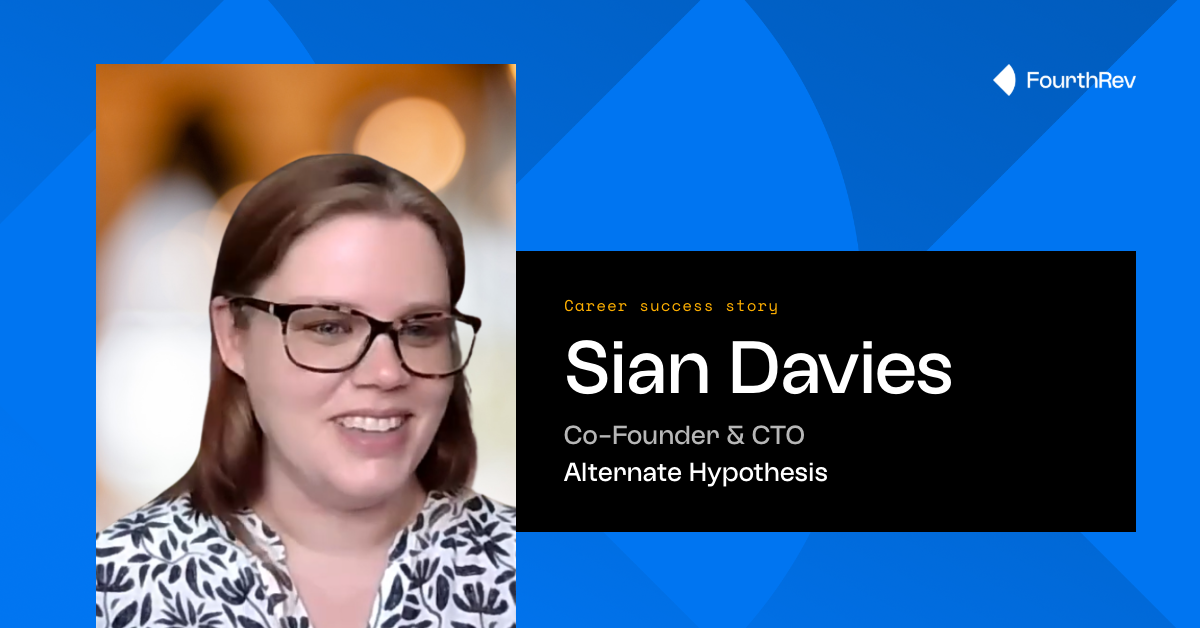
Data Science Career Change Success Story: From Genetics Lab To AI Startup Co-Founder

After more than eight years in genetics research, Sian Davies retrained in data science and AI and went on to co-found an AI startup. This is her career change story, told in her own words. 

Sian is a past learner of the Cambridge PACE Data Science With Machine Learning & AI Career Accelerator, a 7-month programme she completed before making the leap.

“Don’t worry if you’re a career changer, you can do it. I did it,” says Sian.

She joined an Ask Me Anything webinar hosted alongside FourthRev to talk through that transition in detail, from her early days in the lab through to co-founding Alternate Hypothesis, a startup that uses AI to automate statistical testing.

Making the leap 

Rather than a sudden change of direction, Sian’s move into data science built gradually, out of the data analysis she was already doing in her research role and a self-taught grasp of Python that had started to hit a ceiling.

“I’d reached the limit of what I could do with my current knowledge in terms of setting up automations and coding and analysis. So I really needed to take another step.”

Before committing, she joined one of the programme’s own information webinars to learn more. What convinced her to sign up was the practical, project-based way the programme was run, rather than a purely theoretical one.

“I think I liked the detail that this [programme] was going to go into, and the fact that you had projects. So you were doing practical application of the skills. It wasn’t just learning, you were actually applying.”

Putting the learning into practice 

She credits the programme’s structure, in particular an early time-audit exercise, with helping her balance roughly 20 hours of study a week on top of everything else going on in her life.

“One of the things that they did with us in the beginning was getting us to set up time audits, which I found quite helpful. So I was keeping a weekly calendar, blocking off specific hours that I would be working on this.”

None of it stayed abstract for long. The statistics module, in particular, laid the groundwork for the business she has since built.

“The skills that we learned are very applicable, because you’re actually writing the code and building things and testing it within the course.”

The area she came away most confident in was large language models and fine-tuning, skills she now uses directly in her day-to-day work.

“The thing that I’ve really gained confidence in is probably the LLMs and things like fine-tuning, properly testing models and improving them. And that’s the thing that I’ve really carried on from the course into what I’m doing now.”

No coding background? That’s fine 

She began the programme having only self-taught a little Python and done some Excel analysis. She had never built a model before.

She credits her career coach and her fellow learners, as much as the curriculum itself, with getting her to where she is now.

“I just self-taught a little bit of Python before…and I’d done some Excel analysis and things like that. I hadn’t built any models.”

Her message to anyone worried they aren’t technical enough:

“For me, it wasn’t too much of a problem… if you’re already working with computers, and you’ve already experimented a bit, and you’re already interested in coding… I think it’ll be fine.”

More than just the coursework 

Sian points to the career coach and the cohort community as central to her progress, not just the curriculum.

“Mine was really helpful…and encouraging, and she helped a lot…through asking lots of questions, getting me to think about what I wanted.”

Her cohort turned into a long-term support network too, and it’s where she eventually met her Alternate Hypothesis co-founder, Indra Mayengbam, in person.

“In our cohort, we all kind of knew each other. We had WhatsApp groups, and that support was really invaluable as well.”

“I think you shouldn’t feel isolated doing it. In my experience, I didn’t. There was a very strong sense of community… You definitely feel like you’re part of a group.”

The Bank of England project

On the programme’s live employer project with the Bank of England, Sian and her team spent several weeks tackling a genuine, open-ended business problem, sharing leadership of the project as they went.

“In our team, we actually took turns leading… so we’d all get to experience it, because it was over a period of weeks.”

“It was really nice to see what we could achieve together of everything we’d learnt and we kind of had reasonably free rein about what to what techniques to employ to do the project. And, yeah, it’s good.”

Taking the lead in the final presentation and hand-in week stretched more than her technical ability.

“I hadn’t done much online work before starting this course. I certainly hadn’t given presentations online or spoken online before. So that was something that was very new to me. Giving a presentation online, on video.”

Asked what she found hardest across the whole Career Accelerator

“Every project was the hardest challenge until the next project came along.”

“Probably it would have been the final Employer Project, just because the scope of it was probably the biggest challenge.” 

Where she is now 

Sian now co-runs Alternate Hypothesis, a company applying AI to automate statistical testing and make it more accessible to businesses.

She’s clear that the programme played a major part in getting her there, and likely a much faster one than she would have managed alone. She’s still relying on what she learned on a day-to-day basis.

What gave her the confidence to actually start a company? She puts it down to a mix of things: her coach’s support and the confidence she built over the programme itself, in roughly equal measure.

As for whether the programme was worth what it cost, her view was simple: if it gets you where you want to go, it’s worth it.”

Her advice to the next cohort

“You get out what you put in…”

“You will learn all the foundations, but then it’s kind of up to you to take the extra step and pick the ones you want, and really dig into them, if you want to continue this afterwards..”

Download the brochure here to learn more about the curriculum, fees and more.

 

What Is a Career Accelerator? (And Who It’s For)

A Career Accelerator is a structured online programme that combines technical skills, real employer projects, and career coaching. Here’s what it is and who it’s designed for.

If you have been exploring career change options in the UK, you have probably run into the same frustration many professionals face. Traditional degrees can take years to complete, while self-paced online courses often leave you with fragmented skills and no clear path forward. 

At the same time, employers are asking for practical experience, portfolio work, and evidence that you can apply your knowledge in real business situations.

That gap is exactly where the Career Accelerator model fits. A Career Accelerator combines structured learning, career coaching, and employer-led projects into a single online programme designed for busy, working professionals. 

If you are considering changing careers, moving into tech, or building future-focused digital skills, this guide explains what a Career Accelerator is, how it works, and who it is designed for.

To learn more, visit how a Career Accelerator works.

What is a Career Accelerator?

A Career Accelerator is an intensive, part-time online programme that helps professionals build in-demand digital skills, complete a real employer project, and earn a university-recognised credential in around six months.

Unlike standalone online courses, Career Accelerators focus on career progression through a combination of technical learning, practical application, and personalised support.

At FourthRev, they are designed for people looking to change careers, accelerate progression, or future-proof their skills in fast-growing digital industries.

What’s inside a Career Accelerator?

  • Structured curriculum focused on a high-demand digital discipline such as data analytics, product management, UX design, AI, cybersecurity, or digital marketing
  • A live Employer Project based on a real business challenge set by an employer partner
  • One-to-one career coaching throughout the programme
  • A dedicated Success Manager to help learners stay accountable and on track
  • A Certificate of Competence from a leading UK university
  • Access to a professional peer community, networking opportunities, and expert sessions.

If you want a broader overview of the format, read 10 things to know about Career Accelerators.

Many learners also discover that existing transferable skills become more valuable when combined with practical digital capability. Explore more about transferable skills and how they support career change.

How is a Career Accelerator different from other learning options?

Most professionals exploring career change courses have already considered options like traditional degrees, bootcamps, or self-paced platforms such as Coursera and Udemy. While each has strengths, most address only part of the challenge.

Career Accelerators take a more complete approach, combining structured learning, practical experience, coaching, and recognised credentials in a single pathway focused on career outcomes.

FormatDurationCareer CoachingEmployer ProjectStructured CurriculumUniversity Certificate
FourthRev Career AcceleratorSix monthsYesYesYesYes
Coding or skills bootcampThree to six monthsLimitedSometimesVariesNo
Coursera or Udemy courseSelf pacedNoNo LimitedNo
Part-time university degreeOne to three yearsLimitedNoYesYes
YouTube or free resourcesOne to three yearsLimitedNoNoNo

Traditional degrees offer credibility but often lack practical career support, while self-directed online learning can make it hard to stay accountable or turn skills into career progress.

Career Accelerators focus on employability through practical employer projects and personalised coaching, helping learners build skills and apply them in real-world career opportunities.

Who is a Career Accelerator for?

Career Accelerators are designed for professionals at a turning point – whether that means changing careers, progressing into senior roles, starting a digital career, or turning online learning into real career progress. 

The career changer

You may already have years of experience in another field but feel disconnected from where your career is heading. Whether your industry is shrinking, your role feels repetitive, or you want more future-focused opportunities, moving into digital or tech careers can feel challenging – especially when employers expect practical experience alongside technical skills.

A Career Accelerator helps bridge that gap by combining structured learning, practical portfolio work, and a recognised credential. The Employer Project gives you real examples to discuss in interviews, while coaching helps position your previous experience as a strength.

According to FourthRev’s 2023 and 2024 Completers’ Survey, 87.5% of learners achieved a desired career goal within six months. 

If you are considering a major pivot, explore this guide to switching career paths.

The career climber

Not everyone joining a Career Accelerator wants to start over. Many learners already work in digital, operations, analytics, or related fields but want to progress faster.

As organisations place greater value on data literacy, strategic thinking, and digital confidence, Career Accelerators help professionals build those skills while continuing to work full-time.

The combination of technical learning, portfolio projects, and coaching is especially valuable for professionals aiming for leadership or specialist roles.

If you are exploring your next move, take a look at the highest-paying digital jobs shaping the market.

The career starter

For early-career professionals and recent graduates, standing out can be difficult when many candidates share similar academic backgrounds.

A Career Accelerator helps learners build practical, employer-relevant experience through the Employer Project, while structured support provides a clear path from foundational to advanced skills.

This practical approach is one reason Career Accelerators appeal to people exploring career change advice and courses for career change in the UK.

If you are still exploring which direction to take, discover some of the most in-demand tech careers today.

The frustrated learner

This group is often overlooked. Many professionals have already tried online courses, YouTube tutorials, or self-teaching before discovering Career Accelerators. The challenge is rarely motivation – it’s accountability, consistency, and connecting learning to real career outcomes.

Career Accelerators are designed to solve this. A Success Manager provides structure and momentum, while one-to-one coaching keeps learning aligned with long-term career goals.

According to FourthRev’s 2023 and 2024 Satisfaction Survey, 88.2% of learners believe the skills they gained will help future-proof their careers.

Who might a Career Accelerator not be right for?

A Career Accelerator is not the perfect fit for everyone.

It may not be the right option if:

  • You are looking only for a short technical certification without broader career development or coaching support
  • You want a traditional academic research experience with the depth and structure of a multi-year degree
  • You cannot consistently commit around 15 to 20 hours per week for six months
  • You are still completely undecided about the direction you want your career to move in

Career Accelerators work best for people who are ready to take action and apply what they learn consistently over time.

What to look for in a Career Accelerator

1. University accreditation

A recognised university credential adds credibility and signals commitment. It can also help learners stand out when changing careers or applying for more senior opportunities.

2. Real employer involvement

A genuine Employer Project gives learners practical experience grounded in real business problems. That context is far more valuable than purely theoretical exercises.

3. Dedicated career coaching

Career support should be integrated throughout the programme, not added as an afterthought. One-to-one coaching helps learners position their experience, improve applications, and prepare for interviews.

4. Proven graduate outcomes

Strong providers should be able to point to measurable outcomes and learner success stories. FourthRev reports that 87.5% of learners achieved a desired career goal within six months of completion. 

5. Designed for working professionals

Flexibility matters. A programme designed for busy professionals should offer manageable pacing, online delivery, and support structures that help learners balance study with work and personal commitments.

FourthRev Career Accelerator programmes

FourthRev offers Career Accelerators across high-demand digital disciplines, each designed for working professionals and delivered online.

Data Analytics Career Accelerator

Build practical data analysis and visualisation capability using tools such as Excel, SQL, Tableau, Python, and R while earning a Certificate of Competence from LSE.

Data Science Career Accelerator

Develop advanced capability in machine learning, predictive analytics, statistical modelling, and Python.

Digital Marketing Career Accelerator

Learn how to plan, execute, and optimise digital marketing campaigns across modern marketing channels.

Product Management Career Accelerator

Build the strategic, commercial, and technical understanding needed to move into product leadership roles.

UX Design Career Accelerator

Learn user research, prototyping, design thinking, and UX strategy while building a practical portfolio.

AI Leadership Accelerator

Develop strategic AI knowledge and leadership capability to help organisations adopt AI responsibly and effectively.

Cybersecurity Career Accelerator

Build practical cybersecurity leadership and risk management capability in one of the world’s fastest-growing sectors.

Not sure which route fits your goals? Go to Which Career Accelerator should I choose?

FAQs

What is a Career Accelerator?

A Career Accelerator is a structured, part-time online programme that combines technical skill building, a real Employer Project, one-to-one coaching, and a university credential. It is designed for professionals who want to change careers or accelerate progression.

How long does a Career Accelerator take?

Most FourthRev Career Accelerators run for six months, while the Data Science programme runs for seven months. Programmes are designed for working professionals and typically require 15 to 20 hours of study per week.

Do I need prior experience?

No prior experience in the subject area is required for many programmes. Career Accelerators are designed for learners from a wide range of professional backgrounds.

Is a Career Accelerator the same as a bootcamp?

No. Bootcamps typically focus primarily on technical learning. Career Accelerators combine technical learning with coaching, portfolio work, and a university-recognised credential.

What certificate will I receive?

Depending on the programme, graduates can earn a certificate from The London School of Economics and Political Science, the University of Cambridge, or King’s College London.

Can I study while working full-time?

Yes. Career Accelerators are designed specifically for working professionals. Programmes are online, flexible, and structured to fit around professional and personal commitments.

Ready to explore your next career move?

If you are looking to change careers, build future-focused skills, or accelerate your progression, a Career Accelerator can provide the structure, support, and practical experience to help you move forward.Explore Career Accelerator programmes, learn how they work, or speak with an Enrolment Advisor to find the right fit for your goals.

How Luis Broke Into Sports Analytics Through the LSE Data Analytics Career Accelerator 

Luis Cantu is now a Data and Insights Analyst at Leeds United Football Club – a role he moved into from independent commercial consulting, with no prior background in data analytics.

The six-month LSE Data Analytics Career Accelerator gave him the credibility and problem-solving mindset to help him make that shift. 

“I was looking for a strong credential, since I was moving into an area where it was not only completely new to me, but where I didn’t have experience doing data analytics.”

In a recent Ask Me Anything session, he shared the story behind his career transition, offering a candid look at the challenges and decisions that shaped his journey.

From commercial experience to a career crossroads

Luis began his career in commercial strategy and business development, working with small and medium-sized enterprises across the UK. With more than 10 years of experience, he had built a strong foundation in understanding how businesses grow and generate revenue.

But as an independent consultant, he reached a point of uncertainty. He wanted to move into a full-time role while also gaining an edge in a changing job market.

At the same time, he recognised a challenge: moving into a new field like data analytics meant starting without direct experience. That created a credibility gap he needed to close.

He explored several options, from data science to user experience, but data analytics stood out. It offered a way to combine his commercial background with a technical skill set that employers increasingly value.

Luis needed structured learning with real application built in – not just new tools, but the chance to prove he could use them.

The turning point: Learning to think like a problem solver

Enrolling in the LSE Data Analytics Career Accelerator marked a shift in how Luis approached his career.

While the programme introduced new tools like Tableau, Python and SQL, what stood out most was the focus on application and thinking.

He learned how tools work and how to apply them to solve real business problems. The programme encouraged reflection at every stage, helping him connect new skills to real-world contexts.

“The course is structured for you to reflect along the journey. What I’m learning here is just the first step towards learning how to use tools that I can leverage as part of my career.” 

He began to see himself as a problem solver, noting that employers value people who deliver outcomes beyond dashboards and code. 

“What people are going to be looking for is what problems you can solve…” 

That mindset was reinforced throughout the programme, especially during the Employer Project. Working on a live business challenge for six weeks, Luis had to apply everything he had learned under real-world constraints and expectations.

At one point, his team was asked to automate a key part of their solution with less than a week to deliver. Taking ownership of the task, he worked through the problem, found a solution and delivered results that impressed both the employer and his peers. 

“I made something valuable out of everything that I learned through the programme.” 

That experience proved to him that he could take on unfamiliar, complex challenges and deliver meaningful outcomes.

The outcome: A new role in sports analytics

After completing the programme, Luis successfully transitioned into a new industry. He secured a role as a Data and Insights Analyst at Leeds United Football Club, moving into the highly competitive world of sports analytics.

In his current role, he is responsible for helping the club make better commercial decisions through data.

His work includes building the data infrastructure needed to support decision making, identifying the right tools for different teams and analysing fan behaviour to drive revenue.

He described his role in simple terms: the objective is to generate value. 

For example, by analysing customer data, Luis can identify which fans are most likely to purchase different types of tickets, from general admission to premium hospitality packages. These insights help the club target the right audiences and improve commercial performance.

This is where his combined skill set makes a difference. Luis’ background in commercial strategy allows him to understand business goals, while his data skills enable him to uncover the insights needed to achieve them.

The LSE credential also played an important role in his transition.

“LSE is a strong brand, and brands still matter…It doesn’t guarantee you an interview, but it is a positive.” 

In a competitive job market, that signal helped him stand out.

Luis’s outcome reflects a broader trend among learners. According to the FourthRev Completers’ Survey, 87.5% of graduates achieved a desired career goal within six months of completing their Career Accelerator. 

More than skills: Support, confidence and community

Luis’s journey combined technical learning with structured support. 

Throughout the programme, he worked with a Success Manager, a Career Coach and Course Facilitators. He also collaborated with a global cohort of peers.

This combination created an environment where he could ask questions, test ideas, and stay motivated.

“I didn’t really feel alone at any point. You do feel that you have someone you can just send a message to.” 

Career coaching was particularly valuable. Luis’ coach challenged him to think critically about his goals, positioning, and strategy. 

When interviews did not go as planned, they worked together to analyse what happened and improve his approach.

This process helped him build not just skills, but resilience and confidence.

A new mindset for a changing world

One of the most important lessons Luis took from the programme is how to approach problems in a modern, data-driven environment.

He sees tools like AI as part of a broader toolkit that supports critical thinking. 

For him, the real value lies in asking the right questions, testing ideas, and interpreting results.

“If you go for this programme, think of it that way, that it’s going to make you a more attractive person in terms of how capable you are at dealing with challenges that come your way.” 

His advice: Invest in becoming a problem solver

For anyone considering a similar path, Luis’s advice is clear: focus on what tools enable you to do. 

“Think of it as an investment…not just in getting new skills, but building your brand towards becoming someone that can solve problems.” 

That perspective is what ultimately enabled his career transition.

Luis developed data analytics skills, along with the ability to think, act, and communicate like someone who can deliver data results. 

Ready to take the next step?

Luis’s story shows what’s possible when you combine experience with the right learning environment and support.

The LSE Data Analytics Career Accelerator is designed to help you build practical technical skills, create a portfolio of real-world work, and develop the confidence to move forward in your career. If you’re ready to position yourself as a problem solver in today’s data-driven world, download the programme brochure to learn more.

From Knowing “a Little About a Lot” to Confident AI Leadership: Michael Hosler’s Journey

When AI starts showing up in boardroom conversations, many senior professionals find themselves in a familiar position: involved, informed, but not always fully equipped to influence decisions with confidence.

For Michael Hosler, Director, Performance Enablement at FIS, that moment came as AI initiatives began to move from curiosity to operational reality inside his organisation.

“A lot of people know a little about a lot of different things… I wanted to bring structure and clarity to be more informed and involved in conversations and decisions that we were starting to make.”

This is where the LSE AI Leadership Accelerator, an LSE Online programme developed in collaboration with FourthRev, entered the picture. The aim for Michael was not to go deep into technical detail, but to give structure to what he was already doing and help him contribute more confidently in important discussions.

In a recent Ask Me Anything webinar, Michael explained how the programme helped him move from listening in to contributing confidently in AI conversations, using practical frameworks he could apply straight away.

Before the programme: Involved but not anchored

Michael wasn’t new to AI. With over a decade in fintech and responsibility for enabling a 2,000-person commercial organisation, he was already close to transformation efforts.

But proximity isn’t the same as influence.

“I was confident in having casual conversations, but when it came to the decision-making, it was hard to keep up.”

The challenge wasn’t access to information – it was too much of it.

“100 newsletters… 100 YouTube channels… it was complicated to keep up with all of it, especially within the business sense that I was trying to.”

Like many senior leaders, Michael wasn’t looking to become technical. He needed structure and the frameworks to help him filter noise, ask better questions, and contribute meaningfully at the right level.

During the programme: Structure, relevance and immediate application

One of the defining features of Michael’s experience was how quickly learning translated into action.

“I read something that morning that I immediately brought to a meeting that afternoon.”

This wasn’t purely theoretical learning. It was designed for live business environments where decisions are being made in real time.

The most immediate programme impact for Michael came within change leadership.

“What has been the most practical application right away has been the change management course… immediately relevant to projects I’m working on… there’s been some very quick-hit tips that I’ve applied immediately.”

In large organisations, AI is as much a people opportunity as it is a technology one. When leaders align stakeholders, build confidence and embed new ways of working, initiatives are far more likely to scale and deliver lasting value.

The LSE AI Leadership Accelerator helped Michael bring structure to that complexity. “It’s given some very practical tips… just to give some structure to that, because change management is a really big question.”

Gaining confidence without becoming technical

A common concern for senior professionals is whether they need to become technical to lead AI initiatives. Michael’s experience confirms they don’t.

“I didn’t want to say, ‘just wave the magic wand at the data’ to the people who actually have to build it. I needed to understand what’s realistically possible. The sessions with facilitators helped me go deeper on that and gave me much better exposure to how it all works in practice.”

For Michael, the goal was to understand enough to ask the right questions, make informed decisions and work effectively with technical teams.

That shift built real confidence.

“It’s helped me level set with industry best practice… so even if I’m not the ultimate decision maker, I can represent my function quite well.”

In practice, that means earning your seat at the table not through technical depth, but through clear strategic thinking, structured approaches and the ability to contribute meaningfully to significant decisions.

Learning through real work, not abstract theory

Another defining aspect of the LSE AI Leadership Accelerator is its emphasis on real-world application.

Rather than hypothetical assignments, learners are encouraged to work on live business challenges.

“The project encouraged us to work on live things that we’re working with within our companies…”

This makes the output more than academic – it becomes usable. “It’s not just ‘throw some thoughts on paper’, it actually makes you think about [the challenge]… it’s good because it leads to a strong outcome and something that’s usable in the future.”

For busy leaders, this practicality matters. Time invested in learning needs to translate into tangible value quickly.

Formalising what you already do

One of the most valuable outcomes of the LSE Accelerator is validation.

Many senior professionals are already involved in AI-related work. What’s often missing is a clear structure to support and explain their contribution.

With that structure in place, it becomes easier to contribute with clarity and confidence. It’s not about reinventing your career. It’s about strengthening your leadership and building on the experience you already bring.

Support that adapts to you

Beyond the programme curriculum, Michael found value in the flexibility of the learner support teams, particularly the leadership career coaching.

“I’m using it for career development, which has been great because I can use it for my specific need.”

Rather than a rigid framework, leadership coaching is applied on the learner’s terms, whether that is advancing internally in their organisation, exploring new roles or refining leadership direction.

The outcome: Clarity, credibility and contribution

For Michael, the transformation was practical and grounded in real-world application.

He didn’t switch careers. He didn’t become a data scientist.

Instead, he became more effective in the role he already held.

  • More structured in his thinking.
  • More confident in conversations.
  • More credible at the table.

“I can clearly represent my function and explain why I’m at the table in a way that aligns with other stakeholders.”

That alignment between function, strategy and leadership is what enables individuals to contribute more effectively and helps organisations make better, more informed decisions.

A programme built for where leaders actually are

Michael’s story reflects a broader reality.

AI transformation isn’t waiting for specialists. It’s happening across organisations, requiring leaders who can bridge business, technology and change.

The LSE AI Leadership Accelerator is designed for exactly that moment, helping experienced professionals move from awareness to influence without stepping away from their careers or becoming overly technical.

For those already in the room but looking to contribute with greater clarity and confidence, Michael’s journey offers a clear signal of what’s possible.

Explore how the programme could support your next step: Download the programme brochure.

Emma’s Shift into Data Analytics: From Engineering to Solving Business Problems with Data

Emma Roberts did not set out to start a data consultancy. Nor did she expect a mid-career shift would take her from chemical engineering into running her own analytics business. Yet that is exactly where she is today.

Two years after completing the LSE Data Analytics Online Career Accelerator, an LSE online programme developed in collaboration with FourthRev, Emma now leads Nimble Data, helping small businesses and manufacturers modernise their data platforms through analytics, automation and AI.

In a recent Ask Me Anything webinar, she shared what the transition really involved.

A strong career and a growing question

On paper, Emma’s career followed a clear trajectory.

With a Master’s in Engineering, she joined BP through a graduate scheme, became a Chartered Chemical Engineer and later moved to ExxonMobil. Over 15 years, she worked across both manufacturing and office-based roles, some deeply technical, others less so.

Over time, however, something changed.

She found herself missing hands-on problem-solving and working directly with data. As the industry evolved, a more fundamental question surfaced. Did she want to continue on the same path long term?

Working with a career coach helped clarify her thinking. She recognised two consistent motivations: 1) a preference for data-driven decision-making and 2) a desire to help organisations improve performance.

Data analytics offered a way to bring both together without abandoning the experience she had built.

Choosing structure over going it alone

Emma first explored internal opportunities, but when those did not materialise, she assessed her options.

A second degree felt too time-intensive and costly. Self-study, while flexible, lacked structure and accountability.

Instead, she chose a middle path. A structured, part-time programme with clear milestones and support. The LSE Data Analytics Online Career Accelerator runs over six months, part-time and online, building capability across Excel, SQL, Tableau, Python and R before culminating in a live Employer Project.

For Emma, the deciding factor was not just the curriculum, but the support model.

“I was acutely aware I was changing careers mid-way through my working life and wanted support navigating that transition.”

That combination, subject facilitation, a Success Manager and dedicated career coaching, is built into the programme. For those making a career pivot, it can be the difference between starting and following through.

Building confidence through practical work

Emma was candid about her initial concerns.

“University was a long time ago, and my only previous coding experience was a bit of MATLAB during my degree. SQL and Python felt unknown and intimidating.”

What she encountered, however, was a learning experience grounded in application rather than theory.

“It’s very focused on the approach to solving a data problem and equips you with a whole bunch of tools that you can then use to go and find out a way of doing a certain thing or solving a problem later.”

Projects were designed to reflect real business scenarios. The emphasis was not just on learning tools, but on thinking like an analyst.

This came together in the Employer Project.

“And then you have the Employer Project where you work in a team to deliver something, and that’s quite intensive, and it’s the big finale of the course, where you get to bring everything together, there’s not really any rules, you get a pretty generic statement of please go and solve this business problem for someone.”

The ambiguity mirrored real-world work, requiring learners to engage with stakeholders and define solutions.

“It’s very real-world based, you have interactions with the employer to work out what it is you want to do.”

For Emma, this was critical. It meant she was not just learning concepts. She was practising the kind of work she would later deliver professionally.

Reframing experience, not replacing it

A common concern for mid-career professionals is whether prior experience still holds value.

In Emma’s case, it did, just in a different way.

Her background in manufacturing, operations and stakeholder environments became a strength when combined with analytics capability. She could not only build models but also interpret them within real operational contexts.

The programme helped formalise that shift. Structuring analysis, communicating insights clearly and selecting appropriate tools for different business questions.

Even now, she continues to revisit the material.

“Nora, who was our lead facilitator, her weekly lecture material was just perfect, it’s still my Bible, I go back to it most weeks.”

Breaking into the field

Securing her first opportunity in data was not immediate.

“Breaking into data at a mid-career level without 10 years of Python, AWS, Azure, etc., and a computer science background turned out to be very tricky.”

Positioning became key. Emma focused on clearly communicating her hybrid skill set and maintaining visibility, particularly on LinkedIn.

“One tip for anyone considering a career switch: keep your LinkedIn up to date. I wouldn’t be where I am now if I hadn’t.”

Her breakthrough came through a conversation with a potential client looking specifically for someone with both engineering and data expertise.

One project led to another, and eventually to founding her own consultancy.

Applying analytics in practice

Today, through Nimble Data, Emma supports organisations in modernising how they use data.

“It’s been incredible, it’s been life-changing for me.”

Her approach reflects the structure developed during the programme. Define the problem, analyse the data, test assumptions and communicate outcomes clearly.

“I love it, I love what I do, I’ve now got a really flexible career.”

Support that sustains momentum

Emma credits the programme’s support structure with helping her maintain progress during more challenging periods.

“Success managers are your personal cheerleaders and they check in with you that everything’s okay, they give you little pep talks and make sure you don’t miss deadlines and reminders.”

Balancing part-time study with work can be demanding. Structured milestones, accountability and coaching help reduce the risk of losing momentum.

The programme includes up to 12 months of career coaching, with an extension available if a qualifying career milestone has not yet been reached. This is not a job placement guarantee, but a framework designed to support continued progress.

Looking back

Two years on, Emma’s reflection is measured and realistic.

“Is every day perfect? No, it’s still work. But it’s meaningful, mentally stimulating, and aligned with what I care about.”

Her advice for others considering a similar move:

  • Be honest about what you want to change and how you work.
  • Do not underestimate your transferable skills.
  • Expect moments of doubt. They are normal, especially when you’re doing new and demanding things.

For Emma, the transition into analytics was not about starting again. It was about applying what she already knew in a new and more aligned way.

Interested in exploring the curriculum, structure and support model? Download the programme brochure to learn more.

Designing For Good: Klaudia’s Career Path to Purposeful Product Design

When Klaudia Skiba graduated with a degree in Spanish and Marketing, she expected to feel a stronger sense of direction. Instead, she entered a kind of limbo: capable, motivated and full of potential, yet unsure how to channel it into work that felt meaningful.

So, she pressed pause.

“I was working in a café… so that I could take the time and figure out my professional career.”

Those shifts in hospitality were not a detour. They sharpened skills Klaudia already had: empathy, communication, and problem-solving under pressure. But they also revealed a quiet misalignment.

“I realised I was applying my skills in industries that, unfortunately, either didn’t value them or they weren’t paid enough for.”

She recognised that her challenge was not capability but direction. Hospitality had shown her she enjoyed helping people and improving experiences. It was simply the wrong environment for her strengths to grow.

In an Ask Me Anything webinar, Klaudia explained how she started to learn more about UX, began exploring different courses and eventually enrolled on the King’s UX & UI Product Design Career Accelerator. 

That decision set her on the path to becoming a Product Designer in the healthcare technology sector, and eventually Product Lead at Resolutiion®. 

‘I took the leap, even with no experience’

During her self-imposed “gap year”, Klaudia began reading about UX. The more she learned, the more it resonated. Designers she talked to spoke about user journeys and pain points in ways that matched her instincts. This made her think, “…UX would allow me to truly be myself.”

But one question lingered – the same one that concerns many career-changers: don’t you need technical skills to work in UX/UI?

“I knew what UX was, but the entire time I thought… I need to be very tech savvy, I need to know so many different aspects, and I was scared.” 

She worried she lacked the right background. Yet the more conversations she had, the more those fears softened.

Those initial doubts would later highlight just how far her journey had taken her.“I was just a baby when I started this. Now I’m a full-on Product Designer. It can happen to anyone.”

What changed wasn’t that she magically became more “technical” overnight. It was that she found a route into UX that supported people at the very beginning of their careers.

That support quickly translated into practice. The Career Accelerator enabled Klaudia to build a portfolio of real, applied design work that reflected how she approached problems as a designer. By the end of the programme, her portfolio told a clear story through projects shaped by user needs, genuine constraints and measurable outcomes — a compelling proof point for early in their careers.

For Klaudia, and for many others like her, coming from a non-design or non-tech background is not a barrier. It can be a strength.

“Many people in my course were career changers from arts, from data science…. But there are so many different people with different backgrounds, and they make it happen. So it’s definitely possible.”

Learning by doing – and being treated like a designer from day one

From the first weeks of the programme, Klaudia noticed a difference from her previous study experience. This wasn’t months of theory followed by a distant assignment. It was a constant loop of learn → apply → get feedback.

“I remember the first week we were learning about the guidelines for UX and heuristics… and then in the same week we were given… an app, and then we had to audit it.”

Application was immediate, and so were the expectations. Learners were asked not simply to follow instructions, but to interrogate their decisions and justify their thinking.

“Having that practicality ensured that we transitioned, in my instance, smoothly to a successful career.”

Facilitators, all working industry professionals, played a central role in this shift. They pushed learners to articulate their reasoning rather than present polished outputs. They challenged assumptions, asked difficult questions and delivered constructive critique.

“I never felt like I was falling behind, and that was because of the help from facilitators and success managers who were there to help us.”

Through this process, she stopped seeing herself as someone “trying to get into” design and instead began behaving like someone already on the path.

The Employer Project and an unexpected job offer

The programme’s final stage, the Employer Project, was the closest thing to a first job while still studying. For six weeks, Klaudia and her team worked on a brief for a real organisation. 

“There were a lot of unknowns that we had to deal with…but it was so rewarding as well, because once we went through the six weeks of collaboration and designing, we thought, wow, we actually created an entire app that meets the business needs and the project goals.”

What she didn’t know was that someone was taking note. Her facilitator – an experienced designer working in healthcare – had not only observed her work, but her unique approach as well.

In a one-to-one session, Klaudia mentioned to her facilitator that she was applying for roles and asked, almost in passing, “If you know of any projects, whether paid or unpaid, short term, long term…I just want to apply my skills to practice.”

A few days later, the facilitator messaged her: “She messaged me… inviting me to work with her on a project.”

Not every learner receives a job offer from the Career Accelerator’s Employer Project. Yet Klaudia’s story shows what becomes possible when you treat the work like a real job – and someone in industry sees you as the kind of designer they would hire.

Designing for impact, not for aesthetics

After completing the Career Accelerator, Klaudia began working in the healthcare space as a Product Designer at Nuumad – a sector she once felt intimidated by. Yet it quickly became a natural home for her skills and values.

She was struck by problems that affect people at their most vulnerable: “If you’re trying to book an appointment, you’re either stressed or already overwhelmed, either about yourself or the people you love.”

For her, this was the moment UX stopped being abstract and became a question of responsibility. Klaudia elaborated, “Booking an appointment shouldn’t add more complications and more stress to it…Healthcare is something that we should all be able to access….it’s a human right.”

That, she says, is why she took the role. Her work is now not only about creating pretty interfaces, but about reducing friction during high-stress moments, making complex information usable for non-experts, and saving clinicians time so they can focus on care rather than paperwork. 

In short: it is about solving human problems.

Where is she now?

Since sharing her story in the live Q&A, Klaudia has continued to grow her design career – now working as Product Lead at Resolutiion®, leading product redesigns, collaborating closely with engineering and branding teams, and helping to shape the product’s direction. 

Her journey into a leadership role in tech shows not just a successful career change, but true acceleration – powered by clear purpose, applied skills, and confidence built during the King’s UX & UI Product Design Career Accelerator.

If you recognise yourself in Klaudia’s story, you should consider the King’s UX & UI Product Design Career Accelerator. The programme can help you pivot into design, build projects for your portfolio, and connect with people working in the industry. Download the programme brochure to find out more.

Real Projects, Real Outcomes: Olga’s Journey to a Head of Marketing Role

When Olga Sachura set out to restart her marketing career after a break, she knew she needed more than confidence. She needed to get up to speed with the digital world.

“A marketing manager’s job no longer applies just to offline marketing. If you don’t know anything about digital, you just won’t land a job. Marketing is digital now.”

Today, Olga is the part-time Head of Marketing and Advisor at Balentic, a leadership role that blends strategy, analytics, and growth. Her journey there began with the LSE Digital Marketing & Analytics Online Career Accelerator, an online programme delivered in collaboration with FourthRev.

In a recent Ask Me Anything online event hosted by LSE Online and FourthRev, Olga shared her programme experience live:

Bridging the digital skills gap

Returning to work after a break wasn’t easy for Olga. The marketing world had moved on: new platforms, automation tools, analytics dashboards, and AI-driven insights were now central to every strategy.

An experienced strategist with a background in luxury, finance and SaaS, Olga realised her traditional skills were no longer enough. To re-enter the field with confidence, she sought out a programme that could bridge that gap.

As an LSE alumna, she already trusted the School’s academic excellence and global reputation. “I knew the quality of teaching would be top level,” she said. “You don’t only choose the programme; you also choose the brand.”

The credibility of LSE and its globally recognised alumni network became part of her plan to rebuild momentum. She said: 

“Having an LSE name on your CV and LinkedIn profile really makes a difference.”

Learning that maps to real work

The Career Accelerator’s structure immediately stood out to Olga. It combined academic rigour with hands-on marketing practice through real-world briefs, tools, and frameworks. “The programme provides you with a lot of essential tools,” Olga said.

Weekly live sessions and seminars helped bring those tools to life.

“Live sessions are great. You also have a chance to interact with your fellow students, because obviously, one question usually leads to another. And you’ll have a coach, who then leads you through the questions and answers to your questions.”

This blend of flexibility, guidance, and collaboration gave Olga the confidence to apply what she learned directly to her work, and ultimately to her next leadership role.

Turning theory into impact: The Employer Project

The programme’s defining feature was its Employer Project: a live brief from an external organisation where learners work in teams to deliver a digital marketing strategy.

“The real-life project for the employer is next level, and you get to work with other people. It suddenly becomes real because you have a team. You have dedicated roles. You have feedback. You have to organise your time. You have to project manage. It’s great. For the employer, once you present your project or your recommendations, you get feedback….”

Her team partnered with a London-based edtech company called EdPlace, which was seeking to grow and retain its online community while launching new products.

“They came to us with a case study. Pointed out their pain points… where they were struggling, and what they were looking for to achieve. We had to come up with a digital marketing strategy for them, how to take things forward, and what to look out for in terms of KPIs.”

That project became a key part of Olga’s portfolio, showing her skills in strategy, teamwork and results, and giving her something real to talk about in interviews.

Career coaching: Personalised, transformative guidance

Olga also credits her success to the career coaching included in the programme.

“I’m very tempted to say that, for me, perhaps the career coaching was the most valuable part of the programme.”

Her coach helped her reflect on her professional identity, reposition her previous experience, and set achievable goals. “It comes in all forms of advice, from practical advice on how to improve your LinkedIn page to literally sitting down – and it’s a psychological element, you’re sitting down and thinking about what’s really important to you as a person.”

It helped her polish her profile and land her new role through LinkedIn.

Studying online: Structure, support and connection

Far from being an isolating experience, the programme’s online format created a strong sense of connection.

“For anyone who considers this a challenge to study online, it’s absolutely not. It’s really well organised. I think students who invest in this programme are really keen to sit down with you and to find the time. And it’s very manageable online. My study group for my last project, we were all in different places in different time zones.”

Alongside Olga’s Career Coach, support came from her own Success Manager and the dedicated Course Facilitators. “They have been amazing. You can reach out at any point… It is absolutely accessible.”

“It’s a great community for anyone who cannot afford full-time study at LSE. This programme provides an opportunity to get the knowledge, the tutors, the skills, the base, and if you’re lucky to be in London, you even get a library card so you can come and work on campus.”

The outcome: Advancing into a leadership role

By the end of the programme, Olga stepped into a leadership role as Head of Marketing and Advisor at Balentic, a fintech based in Copenhagen. This position draws on both her strategic experience and the digital skills she gained at LSE.

“I’m really glad I had the chance to rethink my career. And most importantly, I learned the skills that I probably otherwise would struggle to learn myself. And that’s another great point about this programme – you’re always supported in terms of organising your time. So yeah, no regrets. I loved it.”

Who this programme is for

“Anyone who’s curious, anyone who’s interested in digital marketing, anyone who is stuck in their career, anyone who just wants to progress with their careers. Anyone who needs a brand on their CV. It’s a great programme.”

She’s equally honest about its value:

“It’s not cheap, but it’s worth it. Even if you break the programme into two parts, the digital marketing programme and the career coaching, and then translate it into budgets, it’s worth it.”

The programme offers a trusted, practical route for experienced marketers and career changers to gain digital fluency, professional confidence, and achieve real outcomes.

Download a programme brochure for a closer look at how the LSE Digital Marketing Strategy & Analytics Online Career Accelerator, delivered in collaboration with FourthRev, can help you transform your career.

From Course to Real-World Impact: Building Cancer Support Netherlands’ Digital Marketing Strategy

Learning digital marketing is one thing. Applying it when the brief is live, the audience is vulnerable, and the consequences are real is another entirely. 

That’s why the Employer Project sits at the heart of the LSE Digital Marketing Strategy & Analytics Career Accelerator, an online programme from The London School of Economics and Political Science, delivered in collaboration with FourthRev.

The final six-week capstone project is where learners move from “I understand the theory” to “I can execute good decisions in the real world”.

For Fernanda Aventurato, that shift carried extra weight.

“Because our decisions would directly affect a real charity and its community, I felt a deeper sense of responsibility.”

This case study tells the story of how learners in small teams partnered with Cancer Support Netherlands (CSN) – a newly registered charity with limited resources and a deeply sensitive mission – to develop a digital marketing strategy that could genuinely be implemented.

The Employer Project, in context

The Employer Project is the culmination of the LSE Digital Marketing Strategy & Analytics Career Accelerator. 

Learners work in teams to respond to a live organisational challenge – not a simulated case – and produce an end-to-end strategy grounded in evidence, feasibility, and professional judgement.

It’s designed to mirror the business world these learners are re-entering: real stakeholders, real trade-offs, and real accountability.

The employer and the challenge: Where empathy comes first

Cancer Support Netherlands (CSN) exists to ensure that no one walks the cancer journey alone – including the many people living in the Netherlands who don’t speak Dutch and can struggle to access support.

As a new, volunteer-led organisation, CSN faces the classic early-stage charity reality:

  • Limited time and capacity
  • No established marketing infrastructure
  • Little to no usable historical data
  • A multicultural audience with real language and cultural barriers
  • A cause that demands sensitivity, trust, and ethical care.

For learners, this wasn’t simply a “growth marketing” activity. It was a challenge to build awareness and engagement without compromising compassion.

Fernanda captured that tension clearly:

“The organisation is driven almost entirely by volunteers, which means limited time, fluctuating availability, no data available and without any established marketing infrastructure… Balancing these factors made it clear that any digital marketing strategy had to be practical, compassionate, and sustainable.”

The brief: What learners were tasked with

CSN needed a strategy that could help them move from early momentum to sustainable growth. 

Learners were tasked with creating the organisation’s first digital marketing strategy and campaign plan, including:

  • Clarifying target audiences and refining personas
  • Shaping messaging that was inclusive, culturally sensitive, and realistic
  • Selecting channels CSN could actually maintain
  • Designing a campaign plan that balances awareness, engagement, advocacy, and fundraising
  • Recommending lightweight infrastructure to capture and nurture community interest
  • Building an experiment-led approach to validate assumptions early.

This wasn’t coursework. Learners were operating at a mid-level-to-senior digital strategist standard, producing work intended to be used.

As CSN board member Jill Murray put it:

“The balance of strategic thinking and practical application really stood out… Their ability to connect academic knowledge with real-world impact was impressive.”

Inside the project: How learners approached a complex, sensitive brief

The project began where real strategy begins: listening, researching, and pressure-testing assumptions.

Teams explored the landscape of cancer support services in the Netherlands, analysed where gaps existed for non-Dutch speakers, and built a clearer picture of how CSN’s audience discovers support – often through fragmented offline touchpoints like hospital flyers and word of mouth.

Branwen Bindra, one of the group team leaders, described a key shift in mindset:

“The challenge was not simply to promote a campaign but to build a foundation with a clear digital pathway that could reliably capture, nurture, and retain people seeking support.”

From there, learners translated theory into practical choices, prioritising what could be implemented by a volunteer-led organisation, not an idealised marketing department.

“This meant prioritising low maintenance systems, simplifying workflows, and focusing on the channels that aligned most closely with their community’s real behaviours.” – Branwen

For Fernanda, the work became personal. As an immigrant, she recognised the vulnerability CSN’s community can feel and how important it is for messaging to be human, not transactional.

“That feeling of vulnerability and disconnection stayed with me… CSN serves people who face similar moments, and it does so in a culturally and linguistically sensitive way.” 

That lived understanding shaped the tone, channel decisions, and feasibility lens throughout the project.

The solution: Strategy, infrastructure, and campaigns designed for real constraints

Across teams, recommendations focused on building a sustainable foundation CSN could grow with, not a complex plan that would collapse under operational reality.

A practical digital marketing strategy and campaign roadmap

Learners developed integrated strategies to increase awareness and community engagement while acknowledging budget and capacity constraints.

As Leila Ferreira, another learner, explained:

“Our team developed a digital marketing strategy focused on increasing the charity awareness and improving the audience engagement to drive growth.”

A campaign with empathy at the centre

One team developed a campaign concept designed to meet people where they are emotionally:

  • “You Are Not Alone” – an empathetic message aimed at people who can feel isolated by language and cultural barriers
  • A phased, test-and-learn approach to validate messages and channels before scaling.

“We created the ‘You Are Not Alone’ campaign… We recommended a phased approach, beginning with small tests to validate messaging and channels before scaling activity.” – Branwen

Another team built a complementary strategic concept:

“The core of our solution was the ‘Connection of the Heart’ strategy, which combined storytelling, search visibility, and community-centred content…” – Fernanda

Lightweight infrastructure to support growth

Because CSN is volunteer-led, teams focused on systems that were simple, low-cost, and maintainable, including recommendations for CRM and lead nurturing foundations.

Fernanda outlined the goal clearly:

“We designed a lightweight digital infrastructure using low-cost and free tools… and built workflows that volunteers could easily follow.”

Recommendations included practical building blocks such as email capture and nurturing, clearer tracking, and channel planning, with careful attention to consent and responsible use of data.

Confidence-building moments: When theory finally “clicked”

For many learners, the Employer Project is where confidence is earned, not through perfection, but through making real digital marketing decisions under uncertainty.

Fernanda described a moment that changed how she saw herself:

“During one of our planning sessions, I caught myself instinctively knowing which frameworks to use… It was the first time I felt that everything I had learned… had genuinely ‘clicked’… I realised I was no longer just trying to keep up, I actually belonged there.”

Leila had a similar realisation – rooted in connecting insight to action:

“One defining moment when everything clicked was seeing how our research and data insights aligned… Data is the real hero of marketing.”

And Branwen described the moment strategy became tangible:

“When I mapped the messaging, channels, expected outcomes, and measurement approach into one clear framework, something genuinely clicked.”

Impact for CSN and career-readiness for learners

The Employer Project delivers impact on both sides of the partnership, creating tangible value for organisations, while building the confidence and professional readiness learners need to progress their careers.

Value delivered for CSN

CSN received actionable work grounded in research, audience insight, and real operational constraints. Jill Murray summed up what stood out:

“We were genuinely amazed by the strength of the presentations. The strategies were creative, well-researched… [and] offered practical solutions that will help us reach more people and advance our mission…”

She also highlighted the why behind the value of live projects for a volunteer-led organisation:

“For organisations like Cancer Support Netherlands… initiatives like this bring fresh perspectives and innovative ideas that we could not realistically commission or pay for in the real world.”

Value delivered for learners

For learners, this was a portfolio piece that proved they can operate professionally on complex, sensitive projects and deliver work that stands up to stakeholder scrutiny.

Fernanda reflected on how the project reshaped her confidence and career direction:

“This experience was genuinely transformational… I was already speaking with my marketing colleagues at work on a more equal footing… I can say that this project has… helped me feel empowered, capable, and ready to step into digital marketing roles with genuine purpose and enthusiasm.”

Leila echoed the readiness built through real-world practice:

“It gave me… first-hand real-world marketing environment experience… [and] more confidence… in defending my strategic decisions and ideas.”

What career-ready learning actually looks like

The strongest digital marketers don’t just know channels. They know how to make decisions when:

  • The data is incomplete
  • The stakeholders are real
  • The audience is vulnerable
  • The organisation can’t “just hire an agency”
  • The right answer is the one that can be implemented responsibly.

That’s the learning environment the Employer Project creates, and why it resonates so strongly with career changers and career advancers looking for proof they can do the work, not just talk about it.

As Jill Murray put it:

“The Career Accelerator clearly equips participants with both the mindset and the tools to address real-world marketing challenges.”

Ready to explore the programme?

If you’re considering the LSE Digital Marketing Strategy & Analytics Career Accelerator, the Employer Project shows what you’ll graduate with: practical judgement, real proof, and confidence to step into your next digital marketing role.

Download the programme brochure to explore the curriculum, learning experience, and outcomes.

How an LSE Data Analytics Career Accelerator Alumnus Advanced His Career at Adidas

When Jip Sanders joined Adidas, he was driven by curiosity and a desire to improve how things worked. In his role managing product launches across European marketplaces such as Zalando and ASOS, he made sure each release went live smoothly. Yet even with his growing exposure to data, he sensed a gap.

I felt like there was something missing, that I didn’t have the fundamental skills to really show that I can do this, and for that I needed to have these data analytic skills….”

He was seeking a structured approach to learning – one that combined academic credibility with practical, hands-on experience. That search led him to the LSE Data Analytics Career Accelerator, developed in collaboration with FourthRev.

Over six months, Jip developed the technical fluency and professional confidence to move into Digital Sales – Product Launch & Optimisation at Adidas. Today, he leads automation projects that simplify data workflows across European marketplaces and contribute to smarter, faster launches. Jip shared his Career Accelerator experience with us during a live Ask Me Anything event.

Building data confidence and collaboration

When he started the Career Accelerator, Jip quickly saw how well it fit around his work. It was designed for professionals like him, people eager to grow while managing full-time careers.

You start off the programme learning about Microsoft Excel. You really learn about what data is, what the different types are, how to read each type of data, and you start at the very first stepping stone and week by week you grow into an individual that understands it.”

For Jip, the Employer Project was the most rewarding part. It brought everything together: technical skill, collaboration and real-world impact.

What I’m most proud of is definitely wrapping up the Employer Project at the end. This is the fourth module, and in this you work together with a group of fellow students… we wrapped up the presentation with a super good feeling. We jumped on a group call, and we celebrated together…”


Working with peers from Amsterdam, the UK, and the UAE on a live brief – forecasting ice cube sales in Spain – showed him how powerful shared problem-solving can be.

To learn how to work as a group is something that was very unique to me, and I think that’s also one of the best qualities of this programme, is that you learn how to work as a team on a data-oriented project.”

The experience mirrored real industry life, where collaboration and communication matter as much as technical expertise. It also gave him a clearer sense of how to use analytics to tell stories and drive decisions.

Career progression and credibility

After completing the programme, Jip’s progress was soon recognised internally. His stronger grasp of Python and SQL, paired with his ability to translate data into business solutions, opened doors to new responsibilities at Adidas.

It’s definitely given me more autonomy to lead on advanced automation projects.”

He soon stepped into Digital Sales – Product Launch & Optimisation, leading automation initiatives that improve how product data flows through Adidas’ European systems.

The credibility of the Certificate of Competence from LSE also made an impression.

When I tell my colleagues that I did a programme at the LSE, they’re like ‘Wow, no way, it’s such a prestigious university.’”

Jip’s story reflects a wider Career Accelerator trend: 87.5% of learners achieved a desired career goal within six months of completing a Career Accelerator (FourthRev 2023/24 Completers’ Survey).

Mindset, support, and advice

Beyond career growth, Jip’s perspective on data changed completely while on the programme. He no longer sees it as a technical process, but as a creative tool for solving problems and shaping ideas.

What this programme really teaches you is that data is not just ones and zeros. There’s a lot you can do with it, and you can really shape it in a certain way, and it can be quite magical... Without this programme, I wouldn’t have been taught that, and I would have put limits on what I believed was actually capable.”

This new mindset has shaped both his work at Adidas and his personal projects. He has built Python scripts to optimise workflows. He continues to explore ways AI can enhance automation and data visualisation tasks — skills also reinforced by the programme’s dedicated AI & Data Analytics Learning Track.

Jip credits the programme’s support system as one of its greatest strengths, saying: “The support system can only be described as excellent. I think you guys are always on standby, ready to answer questions.”

Advice for future learners

Jip acknowledges that starting a new programme alongside work can feel daunting, but he urges others to see it as an investment in their own potential.

I would recommend this to anyone who wishes to shake things up in the world. If you want to learn how to use data and use it to your advantage, or how to change up the ways your organisation works, then this is something that will totally help you.”

Jip’s Accelerator journey is a reminder that data confidence can transform not only a career, but how you think, collaborate, and lead.

Like Jip, you can gain industry-ready skills and an LSE credential that sets you apart. The LSE Data Analytics Career Accelerator, developed in collaboration with FourthRev, equips you to lead with data in any industry – from retail to finance, healthcare to tech.

Ready to take the next step in your data career? Download the programme brochure to see the curriculum, tools and next cohort details.