How to Change Careers into UX Design: A Portfolio-First Roadmap

No design degree? No problem. Here’s a portfolio-first roadmap to transition into UX design that covers what to learn, how to build case studies, and how to land the role.

If you’re researching how to become a UX designer, you’ve probably noticed something frustrating. Every job asks for experience, but you can’t get experience without first getting a job. On top of that, most entry-level UX roles expect you to have a portfolio – even if you’ve never worked as a designer before.

It can feel like a catch-22.

The good news is that UX hiring works differently from many other professions. Your portfolio is your experience. Employers care far more about how you think, solve problems and communicate your design process than whether you’ve held an official UX job before.

Whether you’re moving from marketing, teaching, hospitality, administration or another people-focused profession, this portfolio-first roadmap will show you a practical path into UX design. 

Is UX design a good career to change into? (2026 reality check)

For many career changers, the answer is yes. Organisations continue to invest in digital products, customer experience and accessible services. That means demand remains strong for professionals who understand user needs and can turn insights into better digital experiences.

Today’s UX ecosystem includes roles such as:

  • UX Designer
  • UI Designer
  • Product Designer
  • UX Researcher
  • Service Designer
  • Interaction Designer

The junior market is more competitive than it was several years ago. Employers have become more selective, but they haven’t stopped hiring. Instead, they’re looking for candidates who can demonstrate practical capability rather than simply listing qualifications.

That’s where a strong portfolio becomes your competitive advantage.

UX also suits career changers particularly well because many transferable skills already matter in the profession. 

  • Teachers understand research and communication
  • Marketers know customer behaviour
  • Hospitality professionals excel at empathy and service
  • Administrators are often highly organised problem-solvers. 

These strengths become valuable foundations for UX work.

Can you get into UX design with no experience?

Yes, but you need evidence that you can do the job.

One of the biggest myths about UX is that you need a design degree before anyone will consider hiring you. In reality, hiring managers primarily evaluate whether you can solve user problems and explain your thinking.

That means:

  • No UX job? That’s okay.
  • No design degree? Also okay.
  • No portfolio? That’s the problem to solve.

A portfolio demonstrates your ability to research, prototype, test and iterate. It proves your potential far better than simply saying you’re passionate about UX.

If you’re struggling with confidence during your transition, our guides on your guide to switching career paths and overcoming imposter syndrome in a career change can help you navigate the emotional side of changing careers.

Why a portfolio-first approach beats a course-first approach

Many aspiring designers make the same mistake. They think:

“I’ll finish learning first, then I’ll build my portfolio.”

Unfortunately, that often means six months of study with nothing tangible to show to employers.

A portfolio-first mindset flips the process. Instead of separating learning from doing, every new skill immediately becomes part of a project. Every exercise becomes evidence and every assignment becomes another opportunity to demonstrate your thinking.

Learning and portfolio-building become the same activity. 

This project-based approach accelerates both confidence and employability, which is why how project-based learning accelerates your career is becoming such an important topic for career changers.

The portfolio-first roadmap

Step 1: Learn the UX fundamentals by using them

Start with the core disciplines:

  • User research
  • Information architecture
  • Wireframing
  • Prototyping
  • Usability testing
  • Accessibility

Learn by applying every concept to a project. As your skills grow, so does your portfolio. 

Our guide on how to become a UX designer explores these foundations in more detail.

Step 2: Become fluent with industry tools

Figma is now the standard tool for most UX and product design teams.

Alongside interface design, learn:

  • Interactive prototyping
  • Design systems
  • Developer handoff
  • Responsible use of AI within the design workflow

Employers hire designers who can use design tools to solve meaningful problems. Your portfolio is where you demonstrate that ability. 

Step 3: Build your first self-initiated project

Choose a product or service you genuinely care about. Perhaps redesign a booking experience, improve a charity website or simplify a healthcare journey.

Focus less on visual polish and more on your thinking.

Show:

  • The problem
  • Your research
  • Design decisions
  • Iterations
  • Final solution
  • Reflection

One excellent end-to-end case study is far more valuable than several disconnected screens.

Step 4: Complete real, briefed project work

Self-initiated projects show what you can do. Employer-set projects show how you work on real-world business problems. Together, they give employers strong evidence of your skills. 

This is where programmes like the King’s UX & UI Product Design Career Accelerator stand out by combining structured learning with employer projects that produce credible portfolio evidence. You can also explore how learners build powerful UX portfolios on the accelerator to see what this looks like in practice.

Step 5: Structure your portfolio around case studies

Aim for three or four substantial case studies. Each should answer:

  • What problem were you solving?
  • What was your role?
  • What research did you conduct?
  • Why did you make key decisions?
  • What changed because of your work?
  • What would you improve next time?

Include both self-initiated work and at least one collaborative or briefed project where possible. This could perhaps be from a freelance client you’ve taken on.

If you’d like inspiration, explore what a powerful UX portfolio looks like.

Step 6: Tell your career-change story

Frame your previous experience as evidence that you’ve already been solving human-centred problems, just in a different context.

Klaudia’s move from hospitality into product design demonstrates how previous experience can become a genuine strength rather than something to apologise for.

Step 7: Apply with proof

Prepare to present a case study during interviews and be ready to explain:

  • Your research process
  • Trade-offs you made
  • Feedback you received
  • How your design evolved

Alongside applications, seek portfolio reviews, build your professional network and ask for referrals whenever appropriate.

Resources like launching your UX design career: expert advice and 12 tips to ace your next interview can help you prepare.

What makes a strong UX portfolio?

Every case study should include:

  • Clear problem statement
  • Research methods
  • Key insights
  • Information architecture
  • Wireframes
  • Prototype
  • User testing
  • Iteration
  • Outcomes
  • Reflection

Avoid common mistakes such as:

  • Showing only polished screens
  • Including too many weak projects
  • Skipping research
  • Using unnecessary jargon
  • Forgetting measurable outcomes

If you’re looking for examples, see how accelerator learners build their portfolios.

How long does it take and how should you learn UX?

Most career changers need between six and twelve months of focused, consistent effort to build a job-ready portfolio.

There are several learning routes available:

  • Self-teaching offers flexibility and low upfront costs but requires exceptional discipline and can leave portfolio gaps.
  • Bootcamps provide structure and speed but vary considerably in quality and employer recognition.
  • University-backed career accelerator cohorts combine structured learning, employer projects, career coaching and recognised credentials while helping learners build portfolio-ready work throughout the programme.

If you’re comparing UX design courses in the UK, it’s worth evaluating:

  • Portfolio support
  • Employer involvement
  • Career coaching
  • Learning format
  • Community
  • Industry credibility

Useful resources include cohort-based vs self-paced learning for career changers, how to choose a credible online programme, university certificate vs certification vs diploma, which Career Accelerator should I choose, and how the FourthRev learning model works.

Real people who changed careers into UX

Many successful UX and UI designers began somewhere completely different.

Klaudia moved from hospitality into product design before progressing to Product Lead, using portfolio projects to demonstrate transferable skills.

Anna transitioned into UX before applying those skills within Parliament, showing how strong design thinking can create impact across sectors.

You can explore these journeys alongside more FourthRev impact stories to see how career changers have used portfolio-led learning to launch successful UX careers.

Your portfolio is your strongest career asset

Changing careers into UX starts with building evidence of your skills, one project at a time. Every case study strengthens your portfolio, every real brief builds your confidence, and every portfolio review helps you develop the thinking employers are looking for. 

If you’re ready to switch into UX, explore the King’s UX & UI Product Design Career Accelerator to build industry-ready projects with expert guidance. Or browse all Career Accelerators to find the programme that’s right for your goals.

Frequently Asked Questions

Can I become a UX designer without experience or a design degree?

Yes. Employers primarily evaluate your portfolio, problem-solving ability and design process rather than your academic background.

How long does it take to change careers into UX?

Most learners build a competitive portfolio within six to twelve months of consistent study and practical project work.

What should a career changer’s UX portfolio include?

Three to four detailed case studies covering research, design decisions, testing, outcomes and reflection, including both self-directed and collaborative work.

Do I need to know how to code?

No. Coding knowledge can be useful but is rarely essential for entry-level UX design roles.

Is UX design still a good career in 2026?

Yes. While competition for junior roles has increased, organisations continue to invest in digital products and customer experience. Strong portfolios remain the most effective differentiator.

Should I choose self-study, a bootcamp or a career accelerator?

That depends on your goals, learning style and the support you need. Career changers often benefit from structured programmes that combine practical projects, employer briefs and career coaching.


How to Become a UX Designer in 2026

User experience (UX) design is one of the most accessible and rewarding pathways into tech for those who enjoy problem-solving, creativity, research, and understanding human behaviour. If you’ve ever wondered how digital products become easier to use, more intuitive, and more enjoyable, UX design sits at the heart of that process.

A UX designer focuses on how people interact with websites, apps, and digital products. The role combines empathy, research, strategy, and design thinking to create experiences that meet user needs while also delivering on business goals. User experience is about every aspect of a person’s interaction with a product or service.

What does a UX designer do?

A UX designer helps shape the structure, flow and usability of a digital experience. Depending on the company, the role may include user research, journey mapping, wireframing, prototyping, usability testing and collaboration with product managers, developers and UI designers. UX designers research how people use products and services, then use those insights to improve the experience.

In practice, that could mean redesigning a checkout flow, improving website navigation, testing a mobile app prototype, or helping a team understand why users drop off before completing a task.

Why UX design is still a strong career choice in 2026

Demand for professionals who can improve digital experiences remains strong because almost every industry now depends on digital products. Businesses need websites, apps, platforms and services that are easy to use, accessible and aligned with customer expectations. That means UX skills are valuable not only in technology companies, but also in healthcare, finance, education, retail and media.

UX is also appealing because it is a career that welcomes people from different backgrounds, where transferable skills are highly valued. Many successful designers start in teaching, marketing, customer service, psychology, operations, journalism, or visual design before moving into UX. If you are considering a broader career change, our guide to switching career paths is a useful place to start.

Can anyone get a job as a UX designer?

One of the top reasons for there being a rush of UX designers is the low barrier to entry. UX Design is a relatively easy industry to break into, even if you don’t have a background in tech or design. 

According to King’s College London, who we’ve partnered with on the King’s UX & UI Product Design Career Accelerator, 56% of those working in the field of UX design come from a variety of backgrounds, including banking, teaching, office administration and more, while 44% come from roles in tech like visual design, digital marketing, and software development.

Many of the core competencies that make for a great UX designer are transferable from other professions. Being empathetic to users, able to communicate clearly, and problem-solving when presented with a complicated challenge are just some of the “soft” skills that anyone coming from any field can use to excel as a UX designer.

UX vs UI vs product design: What is the difference?

These job titles are often used together, but they are not identical.

  • UX design focuses on the overall experience, usability, structure and flow.
  • UI design focuses more on the visual and interactive layer, including layouts, buttons, typography and interface patterns.
  • Product design often combines UX, UI, business thinking and product strategy.
  • UX research focuses on gathering and analysing user insights through interviews, testing and behavioural research.

In smaller companies, one person may cover several of these areas. In larger teams, the roles are often more specialised.

What skills do you need to become a UX designer?

In our recent Key skills and strategies for breaking into UX: advice from design recruiters and ‘Discover UX Design Paths’ webinars, industry experts share insights into the day-to-day role of a UX designer, the skills required, and what the current hiring landscape looks like.

When asked what they would look for when hiring a UX designer to join their team, regardless of experience levels, product design expert, Kate Parker, explains how anyone can learn the technical toolkit, but attributes such as attitude, curiosity, storytelling, and thinking differently are what she pays the most attention to. Other standout markers are logic, ideation, good communication, a growth mindset, and being able to give, look for and take on feedback.

According to the National Career Service, these are other important soft skills UX designers should have:

  • Thorough, with high attention to detail
  • Complex problem-solving skills
  • Persistence and determination
  • Analytical thinking skills
  • The ability to be flexible and open to change
  • The ability to use your initiative

What tools do UX designers use?

The exact toolkit varies by team, but many UX designers work with wireframing, prototyping and collaboration tools such as Figma, FigJam, Miro and user testing platforms. However, tools are only part of the picture. Employers are usually more interested in how you think through a problem than whether you have memorised every feature in a design platform.

That is one reason career-focused learning can be so valuable. Instead of only learning software, the best programmes help you apply UX methods to realistic business problems and build confidence in your process.

How to become a UX designer: a step-by-step path

1. Learn the foundations of UX

Start by understanding the principles behind user-centred design. Learn what UX is, how research informs design decisions, and how digital teams use testing and iteration to improve products.

2. Build practical skills

Move from theory into practice. Learn how to create user flows, wireframes, prototypes and usability tests. You do not need to master everything at once, but you do need to show that you can work through a design problem from start to finish.

3. Create portfolio projects

Your portfolio is one of the most important assets in your job search. It should show your process, not just polished screens. Recruiters and hiring managers want to see how you approached the problem, what research you used, what decisions you made and what you learned.

For practical guidance, Nielsen Norman Group has useful advice on building a strong  UX portfolio . You can also explore how learners build work-ready case studies in this FourthRev piece on building powerful UX portfolios .

4. Understand the hiring landscape

Entry-level UX roles can be competitive, so it helps to understand how teams hire. Employers often look for evidence of collaboration, communication, curiosity and the ability to explain your thinking clearly. This is one reason why advice from people already in the field can be so useful. Our article on  launching your UX design career  offers additional perspective.

5. Choose a learning route that fits your goals

Some people enter UX through university study, while others choose short courses, bootcamps or career accelerators. If you want a structured route that combines technical training, portfolio development and career support, it is worth comparing options carefully. This overview of  career accelerators explains what to look for.

​​

Learn more from real people – Advancing as a UX Designer: Read Siobhán’s Story

Do you need a degree to work in UX?

Not always. Some employers value formal education, but many care more about your portfolio, practical skills and ability to solve problems. A degree can be helpful, but it is not the only route. What matters is whether you can demonstrate that you understand users, think critically and contribute to product decisions.

That is why alternative pathways into tech have become more common. Structured online programmes, project-based learning and coaching support can help learners build job-ready skills faster and with more confidence.

How much can a UX designer earn?

Salaries vary by location, experience, specialism and employer type. According to  Prospects, junior UX designers may start at around £20-26k, while experienced and senior professionals can earn substantially more, upwards fo £65,000, especially in larger organisations or specialist roles.

According to Indeed UK, UX/UI designers will earn a base salary of around £43,310 per year, and up to 85k for senior roles. 

Salary is only one part of the picture. Many UX roles also offer flexible working, remote or hybrid options, ongoing learning opportunities and clear progression into senior, lead or product design positions.

What does career progression look like in UX?

A typical path might start with junior UX designer, UX designer, or product designer roles and then progress to senior designer, lead designer, design manager, or head of design positions. Some professionals move further into research, service design, content design, or product strategy.

Because UX sits at the intersection of users, business and technology, it can open doors into a wide range of digital careers. 

If you are exploring adjacent roles too, our guide to the  most in-demand tech careers  may help you compare options.

Is UX design a good career for career changers?

For many people, yes. UX can be a strong fit for career changers because it values transferable skills and diverse perspectives. People from education, customer support, marketing, operations, psychology, and business often have strengths that are highly relevant to user-centred design.

If you are making that transition, support beyond the curriculum can make a real difference. Career guidance, feedback and accountability often help learners move from interest to action. Our article on questions answered by career coaches gives a sense of the support that can help during a career pivot.

Start building your UX design career

If you want to move into UX, the most effective next step is usually to combine structured learning with practical application. That means building a foundation in UX principles, applying those ideas to real-world challenges, and creating portfolio work that shows employers how you think.

The  King’s UX & UI Product Design Career Accelerator is designed to help learners build technical, business and human skills for product design careers. If you want a clearer picture of what that journey can look like, you can also read this learner story about  career change to purpose-driven product design .

Whether you are starting from scratch or building on existing experience, UX design remains a practical and exciting route into digital work in 2026.

Designing For Good: Klaudia’s Career Path to Purposeful Product Design

When Klaudia Skiba graduated with a degree in Spanish and Marketing, she expected to feel a stronger sense of direction. Instead, she entered a kind of limbo: capable, motivated and full of potential, yet unsure how to channel it into work that felt meaningful.

So, she pressed pause.

“I was working in a café… so that I could take the time and figure out my professional career.”

Those shifts in hospitality were not a detour. They sharpened skills Klaudia already had: empathy, communication, and problem-solving under pressure. But they also revealed a quiet misalignment.

“I realised I was applying my skills in industries that, unfortunately, either didn’t value them or they weren’t paid enough for.”

She recognised that her challenge was not capability but direction. Hospitality had shown her she enjoyed helping people and improving experiences. It was simply the wrong environment for her strengths to grow.

In an Ask Me Anything webinar, Klaudia explained how she started to learn more about UX, began exploring different courses and eventually enrolled on the King’s UX & UI Product Design Career Accelerator. 

That decision set her on the path to becoming a Product Designer in the healthcare technology sector, and eventually Product Lead at Resolutiion®. 

‘I took the leap, even with no experience’

During her self-imposed “gap year”, Klaudia began reading about UX. The more she learned, the more it resonated. Designers she talked to spoke about user journeys and pain points in ways that matched her instincts. This made her think, “…UX would allow me to truly be myself.”

But one question lingered – the same one that concerns many career-changers: don’t you need technical skills to work in UX/UI?

“I knew what UX was, but the entire time I thought… I need to be very tech savvy, I need to know so many different aspects, and I was scared.” 

She worried she lacked the right background. Yet the more conversations she had, the more those fears softened.

Those initial doubts would later highlight just how far her journey had taken her.“I was just a baby when I started this. Now I’m a full-on Product Designer. It can happen to anyone.”

What changed wasn’t that she magically became more “technical” overnight. It was that she found a route into UX that supported people at the very beginning of their careers.

That support quickly translated into practice. The Career Accelerator enabled Klaudia to build a portfolio of real, applied design work that reflected how she approached problems as a designer. By the end of the programme, her portfolio told a clear story through projects shaped by user needs, genuine constraints and measurable outcomes — a compelling proof point for early in their careers.

For Klaudia, and for many others like her, coming from a non-design or non-tech background is not a barrier. It can be a strength.

“Many people in my course were career changers from arts, from data science…. But there are so many different people with different backgrounds, and they make it happen. So it’s definitely possible.”

Learning by doing – and being treated like a designer from day one

From the first weeks of the programme, Klaudia noticed a difference from her previous study experience. This wasn’t months of theory followed by a distant assignment. It was a constant loop of learn → apply → get feedback.

“I remember the first week we were learning about the guidelines for UX and heuristics… and then in the same week we were given… an app, and then we had to audit it.”

Application was immediate, and so were the expectations. Learners were asked not simply to follow instructions, but to interrogate their decisions and justify their thinking.

“Having that practicality ensured that we transitioned, in my instance, smoothly to a successful career.”

Facilitators, all working industry professionals, played a central role in this shift. They pushed learners to articulate their reasoning rather than present polished outputs. They challenged assumptions, asked difficult questions and delivered constructive critique.

“I never felt like I was falling behind, and that was because of the help from facilitators and success managers who were there to help us.”

Through this process, she stopped seeing herself as someone “trying to get into” design and instead began behaving like someone already on the path.

The Employer Project and an unexpected job offer

The programme’s final stage, the Employer Project, was the closest thing to a first job while still studying. For six weeks, Klaudia and her team worked on a brief for a real organisation. 

“There were a lot of unknowns that we had to deal with…but it was so rewarding as well, because once we went through the six weeks of collaboration and designing, we thought, wow, we actually created an entire app that meets the business needs and the project goals.”

What she didn’t know was that someone was taking note. Her facilitator – an experienced designer working in healthcare – had not only observed her work, but her unique approach as well.

In a one-to-one session, Klaudia mentioned to her facilitator that she was applying for roles and asked, almost in passing, “If you know of any projects, whether paid or unpaid, short term, long term…I just want to apply my skills to practice.”

A few days later, the facilitator messaged her: “She messaged me… inviting me to work with her on a project.”

Not every learner receives a job offer from the Career Accelerator’s Employer Project. Yet Klaudia’s story shows what becomes possible when you treat the work like a real job – and someone in industry sees you as the kind of designer they would hire.

Designing for impact, not for aesthetics

After completing the Career Accelerator, Klaudia began working in the healthcare space as a Product Designer at Nuumad – a sector she once felt intimidated by. Yet it quickly became a natural home for her skills and values.

She was struck by problems that affect people at their most vulnerable: “If you’re trying to book an appointment, you’re either stressed or already overwhelmed, either about yourself or the people you love.”

For her, this was the moment UX stopped being abstract and became a question of responsibility. Klaudia elaborated, “Booking an appointment shouldn’t add more complications and more stress to it…Healthcare is something that we should all be able to access….it’s a human right.”

That, she says, is why she took the role. Her work is now not only about creating pretty interfaces, but about reducing friction during high-stress moments, making complex information usable for non-experts, and saving clinicians time so they can focus on care rather than paperwork. 

In short: it is about solving human problems.

Where is she now?

Since sharing her story in the live Q&A, Klaudia has continued to grow her design career – now working as Product Lead at Resolutiion®, leading product redesigns, collaborating closely with engineering and branding teams, and helping to shape the product’s direction. 

Her journey into a leadership role in tech shows not just a successful career change, but true acceleration – powered by clear purpose, applied skills, and confidence built during the King’s UX & UI Product Design Career Accelerator.

If you recognise yourself in Klaudia’s story, you should consider the King’s UX & UI Product Design Career Accelerator. The programme can help you pivot into design, build projects for your portfolio, and connect with people working in the industry. Download the programme brochure to find out more.

Designing Your Future: Skills, Strategy And Staying Human In An AI-powered Product Design World

The product design landscape is changing (and that’s a good thing).

The most valuable product designers today aren’t just tool-savvy. They help teams make better decisions – faster, and with more empathy. 

That’s encouraging for starters and career changers alike: crucial skills like strategy, communication and judgement are built through practice and reflection, not gatekept by specific degrees.

As Product & Design Talent Partner and Founder of Multiply Talent, Navin Mahadea, puts it: 

The best design teams have a mix of different experiences – not a group of people who think the same way.” 

In a recent King’s College London and FourthRev webinar, “Path to Product Design: Skills, Advice and AI”, that message rang clear: variety leads to more inclusive, more inventive products.

There’s no one right path, but you’ll need a game plan

The most effective product designers rarely follow a linear path. Teaching, psychology, marketing, engineering, web development, each brings distinct advantages to design work.

Navin explained:

Whatever background you’re transitioning from, you’re bringing in a superpower that perhaps other people in that team don’t have.”

Those transferable skills – simplifying complexity, understanding people, or speaking the language of technology – are what make diverse design teams effective. He also offered reassurance to those making the switch:

 So it’s not a case of completely relearning, reskilling, but using your skills and experience that you already have to transition into product design.”

For career changers, that mindset shift matters as much as any tool. It’s not about erasing past experience but learning how to pivot it.

The truth is, you’ll always feel a bit out of your depth. But that’s kind of the job – you’re always learning, always adapting. So lean into that.”

Tools matter, but mindset wins

Yes, Figma matters. But what really separates junior designers from those who get hired is how they collaborate, explain trade-offs, and bring others along. 

Klaudia Skiba, a Product Lead at Resolutiion and programme alumnus, put it plainly: “It can literally make or break your designs because if you don’t communicate them clearly, people might not get your design thinking.” She also highlighted adapting your message for engineers, sales, or leadership – same design, different conversation.

Navin sees the same pattern from the hiring side: “The best designers I’ve worked with are just incredible communicators, really humble collaborators, and really empathetic listeners.” 

For Justin Hrabec, FourthRev’s Product Design Subject Lead, that humility extends to how designers approach problems. “That’s what great designers do – they ask better questions. They’re not the ones with all the answers, but they help the team get to the right ones. It’s a mindset that also means learning to detach from your work.”

You cannot take your work personally… You constantly need to be updating and changing your designs and throwing away old designs. It’s not a piece of art for you – it’s something for the user and for the business.”

Learn to practise

Credibility in this field is built through doing, reflecting, and doing again. That’s where structured, applied learning helps – not just to improve your craft, but to become job-ready in the way real teams expect. 

The King’s UX & UI Product Design Career Accelerator pairs foundations with hands-on projects, career coaching and an Employer Project – a “safe-to-fail” space to test assumptions and learn how real-world teams operate. It’s not about making pretty things – it’s about building the judgement to explain your thinking, navigate pushback, and align people around a decision.

Klaudia’s reflection captures that journey in full. “We made it work absolutely fine, but it was great to experience that firsthand before we experienced that in the work world,” she says. Working with others challenged “our ego” – receiving feedback, giving feedback, and learning to stay focused on the problem rather than the person.

Those moments – negotiating ego in group critiques, defending decisions to sceptical stakeholders, iterating after testing, and adapting how you communicate depending on who you’re talking to – are the messy middle where confidence forms and learners start to sound like hires.

AI has changed the game, but humans still win

AI is now part of everyday design practice, from research synthesis to first-draft wireframes. Used well, it compresses cycles and frees time for higher-order work.

Justin’s view of the near future is pragmatic: “I think we will get to a point where AI might be doing like 80% of your design work and you are bringing the rest of the 20%.” That last 20% is where judgement, brand, ethics and product strategy live – areas that resist automation because they’re rooted in values and context.

Designers are already blending tools into their flow. Klaudia shared a practical example: “My favourite currently is UX Pilot… it gives me something – either an awesome idea or at least something to move forward with.” 

Navin reframed expectations from employers:

The AI aspects just help enhance that. It automates that. It improves efficiency effectively.” 

But he’s also clear about the limits:

AI can give you 100 iterations of something, but it’s still on you to know which one fits your users, your goals, your values.” 

In other words, AI accelerates exploration, but designers own the judgment.

Additionally, McKinsey reports that 78% of organisations now use AI in at least one function – meaning designers who can’t work alongside it will increasingly stand out for the wrong reasons.

Two implications for early-career designers:

  • Treat AI as a junior copilot. Use it to propose variations, draft research guides, stress-test flows, or suggest accessibility checks – then validate with users and stakeholders.
  • Keep the human edge. Communication, critical thinking, ethical awareness and product sense are your moat. LinkedIn’s 2025 skills trends likewise elevate communication and relationship-building alongside AI literacy – a useful tripod for modern product teams.

Want to change to Product Design? Here’s what to do now:

You don’t need a prescriptive checklist. You need momentum – and a practical way to build it.

Start by turning what you already know into evidence. Frame case studies around real problems, the decisions you made, and the outcomes you reached. Be explicit about collaboration and credit the team, because employers want to see how you work with others, not just what you can do alone. 

Then get comfortable explaining trade-offs to people who aren’t designers – engineers, stakeholders, users. That’s where judgement is built, not in mastering another prototyping tool.

Use AI as an accelerator, not a substitute. Let it speed up exploration, but keep ownership of the decisions. And most importantly, put yourself in a structure that accelerates your learning: real projects, expert feedback, and career coaching help you iterate faster than you ever will alone.

That’s the shift Klaudia experienced.

I just thought about the first time I submitted… and how overwhelmed I was,” she reflects. “But I’m here now, so it definitely worked.”

To explore how the King’s UX & UI Product Design Career Accelerator helps learners change to fulfilling product design careers, find out more here.

From Classroom to Consultants: How an Employer Project Became a Launchpad for Two Career Changers

When Rie Kato and Maria Inês Pires started their final project, they were career changers learning product design. Six weeks later, they were offered consultant roles with the business they’d just designed for.

In six months, Rie Kato went from Senior Account Executive in public relations to confidently calling herself a product designer. Maria Inês Pires evolved her creative practice, bringing strategic, human-centred UX thinking into her brand design work. And before the programme even ended, both had been offered freelance consultant contracts with the health diagnostics start-up they’d just designed for.

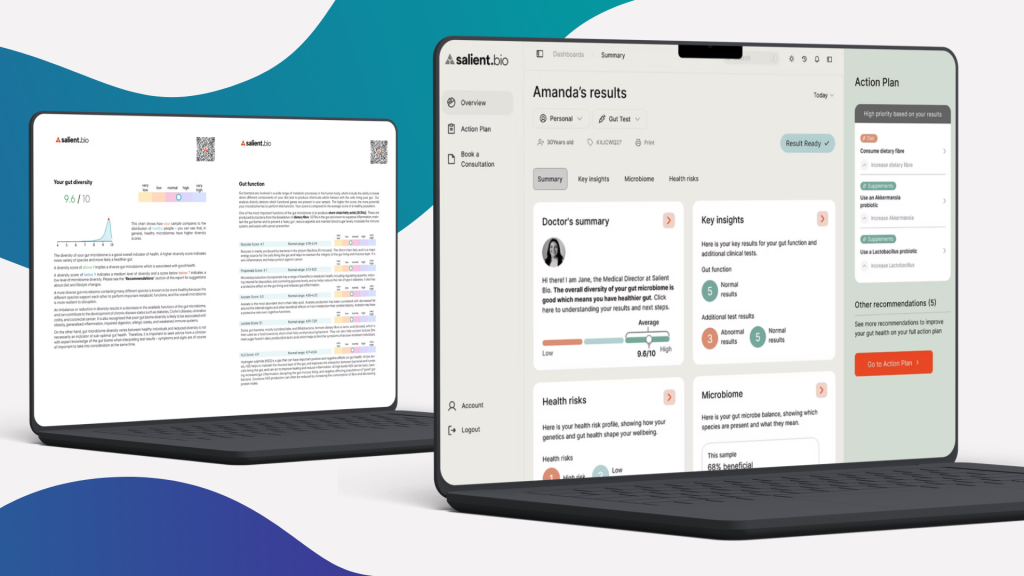
That’s what became possible during the King’s UX & UI Product Design Career Accelerator – specifically during the final Employer Project, where learners work directly with a real business. For Rie and Maria, that business was Salient Bioscience, an award-winning biotech company seeking to redesign its patient registration and results experience.

This is the story of how a live brief became a launchpad, and how academic rigour, practical learning, and real-world opportunity came together to change two careers.

Why learners choose King’s 

The King’s UX & UI Product Design Career Accelerator is a six-month, part-time online programme created by King’s College London in collaboration with FourthRev. Learners move from user research and journey mapping to prototyping and high-fidelity design, applying everything in a live Employer Project with a real industry partner and dedicated support throughout.

That combination of academic rigour and practical experience, and the chance to build a portfolio of real work, was what drew Rie and Maria in.

Rie was looking for something credible and immediately applicable.

“The programme really stood out – a friend who works in the industry said the process was very good, especially because of the Employer Project at the end. Having that real-world experience and something to put in your portfolio before applying for jobs was a big reason I chose the King’s programme.” – Rie, Career Accelerator Alumna

She also valued the depth of learning that came from studying with a world-leading university.

“Because it’s in collaboration with King’s, the course combines academic depth with practical application – guiding you through the theory, logic, and real-world implementation of UX.”

For Maria, who had worked with brands such as TikTok and Cult Beauty, it was about taking her design expertise to a more strategic, user-centred level. Both learners were ready to redirect their professional paths and to see where real-world experience could take them.

The employer challenge: Making science understandable

For Salient Bioscience, partnering with King’s and FourthRev offered a chance to explore how UX design could make scientific complexity feel clear, human, and actionable.

The start-up’s Scientific Lead, Rob Bradley, explained that his team wanted specialist UX perspectives to improve how patients interact with test results and registration forms.

“We knew we would benefit from some specialist UX knowledge as we look to improve the existing client-facing elements of our workflows.” – Rob Bradley, Scientific Lead, Salient Bioscience

The brief to the learners was precise: redesign the patient registration and results experience to help users navigate complex medical information with confidence. The goal was to make results actionable, not overwhelming, while maintaining scientific accuracy and trust.

For Salient Bio, collaborating with external product designers went beyond simply refining a process – it helped reimagine how patients engage with their health information, creating a more intuitive and meaningful experience in what can often feel like an overwhelming and complex journey.

Inside the project

Working in teams, learners approached the challenge from multiple user perspectives, applying the full UX and UI design process they’d developed throughout the programme.

In a unique opportunity specific to this Employer Project, the Salient Bio team invited learners to visit their London lab, giving the teams a chance to see the diagnostic process up close and connect design decisions to real workflows.

“One of the things that was really helpful was beyond the initial consultation, we did a site visit. We went into the lab, met everyone, and were shown the process from the moment the parcels arrive to what happens inside and what equipment is used.” – Maria, Career Accelerator Alumna

That visit helped the teams see the product from the user’s point of view and ground their design decisions in real context. Working collaboratively also helped Maria see the parallels between the classroom and the workplace.

“I found it valuable to work in a group because once you go into an actual project in a job, you’ll be working in a team with people who have different experiences, strengths, and needs.”

For Rie, the Employer Project was a clear milestone – the point where her learning turned into confidence.

“The biggest change is that I can now confidently call myself a product designer. Six months ago, I couldn’t say that. I’ve gained a completely new set of skills, knowledge, and confidence to apply for roles in UX/UI design. It’s been a huge transformation in a short time.”

The design outcome

Across all teams, the learners’ prototypes shared a common goal: to make complex diagnostic information feel clear, navigable, and reassuring. Using layered data visualisation, intuitive navigation patterns, and supportive microcopy, they reimagined how patients might receive and interpret their results online.

“A common outcome from all teams was a focus on communicating clearly what actions needed to follow the users’ results,” said Rob. 

“The teams produced lots of ideas to help users feel they had obtained good value from our test results and wanted to stay within our product ecosystem.”

He noted that each team contributed usable ideas that the company could combine as it builds the next version of its platform.

“All four teams produced outputs with unique and interesting aspects that we can now combine as we build the portal. Their approach and presentation were structured and professional.”

From project to opportunity

Both learners’ journeys came full circle when they were offered Product Design Consultant contracts with Salient Bio, a moment that validated everything they’d learned and built over six months.

“The Employer Project reassured me that I made the right choice in changing careers. It was the first moment I felt I could contribute something meaningful in a new industry, and that gave me a sense of confidence I needed moving forward.” – Rie, Career Accelerator Alumna 

Explore Rie’s portfolio of Career Accelerator work here, including her redesign of a health app.

For Maria, the learning experience reinforced just how much thoughtful design begins with understanding people – something she had come to value most throughout the King’s Career Accelerator.

“The tools I really valued were from the first course, especially when we were understanding user needs and learning terminology that was psychology-based – reframing mindsets, influencing users to take certain actions, and achieving results in an ethical way.”

She also reflected on how many of those lessons reached beyond design itself, influencing how she thinks and approaches challenges in her everyday life.

“A lot of those learnings I’ve translated into my personal life. For example, reframing mindsets – when I’m feeling negative now, I try to do that for myself.”

Visit Maria’s LinkedIn profile to view her portfolio in her Experience section.

Results and impact 

For Salient Bio, the partnership delivered prototype designs, information-architecture recommendations, and fresh ideas that have directly influenced their ongoing development.

“This partnership has been really beneficial to Salient. It’s brought in ideas and prototype designs that would have been impossible to achieve with our in-house team. We’ve also learnt a lot from the students about the underlying principles of UX, which will influence our approach to future projects.” – Rob Bradley, Scientific Lead, Salient Bioscience

For learners like Rie and Maria, the experience became clear proof of how a carefully designed, careers-first programme can help you make a successful career change possible in months, not years.

Rie said the strength of the course content and the calibre of her peers confirmed she’d made the right choice in joining the programme.

“A classmate who’s a senior UI designer told me the UX content was amazing. I imagine this is one of the best you could choose if you’re serious about changing your career.”

Design that transforms lives and learning

The Employer Project with Salient Bio stands as a clear example of what happens when education, industry, and careers intersect on the Accelerator.

For the employer, it produced actionable design ideas and new ways of thinking about user experience in healthcare. For the learners, it offered confidence, credibility, and their first steps into a product design career – proving that a rigorous, applied learning experience can lead not just to new skills, but to new careers.

If you’re ready to explore what your own journey into product design could look like, download the brochure for the King’s UX & UI Product Design Career Accelerator.

Designing Change: How Learners Build Powerful UX Portfolios in the King’s UX & UI Product Design Career Accelerator

Before entering the product design world, new designers often face a daunting question: How do I prove what I can do?

In an industry that prizes process as much as outcomes, a UX/UI design portfolio isn’t just a formality — it’s a clear demonstration of your skills, your unique process, and your ability to deliver real design impact.

For learners in the King’s UX & UI Product Design Career Accelerator, that proof comes not from hypothetical exercises but from real-world projects, expert feedback, and a deepened sense of self-belief.

The programme at a glance

The King’s UX & UI Product Design Career Accelerator is a six-month, part-time, fully online programme created by King’s College London in partnership with FourthRev. It’s designed for people ready to build a career in UX and UI product design, whether they’re making a pivot, building on creative or technical skills, or looking for a structured path into the industry. Learners receive:

✅ Practical experience through hands-on case studies and a six-week Employer Project

✅ Early and ongoing portfolio development starting in Course 1

✅ Training in industry-standard tools like Figma, applied in design scenarios

✅ Career coaching, personalised feedback and peer support throughout

✅ A UX design certificate from a globally respected university

This Career Accelerator prepares you to do the work, speak to your process and stand out for your impact, and learners from a wide range of backgrounds are proof.

From blank page to portfolio powerhouse

When Rajdeep Deo, a mechanical engineer, joined the programme, she was planning a significant career pivot. At first, UX might not have seemed like the obvious next step, but for her, it quickly clicked.

“It made sense to me, even if it wasn’t a typical transition that others had made. Once I started, I thought, ‘This actually makes perfect sense.’ It has everything I enjoyed about engineering, just in a way that feels more creative and exciting for me. It really suits my background.” — Rajdeep, King’s Career Accelerator Alumna

Over the six-month programme, Rajdeep applied her structured problem-solving mindset to multiple design challenges — including building three end-to-end UX case studies with real industry companies: a voice interface concept, a health-tracking app, and a tourism site redesign. These weren’t theoretical tasks; each one mirrored actual business scenarios, designed to help learners demonstrate breadth and depth across key UX principles.

“The course encouraged us to apply what we learned to real projects and case studies — not just made-up exercises. I’ve worked on a tourism site, a health app, and now a voice interface challenge. It’s helped me show a good range.”

“The way the course is structured encourages you to go beyond just reading theoretical material — you’re constantly applying what you learn to practical projects and real case studies in a meaningful way. I think that’s going to help me stand out to employers as I start looking for jobs.”

These projects formed the backbone of Raj’s UX/UI design portfolio, which she created during the Career Accelerator. The depth and range of work, combined with the clarity of her storytelling, became something she could take pride in.

“It’s crazy when I think back to when I started six months ago. If you’d shown me my portfolio now and told me how much I’d learn by the end, I don’t think I’d believe it was mine, just because of the amount of work involved and the depth we’ve gone into. It’s been really amazing. I feel like I’ve come a long way in just six months.” — Rajdeep, King’s Career Accelerator Alumna

Feedback that sharpens, structure that guides

From the beginning, portfolio development is an integrated part of the learning journey — not an afterthought. Learners receive feedback from Course Facilitators, attend dedicated portfolio sessions, and take part in live reviews that help them refine their narrative and showcase their process clearly.

“We had a lot of portfolio classes throughout the course, which were really valuable. My approach was always to tell a simple, clear, and concise story behind each project — not just what I did, but why I did it, and making that obvious to anyone reading it.” – Rajdeep, King’s Career Accelerator Alumna

In UX hiring today, that storytelling ability is a powerful differentiator. According to Indeed’s design hiring team, the UX portfolio examples that stand out aren’t just polished — they clearly explain the thinking behind the work. They show process, not just outcomes.

💼 Explore Rajdeep’s UX portfolio here.

Group projects, real outcomes

Portfolio-building in the programme isn’t limited to individual assignments. Some of the most powerful and job-relevant work comes from collaboration, through group projects that mirror what it’s like to design within a product team. These experiences don’t just sharpen communication and teamwork skills — they often lead to standout case studies learners feature in their portfolios.

The final six-week Employer Project in the King’s UX & UI Product Design Career Accelerator is a prime example. Set by an actual industry company, it’s designed to simulate the realities of UX and UI design work: cross-functional teams, evolving priorities, tight deadlines, and client-facing briefs. Rather than an academic exercise, it becomes a six-week glimpse into the day-to-day working environment learners are preparing to enter.

It was during this project that Emma, a design assistant looking to step into a more strategic, user-focused role, discovered how much she could grow — both as a collaborator and as a designer. After completing the programme, she landed a UX Designer position at EasyJet, and the Employer Project became a turning point, shaping one of her most impactful portfolio pieces.

“I’m not someone to really enjoy group projects so much, but because I was in such a good team and everyone had different strengths, it allowed me to observe what other people are doing that worked, and what I should be taking on myself. It was a massive learning curve for me, and it really changed my perspective on group projects. It was very nice to be in that environment.”

That experience helped Emma connect theory to practice and produce project work she would later feature in her portfolio. It also made the leap into her new UX role feel natural.

“Now that I have a job in UX, it really made me think that what I learned in the course was very relevant to what I’m doing now. The industry project helps build that connection between what you’re learning and real-life situations.” — Emma, King’s Career Accelerator Alumna

Emma’s experience reflects a wider truth: when learning mirrors professional UX design challenges, the shift from classroom to career becomes not just achievable, but seamless.

🎥 Watch Emma showcase her portfolio at this event.

Tools that make the work real

Product design is grounded in practice — in tools, team platforms, and design systems. That’s why, from day one, Career Accelerator learners work with industry platforms like Figma and Notion, applying them to professional-level design problems.

But learning tools are only the starting point. What sets this online UX training apart is how learners apply those tools — for real-life users, under real constraints, and with tangible results.

Klaudia Skiba, who entered the programme at the beginning of her UX journey, landed her first Product Designer role at a healthcare software company while still completing the Career Accelerator — a connection made through her Course Facilitator. Her Employer Project became a standout portfolio piece: her team redesigned an NHS app, using actual user reviews to define the problem and propose validated solutions.

“You have to provide research pieces that show it’s viable and that it’s essential that it’s improved. For example, I was working on an NHS app used in the UK. I used the bad reviews from the Apple Store and showed the exact pain points that users had. Then I went through usability testing. We also presented it, so it’s essentially a whole other case study for your portfolio.” 

Experiences like this, identifying user problems, conducting UX research, iterating based on insights, are what make a portfolio relevant, respected and ready for hiring conversations.

💼 Explore Klaudia’s UX case study.

Support that strengthens every step

While tools and projects lay a strong foundation, the support learners receive often makes the biggest difference in building confidence.

Every learner in the King’s UX & UI Product Design Career Accelerator is paired with a Career Coach and a Success Manager who support them throughout their learning journey. Whether building a study schedule, refining a CV, preparing for an interview, or getting feedback on a portfolio case study, the support is consistent and expert.

“The Facilitators have been amazing…It’s really nice to be able to chat to industry professionals and get their take on it. I felt really supported and guided whenever I was working on coursework or assignments. If I had any questions about jobs or portfolios, it was great to have someone knowledgeable there to turn to.” — Rajdeep, King’s Career Accelerator Alumna

Making the shift: From learning to doing

Learners are drawn to this programme because it offers more than skills — it offers the chance to think, create and deliver like a UX designer from Course 1. Each activity and assignment is designed to build confidence through practical, hands-on experience.

Rizal Azlan, who has a psychology background, used what he learned to take on freelance UX projects while still in the programme, demonstrating just how immediately applicable the content is.

“The type of learning was incredibly practical for me. I was doing freelance projects for UX design, and I found that to be a really good way to embed everything that I have learned straight into a real-life application.” — Rizal, King’s Career Accelerator Alumnus

The Employer Project, where Rizal’s team worked on a hospital booking app, helped him experience what many online UX bootcamps miss — true collaboration, with real-world stakes.

“We were working with Creative Navy on a hospital booking app. I felt like that really stood out compared to a lot of my previous learnings, where it’s all very theory-based — you don’t really get hands-on to work on a project, especially with other people, until you’re in the working world, until you actually have to apply it. By that time, it’s kind of too late because they expect you to have those skills already.”

This is what makes the difference: learning that feels like doing, and doing that leads to jobs. Or, in Rizal’s case, to launching 1+1 Studios, the gaming company he co-founded after completing the Career Accelerator — applying his UX skills to create something of his own.

 🔗 View Rizal’s low-fidelity game design.

Designed with the industry and recognised by it

Across this case study, learners have mentioned companies like the NHS, Creative Navy, and real tourism and healthtech brands — and that’s by design. The King’s UX & UI Product Design Career Accelerator connects learners to the standards, tools and expectations of real companies, through case studies and projects grounded in professional practice.

At the centre of it all is King’s College London — a name that adds immediate weight to their skills and learning, recognised by employers around the world.

“The truth is, I’ve got the confidence now, and I wasn’t half as confident after four years of university, and it’s because I worked with experts.” — Klaudia, King’s Career Accelerator Alumna

“Being associated with King’s has given me a real sense of credibility and confidence in my skills. I already feel very connected to the industry, which is something I don’t think I would’ve gotten from another course. The combination of industry experience, course content, and being backed by the university — all of that has really helped set me up for the field.” — Rajdeep, King’s Career Accelerator Alumna

The combination of company-led challenges, expert feedback and university backing offers clear proof of your readiness for the field. It shows you’ve solved real employer problems and worked to high industry and academic expectations. In job conversations, this elevates your credibility, helping you stand out as someone already thinking, working, and presenting like a professional designer.

The design decisions you can show — and stand behind in interviews

One of the most valuable outcomes of the programme is learning how to showcase your UX work in a way that stands up to real hiring conversations. Through live reviews, expert feedback, and repeated practice, learners develop the clarity and confidence to present their portfolio and connect with employers in ways that resonate.

Learners like Rajdeep, Emma, Klaudia and Rizal have all shown that career progress isn’t just about what you design — it’s about how you share your thinking, demonstrate your process, and speak to the value of your work.

“The truth is that the industry is quite competitive, and having your portfolio stand out and attract well is important. The transition [into my new role] was so seamless. I could not be happier.” — Klaudia, King’s Career Accelerator Alumna

“I feel confident job hunting now and talking about what I’ve done — because I’m really proud of it. I didn’t feel that way when I was job hunting in mechanical engineering. I think that says a lot about what I’ve learned and the process I’ve gone through during these six months. It’s been a big shift in how I think about working in the industry — and I have the course to thank for that.” — Rajdeep, King’s Career Accelerator Alumna

By the end of the six months, learners graduate with a portfolio of work developed through industry-aligned briefs, shaped by feedback and strengthened by self-reflection. But more than that, they know how to showcase it — how to explain their choices, respond to feedback, and own their story.

That’s the real proof of progress.

Ready to see what your own journey could look like? Download the brochure to explore the full programme.

Taking UX Into Parliament: How Anna Changed Careers With the King’s UX & UI Product Design Career Accelerator

When Anna Prokůpková was part of the team drafting legislation for the European Health Data Space, she noticed a missing piece. The framework was meant to help patients across the EU, but the process lacked a crucial element: user experience. Despite the project’s scale and significance, little was understood about how real people would engage with the system once it was built. 

“The first time I actually heard about UX was when I was working on legislation… and none of us had a clue what UX really was.”

This experience marked a turning point for Anna, who was working as a Public Health Advisor at the European Parliament. It sparked a new curiosity about the practical application of policy and what happens after laws are written.

That curiosity would eventually lead her across the world – from Brussels to New Zealand – and into a new career at the intersection of policy and product design, with the help of the King’s UX & UI Product Design Career Accelerator.

We spoke to Anna during a live Career Accelerator Info Session. You can catch up on the full conversation and hear how her career change into UX design began here:

Considering new horizons

When Anna and her partner decided to pursue a long-held dream of relocating to New Zealand, the personal move brought with it professional unknowns. Her partner had already secured a role, but for Anna, it meant leaving behind a successful position in the EU Parliament and preparing for a completely new job market.

“I joined this Accelerator to be competitive in a completely new job market, and to up my skills as I was preparing for this challenge.”

With multiple priorities to juggle, including wrapping up her role in Brussels, planning an international relocation, and continuing her studies, Anna sought out a flexible UX design course that could help her stay focused, motivated, and supported. The Career Accelerator met these needs head-on with structured assignment-based learning, industry-validated projects, personalised career coaching, and the credibility of King’s College London.

Exploring a new skillset

With a background in policy and law-making, Anna began exploring UX and product design as a way to build on her strengths – translating complexity into clarity and designing for real-world application.

“UX actually sounded really interesting – it’s all about critical thinking and solving different problems.”

She was particularly drawn to the comprehensive and practical structure of the King’s UX & UI Product Design Career Accelerator, which combined user research and testing skills with hands-on experience in real design tools. The programme didn’t just offer technical learning, it helped her build an end-to-end understanding of the UX process, backed by a portfolio-ready project and personalised coaching.

“For me, it was very important that it was structured. I didn’t want to do one course on Figma here and another on research there… Just the fact that King’s College London is actually supporting the course… that was a guarantee of quality for me.”

Building a bridge to new opportunities

Anna’s transition “wasn’t just about learning things”, it was about applying what she learned to build a competitive presence in a brand-new job market. With personalised one-on-one support from the Career Accelerator’s career coaching team, she was able to:

  • Update her CV and LinkedIn profile to align with New Zealand’s hiring standards
  • Craft tailored cover letters to stand out in a market where she had no prior network
  • Build a UX project portfolio by taking on freelance and pro-bono UX work, including for a local NGO
  • Strengthen her job search strategy, with coaching that helped her identify opportunities, build confidence, and grow her network
  • Balance her coursework and relocation challenges thanks to regular check-ins and flexible support from the programme team

Even with the pressures of an international move, multiple time zones, and a 11-hour difference, Anna stayed on track, thanks to consistent, practical support that adapted to her circumstances.

A real-world role that aligns with her skills

It all paid off. Anna landed a role that perfectly blends her policy expertise with her newly acquired UX and product design skills: Senior Advisor on Policy and Strategy at the Medical Council of New Zealand. The organisation was excited by her experience and blend of skills and was able to create a tailored position covering policy, strategy, and service design.

“I had to draw a strategy on how I would integrate a new medical product into the healthcare system. That was the test. And it reflected exactly what the role turned out to be – a mix of policy and service design.”

Anna’s new role allows her to shape healthcare policy through a user-centred lens, a unique and impactful intersection of her past and present careers.

Finding the right balance between bias and empathy

One of Anna’s biggest mindset shifts while on the programme came from learning how to separate personal bias from user feedback – something she hadn’t needed to do in her policy work.

“While in policy, I’m mainly just selling my own bias and trying to convince people about what I think is correct… In UX, I had to completely distance myself and focus on what the users are saying.”

The programme introduces learners to research frameworks and testing methodologies that challenge them to listen first, analyse patterns, and let user feedback drive their decisions. It’s not just a change in tools, it’s a shift in mindset.

“Then later, you have to switch back on, defending the user in discussions with stakeholders like management or developers. That’s been really useful, and I think I’ve trained it quite well within the course.”

This human-centred approach is core to the King’s UX & UI Product Design Career Accelerator. For many learners, including Anna, it becomes the foundation for how they approach not just design, but communication, leadership, and collaboration in a new career.

Practical, flexible learning that fits real-life

Anna also appreciated how the programme’s structure fit into her unpredictable and high-pressure schedule.

“I really liked the fact that it was assignment-based. You manage your own time throughout those six weeks, but that deadline is there and that motivates the learners to do it in time.”

She used AI tools like ChatGPT to improve her user research and critical thinking – an approach encouraged by the course’s emphasis on real-world tools and AI literacy.

“I redrafted my questions about four times and then asked ChatGPT to identify leading questions and explain why. That feedback was excellent, and that’s how I finally understood what a leading question actually is.”

A journey made possible with support

In just a few months, Anna relocated internationally, closed a high-profile chapter in Brussels, retrained in a new discipline, and secured a job that combined her passions and skills.

The King’s UX & UI Product Design Career Accelerator supported Anna’s journey through its blend of structured learning, real-world application, personalised coaching, and community support – hallmarks of strong UX design course outcomes.

“It’s very comprehensive… The quality of services I’ve gotten out of this course… I’m very happy with the whole package.”

Ready to make your career change into UX design?

The King’s UX & UI Product Design Career Accelerator has helped learners around the world in making confident, strategic career moves into UX, service design, tech, and more.

Download the programme brochure to view the curriculum and UX project portfolios, and discover how alumni have successfully transitioned into impactful roles across industries.

Advancing as a UX Designer: Read Siobhán’s Story

Siobhán started her career as a software engineer. After seven years at her current company, she had the opportunity to move into a UX designer role. Looking to advance her skills in her new position, she tried a handful of online courses but found that she needed more structure and human interaction to keep her on track.

That’s when she discovered the King’s UX & UI Product Design Career Accelerator.

“I found that I didn’t have the discipline, honestly, to be able to work through these things by myself. I was looking for something where I could actually talk with other people and get more guidance to get through it and come out the other side with something valuable, which to me, is both the certificate and the knowledge I’ve gained. When I came across this programme, it ticked all the boxes for me. It had everything that I needed.”

The programme is really people-focused

“During one of my initial calls with my Enrolment Advisor, she told me about the support network I’d have. I hadn’t really thought much about career coaching. And I didn’t really know what a success manager was. But once they were explained to me, I really liked that they could help me with the course content and how to improve my career overall. Having someone to ask questions and help throughout the process is what clinched it for me, really. I’m really human-focused, so having that extra kind of personal touch was immensely helpful for me.”

You’ll be able to use your new skills fast

“I really had no clue when I started how to conduct UX research. Within the first six weeks, we were actually doing exactly that. I went from knowing nothing to carrying out my own research initiative in my company, which went really, really well. It ended up giving me a really good opportunity to move into a lead role because I had learned so much, and I had proven the value straight away. So really, it was immensely helpful straightaway for me.”

My Career Coach provided the right support for me

“My Career Coach was brilliant. For me, I needed to focus on soft skills, like how to stand up and present with confidence. Impostor Syndrome was a big thing for me, particularly at the very start of my career, because I was never really sure whether I was doing the right thing. I didn’t have the confidence to explain myself properly. Working with my coach helped me build up those skills in a way I couldn’t have imagined. It was very much tailored to me.”

Iryna, one of our learners on the King’s Product Management Career Accelerator, thought that she would have to start her career from scratch after closing her business and exploring a new path. Her Career Coach helped her see the value of her past experience and gave her the confidence boost she needed to apply for her dream position. Read her story here. 

You get a real sense of the job while working on the Employer Project

“We were responsible for designing a mobile app for one of Creative Navy’s clients. In the first week, we met the team and carried out some quick user research to understand who we were designing for and identify their problems. Then we moved onto mid-fidelity wireframes, which involved taking all the insights we got from our user research and putting together a few screens to demonstrate how we could solve the user’s problems. This project was then graded both by the client and Creative Navy. We got some amazing feedback from them about how we approached it, and they gave helpful advice on the changes we needed to make. The final result was a fully-fledged prototype and a full demonstration to Creative Navy at the end of the course, which went really well. It was a great experience.”

“Throughout the programme, we were given a huge amount of feedback from people in the industry to show exactly where we’re doing well and what we can improve on.”

My Success Manager kept me on track 

“I had a one-on-one call with my Success Manager every week. It was like having my own support network all in one. Once, I was having a really hard time at work with a lot going on, which meant I wasn’t doing as much as I should have. She reached out to me saying, “Siobhan, are you okay? Is there anything we can do? How can we help you get through this and minimise your stress?” It was nice to have someone there to check in and make sure everything was okay. That was really helpful for me to keep me on track.”

UX is accessible to anyone

“All of the people in my group working on the Employer Project came from different backgrounds: We had graphic design, product management, psychology, fashion – they all had different aspects, but they approached the course the same way. They brought their previous experience in alongside everything that we’ve been doing as part of the course, which really helps to build up a portfolio – one of the most important things that you can have when you’re going into a UX career.”

This investment in my education was worth it

“With the progress I’ve made in my career over the last six months, in terms of the added responsibility and the ability to actually work properly in this industry, I think it’s going to pay for itself. At the end of the day, you get out of it what you put into it. I’ve tried to get as much out of it as I can. And I think it’s gone really well for me.”

We’re proud to have watched Siobhán’s confidence grow and the positive results this has had for her career. If you’d like to get a better idea of some of the practical work Siobhán did on the programme, take a look at this case study. 

You can also watch her Q&A with our Head of Enrolments here:

If you’re interested in exploring how the King’s UX & UI Product Design Career Accelerator can help take you further in your career, take a look at the programme page.