From Classroom to Consultants: How an Employer Project Became a Launchpad for Two Career Changers
FourthRev Team
When Rie Kato and Maria Inês Pires started their final project, they were career changers learning product design. Six weeks later, they were offered consultant roles with the business they’d just designed for.
In six months, Rie Kato went from Senior Account Executive in public relations to confidently calling herself a product designer. Maria Inês Pires evolved her creative practice, bringing strategic, human-centred UX thinking into her brand design work. And before the programme even ended, both had been offered freelance consultant contracts with the health diagnostics start-up they’d just designed for.
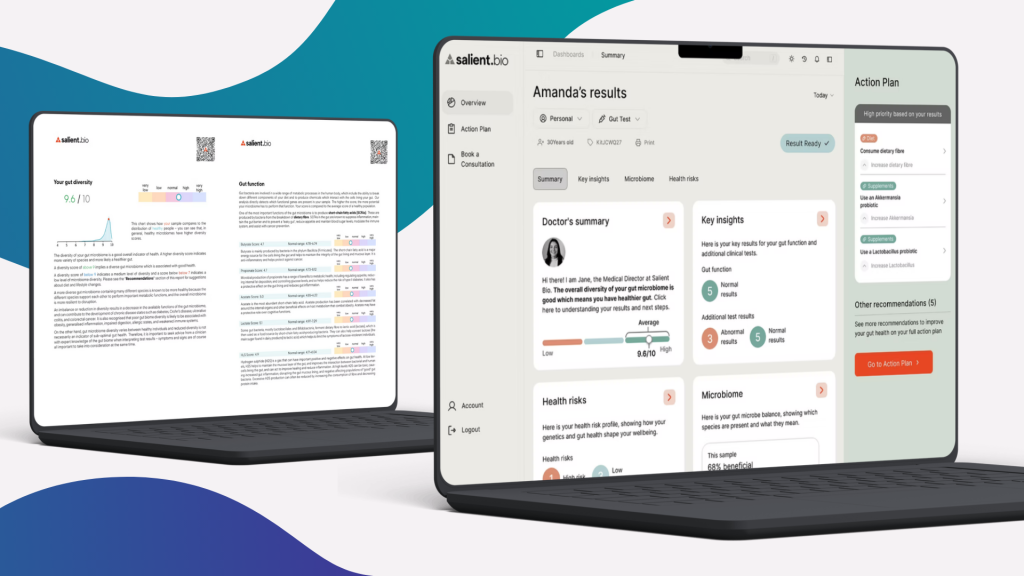
That’s what became possible during the King’s UX & UI Product Design Career Accelerator – specifically during the final Employer Project, where learners work directly with a real business. For Rie and Maria, that business was Salient Bioscience, an award-winning biotech company seeking to redesign its patient registration and results experience.
This is the story of how a live brief became a launchpad, and how academic rigour, practical learning, and real-world opportunity came together to change two careers.
Why learners choose King’s
The King’s UX & UI Product Design Career Accelerator is a six-month, part-time online programme created by King’s College London in collaboration with FourthRev. Learners move from user research and journey mapping to prototyping and high-fidelity design, applying everything in a live Employer Project with a real industry partner and dedicated support throughout.
That combination of academic rigour and practical experience, and the chance to build a portfolio of real work, was what drew Rie and Maria in.
Rie was looking for something credible and immediately applicable.
“The programme really stood out – a friend who works in the industry said the process was very good, especially because of the Employer Project at the end. Having that real-world experience and something to put in your portfolio before applying for jobs was a big reason I chose the King’s programme.” – Rie, Career Accelerator Alumna
She also valued the depth of learning that came from studying with a world-leading university.
“Because it’s in collaboration with King’s, the course combines academic depth with practical application – guiding you through the theory, logic, and real-world implementation of UX.”
For Maria, who had worked with brands such as TikTok and Cult Beauty, it was about taking her design expertise to a more strategic, user-centred level. Both learners were ready to redirect their professional paths and to see where real-world experience could take them.
The employer challenge: Making science understandable
For Salient Bioscience, partnering with King’s and FourthRev offered a chance to explore how UX design could make scientific complexity feel clear, human, and actionable.
The start-up’s Scientific Lead, Rob Bradley, explained that his team wanted specialist UX perspectives to improve how patients interact with test results and registration forms.
“We knew we would benefit from some specialist UX knowledge as we look to improve the existing client-facing elements of our workflows.” – Rob Bradley, Scientific Lead, Salient Bioscience
The brief to the learners was precise: redesign the patient registration and results experience to help users navigate complex medical information with confidence. The goal was to make results actionable, not overwhelming, while maintaining scientific accuracy and trust.
For Salient Bio, collaborating with external product designers went beyond simply refining a process – it helped reimagine how patients engage with their health information, creating a more intuitive and meaningful experience in what can often feel like an overwhelming and complex journey.
Inside the project
Working in teams, learners approached the challenge from multiple user perspectives, applying the full UX and UI design process they’d developed throughout the programme.
In a unique opportunity specific to this Employer Project, the Salient Bio team invited learners to visit their London lab, giving the teams a chance to see the diagnostic process up close and connect design decisions to real workflows.
“One of the things that was really helpful was beyond the initial consultation, we did a site visit. We went into the lab, met everyone, and were shown the process from the moment the parcels arrive to what happens inside and what equipment is used.” – Maria, Career Accelerator Alumna
That visit helped the teams see the product from the user’s point of view and ground their design decisions in real context. Working collaboratively also helped Maria see the parallels between the classroom and the workplace.
“I found it valuable to work in a group because once you go into an actual project in a job, you’ll be working in a team with people who have different experiences, strengths, and needs.”
For Rie, the Employer Project was a clear milestone – the point where her learning turned into confidence.
“The biggest change is that I can now confidently call myself a product designer. Six months ago, I couldn’t say that. I’ve gained a completely new set of skills, knowledge, and confidence to apply for roles in UX/UI design. It’s been a huge transformation in a short time.”
The design outcome
Across all teams, the learners’ prototypes shared a common goal: to make complex diagnostic information feel clear, navigable, and reassuring. Using layered data visualisation, intuitive navigation patterns, and supportive microcopy, they reimagined how patients might receive and interpret their results online.
“A common outcome from all teams was a focus on communicating clearly what actions needed to follow the users’ results,” said Rob.
“The teams produced lots of ideas to help users feel they had obtained good value from our test results and wanted to stay within our product ecosystem.”
He noted that each team contributed usable ideas that the company could combine as it builds the next version of its platform.
“All four teams produced outputs with unique and interesting aspects that we can now combine as we build the portal. Their approach and presentation were structured and professional.”
From project to opportunity
Both learners’ journeys came full circle when they were offered Product Design Consultant contracts with Salient Bio, a moment that validated everything they’d learned and built over six months.
“The Employer Project reassured me that I made the right choice in changing careers. It was the first moment I felt I could contribute something meaningful in a new industry, and that gave me a sense of confidence I needed moving forward.” – Rie, Career Accelerator Alumna
For Maria, the learning experience reinforced just how much thoughtful design begins with understanding people – something she had come to value most throughout the King’s Career Accelerator.
“The tools I really valued were from the first course, especially when we were understanding user needs and learning terminology that was psychology-based – reframing mindsets, influencing users to take certain actions, and achieving results in an ethical way.”
She also reflected on how many of those lessons reached beyond design itself, influencing how she thinks and approaches challenges in her everyday life.
“A lot of those learnings I’ve translated into my personal life. For example, reframing mindsets – when I’m feeling negative now, I try to do that for myself.”
For Salient Bio, the partnership delivered prototype designs, information-architecture recommendations, and fresh ideas that have directly influenced their ongoing development.
“This partnership has been really beneficial to Salient. It’s brought in ideas and prototype designs that would have been impossible to achieve with our in-house team. We’ve also learnt a lot from the students about the underlying principles of UX, which will influence our approach to future projects.” – Rob Bradley, Scientific Lead, Salient Bioscience
For learners like Rie and Maria, the experience became clear proof of how a carefully designed, careers-first programme can help you make a successful career change possible in months, not years.
Rie said the strength of the course content and the calibre of her peers confirmed she’d made the right choice in joining the programme.
“A classmate who’s a senior UI designer told me the UX content was amazing. I imagine this is one of the best you could choose if you’re serious about changing your career.”
Design that transforms lives and learning
The Employer Project with Salient Bio stands as a clear example of what happens when education, industry, and careers intersect on the Accelerator.
For the employer, it produced actionable design ideas and new ways of thinking about user experience in healthcare. For the learners, it offered confidence, credibility, and their first steps into a product design career – proving that a rigorous, applied learning experience can lead not just to new skills, but to new careers.
If you’re ready to explore what your own journey into product design could look like, download the brochure for the King’s UX & UI Product Design Career Accelerator.
SHARE
Find out more about the LSE Data Analytics Career Accelerator
A practical four-step guide for Excel-confident professionals who want to become data analysts – without starting their career over. Get the essential tips.