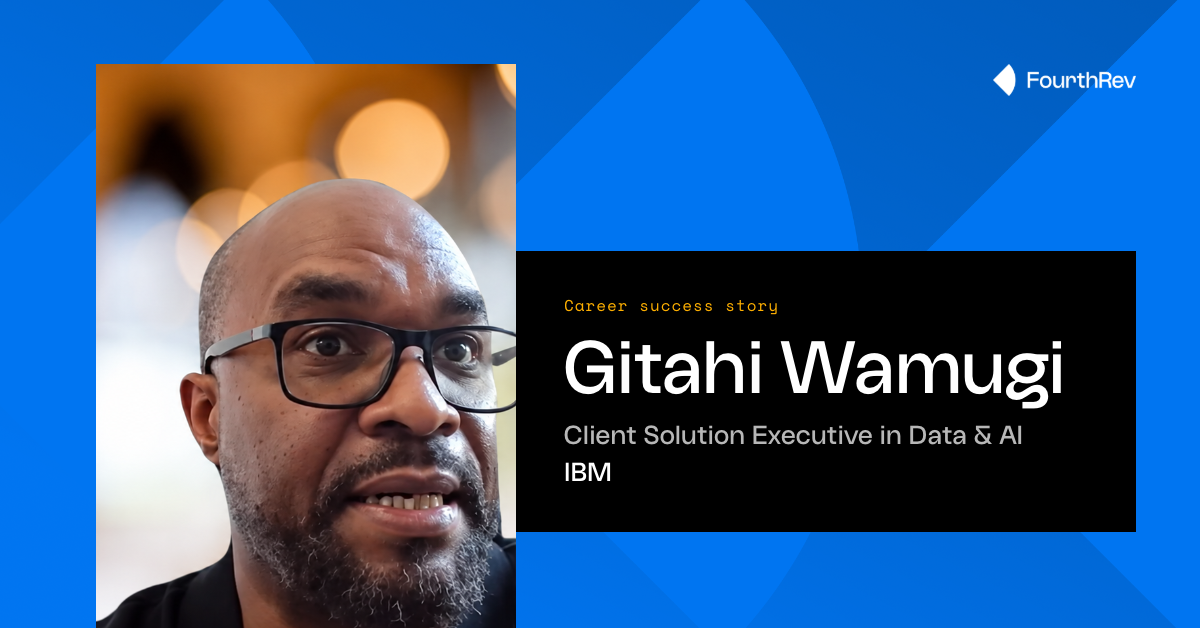
Gitahi Wamugi advises C-suite and senior executives across 68 enterprise customers as a Client Solution Executive in Data and AI at IBM. He completed the LSE AI Leadership Accelerator and spoke to us in a recent AMA webinar about how it changed the way he advises clients.
“The first question is always why?”
For Gitahi, that question sits at the centre of every AI conversation. He has worked at IBM in the UK for about five years. Before his current role, he spent time as a customer success manager, helping clients get value from the software they had already bought.
About three years ago, generative AI changed the shape of that work. Gitahi saw a wave of product uptake across his customers, and a growing problem behind it: many organisations were struggling to get AI into production. Boards wanted to move quickly, yet many enterprises were still running legacy systems.
That left him with a question: how could he explain to customers that no single tool would shortcut modernisation, and that progress depended first on a conversation about business value and managing change?
That question sent him looking for a different kind of learning.
Choosing leadership over another technical course
IBM gives Gitahi plenty of technical training, and he is clear that technical qualifications still matter in his field. What he was missing was a leadership view: how to help customers turn strategic direction and expected business value into results.
“I really wanted a course that would speak to the business value,” he says.
He researched the market and was initially sceptical. With so many AI programmes available from leading universities, he wondered whether he would be drawn into an academic view of AI when his own experience came from implementation in the field. He reviewed the LSE AI Leadership Accelerator in detail and spoke with the enrolment team, which helped him decide.
Two things stood out. First, the programme focuses on leadership, organisational change, and the business impact of AI. The second was the leadership coaching that runs alongside it.
“For me, that was added value. That was a decision maker. I didn’t see that in any of the other courses that I researched on that were available in the market.”
He already knew LSE, having completed a three-month LSE course on AI governance and ethics the year before.
Learning that showed up in client work
Gitahi has a technical background spanning enterprise data and AI, although his work focuses on solution strategy, transformation and business value rather than software development. He found the Accelerator gave enough grounding in the technical side of AI for learners without an IT background, while pointing everyone towards the leadership frameworks and methods they would need to keep building their knowledge.
What mattered most to him was how quickly the learning moved into his day-to-day work. Because his role is to help customers get value from AI, he began applying ideas from the group discussions and lectures straight away, and his assignments drew on use cases from his own client work.
He started building his own playbooks and looking at customers in new ways. One example came from industry reports on where chief data officers saw the biggest gaps: data quality, governance, and a repeatable way to connect AI to the right data.
“So I was able to develop a playbook for identifying and accelerating suitable use cases towards value within a 30-day framework.”
The programme also shifted how he reads a boardroom. The module on the psychology of change, including the idea of affinities and aversions, made him look again at the people behind each decision, and at his own reactions to change.
“In a lot of cases, I’m beginning to see that the human psychology of the people who have power sitting around that table might be the most important thing to driving the change that you want to achieve.”
C-level leaders bring their own objectives, he says, and many share the concerns anyone else has: whether AI will affect their role, and whether they can deliver what the board expects.
Governance as a continuous process
Gitahi came to the programme with a data transformation background, and in earlier client conversations, governance had usually meant governing AI models, from the top down. The Accelerator showed him a further gap: organisations also need to govern the data their models draw on, from the bottom up.
“It’s not a goal, it’s not a project. It’s not a place that you get to – it’s a continuous process. You have to continually manage that.”
He sees this as central to the question many enterprises now face, which is how to move AI into production. His answer is governed data products and assets, with risk and compliance managed at the foundations. The programme also gave him a way to make that case in commercial terms.
“You can actually translate that into an ROI calculation for your board and say, this is the cost of doing nothing.”
The people around the table
Gitahi learned alongside senior professionals from a range of sectors, and he found the breakout sessions especially useful.
“This was very valuable, because you got to hear from people of different domains, what was important to them.”
He also noticed that peers without an IT background earned high distinctions on the project assignments, which he puts down to them approaching the concepts without the biases that experience can bring. In his view, he had to navigate his own.
His leadership coach helped him see his client conversations from the outside.
“It was really good to have the conversations with a coach who would listen to me and mirror back what I had said and to hear what my clients hear when I speak.”
Coaching on the Accelerator runs for 12 months, so Gitahi’s sessions continue after the programme ends.
Making the time
Gitahi works hybrid and his days are long. He is honest that the programme took effort.
“I still had to take time. I had to find time to work over weekends, late nights.”
In a typical week, he set aside about an hour in the evening for reading, then caught up on weekend mornings. Having recently finished an MSc, he wanted something shorter and more focused, and the six-month format suited him.
Looking back, his one piece of advice to himself would be to go deeper. “It’s helped me also see areas of potential growth for myself.”
The LSE name in the room
Gitahi does not lead with his qualifications in meetings, but he knows some clients look him up first.
“But there are certain meetings that you go into where people will do their homework about you before you walk into the room.”
In those settings, he says, the LSE name carries weight at board and executive level, and it opens the door to a more personal, intellectual discussion that helps him understand what the other person values.
What comes next
Gitahi sees a lasting need for change management as AI reshapes roles and workforces, even in organisations that have led transformation before. He is positioning himself to grow further into a trusted advisory role, helping organisations translate data and AI strategy into measurable transformation, while continuing to deepen his expertise in AI, governance and organisational change.
His advice to senior professionals under pressure to lead AI is to start with purpose rather than fear of missing out.
And on the decision to apply, he recalls the question he asked himself:
“I looked at the rate of change in the industry and asked myself, am I willing to wait another year before I make this kind of a decision?”
“And having made the decision, I don’t have any regrets.”
Lead AI in your organisation with the LSE AI Leadership Accelerator. Over six months online, you’ll work through four courses (Applying AI in Organisations, From Vision to Value, AI and Change Leadership, and AI for Executive and Team Performance) and produce four board-ready deliverables, supported by 12 months of 1:1 leadership coaching.
Download the brochure here.