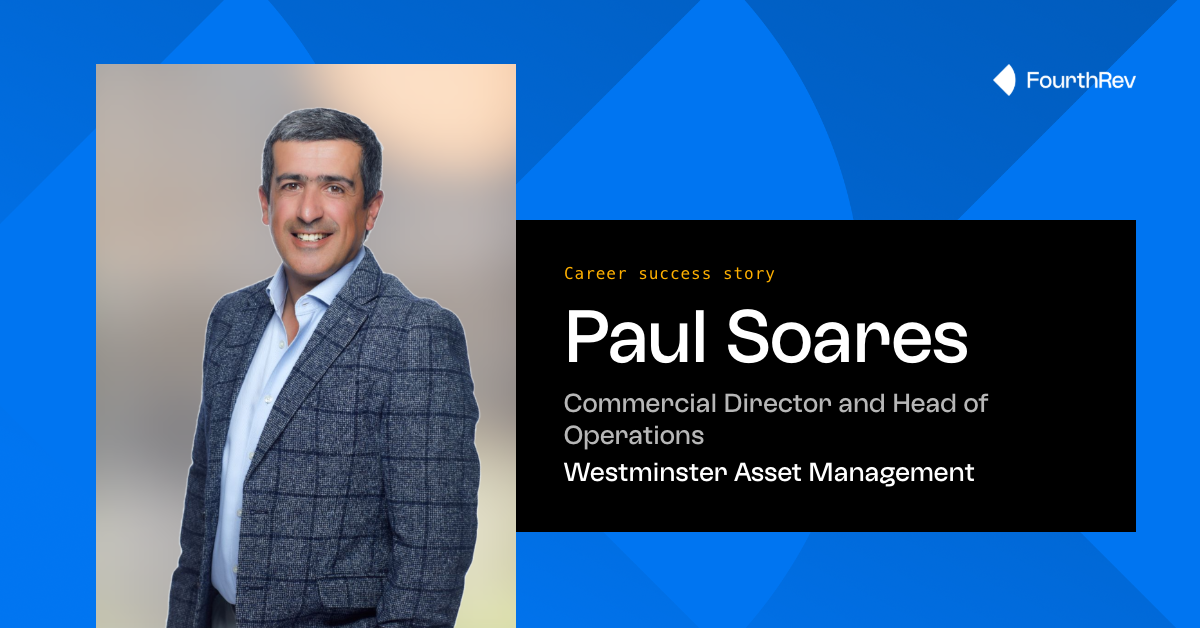
How Paul Soares built a stronger framework for AI with the AI Leadership Accelerator

Paul Soares is Commercial Director and Head of Operations at Westminster Asset Management in Jersey, where he helps lead a regulated private client and asset management business. 

In an AMA webinar, Paul shares his experience on the LSE AI Leadership Accelerator and how he was already applying what he’d learned at work while still completing the programme, which he has since successfully completed.

“I now move more quickly to underlying questions: what problem are we actually trying to solve? What decision are we trying to improve? Where is the real value? What has to be true for this to work? What governance needs to sit around this? That sounds simple, but it’s quite a significant shift from where I was before.”

For Paul, that shift is the heart of what the LSE AI Leadership Accelerator has given him. 

His career has been built around growth, transformation, operating models and governance in a trust-based, regulated industry. He has also trained in Lean Six Sigma to Green Belt level, which shaped how he thinks about process discipline, control, and change that scales.

When AI became a leadership question

Paul’s decision to study came from a change he saw in his own role.

“AI had stopped being an interesting external topic and had become more of a real internal leadership question.”

Part of his job is to help lead the business through growth, operating discipline, governance and change, so AI couldn’t sit on the sidelines.

“So that means I can’t look at AI as something separate from our business. I have to think about it in terms of value, implementation, control, accountability, and readiness.”

He also saw a gap between how vendors present AI and what it takes on the buying side to make it useful, governable, and commercially credible. He noticed plenty of discussion about AI but less practical understanding of how to lead it inside a regulated business. He wanted a structured approach and a framework to work from.

Choosing a programme built for leaders

Paul compared several options, some more technical, some focused on finance and some only focused on regulation or specific tools. He found the LSE Accelerator through his own research, using AI to help.

“I researched a number of AI and leadership programmes, including options from leading universities in the UK and the US. The LSE AI Leadership Accelerator stood out because the skills and methods could be deployed immediately in my working environment.”

The deciding factor was fit, because Paul’s goal was to lead AI implementation more effectively rather than to become more technical for its own sake. 

“This course is clearly designed for leaders, rather than for specialists. It focuses on strategy, decision making, governance, implementation, and really, at the core of it, business case thinking.”

Learning that went straight to work

Paul says he didn’t expect the depth the programme would reach, particularly on governance, leadership, and business cases. He also didn’t expect how soon it would show up in his day-to-day work.

“I found myself using the thinking almost straight away in discussions around operating models, management information, workflow designs I’m implementing, and governance and decision support. That is what makes it practical – it improves the quality of the discussions and conversations you’re already having.”

His organisation is now carrying out a full review to get the business ready for AI, covering infrastructure as well as software. That work includes putting guardrails around the firm’s chosen AI tool, reducing the risk of data leaking through staff using their own AI tools, and building a policy, framework, and phased implementation plan. 

Paul says the programme has benefited both him and his organisation while he has been studying. The programme also changed how he approaches business cases.

“One of the risks with AI is that organisations can move too quickly from the possibility to the assumption.”

“Business cases are rarely just about what the technology can do. They’re about the value, the timing, the readiness, the confidence, and the control.”

Governance inside the design

For a regulated investment business, governance is critical, and the LSE Accelerator reinforced its role.

“What the programme has reinforced for me is that governance can’t sit outside AI adoption – it has to be inside the design from the get-go. In a regulated environment, the key question is not simply whether something is possible. It’s whether it’s proportionate, governable, and explainable to the regulators.”

Paul’s operational background already led him to think about how change gets embedded. The programme added a more explicit leadership dimension to that thinking, which he says he had not fully used before.

Coaching that turns ideas into action

Paul singles out the 1:1 leadership coaching that runs alongside the courses.

“At a senior level, the question is often less about whether the content is good, and more about how you apply it, how you position it, how you use it to sharpen your leadership focus.”

After one coaching session, he was set a task to complete before the next. 

“In the month that intervened, that task and the outcome from it delivered huge value – not only to me personally, but hugely to my organisation as well.”

He is clear about where the responsibility sits.

“Your coach is there to steer you, but you’re the engine that needs to drive that thinking.”

Confidence, credibility, and a wider view

Paul describes his AI confidence as having grown, though not in a technical sense.

“My confidence has most definitely shifted – but I would describe it as executive confidence, rather than technical confidence. I feel more confident because I now have a stronger framework and clearer language for discussing AI with senior stakeholders.”

He also sees the LSE name as adding weight in conversations with executives, boards, clients, and wider stakeholders.

“It matters because it signals that this is not just a passing interest. It reflects a serious investment in building leadership capability around AI at a time when many organisations need exactly that.”

His cohort added another dimension. Coming from investment management, Paul valued hearing from peers in a wide range of industries, from large corporates to self-employed professionals. Their use cases differed, but he found many of the leadership questions were the same: how to create value, manage risk, lead change and build credibility.

Fitting the programme around a senior role 

Paul is honest that the flexible format still takes effort.

“Applying and undertaking this course still requires a huge amount of discipline.”

What has worked for him is treating the programme as part of his current leadership challenges rather than something separate from work, so the time feels relevant from week to week. He cannot attend every live session, but recordings let him catch up in his own time.

Sharpening, not reinventing

Looking ahead, Paul believes future leadership roles will increasingly require the ability to connect commercial value, governance, change, and technology.

“I wouldn’t describe it as changing the fundamentals of who I am professionally – I describe it as strengthening and sharpening them.”

His advice to senior professionals under pressure to lead AI is to first clarify the capabilities they need. Deep technical training and narrow regulatory updates have their own routes. 

If the need is to make good leadership decisions about where AI adds value, how it should be governed, how to build a credible case and how to lead adoption responsibly, he sees the LSE Accelerator as a strong place to start.

And the thing he wishes he had known before he began?

“I didn’t know how quickly it would improve the quality of my questions. I expected to gain knowledge, but what I found was a stronger decision framework.”

Lead AI in your organisation with the LSE AI Leadership Accelerator. Over six months online, you’ll build four board-ready deliverables (a board advisory memo, a business case, a change management strategy and an executive AI playbook), supported by 12 months of 1:1 leadership coaching.

Download the brochure here.

The AI Skills Executives Actually Need in 2026

The gap between AI ambition and executive readiness is widening. Over the next three years, 92% of companies plan to increase their AI investments. Yet despite this rapid acceleration, only 1% of leaders describe their organisations as “mature” in AI deployment. Many have yet to integrate AI into everyday workflows or achieve meaningful results. 

This raises a clear question for senior leaders: how can organisations invest wisely and move closer to real AI maturity? The cost of falling short is already visible – failed projects, wasted resources and a weakening competitive position.

These challenges rarely come from weak algorithms or limited technical talent. They reflect a leadership gap – executives are now expected to make strategic, ethical and organisational decisions about AI, yet many lack the skills needed to guide transformation with confidence. 

This article examines the evidence behind the executive AI literacy gap, identifies the five key AI leadership skills leaders will need in 2026, and outlines practical steps to help build them.

The AI leadership gap is real – and growing

The pace of AI adoption now exceeds leaders’ ability to steer it. This widening AI literacy gap often determines whether organisations move beyond pilots or remain stuck in early experimentation. The impact is already visible across organisations:

Executive AI literacy lags behind organisational ambition

Boards are investing more in AI, yet many executives lack confidence in judging opportunities or readiness. The result is overselling and poorly governed projects. 

Organisational failures stem from leadership gaps, not technology

Research shows that most AI initiatives fail because of unclear strategy, weak governance and limited cross-functional coordination. The issue is usually not the model but misaligned leadership.

Formal AI training for leaders is still scarce

Despite rising demand for executive AI readiness, structured learning opportunities for leaders remain limited. Most offerings focus on technical concepts rather than the leadership AI skills required to make sound decisions on investment, governance and people. 

Why this gap exists

Analysts point to two pressures on leaders: less time to build judgement and far more information to absorb as AI accelerates change. Together, these pressures widen the gap between what organisations need and what leaders can provide.

Many senior leaders also built their careers before AI became central to strategic decision-making. AI introduces new demands such as uncertainty, data reliance, regulation and ethical expectations. These require updated ways of thinking.

The cost of inaction

The consequences of failing to close the AI literacy gap are already visible:

  • Failed pilots, often abandoned before value is realised
  • Wasted investment, when enthusiasm outpaces capability
  • Diminished competitiveness, as more mature organisations capture value faster
  • Talent exodus, when employees lose confidence in leadership direction.

Executives who build the right leadership AI skills will not only guide their organisations toward more mature use of AI, but also reinforce trust in their ability to lead through uncertainty.

If you would like to explore a structured learning pathway focused on strategy, governance and organisational readiness, then explore the LSE AI Leadership Accelerator.

Common misconceptions about leadership AI skills

The skills that matter are non-technical AI skills that enable leaders to make sound decisions, govern responsibly and align the organisation.

The myth of the technical executive

A persistent misconception is that executives need to learn to code. They do not. Coding is a specialist discipline, and executives will never out-code engineers. 

More importantly, technical fluency does not equate to strategic AI leadership. Leaders only need enough understanding of AI to question decisions, weigh options and keep projects on track.

Why coding bootcamps miss the mark

Most forms of technical training focus on algorithms and data engineering. These are essential for practitioners but insufficient for senior leaders who must:

  • Set strategic direction
  • Define credible business cases
  • Govern risk and ethics
  • Align teams and stakeholders
  • Prepare the workforce for change.

The real gap lies in strategic judgement, not syntax.

The five AI skills executives actually need in 2026

According to McKinsey, “Achieving AI superagency in the workplace is not simply about mastering technology. It is every bit as much about supporting people, creating processes, and managing governance.”

These five leadership AI competencies are becoming the basis of effective executive performance in an AI-driven environment:

1. Strategic AI thinking and business case development

Executives must be able to diagnose where AI creates genuine value and whether the organisation is ready to deliver it. 

This means being able to:

  • Diagnose where AI improves outcomes
  • Assess feasibility and strategic fit
  • Develop investment-grade business cases
  • Define KPIs and benefit realisation plans.

2. AI governance and responsible AI leadership

Governance is now a core leadership responsibility. Executives must ensure that AI is deployed ethically, transparently and in line with regulatory requirements. 

Effective leaders understand:

  • Ethical considerations and approaches to bias
  • Regulatory expectations and reporting requirements
  • Human in the loop safeguards
  • Organisational guardrails for safe experimentation.

3. Change management and organisational transformation

AI adoption succeeds or fails because of people. Effective AI change management helps leaders guide teams, and this is what speeds up organisational AI adoption.

Executives need to:

  • Guide teams through AI-related workflow changes
  • Address concerns about the job change with clarity
  • Build cross-functional alignment
  • Equip managers to lead with confidence.

4. AI-powered decision-making and executive productivity

Gartner suggests that more leaders will use AI as a mentor and reviewer to improve decisions. 

For executives, the real benefit is better judgment, not just speed. The challenge, however, is knowing when to draw on AI and when human oversight must lead.

5. Cross-functional AI collaboration and communication

AI work spans disciplines, so leaders must be able to bridge technical and non-technical teams. 

Effective leaders:

  • Set shared language and expectations
  • Balance innovation with risk
  • Ensure teams understand what is being built and why
  • Foster constructive dialogue across functions.

How to close the AI skills gap

Team leads, senior managers and executives can take practical steps to build capability in the areas that matter most.

  1. Start with an honest assessment of your AI literacy

Professionals should map their capability across four domains: strategy, governance, change and value measurement. Identifying blind spots is not a weakness – it’s a leadership strength.

2. Choose the right learning pathway

Awareness-only webinars or technical bootcamps are unlikely to shift leadership behaviour.

Options include:

  • Executive AI education programmes designed for strategic, non-technical roles
  • Peer learning communities where leaders exchange practical lessons
  • Structured frameworks that help connect AI concepts to organisational decisions
  • Applied, project-based learning that results in tangible artefacts.

3. Apply learning through real organisational projects

Skills developed by testing use cases, setting governance and planning for change.

4. Build cross-functional partnerships early

AI success depends on collaboration between technology, operations, HR, finance, legal and the executive team.

5. Seek structured guidance when needed

Coaching and practitioner input help leaders turn concepts into practical decisions.


The AI leadership gap is growing, and the AI skills for executives in 2026 are increasingly strategic and organisational. Addressing this gap requires purposeful learning and stronger leadership judgment.

Leading AI effectively is no longer optional. It’s a competitive necessity.

If you’re exploring how to build these strategic AI leadership capabilities, the LSE AI Leadership Accelerator, an LSE online programme developed in collaboration with FourthRev, offers a focused, non-technical pathway for executives. You can download the programme brochure to learn more.


Frequently asked questions

Q1: What AI skills do executives need in 2026?

Five skills matter most: strategic AI thinking, sound governance, effective change management, AI-supported decision making and cross-functional collaboration.

Q2: Do executives need to learn to code?

No. Executives create value through strategy, governance and organisational alignment, not through programming.

Q3: Why is there an AI skills gap at the executive level?

Many leaders were promoted for pre-AI capabilities. Most training still focuses on technical concepts rather than the judgement and governance skills executives now need.

Q4: How can executives close the AI skills gap?

By taking part in focused executive education, applying learning through real projects, learning with peers and using practical frameworks that link AI to organisational decisions.

Q5: What is the cost of the AI leadership gap?

Stalled pilots, wasted investment, rising regulatory risk, cultural resistance and loss of competitiveness.