
Introducing FourthRev

FourthRev Introduction

FourthRev has been founded on the belief that close collaboration between industry and the education sector is key to addressing the skill demands of the fourth industrial revolution.

Our vision is to be the world’s leading enabler of industry co-created, career-focused education experiences at universities, colleges and educational institutions.

Our mission is to accelerate our education partners’ capability to develop student and lifelong learner competencies aligned to the needs of the digital economy.

Our purpose is to create social and economic value by closing the digital skills gap.

The digital skills challenge

Our previous post explored the scale of the digital skills challenge across the globe. The statistics we shared demonstrate that our education systems are struggling to meet this challenge in the current paradigm:

  • Digital skills are ‘essential requirements’ for 82% of all UK job vacancies;
  • European Commission figures show that around 37% of workers in Europe don’t have even basic digital skills;
  • The world economic forum estimates that more than half (54%) of all employees will require significant reskilling by 2022;
  • Deloitte reports that by effectively addressing the ‘future of work’ skills crisis in Australia, a $36 billion economic bonus can be fulfilled;
  • The US has 1 million unfulfilled IT jobs.

Changing nature of job roles

“Digital skills are becoming near-universal requirements for employment.” UK government, dept. of digital, culture, media and skills.

The relevance of this challenge will be apparent to the vast majority of professionals reading this post. Even for those that graduated a small number of years ago, new fundamentals will be playing a critical role in day-to-day functions:

  • Marketing professionals now need to be experts across many social media platforms, SEO, CRM, etc.
  • Computer programmers have migrated from working with on-premise servers to cloud computing, working in agile and DevOps.
  • Finance professionals now leverage cloud accounting software and automation.
  • HR professionals focus on employee analytics and engagement platforms through data-management platforms.

This list could go on. Beyond job-specific skills, every professional is also now expected to demonstrate a basic level of digital literacy to successfully operate in the digital economy. This includes productivity tools such as Office 365, G-suite, Trello or Asana and collaboration tools such as Teams or Slack. It has been reported 98% of Fortune 500 companies use Applicant Tracking Systems that filter applications based on keywords, meaning that many of the students graduating this year will need to have familiarity with these tools and technologies to secure their first job.

Universities, colleges and further education institutions remain the key to solving this challenge

In 2017, the UN reported over 200 million people were studying in accredited higher education worldwide, a number estimated to hit 200 million by 2030. This compares to an estimated 20,000 students that completed bootcamps in the US in 2018, the largest market for such courses. Therefore, whilst the growth of alternative pathways, such as bootcamps and online platforms, is a highly significant development (to be explored further in a later post), it is clear that the formal education sector needs to be at the centre of any solution that impacts the digital skills crisis at scale.

It is not therefore a question of university or bootcamp, degree or certification. Our predicted 100-year life across multiple jobs and careers will likely see us engage with universities, colleges, and alternative pathways, and on the job training. Moreover, whilst specific technical skills are becoming ever-more important, employers are still crying out for the human and business enabler skills that allow people to use technology to create meaningful outcomes. Universities and colleges have the opportunity to develop all these skills, including critical thinking, collaboration and problem solving.

Evolving offerings for the digital economy

The real question for educational institutions is therefore how to continue to evolve and adapt their course offerings to meet the changing and diverse needs of the 21st century learner. Many institutions are already innovating, evidenced by the growth of micro-credentials, university MOOC platforms, and higher education apprenticeships. At the heart of many of the most successful innovations has been close collaboration with industry, exposing students to up-to-date tools and technologies, supporting the development of applied skills and providing insights into different career paths.

FourthRev has been established to accelerate these innovations and enable them at scale. Working closely with leading technology companies, including AWS, Tableau, Salesforce and Xero, we support our education partners to quickly release and maintain up-to-date, highly relevant programs that can allow students to access some of the most exciting roles across the digital economy. These courses range from micro-credentials through to degree courses and FourthRev can then support the connection of these students to employer partners specifically seeking those skillsets.

For our partners students, they get the benefits of a holistic education that sets them up for long term career success, and industry co-created experiences aligned to the fast changing dynamics of the digital economy.

The Digital Skills Crisis

How big is the digital skills crisis?

The McKinsey Global Institute (MGI) estimates that an additional USD $13 trillion could be added to global GDP from 2018-2030 through digitisation, automation, and AI resulting from the creation of new business opportunities and the reinvestment of productivity gains into economies.

Yet the majority of the promised gains since the advent of the digital economy have yet to be realised. In fact, for the decade to 2017, the US, still the global leader of the digital economy, witnessed its most sluggish productivity growth since the 1970s.

Research has demonstrated that a key explanation behind this ‘productivity puzzle’ is a digital skills crisis that is preventing individuals, organisations and entire economies from maximising the output of new technologies. Research by Accenture has found that:

  • USD $11.5 Trillion of GDP growth forecast to be lost over the next 10 years if G20 countries cannot meet new skill needs;
  • In excess of 1% of global GDP growth to be lost every year due to skill shortages.

These findings strongly align with further global research. The UK government has identified that digital skills are ‘essential requirements’ for 82% of all UK job vacancies, and that ‘digital transformation can make every business in every sector more productive’. Yet the Open University’s 2019 Bridging the Digital Divide report found that 88% of UK organisations stated a shortage of digital skills currently has a ‘significant negative impact on productivity, efficiency and competitiveness’.

Comparable challenges are being reported by european and global counterparts:

  • European Commission figures show that around 37% of workers in Europe don’t have even basic digital skills;
  • The world economic forum estimates that more than half (54%) of all employees will require significant reskilling by 2022.

What is driving this crisis?

“Education has won the race with technology throughout history, but there is no guarantee it will do so in the future” (Schleicher, Director, OECD Directorate for Education and Skills, 2019).

The acute skills shortage being faced across the globe is being driven by the confluence of two key factors:

  1. Technology is now accelerating at an ever faster rate;
  2. Technology (and digital skills more broadly) are now critical to an ever higher proportion of job roles.

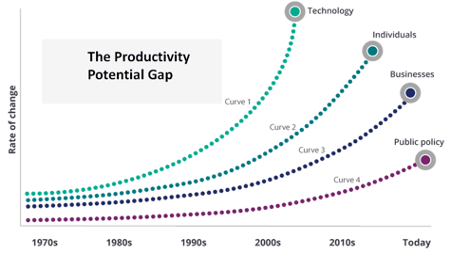
Thus although education has always has always faced the challenge of keeping pace with technology, the issue is more acute than ever, impacting an ever growing proportion of the workforce. This gap between the productivity potential promised by new technologies and the productivity that can be realised by the skills of the workforce is known as the productivity potential gap:

The Productivity Potential Gap
As the graphic depicts, technological change is accelerating at an ever faster rate, with individuals struggling to keep pace, and businesses and public bodies lagging farther behind.

Developing the new foundational skills of the digital economy

Closing this gap will be critical to realising productivity gains promised by digital technologies, must be critical focus of our education systems, requiring innovations in both how and what we teach.

Job market data firm, Burning Glass, completed an analysis of 56 million resumes and more than 150 million unique job postings, which identified 14 critical ‘New Foundational Skills’ for the digital economy:

  • Demand for the 14 skills grew at an average of 32% over 5 years to 2018;
  • Digital Building Blocks are becoming critical to all organisations and industries beyond traditional tech fields;
  • Business Enabler skills are required to realise value in markets when customer-centricity is a key indicator of business success.
  • ‘Human Skills’ are increasing in importance as we move from a knowledge economy to an innovation economy;
  • Demand for the skills is not confined to the IT or ‘digital’ sectors with growth across all industries.

“Digital skills drive career advancement, increase pay and better prepare workers for a changing labour market.” UK government, Dept. Digital, Media, Culture and Sport.

If these skills can be developed successfully then the benefits for learners are dramatic: UK data shows that digital skills carry a wage differential of 29% over non-digital roles and specific digital skills reduce workers risk of automation by 59%.

Alongside the rise of alternative educational pathways, such as bootcamps and online learning platforms, universities and further education institutions will be critical to solving this challenge. All must work in close collaboration with industry and provide a breadth of educational innovations across traditional degrees, post-graduate programs, apprenticeships and lifelong learning opportunities.

Bibliography:

Accenture, It’s learning. Just not as we know it.

https://www.accenture.com/gb-en/insights/future-workforce/transforming-learning

McKinsey Global Institute, Twenty-five years of digitization.

https://www.mckinsey.com/~/media/mckinsey/business%20functions/mckinsey%20digital/our%20insights/twenty-five%20years%20of%20digitization%20ten%20insights%20into%20how%20to%20play%20it%20right/mgi-briefing-note-twenty-five-years-of-digitization-may-2019.ashx

U.S. Bureau of Labour Statistics, Labor Productivity and Costs

https://www.bls.gov/lpc/prodybar.htm

Andreas Schleicher, Director, OECD Directorate for Education and Skills, What the fourth industrial revolution could mean for education and jobs

Open University’s 2019 Bridging the Digital Divide

http://www.open.ac.uk/business/bridging-the-digital-divide

Miguel Milano, President, Salesforce, The digital skills gap is widening fast. Here’s how to bridge it

https://www.weforum.org/agenda/2019/03/the-digital-skills-gap-is-widening-fast-heres-how-to-bridge-it/

UK Gov. Dept. of Digital, Media, Culture and Sport, No Longer Optional: Employer Demand for Digital Skills

https://assets.publishing.service.gov.uk/government/uploads/system/uploads/attachment_data/file/807830/No_Longer_Optional_Employer_Demand_for_Digital_Skills.pdf

Burning Glass, New Foundational Skills of Digital Economy

https://www.burning-glass.com/wp-content/uploads/New_Foundational_Skills.pdf

Alvin Toffler, Future Shock

https://books.google.co.nz/books/about/Future_Shock.html?id=PJHi444dlRcC&redir_esc=y