Opening Industry Doors With Data: Read Hussein’s Story

After 10 years as an economist in government civil service, Hussein Farook wanted a new career in a different sector. For him, that meant a career change to data analytics – but he had no idea how to get there. That was before he found the LSE Data Analytics Career Accelerator. 

I didn’t have coding skills before

“The programme was very good at being able to break things down from a practical perspective. So any problem is made up of a series of questions and then a series of answers, and how well you structure those. It doesn’t matter how good your coding skills are. If you’ve got a good framework and thought process; I found that really invaluable.”

I landed a new role four months into the programme

“I already had about four months of experience or learning under my belt [when I started my new role as an economic consultant]. And it was amazing to see that actually, the skills that I was learning in the course, could be applied in my role. So I think my first takeaway for anyone who’s interested in this is: regardless of what conceptions you have, about how you’d use these kind of practical skills, you can apply it to almost any industry, whether it’s data, and I think, given how interconnected everything is that being able to tell a story – or to scrape a website – to really understand how to segment a market has been really beneficial to my career. So in a very short space of time, I’ve been able to use those skills and it’s become an increasing part of my day to day toolkit.”

“I think part of the reason I got my new role was the fact that I enrolled on this Career Accelerator. And it was part of my interview discussion at the end. So it was definitely something they took note of.”

Elodie Hudson is another LSE Data Analytics Career Accelerator learner who has a story of great success. With her new skills, she changed her career from teacher to data analyst. Read it here.

My Success Manager kept me on track, accountable, and prepared

“I remember eight months ago when you mentioned the role of the Success Manager, I wasn’t entirely clear how well I needed to interact with them. But actually, having someone you dock in with regularly – outside of the general kind of Q&A you have about the course material, or separately about longer term career aspirations –  those weekly catch ups with my Success Manager were really helpful”.

My Career Coach helped me rethink my career

“So I think the most rewarding thing from this programme was just how manageable and bite-sized the pieces of advice were. So rather than thinking about: ‘I need to get a job in this industry by this time’, it was: ‘have you thought about what motivates you, what interests you,’ then think about where you’re most engaged or at least engaged, and then you start thinking about where those skills might be most applicable.”

I learnt how to build my brand

“Does your LinkedIn profile say what you want it to say? It was remarkable how little attention I pay to LinkedIn, and how useful that is as a marketing tool for yourself. So building my profile on that, thinking about how I sell myself, who I’d like to sell myself to, and how I reach out to people, that was really helpful.”

This is what you can expect

“If you can at the outset embed 15 to 20 hours a week, it’s really beneficial. It’s quite difficult to try and pick up a language quickly on the fly, I think it’s something you need to do constantly.”

“Because I worked full time, I would normally dial in to the 7pm [lecture] – that’s recorded. So you have a very easy to use interface where you can replay any of the lectures, they come with an online notebook as well. So you can annotate and reference questions during those lectures, which is really useful. In addition to that, I think the biggest benefit for me was the way the online learning was structured. So you have access to a website, each module is broken down into submodules with questions and practical examples, and then assignment tips and learning – you can break that up as and when it’s most convenient to you.”

When Hussein started thinking about his future opportunities, he knew he wanted a toolkit that gave him opportunities to use data – but not be pigeonholed into that role. Ultimately, he’d love to marry his passion for music with his career by working for companies like Spotify. With his new skills – and growth mindset – we have no doubt that Hussein will go further than he thought was possible. 

A career in data opens up opportunities in nearly every industry. If you’re interested in the LSE programme that helped Hussein get real career results, check out the programme page. 

Career Starter, Changer Or Advancer? Here’s How to Find a Job in 2023

It never used to be this complicated. A few years ago, when you were searching for a new job you’d provide your CV and perhaps a cover letter – at most. Today, even the design of your CV can impact your chances. Landing a job is now dependent on various factors, from your LinkedIn profile and social media accounts, to your portfolio, website, and networking connections. 

In this blog, we’ll teach you how to find a job in 2023 (even with no experience):

Find a job as a career starter

Believe it or not, to find a job with no experience is (statistically) not as challenging as it’s commonly touted. Everyone starts somewhere, and for career starters, there’s reason to be optimistic. According to Highflyer’s The Graduate Market in 2023 report, the number of graduates recruited in 2022 jumped by 14.5%, compared with the previous year – with the number of graduate jobs available in the technology sector seeing a 40% increase. 

Here are some practical tips to help you find a job with no experience:

  • Focus on your skills and strengths: Identify and showcase the skills you possess that are relevant to the job you’re interested in. These can be transferable skills gained through volunteer work, hobbies, university projects, or personal experiences.
  • Tailor your resume and cover letter: Explain how your skills relate to the job requirements. Emphasise your enthusiasm, willingness to learn, and any relevant coursework or certifications you have.
  • Gain practical experience: Look for opportunities to gain practical experience, even if they’re  part-time. Consider internships, volunteer work, or freelancing in your desired field. These experiences can help you build a portfolio and demonstrate your commitment.
  • Networking: This is a great way to discover job opportunities and connect with professionals in your industry. Attend industry events and webinars, and use LinkedIn to build relationships with hiring managers, recruiters, and experienced industry professionals.
  • Apply for entry-level positions: Be transparent and specific when looking for jobs: if you type ‘entry level’ in your LinkedIn search, you’ll find jobs that require minimal experience – and potentially on-the-job training.
  • Showcase personal projects or portfolios: These should reflect your skills and abilities and serve as a trophy stand for actual work you’ve done. This could include design work, writing samples, coding projects, or any other relevant work.
  • Don’t wait until you’ve finished studying to start looking for work: Most universities or colleges have career open days, networking events, student organisations, and part-time department work.
  • Leverage personal connections: Don’t be shy; tell your friends, family, and acquaintances that you’re looking for work. Your community may know of job openings or be able to provide referrals or recommendations.
  • Get as much interviewing experience as possible: This will bolster your interview skills so that when your dream job does come along, you’ll know exactly how to impress the hiring manager.
  • Be proactive and persistent: Keep applying, follow up on your applications, and ask for feedback when possible. Landing your first job is hard, and rejections will happen – but keep persevering. 

Find a job as a career changer

US government research shows a ‘job for life’ is becoming a rarity, with university graduates between the ages of 18 and 46 likely to have around 12 jobs during their careers. Though career changers may have experience, they too will face some of the same challenges that a career starter experiences.

Career changers – your ways to find a job will be slightly unconventional: 

  • Still not sure what your next career should be? A career plan will help you define your experience, skills, and goals for the future. You’ll then be able to identify how your skills can be transferred to other jobs and what skills gaps you may need to focus on. Once you know what you want, you can start searching for the right roles.
  • Upskill or reskill: Though you’ve got an existing skills toolkit, you’re changing careers, which means there may be some new gaps. With online learning, you can upskill (or totally reskill) while searching for your new role. Look for intensive programmes that are affiliated with universities or industry partners, so you know they’ll make a true impact on your career. 

Our Career Accelerators do both, plus some: you’ll get to experience the unique benefits of intensive university education, expertly crafted in collaboration with industry leaders. You can learn more about our programmes and what they’re designed to do here.  

  • Network, network, network: We’ve spoken about the power of networking before, but for career changers, it’s even more important.  Don’t just stop at LinkedIn, reach out to your university peers and networks, and join events or webinars in the new industry you want to break into.
  • Personal branding: Your personal brand should reflect your new career. Up your game by working with a career coach who can help you clarify your goals and reposition yourself in a new field. Start by writing a personal mission and vision statement to help define what you care most about, and what you’d like to accomplish.
  • Don’t skimp out on application preparation: Build up your portfolio of evidence and work on a powerful cover letter that describes your interests, transferable skills, qualifications, and relevant knowledge and experience. This will serve you in any job application.

Find a job as a career advancer

Advancing in our careers takes focused, hard work. When you feel you’ve reached the ceiling in your job, or you’re wanting a totally new challenge, you can use these tips to go further in your career, faster: 

  • Update your skill set: Whatever your career ambitions are, you always need to keep your skills up-to-date – especially if you’re in technology. That also means staying in tune with industry trends. It also shows that you’re committed to your job and industry, and could help unlock the next stage of a long and satisfying career. 
  • Speak to your leaders: Don’t underestimate the power of a career growth map even as an experienced professional. It can help focus and direct your next steps, and turn goals into actual career results. It’s also critical that you bring your leader along for that journey: make them aware of what you want. Hopefully you can decide together if that’s something your current company can offer you.
  • Become a mentor: There are many benefits to sharing your expertise with others – for both sides. It can help solidify your leadership style while you empower someone hungry for knowledge and guidance, and perhaps through the process it reveals the gaps in your management toolkit that you can focus on.

Ensure you have the right skills for your next career move

While signing up with recruitment agencies and applying for jobs through employment websites and social media sites such as LinkedIn remain important first steps, there is so much more you can do to move forward professionally. Upskilling and continuous learning are key steps we all need to take, regardless of whether we’re starting out, changing jobs, or aiming for a promotion. 

Fourthrev programmes are designed to help you realise your potential in high-growth roles across the most exciting industries. You can find our full programme portfolio here.

How to Prepare for a Job Interview in 2023

If you’re in the market for a new job, you already know that preparing for an interview is critical. Showing up with the right questions and curiosity can distinguish you from the other candidates. And in today’s competitive job landscape, you need every advantage you can get.

This article will teach you how to prepare for a job interview, with updated tips and tools for 2023.

1. Research the company: Understand work values and culture

First up on the interview preparation checklist is learning more about the companies you apply to – that means doing your research. Now, more than ever, employers value candidates with the necessary skills that align with their work values and company culture. By thoroughly understanding what the company does, you can demonstrate your genuine interest and fit within the organisation. Here are a few tips:

  • Explore their website: Study the company to learn about their products, services, and recent news or achievements. Pay attention to their mission statement and core values, and find ways to demonstrate how they align with yours during your interview.
  • Check social media and online presence: Browse the company’s social media accounts, LinkedIn profile, and any relevant online publications. Doing so will give you a broader understanding of their industry presence and current initiatives. It may also reveal if you have any connections within the company who can vouch for you, personally or professionally.
  • Tap into your network: On that note, reach out to professionals in your network who may have connections to the company or industry. Their insights and experiences can offer valuable information beyond what is publicly available. 

Don’t be shy: show what you know about the company’s values and culture when you’re in the interview. Better yet, if their values align with your personal ones, make that known, too. 

2. Showcase your skills: The power of an online portfolio

When applying for a job in the creative or tech industry – such as UX design or software engineering – having an online portfolio is a powerful way to demonstrate your skills and provide interviewers with a tangible representation of your work. Interviewers often review candidates’ portfolios ahead of time to gain insights and discuss relevant topics during the interview. Here are a couple of tips to create an impactful online portfolio:

Curate your best work

Carefully select and showcase your most impressive projects, emphasising the skills and expertise that align with the job you’re applying for. Ensure that your portfolio reflects your ability to solve problems and deliver results. It can be tough to do this when just starting your career, so work with what you have: personal projects, university or internship work.

Provide context and explanations

Alongside your portfolio pieces, include descriptions and explanations of the projects, highlighting the challenges you faced and the solutions you implemented. Doing so will help interviewers understand your decision-making process and the impact of your work within a wider project or organisation.

By having a well-curated online portfolio, you demonstrate your skills and expertise, leaving a lasting impression on potential employers. You can have multiple portfolios showcasing different skill sets. For a full-stack developer applying for a backend developer job, it might be helpful to have a separate portfolio showcasing specific pieces of work that support your application rather than everything you’ve ever done.

Is your portfolio looking sparse? Consider investing in an online course or certification that adds to your overall expertise. You can branch out, too – focusing on skills that help you to make better decisions at work. For example, marketing professionals can consider improving their data skills, as it’ll lead to a more holistic understanding of marketing metrics, goals, and business results.

If you already know that you want to build or improve your data skills, take a look at the Data Analytics Career Accelerator from the London School of Economics and Political Science.

3. Effective communication: Active listening and engaging responses

Employers value candidates who actively listen, engage in conversation, and provide thoughtful answers. Here are a few tips to enhance your communication skills during an interview:

  • Active listening: Pay close attention to the interviewer’s questions, ensuring you understand them thoroughly before responding. Demonstrate your attentiveness by maintaining eye contact and nodding to show your understanding.
  • Conversational and upbeat tone: Maintain a conversational and upbeat tone throughout the interview. Be confident but also genuine and personable – this helps create a positive rapport with the interviewer.

4. Master the STAR method: Tell your story effectively

Employers often ask behavioural-based questions during job interviews to understand how candidates will handle specific situations. The STAR method is one technique for answering these types of questions. Here’s how it works:

  • Situation (S): Start by describing the situation or context in which the experience occurred. Provide enough details to help the interviewer understand the background of the situation. Be concise and focus on the key elements relevant to the question.
  • Task (T): Clearly explain the task or goal you were trying to achieve in that particular situation. This helps the interviewer understand the purpose and goal of your actions. Emphasise any challenges or obstacles you encountered during the task.
  • Action (A): Describe your actions to address the situation and accomplish the task. Highlight your contributions and the steps you took to overcome challenges. Be specific and provide enough details to showcase your skills and abilities. Focus on your problem-solving skills, leadership qualities, and ability to work collaboratively.
  • Result (R): Finally, share the outcome or result of your actions. Quantify the results, such as increased sales, improved efficiency, or positive client feedback. Highlight the positive impact of your actions and demonstrate how your contributions made a difference in the overall outcome. If there were any lessons learned or personal growth from the experience, mention that too.

The STAR method lets you structure your answers clearly and concisely, giving the interviewer a well-rounded understanding of your abilities and accomplishments. It helps you stay focused on the relevant details and ensures that your responses are organised and impactful.

5. Technical interview preparation: Practise with a focus

For those in tech, you can expect to flex your technical abilities in dedicated interviews. These evaluations show employers how you navigate technical problems, as well as your breadth of tech skills and tools. 

Here are a couple of tips to help you excel:

Study industry-specific interview formats 

Different companies and industries may have specific interview formats tailored to their needs. Research standard technical interview formats used by top tech companies in your field and understand the types of questions and problem-solving scenarios they ask. 

Practice with a friend or coach

One of the best ways to prepare for technical interviews is through practice sessions with a friend or career coach. Use a whiteboard or coding platform to work through problems together; some online coding platforms even offer practice interview questions.

During practice sessions, take note on how you problem-solve, devise efficient solutions, and communicate your thought process. Remember, technical interviews assess not only your technical skills but also your approach and ability to explain your reasoning.

Prepping for an interview is also the perfect time to work with a career coach. Every learner on our Career Accelerators has access to free 1:1 coaching. Career Coaches help learners at whatever stage they’re at, whether that’s prepping for an interview or setting goals to achieve a promotion. 

Go into your interview with confidence

There’s lots of work to be done during the interview process, but what about landing that interview in the first place? That’s where your experience and education really plays a part. 

Career Accelerators step beyond simply giving you a set of skills to do a job – they set the foundation for a long and meaningful career. FourthRev partners with world-class universities, tech leaders, and employer partners to ensure you gain the skills companies actually need. A university certificate will immediately set you apart from other job candidates, and it provides the ultimate validation that you’ve got what it takes to succeed. 

FourthRev Career Accelerators can also connect you to top employers, helping you get to that interview stage, faster. Take a look at the six-month, online programmes in UX design, product management, and data analytics. 

What Career Progress Means to a Single Mom: Read Gåbriela’s Story

We’re often our own worst critic. But when we’re able to move beyond our professional insecurities is when real potential and career progress is unlocked.

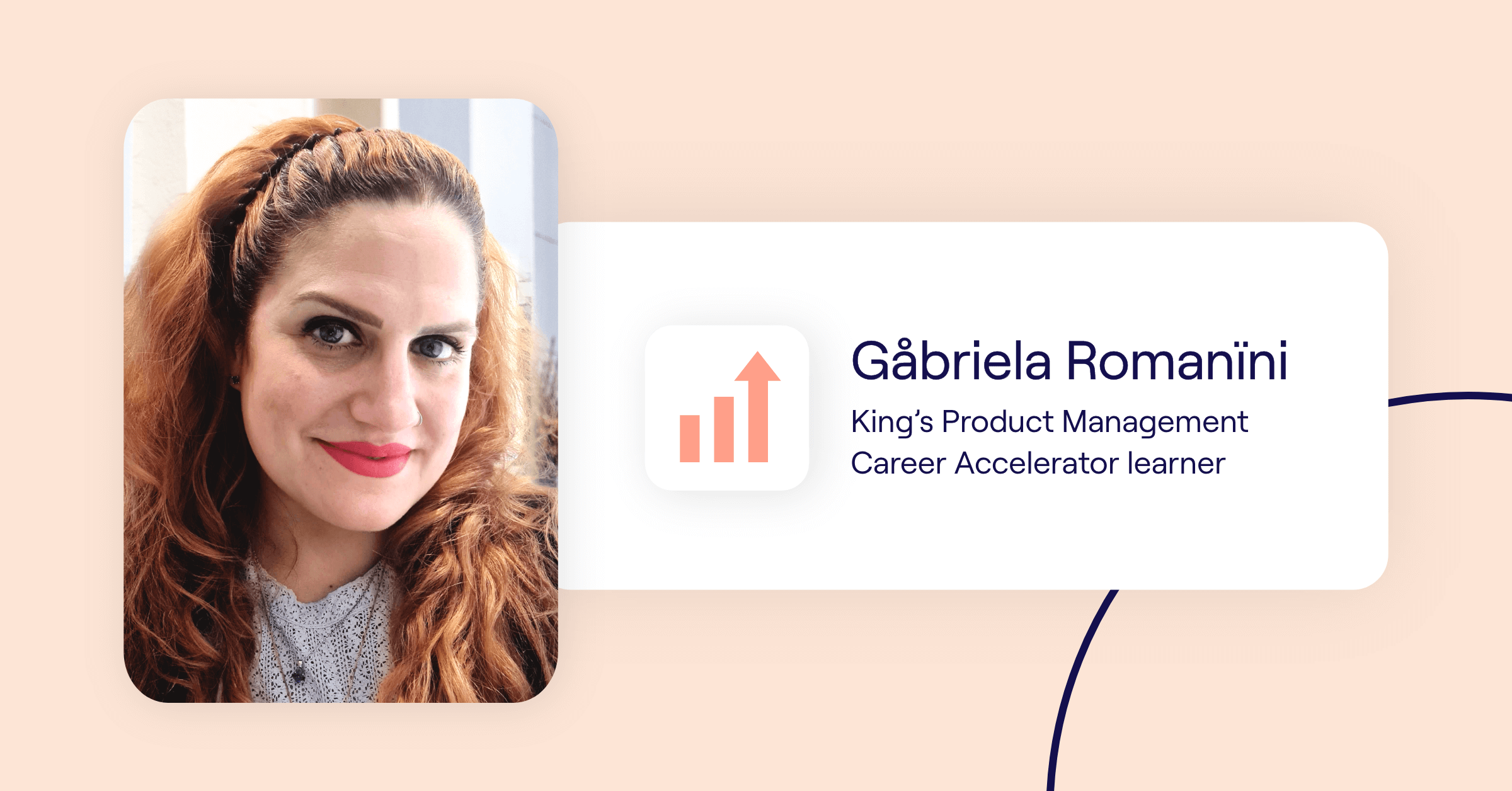
That’s exactly what happened to Gåbriela Romanïni. Since 2008, Brazilian-born Gåbriela has been working as a business analyst in the insurance industry in London. Recently, she began to doubt her career choice and felt she needed more serious qualifications to excel in her job. The King’s Product Management Career Accelerator gave Gåbriela the validation and confidence to achieve just that. 

After only two months on the programme, she landed a new job. The Career Accelerator helped validate all the knowledge Gåbriela had gained on the job over the years, and took her skillset to new horizons. It re-invigorated her passion for her career path and gave her the power to choose a new company that aligned with her professional goals for the future.

We recently ran a Q&A with Gåbriela where she shared some personal and inspiring stories of her experience on the Career Accelerator programme. 

How did your Career Coach and Success Manager help you to find a new job?

“My Career Coach helped me prepare for the interview. My Success Manager also helped me to calm down and trust myself. It’s fantastic the structure we receive here, and I’m getting biased now because my Success Manager was my rock during this course.”

“I’m a single mom and I have a 12-year old and I live by myself. I need to support myself; I have no network support. So I study and I work and I need to take care of a house, all on my own. So having that person that you know, the course provides that care for you […], for your problems, it’s massively important. I recently had a personal problem, I thought I wasn’t going to be able to deliver the assignment. And her words kept resonating with me: […] “you can do it”. And it sounds silly, but it’s so important. And I kept remembering that and I managed to do it. They […] sympathised with the problem that I was having at the time, and they gave me an extension, because one of the things here is that we’re all adults. I’m not in my 20s anymore where I only study and can dedicate all that time – I have a whole life going on. And the structure provided makes the whole difference to get there.”

How are you balancing a full-time job and single parenting with studying?

“The course tells you that you need to dedicate 10 to 12 hours a week. And it seems a lot and it is a lot. It’s not easy, it’s content heavy, but the structure is exciting. At the beginning I used to take maybe an hour and a half to consume the contents of one chapter within a module. And now I do five or six because the more you practise, the more you read, because remember, I was 20 years without studying, it started to all come back to me. It’s like your brain adapts to that speed, and information starts to come easier for you.”

“[My son and I] study together. I help him and then he asks me questions about what I’m doing. I did explain to him: it’s not going to be forever, but this is important for me to do now.”

It’s a six-month programme – how do you keep yourself motivated? 

“I think it’s really important to keep yourself motivated but it’s the respect for the money I invested in this course. I think you need to be very conscious – it’s an expensive thing. But it’s a great investment, I don’t regret it. And if you allow me, I’d like to share a personal story.”

The video below holds the full story of Gåbriela’s journey to career development; it’s personal, inspiring, and shows her commitment to learning.

How practical is the learning?

“It’s very practical; you’re given a technique and you need to apply the technique.”

Employability is at the core of Career Accelerators. We partner with tech and employer partners, such as Atlassian and Dropbox, to ensure you gain the skills and practical experience to get you hired as a product manager.
Watch the King’s Product Management Career Accelerator video to find out more about the programme.

Tell us about your fellow peers – do you feel connected to your cohort? 

“I was part of an incredible cohort of students, very respectful people, and people willing to help each other. […] And in the peer reviews, they’re so respectful with you, because you need to remember that we’re all learning. There’s no stupid [answers], we’re all trying our best. And you get motivation from your peers to carry on.”

Meet Kelli Wingfield, another learner from the King’s Product Management Career Accelerator. Like Gåbriela, Kelli was also promoted while on the programme. She attributes her success to the Career Accelerator. Read her story.

Much of your cohort don’t have product management experience. How did they progress?

“They’re dedicating themselves and they’re doing really well. They agree with me that the way that the course is structured is helping them to achieve what they want, which is a career change.”

Do you feel the Career Accelerator impacts your employability and earning potential?

“Definitely. Because I’m a mother, and I’m […] in my 40s,  I couldn’t afford to take a smaller salary to change industries. […] I started doing my own research into the industries where you can be a product manager. [But then I thought] I’m not being grateful enough for the industry I am in, because I already have all of the knowledge. So, why change? Why not improve all aspects, your technical abilities, your knowledge, and then you have the perfect employability package.”

“At the time, I was working in the insurance industry and I was questioning myself; I was feeling like a failure, like, do I know this enough? With FourthRev and King’s College, I’m learning so much that now I am finding the time to start […] dedicating [myself] to the insurance market again, refreshing my knowledge and understanding.”

“I’ll be straightforward about it: I do believe the programme can help you get a better paid job. I do believe that because I got it. The Career Accelerator helped me to change jobs. In my job interview the questions they were asking me were technical and I had the confidence to answer them because I was already studying those things.”

Feel inspired by Gåbriela‘s story? Download a programme brochure to see if this Career Accelerator is right for you.

FourthRev and The London School of Economics and Political Science launch first ‘Career Accelerator’ in data analytics

FourthRev, the digital education company, and The London School of Economics and Political Science (LSE) are announcing today the launch of the online Data Analytics Career Accelerator. Built in collaboration with global technology companies and leading employers, this Career Accelerator delivers an immersive, project-based, and fully online experience available to learners anywhere in the world. The programme empowers participants with the technical, analytical and human skills necessary to launch or advance a career in the digital economy, and provides the project portfolio and job matching support to enable graduates to successfully secure new employment in data-focused roles.

The online Data Analytics Career Accelerator will open for enrolment in August 2021, with the first learners commencing their studies in February 2022. The curriculum will prepare learners to enter data analytics roles with a critical combination of in-demand technical skills including data analysis, visualisation and programming, with  human skills such as problem-solving, influencing and critical reflection. The programme has been developed by LSE’s world class Departments of Statistics and Methodology in collaboration with global data analytics companies, such as Tableau, and includes virtual projects with employer partners and job matching support from global recruitment specialists, such as Robert Walters.

While full details of the curriculum will be available when enrolment opens, the programme is designed to enable learners to:

  • Conduct descriptive analytics in order to prepare reports and insights to support business decision-making
  • Prepare advanced data visualisations and data stories to communicate compelling, guided narratives to key business stakeholders
  • Acquire large amounts of complex data from multiple sources and complete advanced analytical processes using popular analytical tools
  • Apply predictive models to transform insights into actionable strategies
  • Collaborate in solving business problems and justify strategic recommendations that leverage best practice and advanced data-analytic approaches
  • Build practical experience with critical in-demand analytics tools: Excel, SQL databases, postgres, Python, R, and Tableau

Professor Pauline Barrieu, Academic Director of Online Programmes at LSE commented: “Supporting alumni and professionals to refresh and adapt their knowledge and skills throughout their evolving careers is important to us. We are excited to be working with FourthRev to deliver the Data Analytics Career Accelerator and hope to empower more people from varied backgrounds to advance in this fast-growing field.”

Mark Lester, Chief Partnerships Officer for FouthRev shares “We are delighted to be launching the Data Analytics Career Accelerator with LSE. FourthRev designed the Career Accelerators concept to take a fresh look at delivering highly relevant online short course education for the digital economy. Learners should not need to choose between an industry-led bootcamp or an academic programme, and so this approach combines the best of both. Learners will experience the robustness and recognition of LSE’s world-leading education alongside the best job-focused technical education, designed by top industry and employers.”

Tom Chambers, Associate Director of Technology & Growth at Robert Walters said: “This programme from FourthRev and LSE will help to address the skills gap through the combination of both academic credibility and hands-on, practical experience. What’s most important about the Career Accelerator programme is the genuine foot on the employment ladder it provides through our developed recruitment network. What is also exciting is the foundation they offer for diverse groups of people to build strong careers in technology.”

Although available to all, LSE and FourthRev expect the programme to appeal most to people who are looking to fast track their professional development while in work still or people looking to switch careers and move into the digital technology sector. FourthRev is planning to launch additional Career Accelerators from LSE and from other leading universities and global corporations over the coming year.

How Covid has created a new imperative for universities to work with edtech

1. Digital transformation in teaching, learning and assessment

Like all sectors, higher education has been forced to lean into a digital future more quickly than expected. The challenge of rapid transformation in teaching and learning has already been felt by many institutions since the start of the academic year. Yet much of the dissatisfaction with online provision speaks to the common confusion of on-campus learning delivered online with learning designed to be delivered in an online-first manner. Where this is the case, as in the postgraduate sector, a recent Deloitte survey in Australia found that 77 per cent said digital learning was equal to or better than face-to-face learning. In fact, many in the sector believe that the pandemic-enforced exposure of students and faculty to the benefits of online or blended learning will rapidly accelerate its adoption.

This is certainly the case in the postgraduate sector. Since the beginning of lockdown, universities partnered with Online Program Managers (OPMs) have dramatically accelerated their portfolio growth plans to the point of maximum production capacity at many OPMs. Holon IQ forecasts the resultant growth of these initiatives will more than double the online degree market from $36bn in 2019 to $74bn in 2025.

Yet many are now seeing this as a key part of the future of undergraduate study too. As well as offering fully online degrees, universities are now working with traditional OPMs to support online components of on-campus courses. Two new startups founded by prominent sector luminaries, have recently raised investment to deliver more engaging synchronous online experiences targeting the undergraduate body. These are ClassEdu, from a founder of Blackboard, and Engageli, from a founder of Coursera.

2. Employability

As shown by record university enrolments this autumn, the education sector is consistently counter-cyclical to economic downturns. Yet in an environment where course employment outcomes were already under scrutiny, in the covid era all stakeholders will be examining this aspect of the university value proposition more closely than ever, including students, parents, the government and employers.

With the economy undergoing rapid and mass digital transformation, it is unsurprising that the strongest employment demand is in the digital sector, with Microsoft’s post-COVID analysis estimating an additional 3 million UK digital technology jobs by 2025. However, it remains a clear challenge for education institutions to develop learners with the digital capabilities matched to employer demand. Employer skills shortages and graduate unemployment/underemployment are two sides of the same coin, directly resulting from rapid digital transformation:

  • Technology is now accelerating at an ever-faster rate;
  • Technology (and digital skills more broadly) are now critical to an ever-higher proportion of job roles.

The UK government has identified digital skills as ‘essential requirements’ for 82% of all UK job vacancies, so the issue is now more acute than ever, and as relevant to arts, humanities and social science graduates as it is to STEM.

To tackle this challenge, universities are working with edtechs in two key areas. Firstly, universities are applying an increasing focus on making sure they offer up-to-date, industry relevant content and curriculum that develops knowledge, skills and capabilities that employers want. At FourthRev we’re working with universities to offer ready-made, world-class online content and curriculum, co-created with industry partners including Tableau, Salesforce and AWS, that enable students to develop industry certified capabilities. Built to a problem-based pedagogical framework, learners complete authentic business challenges and develop a portfolio showcasing skills for the digital economy. These modules can be easily integrated with or added to existing degree programmes. Canadian edtech, Riipen, provides a marketplace and project management tools to allow faculty to integrate virtual projects with industry partners into their on-campus or online course offerings.

Secondly, universities are partnering with edtechs to ensure their students gain greater exposure to job opportunities outside of traditional fields. The digital economy job market is incredibly dynamic, as evidenced by LinkedIn’s emerging jobs report. this makes it increasingly challenging for careers services or faculty to support students into the wide variety of available opportunities. FourthRev’s offerings provide learners with exposure to these new and emerging fields, with a focus on supporting immediate job outcomes and longer term career success. Forage offers mini-virtual internships to gain insight into specific companies, while recruitment platforms such as Handshake and Kandidate focus on matching graduates to available jobs in growth sectors.

3. Alternative Credentials for lifelong learning

As always, crisis breeds innovation, and the uncertainty brought about by the pandemic has encouraged pioneering university leaders to ask fundamental questions about the role of the university in a rapidly changing world:

  • What is the role of the university in a world where people need to continuously upskill and reskill to adapt to a fast-changing, digital economy?
  • How do we best serve those who want shorter, sharper learning experiences that deliver an immediate career outcome?
  • How can this be done in a way that suits today’s busy and digital lifestyles?
  • What unique value can the university offer to this audience that private incumbents cannot?

The answers to these questions are driving the significant growth of university offerings in the alternative credentials space. Examples include RMIT’s online professional education offerings; FutureLearn’s microcredentials, offering stackable credentials that allow learners to work towards degree qualifications; and university branded bootcamps (intensive, job outcome focused learning experiences). Yet the next decade will see universities contribute huge and unique value through major innovations in this space.

FourthRev is partnering with multiple universities to help them rapidly deliver such offerings, building new audiences and delivering meaningful outcomes beyond the traditional degree. As universities offer up-to-date, market-driven curriculum in smaller stackable chunks towards credit into formal university qualifications, they are beginning to provide the best of their traditional value in a way that meets the needs of many modern learners. By adding academic excellence and rigour to the alternative credentials formula, and underpinning it with the sustained value that university credentials hold with employers, institutions can hit the sweet spot of student demand and employability success.

Conclusion

Whilst the pandemic has created unprecedented uncertainty for the sector, universities that embrace innovation throughout this period can accelerate their ability to support the needs of today’s students and learners. The institutions that do this while staying true to their mission will be most successful because a university’s imprimatur continues to hold unparalleled value for students and employers alike.

_________________________

This blog was co-authored by Mary Curnock Cook, Network Chair at Emerge Education, and Jack Hylands, Co-Founder/CEO of FourthRev. You can find Mary on Twitter @MaryCurnockCook . This was originally published on hepi.

Introducing Career Accelerators

Data Analytics Career Accelerator

The inaugural career accelerator in Data Analytics brings together knowledge from experts at LSE, technology leaders Tableau and Github, and industry employers Thoughtworks and Robert Walters.

LEARN MORE

FourthRev Career Accelerators

The digitisation of the global economy driven by The Fourth Industrial Revolution has been dramatically accelerated by the COVID-19 pandemic, with company digital transformation agendas shifting forwards by up to 7-years.

As a result, the post-pandemic economy will look fundamentally different to that which came before. The world economic forum has forecast that digitisation of the global economy will result in 85 million lost jobs, primarily resulting from AI & Automation, whilst simultaneously creating 97 million new jobs. Microsoft has recently forecast that digital technology job capacity will increase by 149 million worldwide by 2025, including 3 million in the UK.

To succeed in this new economy, the workforce of the future will require specific and different technological, social and emotional, and higher cognitive skills. To rise to the challenge of developing these capabilities, the education sector must be at the forefront of change, continuously evolving and adapting to meet these new needs.

At the centre of this innovation must be the university sector, whose scale, reach and impact will be fundamental to developing the higher-order capabilities that will define the future of work. To succeed in this challenge, university offerings must continue to evolve to adapt to the changing economy and to ensure that they are built to meet the new needs of the modern learner.

This is why we are absolutely delighted to introduce FourthRev’s University Career Accelerators.

What are FourthRev’s Career Accelerators?

University Career Accelerators are unique, online programmes developed by world renowned universities and leading global technology companies to meet the needs of the digital economy and the modern learner. Career Accelerators develop the technical knowledge and practical skills needed to perform in real-world roles, the business knowledge necessary to translate those abilities into meaningful company value, the human skills crucial for gaining and retaining jobs, and the cognitive capabilities essential for ongoing growth.

University Career Accelerators key facts:

  • 6-month, online programmes developed by leading universities in collaboration with FourthRev’s global technology partners
  • Built for career changers and career starters seeking high-growth opportunities in the digital economy
  • Prepare learners for career success through a unique combination of academic excellence, technology skills, human skills and applied professional development
  • Result in certification from globally renowned universities with credit pathways to formal academic postgraduate qualifications.
  • Central focus on job outcomes, with job matching to FourthRev employer partners seeking digital talent.

Why are Career Accelerators needed?

To enable individuals to lead fulfilling and successful economic and social lives, and for the economies of the future to succeed, we must close the digital capability gap. The current mismatch between the huge demand for digital talent and the dramatic shortfall of graduate and working professionals with the requisite digital capabilities is forecast to cost G20 countries $11.5tn in lost GDP growth to 2030.

FourthRev’s own research has found that without access to the right quality and quantity of talent, well over half of businesses reported they were concerned about missing out on key strategic deliverables (60%) within the next five years, as well as not delivering value to shareholders (55%). 54% reported finding it difficult to source good candidates for entry-level digital economy roles and that just over half (53%) would pay over the odds to acquire the digital skills they need.

We found that a key cause for concern amongst employers (88%) is a lack of confidence in the existing structures of the education sector to deliver capabilities required to thrive in the digital economy. With only 15% of organisations backing digital skills boot camps as a way to close the gap and 22% feeling that university alone would provide the right skill sets, 66% of talent leaders would prefer a hybrid solution that combines academic qualifications as well as a practical work portfolio.

By combining the very best of career focused, high ROI education with the value of the world’s best universities, Career Accelerators offer a unique proposition to unlock high-growth digital careers:

The very best of career focused, high ROI education (bootcamps):

  • Technical skills
  • Real project experience
  • Industry certification
  • Career coaching
  • Job matching

Unique value of the world’s best universities:

  • Higher-order graduate capabilities
  • Academic quality and excellence
  • University certification
  • Employer Recognition
  • Globally recognised academic qualifications

What does this mean for learners?

For career changers and career starters seeking high-growth roles in the digital economy, Career Accelerators offer a truly ‘best of both worlds’ proposition.

These intensive learning opportunities are built with industry and acutely focused on delivering direct job outcomes. Simultaneously, delivered by the world’s best universities, learners know they will undertake a learning experience of the highest quality, develop the higher order capabilities that will differentiate them in the digital economy, and be backed by qualifications that will be recognised all over the world.

Career Accelerators are delivered by top university faculty and industry expert facilitators that operate in digital fields on a daily basis. They follow a project-based learning framework focused on developing applied capabilities that can be evidenced to employers through an assessed project portfolio.

Learners build holistic skills sets developed utilising proprietary industry data and informed by FourthRev’s technology and employer partners. These skills sets ensure they have the pre-requisite capabilities required to gain digital technology jobs, and the higher order capabilities that will differentiate them and allow them to adapt and thrive to accelerate their careers.

Learners receive intensive careers support throughout their learning journey, including strengths analysis, CV development, mock interviews and job matching through FourthRev’s network of employer and recruitment partners.

By combining the best of careers focused education with the value of the world’s best universities, Career Accelerators deliver two key outcomes for learners. The first is the delivery of new career opportunities, with learners prepared for new job success or to accelerate their progression within an existing field. The second outcome is a credential from a renowned university recognised all over the world, with a pathway to an accredited postgraduate qualification.

How can learners get started?

FourthRev is delighted to launch our University Career Accelerators September 2021 with the first of our university partner programmes enrolling learners now.

These online first programmes are designed to support career changers and career starters whenever they are located as long as they are committed to achieving high-growth roles in the digital economy.

University offerings to support ‘Career Changers’ will be critical to the post pandemic recovery

The pandemic is dramatically increasing the number of workers that will need to transition careers, disproportionately impacting women and underrepresented groups

Of many important trends highlighted by a recent McKinsey Global Institute report on the future of work after COVID-19, the most striking was that up to 25 percent more workers than previously estimated will need to switch occupations.

Importantly, this fallout from the pandemic is not being felt equally. In both the US and Europe, workers without a bachelor’s degree, members of ethnic minority groups, and women are more likely to need to change occupations after COVID-19 than before. For example, in France, Germany, and Spain, women are 3.9 times more likely than men to have to change roles due to trends influenced by COVID-19.

It is a similar story in the UK, with sectors that have prospered through the pandemic, such as tech, having an underrepresented number of women and members of ethnic minority groups. Those in lower paying jobs and younger works are also significantly more likely to have lost their jobs or be on furlough.

Reskilling these workers for high-demand, high-growth career paths will be essential to their future and the broader economic recovery

Prior to the pandemic most job losses were being felt in middle income jobs, reflecting the impact of automation on manufacturing and some white-collar roles. Low and high-income jobs were continuing to grow. Where low wage workers did lose jobs due to automation, e.g. data entry analysts, they were able to source new low wage roles in areas such as retail and hospitality.

The pandemic has significantly shifted these trends. Where low wage roles are declining, they are not being replaced by growth in other low wage sectors. Instead growth is concentrated in higher wage occupations, such as digital technologies, healthcare and pharmaceuticals.

These sectors were already suffering dramatic skills shortages, which have now been exacerbated by the pandemic. Research by the Learning & Work Institute published last week based on interviews with over 1,000 businesses warned that the UK is facing a “catastrophic” digital skills shortage “disaster”.

To avert this disaster and ensure that groups adversely impacted by the pandemic can find new opportunities, it will be essential that they can access educational pathways that support the development of new, in-demand skills, supported by access to employers to accelerate their careers in these growth sectors.

This represents an important and significant opportunity for universities to deliver on their mission of access, participation and success

One of the key roles of the university is to provide access to higher education for underrepresented and disadvantaged groups, and through the university experience access to opportunities in highly fulfilling and rewarding professional careers.

The focus of this mandate has traditionally centred on school leavers, where the sector has made significant strides in recent decades. Yet the challenges brought about by the pandemic has highlighted the critical need for this mandate to be applied more broadly, underlining the important role for the higher education sector to support underrepresented groups throughout their lives and their career.

The unique challenges brought about by the pandemic represent both a challenge and an opportunity for universities to deliver a new category of career accelerators that combine new technical capability development, with the soft and enterprise skills needed to succeed in the digital economy and connections to employers desperately seeking digital talent. By supporting demographics most significantly impacted by the pandemic through this journey, universities can fulfil their mission and support the economic recovery.

By combining traditional university strengths with industry focused learning experiences, universities will lead the post-pandemic recovery.

By combining traditional university strengths with industry focused learning experiences, universities will lead the post-pandemic recovery.

Although far from unique, the higher education sector has experienced a particularly tumultuous 12-months. The pandemic has brought unprecedented difficulties for all stakeholders, and myriad challenges remain across admissions, course delivery, and student and staff wellbeing.

At the same time, universities have excelled in many ways. University research has been critical to developing vaccines in extraordinary timeframes, saving millions of lives. University graduates have been heroes of the pandemic response as experts of the statistical, scientific and medical professions. And universities have experienced record applications and enrolments, testament to the fact that in times of uncertainty, more people trust their futures to universities.

And beyond these short term horizons, the key trends that were posing existential questions for university leaders before the pandemic have not gone away. Instead they have been accelerated and exacerbated by the mixture of economic crisis and rapid digital transformation that has characterised the global economy.

So as vaccine programmes start to be rolled out at scale and we begin to look to the post-pandemic future, the critical question for sector leaders is how do universities lead societies, and themselves, to bounce back stronger than before?

The post-pandemic recovery will be built upon the digital economy

TechUK’s jobs barometer found that 45% of surveyed UK businesses were actively recruiting for tech roles in the first month of 2021. Antony Walker, Deputy CEO of techUK, said: “Amidst the global pandemic we know that technology and tech-enabled jobs are sustaining the economy, as well as providing the key to our economic recovery.”

Microsoft has recently forecast that digital technology job capacity will increase by 149 million worldwide by 2025, including 3 million in the UK. A recent report by RMIT university and Deloitte Access Economics reached similar conclusions on the Australian economy, whilst highlighting that a lack of digital skills risked $10 billion growth over the same period. These critical gaps are in well-known fields including data analytics, software programming, artificial intelligence and cyber security.

Universities already faced challenges in developing learners’ digital skills prior to the pandemic, and it is clear that this need will only become more acute into the future. With digital skills a prerequisite for 82% of all UK job roles as early as 2019, learners across every discipline need the opportunity to develop up-to-date, industry relevant, digital knowledge and skills. To meet employer expectations, this means graduates being able to evidence meaningful technical and enterprise capabilities through work experience and project portfolios.

Education offerings for a digital economy should build upon the best of traditional university education

The common backlash against increased demand for digital skills in universities is that it equates to a call to eschew traditional university offerings in favour of becoming jobs factories defined by industry. This debate rests on false binaries that have held the sector back from fully embracing its unique role in the digital economy.

Businesses that have survived the last 12-months have done so because their teams are full of individuals that can solve problems, that can exist in ambiguity and manage in uncertainty. Teams that have succeeded have rapidly learnt new ways of working, of communicating and engaging with each other.Teams that have thrived have reimagined entire business models by understanding the new challenges of their customers, and then successfully delivered them by empathising with the unique challenges of their colleagues.

These are examples of the higher order capabilities that universities have successfully developed in individuals for generations. These are the capabilities that employers seek when they look for outstanding talent that can join their team and accelerate their careers. In a digital future, where the only certainty is continuous and rapid change, these higher order capabilities are more important than ever.

To prosper in the post-pandemic world, the sector will build upon its traditional strengths, evolved and adapted to meet the needs of the modern, digital economy

The universities that lead our recovery will combine the best of their traditional educational value with up-to-date industry relevant experiences that develop critical digital capabilities. It is through this approach that universities can ensure learners have the requisite technical knowledge, skills and demonstrable know-how to accelerate their career in the short term, yet also possess the higher order capabilities to build their long term success.

By tailoring these experiences to serve the needs of diverse learners at different stages of their lives, universities will also help people transition from challenging circumstances into new, high-growth careers. As we seek to bounce back from the pandemic, this is a wonderful way for universities to lead.