From Architecture Grad to UX Designer: Read Aman’s Story

After completing her bachelor’s degree in architecture, Aman realised that it wasn’t the right career path for her. She got a job working as a PowerPoint designer, and it was through that that she was introduced to aspects of user experience (UX) design. She launched into researching what a career in UX might look like, and that’s when she found the King’s UX & UI Product Design Career Accelerator.

I felt this Career Accelerator would lay a foundation for launching my career

“I did my bachelor’s degree in architecture. After I did that, I kind of realised that it wasn’t the career for me, and so I was essentially starting from scratch. I managed to get a job as a PowerPoint Designer at a healthcare company, and through that I was introduced to UX and some of the principles. It piqued my interest, so I did some research, came across this course, and kind of began my UX career from there.”

The Career Accelerator allows you to build a comprehensive portfolio as you learn

“I think the course is structured really well in the sense that it breaks down different aspects of UX design in a way that allows you to build quite a comprehensive portfolio as you go along. And that really helped with job interviews and things like that.”

My Success Manager and Career Coach were invaluable

“My Success Manager was really helpful to just chat to about how I was getting along with the course and speak about what I was worried about, or what I needed help with and kind of gain more clarity. And then, alongside that, the Career Coach was really helpful in prepping me for interviews, telling me what I was doing right and also what I needed to improve on, and just helping to build my confidence because I think that was personally something I was lacking when I first joined. To have that mentorship was really valuable.”

I felt supported every step of the way

“I think Course One is where you kind of figure out what works best for you. It’s flexible, which is useful. If you’re struggling, I recommend just talking with your Success Manager because they can really help you figure out your routine, give you the confidence and say, “Look, you know, this might help here, or why don’t you try this?” And it’s nice to have someone to talk to when you’re feeling a bit overwhelmed.”

It’s an interactive learning experience with tutors and peers

“Alongside the career coaching, having the Success Manager as someone you can talk to throughout the process is what made the programme stand out for me.”

“I really like the live sessions that we have weekly, which give us an opportunity to chat with the tutors and ask any questions we have. And I think the peer reviews are quite unique because it’s quite a good way to get everyone involved. We haven’t started yet, but I’m really looking forward to the Employer Project too. I think it’s a really good opportunity to get some real-life experience and see how it would work in the real world.”

I got a job after only four months on the programme

“I was able to land something within four months of starting the course. And I’m now working at a separate healthcare company in their marketing department but as a UX designer.”

“We’re currently working on an eczema management app, which is great because much of what I’m doing is very similar to what is covered in the course.”

Each day, I’m learning something new

“Working as a UX designer means my day-to-day is very different, which I love. Each day I’m learning something new; I’m talking to different people; I’m working on something different, which is really fun.”

Elodie Hudson is another Career Accelerator learner who trusted her intuition and pursued a new career in what she was passionate about after working in the same industry for 16 years. Read her story here.

I’ve future-proofed my career with transferable soft skills

“So, I think in terms of competitiveness, the job market at the moment is just crazy for everyone, which is really unfortunate. A lot of people talk about AI and computers taking over. But I think the one thing they’re not really able to provide is that human empathy and interaction, which is quite crucial for UX because you’re thinking about how your user is going to feel or how you want their actual overall experience to be when using a product or an app or website. I’m quite confident in saying that I don’t think AI is going to take over anytime soon, which is great for us because we provide that kind of human connection.”

If you’re smart with your time, you can manage this programme while working full-time

“I’m working during the day, and then after work I’ll do at least two to three hours per evening. I think that’s the most I’ve been able to manage without feeling burnt out. And then, I try to dedicate at least one day a weekend just to go over everything. Obviously, towards the end of each course, that kind of picks up a bit and you do end up spending more time. But I think that would probably equate to 15 to 18 hours per week, roughly.”

We’re excited to follow Aman’s growth as she continues to develop in her new UX design career. She recently joined us at a webinar to share more about her learning journey and experience working as a UX designer. You can watch the recording here.

If you’re interested in exploring whether the King’s UX & UI Product Design Career Accelerator can help you change your career track, check out the programme page.
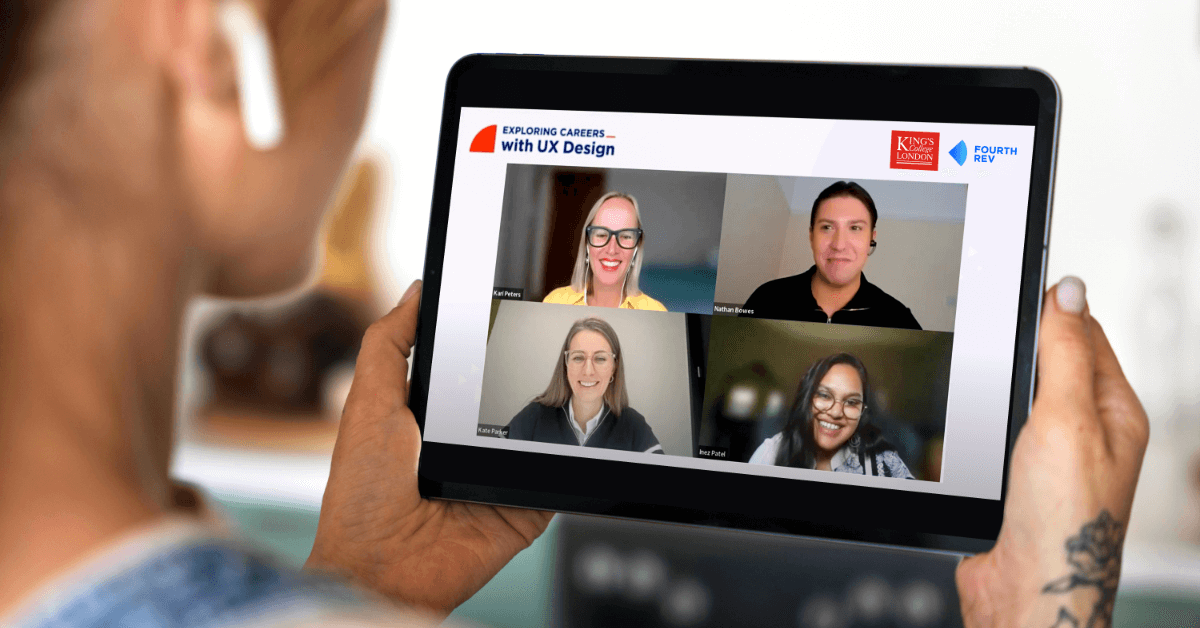

Launching Your UX Design Career: Advice from Industry Experts

UX is an exciting field to work in, and according to the Bureau of Labour Statistics, employment opportunities are growing. Between 2021 and 2031, the number of UX design jobs is projected to increase by 23% as companies around the world compete to provide the best digital experiences.

“There’s certainly a huge growth in the acknowledgement of the impact UX design can have on businesses.” – Tilly Guess, Lead Product Designer at Rightmove

So, if working in UX is something that interests you, now is a great time to explore it as a career option. But where do you start?

We’ve hosted a series of webinars with UX experts from around the world to answer questions about how to launch a UX career and set yourself apart as a candidate employers are eager to hire.

You can catch up on the full recordings of these webinars here:

Discover UX design career paths

Break into UX design

How to stand out and get hired in UX

Key takeaways from UX experts

You’ve got more transferable skills than you think

“There are quite a lot of transferable skills that everyone will likely have from their previous jobs. And these are usually the soft skills, which are the most important for UX because the reality is there’s only one super hard skill. And that’s the actual designing… This is a hard skill, but it’s not, you know, nuclear physics, it can be learned. And if you are naturally creative or skilled in the art, it can help you pick it up quite quickly. It’s not a deal breaker.

“The four key sets of soft skills I look at are:

  1. Communication and collaboration: You’re almost always working within a team, so you need to work together with other people to make decisions. And you’re going to be constantly pitching your ideas to stakeholders, so you need to be able to communicate what you’re designing. 
  2. Creative and critical thinking: You’re going to need to think creatively and critically to solve problems because, at the end of the day, what you’re doing is creating experiences that help people solve their own problems and achieve their own goals. And it’s likely that you’ve probably done critical problem-solving at your previous job. So maybe you improve sales or customer experience, but you didn’t necessarily use UX to solve that part. 
  3. Empathy: Anyone that’s read a little bit about UX design would know that this is very crucial. If you’ve done any kind of design thinking, using the kind of designer mindset to approach problems or any research, that could go a long way. I know a lot of people don’t have this experience. But that’s been a real plus when I’ve looked at people to hire in the past.
  4. Being adaptable and open to feedback: You cannot get attached to your work – you’re not doing artwork for yourself. You’re designing for the end users, so you need to be prepared to constantly iterate and change based on either their feedback or changing business needs.” – Justin Hrabec, UX and UI Subject Lead at FourthRev

Your work is multi-faceted

“No one day ever looks the same. And that’s what makes it so exciting and interesting. If we take it at a broad level, a product manager will be trying to understand what to build, and you, as a UX designer, will be trying to figure out how to build it. A lot of your day-to-day work will be focused on getting to know the motivations and behaviours of your users and then understanding the logic and the feasibility of user flows working from end to end. For me, UX Design is actually more about thinking and problem-solving than it is about design – that’s often the last component of the process. Your day-to-day will involve a lot of communication because you’ll be working with a lot of different people, stakeholders and customers.” – Kate Parker, Head of Product Design at LSG and a contributor to the King’s UX & UI Product Design Career Accelerator

Be inspired by your interests and document everything

“Everything in anything is available for you online. Go on tools like Figma and start doing your own mini projects. I’d take on any websites you think could be improved, put together some user research – ask your friends what they think about the website, and then create some low-fidelity, high-fidelity mock-ups and prototypes. Show what you’re passionate about – it doesn’t necessarily have to be professional work. I’ve got a lot of little fun projects that I’m really passionate about, like, I love Spider-Man. So whenever a new Spider-Man film comes out, I’ll work on a little website based on Spider-Man.” – Kevin Auyeung, Lead Product Designer at Toyota

Your network is a powerful way to get information

“I think it’s handy to reach out to people. I know that when I was moving to a new country, I had no idea what the UX research salaries were like. I didn’t know what the cost of living was. So besides looking at PayScale, and Glassdoor, I just was bold, and I reached out to people on LinkedIn. I asked about what the different ranges were from research managers to research directors to researchers themselves, UX designers and UX directors and just really got a good idea within my network. I’m so glad I did that because networking like that opened up a lot of doors. – Kari Peters, Director at the UX Research Institute

Bonus: Go-to UX design resources

We asked our panellists from this webinar series to share what books, podcasts and websites they’ve found helpful for their work. Here’s what they had to say:

Tilly Guess

Justin Hrabec

  • LinkedIn communities 

Kate Parker

  • NNG has everything you need for the practical side of things
  • A general following across TechCrunch to see what going on across multiple industries
  • Any and all books about strategy and change

Kevin Auyeung

  • Directly from sources like Figma, Apple and Google

Launch your UX design career

If you’re set on moving into product design, the King’s UX & UI Product Design Career Accelerator might be the programme you’ve been looking for. 

Co-designed by faculty from King’s and industry leaders from companies like Creative Navy, Dropbox and Atlassian, you’ll gain relevant knowledge that will help you secure a UX role, fast. Supported by a dedicated Career Coach and Success Manager, you’ll set career goals that set you up for success during your studies and as you advance in your career.

Download the programme brochure and book a call with an Enrolment Advisor today. 

New Launch: FourthRev Partners with King’s College London on a UX & UI Product Design Career Accelerator

Continuing on the strong partnership built through the launch of the Product Management Career Accelerator, FourthRev is delighted to announce our next Career Accelerator with King’s College London – this time in UX and UI product design.

Why product design?

Having an online presence in today’s post-pandemic world is non-negotiable. For businesses to stand out, however, they need to connect with their audiences in a meaningful way. Product design has become critical in facilitating this sense of connection by providing seamless digital experiences that ‘make sense’ for users, encourage engagement and, in turn, secure customer loyalty.

The demand for UX and UI designers – across all skill levels – is rising. Shaped by the Department of Digital Humanities at King’s in collaboration with experts across several industries, our new Career Accelerator has a strong focus on the fundamentals of UX and UI design, as well as the essential human skills required to work within cross-functional digital teams.

“We are proud of the incredible talent we have in this important area, placing us at the forefront of digital developments. Providing the skills and knowledge to enable us to live better with technology is an essential part of King’s mission, helping tackle the major challenges of the twenty-first century. This course ensures our expertise intersects with industry practice, driving positive change through inspiring interactions.”

Professor Marion Thain, Executive Dean of the Faculty of Arts and Humanities at King’s College London

What you need to know about the King’s UX & UI Product Design Career Accelerator

Whether you’re looking to start your design career or move into this exciting field, the King’s UX & UI Product Design Career Accelerator has been designed to help you achieve your career goals.

You’ll learn from esteemed faculty members at King’s, as well as leaders from companies like Creative Navy, Mailchimp, Dropbox, Atlassian and more. You’ll also get the chance to engage with your peers on a weekly basis during live lecture sessions and community forums.

The project-based learning approach of this programme ensures that you develop a portfolio of evidence by applying your new capabilities in industry-backed projects attached to each of the three courses. At the end of the programme, you’ll undertake a final Employer Project, whereby you work with peers to solve a real-world industry problem set by a company such as Creative Navy, a UX/UI design agency that ranks among the top 10 global UX design agencies.

“We’re excited to be involved as an Employer Partner on this Career Accelerator. The Employer Project is a real-life application of design practices; it’s the learner’s chance to do some real work and to get their hands dirty. It will be fun, but more importantly, it will be precisely something employers are looking for.”

Dennis Lenard, CEO of Creative Navy

Kate Parker, an expert in product and UX design who has contributed to the programme says “Co-designing the Career Accelerator has been a brilliant opportunity to help shape a future wave of UXers. The goal for me was to create a course that enables the learner not only to design and solve problems but to build an informed and balanced view of how UX/UI fits into the broader ecosystem of product development – and I think we’ve done just that. The UX & UI Product Design Career Accelerator is a brilliant combination of industry experience and world-class academia, bringing a new and practical approach to discovering more about UX and learning how to apply the skills in reality.”

To ensure that this investment in your career helps you achieve what’s meaningful to you, you’ll have the support of a dedicated Success Manager and Career Coach throughout. Together, they will help you set professional and personal goals that will set you on the path to whatever success looks like for you.

At the end of the Career Accelerator, you’ll receive a certificate from King’s to recognise your achievement.

Get more information

If you’re interested in finding out more about the King’s UX & UI Product Design Career Accelerator, you can download the programme brochure here.