As Chief Operating Officer at Enterprise Nation, and formerly Head of Product, Polly had already achieved what many product professionals aspire to. She’d helped scale the organisation from four people to 50, shaped new features, and led its transition from in-person delivery to a digital platform.
She had the experience. She had the credibility.
But she also recognised a gap.
The reason why I came on the course was because I didn’t go to university to study product. I was like, surely I’m missing frameworks, theory, stuff that big corporates do and bigger products and platforms do that I don’t know about.”
The idea was never to change jobs, but rather to strengthen her foundations and lead with more intention.
Polly didn’t come to the programme as a beginner or someone trying to “break into” product. She’d led teams, shaped platforms, and helped scale the company.
On paper, she’d made it.
In reality, she felt something experienced PMs rarely admit: there were gaps she could feel, but couldn’t quite name.
Her product career had been built the way many mid-career PMs learn, through doing. Trial, error, iteration. It worked, but instinct alone wasn’t enough anymore. She was ready to operate more strategically.
I think I kind of did things a bit backwards. I got the experience first and then I thought I need to look for a product course as well.”
Polly wanted to validate what she already knew and build a more structured toolkit to support the next stage of her career. She wasn’t stuck – she just wanted to sharpen her thinking and step into a more strategic way of operating.
Why thinking like a team made all the difference
For Polly, the most valuable parts of the programme weren’t the frameworks or tools – it was the shift in how she approached problems, and how she learned to think alongside others.
This shift happened not just through theory, but through deliberate practice, especially in the group sessions.
A lot of my role is just me working with a CEO, so my role as a COO and Head of Product before was solving problems, and you have to get comfortable with solving problems and failing. For me, the practical side of doing the breakout rooms every single week was really good.”
Each session blended a framework with immediate application.
Our course facilitator would do a session around, let’s say, a particular SWOT analysis framework, and then you would take it, and he would say, ‘Okay, here’s a made-up situation – how would you solve this problem?“
For Polly, this was a turning point. After years of making decisions alone, collaborating with others in a structured environment stretched her thinking in new ways.
And that, for me, was really good because it felt like for a long time I’ve just been solving problems solo. And that’s okay, but it’s nice to get a group environment as well.”
Not only did she love collaborating with her peers in these sessions, but she also noted that working as part of a team on other projects was “really impactful.”
Yes, it fits into a full-time job
If you’re looking to upskill and further your career, you probably share the most legitimate concern of all: Will I have enough time to fit this intensive course into my day-to-day?
Polly felt the same. As a COO, her plate was already full: leadership responsibilities, board roles, speaking and mentoring commitments, plus running a not-for-profit on the side.
She went into the programme assuming the time commitment might be exaggerated. It wasn’t.
It’s intensive but incredibly rewarding. When someone said it’s intensive, I was like, ‘20 hours a week is for those who read quite slow’ and I was like I’ll be able to do that in 10 hours. But it really is 20 hours a week.“
The key difference? She designed for it: “I changed my whole work day to accommodate this course, to make sure I was doing two hours of learning every day, and my main goal of the course was that I wanted a first.”
She also used tools like Trello/Notion to keep herself on track.
If you have the urge in you, you will have enough time to learn it and take it forward.”
Connecting the dots in the Employer Project
That balance between structure and flexibility also gave Polly the chance to apply her learning in the real world through the Employer Project – a six-week live brief with an industry partner where everything she’d learned came together.
We worked with Sky. We were talking to their product team as well, and that’s exposure that I’ve never had before in a real-time setting.”
She really liked how organised her group was. They worked across time zones, met regularly and shared the workload in a way that played to everyone’s strengths. Together, they built a clear, strategic presentation for Sky’s product team.
For Polly, this wasn’t about gaining basic product experience. She already had plenty. It was about making her thinking visible, seeing how a major corporate product team operates and testing her approach with real stakeholders.
And the impact was immediate. She began framing decisions more clearly and stepping more fully into the strategic leader she wanted to be.
The “secret weapon” she didn’t expect: career coaching
Interestingly, the element Polly describes as “probably the most impactful part” of the programme wasn’t a module or assignment. It was career coaching.
She’d never worked with a career coach before, and was initially expecting a “light therapy session”. But as a senior leader, having a dedicated space to think out loud, plan her next moves and problem-solve proved invaluable.
Career coaching was probably the highlight of me doing this course.”
Coaching helped her navigate challenges in her COO role, get honest about what she wanted next, and move from vague ideas – like “I’d like to consult one day” or going all-in on her startup, Life in Product – to concrete plans.
That clarity paid off: she signed her first three clients in January.
For her, the coaching came “just at the right time” and supported her both in her day-to-day role and throughout the course. It pushed her to scale her impact in product, both inside her organisation and on her own side projects and businesses.
You don’t always need a new job to reignite your purpose
Polly didn’t switch companies or roles after finishing the programme, but how she approached her work changed dramatically. She reconnected with a sense of purpose and possibility that had been dulled by routine.
I loved every week of learning. I felt like I had this regained purpose, which sometimes, when you work day-to-day in a nine to five, it’s really hard to find.”
Polly’s journey shows that you don’t need to change jobs to experience real career progression. Sometimes, the biggest shift comes from how you grow, how you show up and how you think.
Ready to explore your next level in product? The King’s Product Management Career Accelerator helps experienced product professionals like Polly move from capable to truly strategic – with flexible learning, real-world projects and dedicated career coaching designed for working PMs.
A common concern for learners everywhere – whether they’re enrolled in degrees, short courses, bootcamps or Master’s programmes – is whether their education will translate into results in the real world. The challenge for education providers is that every learner’s goals are unique, so a one-size-fits-all approach doesn’t work equally well for everyone.
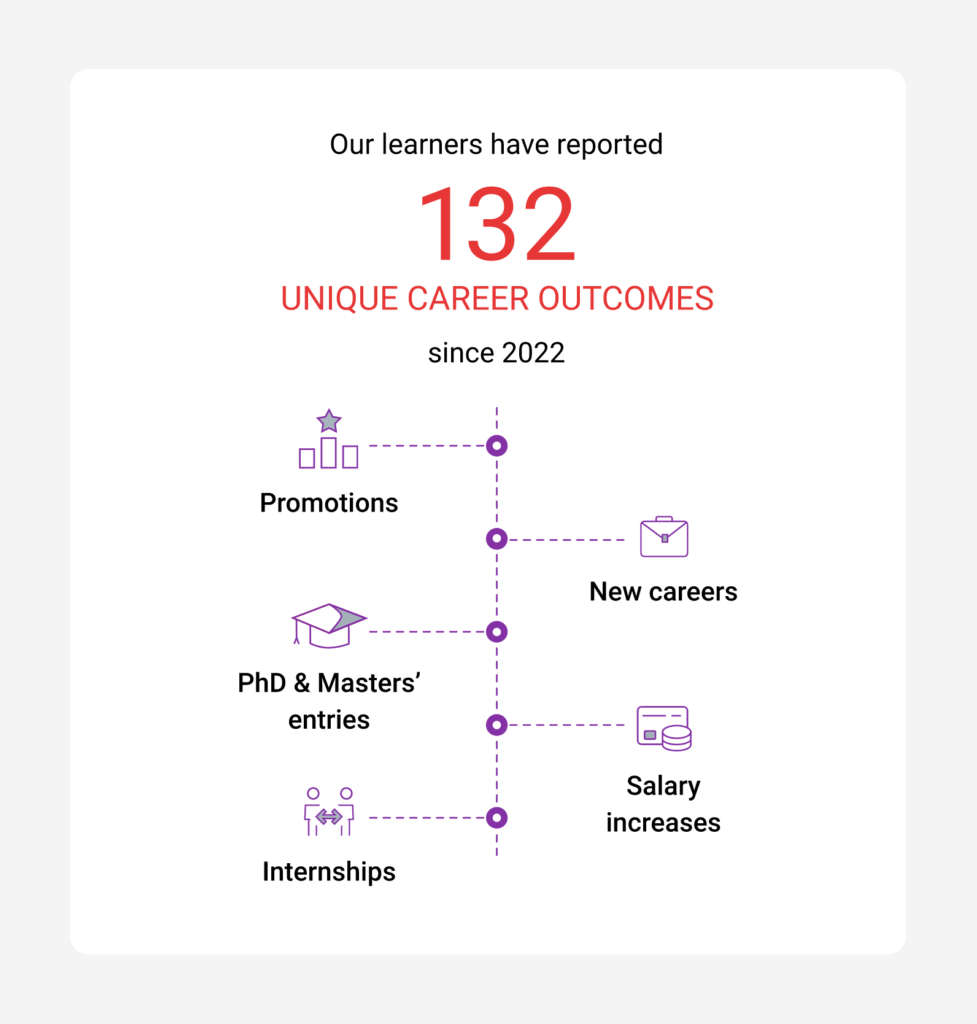
To keep the focus on real-world results, the ultimate measure of success for a Career Accelerator is the number of “unique career outcomes” achieved; the number of learners who meet or exceed the goals they set in the first few weeks of orientation.
There are also elements of a Career Accelerator – like 1:1 career coaching and a support team of success managers and facilitators – that adapt to the specific needs of each learner. This team helps you map a tailored approach that considers your aspirations, limitations, and biggest opportunities.
As of January 2024, 87.5% of learners have achieved their desired career goal within just six months of completing a Career Accelerator.1
Since 2022, 230+ learners fromthe LSE Data Analytics Career Accelerator have achieved the intended outcome they set at the start of the programme, and that number continues to grow.2
Meet our learners
While our Career Accelerator learners come from a range of backgrounds, they’re all ambitious professionals who understand that data fluency is essential for better decision-making, improved business performance, and standing out in a competitive job market.
Get a glimpse of the people starting out; transitioning into new fields; getting promotions; securing salary increases, and building meaningful careers to thrive in.
Our learners join the programme because they want to:
gain the skills job ads ask for and fill their technical skills gap
boost their professional image and be more marketable in a competitive job market
get hands-on experience and build a portfolio that proves their skills
Most of our learners are full-time working professionals who needed a programme that was structured and supportive. They were able to fit studying into their busy schedules with the help of the asynchronous learning experience; you can study and catch up on recorded sessions when it suits you best. Plus, you have a dedicated Career Coach to help you set goals, and a Success Manager to help you keep your studies on track.
“The experience of the Career Accelerator has been great. I’ve learned so many things outside of the course content and felt supported throughout. This programme has surpassed all my expectations.”
Here’s what they’ve achieved*
*Since writing this article, our learner outcomes have grown to 239, and counting.
I changed industries
“I re-entered the job market during the pandemic after running my own business for 20 years. I had no previous data experience and was hired as a senior data engineer.”
I got promoted
“I was happy with my job but I couldn’t help thinking, ‘What next?’ (I got) a fresh perspective and I saw how many opportunities there are working in data. My new skills helped me take on more responsibility at work and feel more fulfilled.”
The average salary increase reported by our learners since completing a Career Accelerator is 21.9%. Many of our learners were looking for a programme to help them boost their professional image and opportunities. Earning a formal qualification from LSE gives employers credible proof of what you’re capable of, and ensures the recognition – and promotions – you deserve.
I pivoted into a new role
“I was working in the training and development team, but wanted to move into data. My employer was so impressed with my progress on the Career Accelerator that they promoted me to an analyst role effective immediately.”
Highlights of the learning journey
Career coaching
“Working with my Career Coach was a real eye-opener for me. I really questioned whether it was too late to do something different at my age, and she helped me see the world of possibilities that are out there. I left my career in education after 16 years and am now thriving in my new role as a lead data scientist.”
Structured learning
“The material is presented clearly and the online platform is easy to use. The concepts build logically throughout the course and I like all the additional support, like the live sessions and student community, that you don’t usually get on most programmes. I also like the fact that I can study at times that work for me.”
Course content
“This Career Accelerator teaches a high quality of content. It’s very interactive with good practical exercises and strong support from the programme team.”
You can learn more about the Career Accelerator structure and experience here.
Online learning
“Studying online gave me the freedom to decide my own hours. The original draw to it was that it was a part-time course where I could work on it as well as spend time for myself and work on projects. That split was very useful for my own mental health and physical health in general.”
1Based on FourthRev graduate data as of January 2024.
2 Based on FourthRev graduate data as of March 2025.
In 2021, we saw a gap in the market: education that leads to better career outcomes. At the same time, we saw the growing demand for data analytics skills. Fast forward to 2023, and the demand hasn’t let up – data analytics is the number one emerging career, with job opportunities expected to increase by 25% in the next eight years – far above the 5% average.
Closing the gap with the LSE Data Analytics Career Accelerator
Driven to provide better career results for learners, we partnered with The London School of Economics and Political Science (LSE) to launch our first accelerator programme, the LSE Data Analytics Career Accelerator. It’s an industry-aligned programme that pairs the best minds in academia with the expertise of business and technology leaders. This unique approach to education has helped many of our learners change careers and get impactful results within their work.
“We’re driven to close the skills gap by combining the rigour and relevance of LSE teaching with applied, job-ready skills. By collaborating with industry leaders and employers, we not only integrate industry insight and experience into coursework but ensure our programme outcomes align with expectations of work-ready abilities and help professionals develop in-demand skills,” said Professor Wim A Van der Stede, Dean for LSE Extended Education.
When we started to look for an industry partner – so that our learners could get the technical skills and practical experience that employers look for – Tableau was a natural choice.
Tableau is a world-leading analytics program, and partnering with them enabled us to give our learners first-hand experience with a tool they’ll use working in the industry.
“Consistently and increasingly, industry is telling us they’re looking for data analysts who have demonstrable, practical skill sets, and Tableau is one of the platforms where they’re looking for candidates with strong capabilities,” says Lauren Smirfitt, our Head of Product Strategy.
A look at Tableau in the programme
During orientation, our learners are guided through the Tableau Desktop set-up to ensure they’re comfortable with the environment before the programme begins. They later spend a full week learning about data visualisation, where they’re taught how to create visualisations for exploratory analysis and for presenting insights to teams and business leaders.
To put these skills into practice, learners examine data sets and develop business recommendations based on their insights. They can access Tableau reference documents, online Community Forums, and other resources to help guide their approach and learning.
These learners changed their careers
So far, we’ve seen great career results for many of our LSE Career Accelerator learners. Coming from a range of backgrounds – including marketing, business management, healthcare logistics, and teaching – many have completely pivoted their careers and moved into data analytics. Others have been promoted to senior data positions with bigger salaries.
Similarly, after working as an economist in government civil service for ten years, Hussein discovered how he could reinvent himself and his career options through the LSE Career Accelerator. Megan, Haroon and Ash also experienced positive career results after completing the programme, including changing roles, becoming more efficient at work and presenting themselves more confidently to employers.
Reflecting on this, Ryan Rushton, our Strategic Partnerships Director, shares: “Many participants have gone on to achieve the career goals they set with a Career Coach during the programme – some even before they finished their studies. Their stories are one important way for us to determine whether we’re meeting our students’ expectations in helping them achieve their career goals.”
Take the next step in your data analytics career
If you’re interested in learning more about the LSE Data Analytics Career Accelerator and our collaboration with Tableau and other industry leaders, we’d love to talk to you.
Book a call with one of our Enrolment Advisors here. Our goal is to get an idea of where you’re currently at in your career and what your future aspirations are to ensure this programme is a good fit for you. If it isn’t, we’ll tell you. We also believe a quick chat with a human is the best way to get all the information you personally need to make the right decision.
If you’d like to find out more about the Career Accelerator before booking a call, you can download a program brochure here.
A version of this article was originally published by Tableau here.