Become a Product Management Expert with a Postgraduate Certificate from King’s

You can now build on your product management foundation with the King’s Postgraduate Certificate in Product Management. It picks up where the King’s Product Management Career Accelerator leaves off, giving you the credentials, the depth, and the network of one of the world’s most respected universities.

Since we launched the programme with King’s, the product management job market has changed considerably. Roles are more competitive, hiring managers expect proof of applied skill, and AI has reshaped what “good” looks like for a product manager. A Level 7 qualification from a Russell Group university is one of the strongest ways to show you’ve kept pace with all of it.

Here’s what Dr Mark Hedges, Head of the Department of Digital Humanities at King’s College London, said when the programme launched:

“Completing this Postgraduate Certificate in Product Management will not only equip learners with the practical skills, hard and soft, needed in the product management workplace but also provide them with the academic and critical skills needed to engage with their professional career in an informed and reflective way.” – Dr Mark Hedges, Head of Department of Digital Humanities at King’s College London

It remains the first postgraduate certificate in product management offered by a Russell Group university. Below, we’ve refreshed what a postgraduate certificate actually is, what the King’s programme covers, and how it lines up with what the UK product management market looks like in 2026.

What is a postgraduate certificate?

A postgraduate certificate is a Level 7 qualification in the UK, the same academic level as a Master’s degree, but shorter, less expensive, and focused on a specific area of study. It typically carries 60 academic credits and can count toward a full Master’s later on.

According to the UK government’s list of qualification levels, Level 7 covers Master’s degrees, integrated Master’s, and postgraduate certificates. They sit at the same tier academically. What separates them is scope and time.

How a postgraduate certificate differs from a Master’s

Credit weight: A postgraduate certificate is worth 60 academic credits. A Master’s is 180. Because the credits sit at the same level, most universities let you carry your PGCert credits into a Master’s later if you decide to keep studying.

Time: Most postgraduate certificates take three to six months of part-time study. A Master’s usually takes at least a year full-time, or two years part-time. 

Cost: A PGCert is typically a fraction of the cost of a full Master’s, which makes it a lower-risk way to earn a Russell Group credential.

A closer look at the King’s Postgraduate Certificate in Product Management

The postgraduate certificate is a direct continuation of the King’s Product Management Career Accelerator. It’s designed for graduates of the Career Accelerator who want to go deeper into a chosen area of product management and walk away with a globally recognised, credit-bearing qualification from King’s.

Over four months, you’ll produce a comprehensive portfolio and a research-based written dissertation. Both draw on your Career Accelerator work, but this time you choose the topic and specialise. Working with a King’s academic supervisor gives you the space to zoom in on one area of product management and become a specialist. That kind of focused expertise is what hiring managers actually pay attention to when they shortlist for senior roles.

What the programme includes

  • Two to three one-on-one sessions with a King’s academic supervisor
  • Regular check-ins with an industry mentor working in product
  • A structured, self-directed research and portfolio project spanning four months
  • Access to the King’s campus and library 
  • An in-person graduation ceremony on campus 
  • Full alumni network membership once you graduate

Building a working relationship with an academic supervisor and an industry mentor is one of the more underrated parts of the programme. Those are the connections that lead to introductions, invitations, and job leads long after you’ve submitted your dissertation. Between 75 and 100 Career Accelerator graduates have gone on to take the postgraduate certificate so far, and that number continues to grow with each intake.

Your path to becoming a product management expert

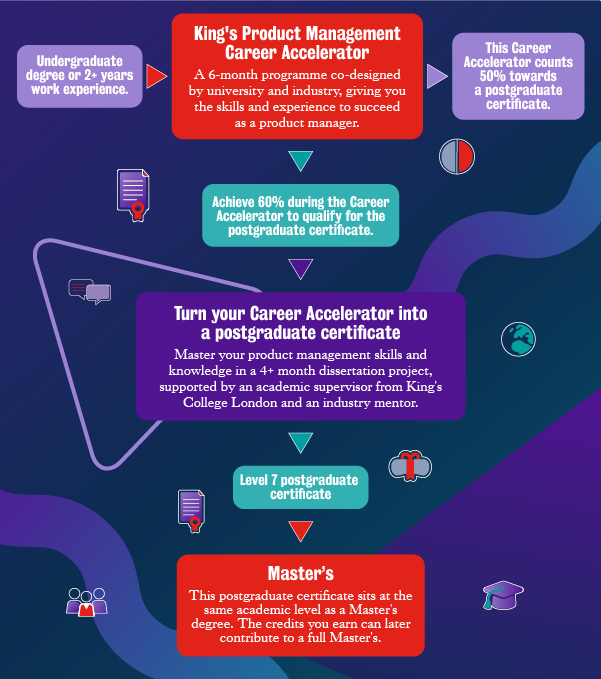
Right now, the postgraduate certificate is open to current and past learners of the King’s Product Management Career Accelerator who achieved an average of 60% or above on the Career Accelerator.

To enrol on the Career Accelerator itself, you need an undergraduate degree or at least two years of professional work experience.

Your Career Accelerator work counts toward the postgraduate certificate directly: 50% of the academic credits you need to complete the PGCert come from the Career Accelerator you’ve already done. In other words, the two are stacked by design, so the time and money you’ve already put in continues to compound.

Once you finish the PGCert, you’ll hold a Level 7 qualification from a Russell Group university. If you decide to go further and complete a Master’s later, the credits from this programme can count toward that degree too. This is what continued learning across a career is supposed to look like: modular, credit-bearing, and additive.
Who this programme is for

  • Career Accelerator graduates who want a specialist edge in one area of product
  • Product managers looking for a credit-bearing qualification to support a promotion or a senior job move
  •  Anyone considering a future Master’s who wants to test the water at Level 7 first
  • Career changers who want a Russell Group credential on their CV without committing 1–2 years to a full Master’s

Why this matters in the 2026 product management market

Product management remains one of the strongest-paying and most competitive roles in UK tech, but the bar has moved.

The average UK product manager now earns around £62,953 a year from Glassdoor UK, June 2026. In London, the average sits at £69,447. Senior product managers earn a UK average of £86,124, rising to £91,262 in London.

AI has changed what employers ask for. 61% of product manager job postings now require AI experience, and AI-focused product roles in the UK have grown around 32% year on year in 2026. AI product managers command a 25–35% salary premium over generalist PM roles, with senior specialists in London regularly clearing £120,000.

There are now more product manager job openings than ever, but the roles that pay well and progress fastest now expect a mix of academic rigour, applied experience, and current AI literacy. A generalist CV without depth in any of the three is a harder sell than it was in 2024.

The postgraduate certificate speaks directly to those three demands. It gives you the depth of a specialised research project, the academic rigour of a Russell Group Level 7 qualification, and the freedom to focus your dissertation on a modern PM problem area, whether that’s AI product strategy, applied LLMs, platform product management, or something else you want to stand out for.

Is a postgraduate certificate worth it?

The honest answer is it depends on what you do with it.

Employers rarely hire on the strength of a certificate alone. What they hire on is what a certificate helps you demonstrate: relevant, recent skills, applied experience, and a credible institution behind the credential. Our guide to how employers actually evaluate university certificates goes deeper on that.

If you’re weighing up whether the extra four months is worth the fee, our framework for measuring ROI on a career programme is a useful starting point. 

Salary bump is one measure. Confidence, portfolio depth, career trajectory, and proof of applied skill are the others that actually shift what happens in the next interview.

The Career Accelerator lays the foundation you need to build your knowledge and confidence to go further in your product management career. The postgraduate certificate builds on this and helps you further develop your skills. The two are interlinked, and it makes sense that your investment in the first part of the journey continues to pay off as you progress.

Frequently asked questions

Is a King’s postgraduate certificate the same as a Master’s?

No. Both are Level 7 qualifications, so they sit at the same academic tier, but a postgraduate certificate is worth 60 academic credits while a Master’s is worth 180. A PGCert is shorter, more focused, and typically much cheaper. The credits you earn on a King’s PGCert can count toward a Master’s later if you decide to continue.

Who can apply for the King’s Postgraduate Certificate in Product Management?

The programme is open to current and past learners of the King’s Product Management Career Accelerator who achieved an average of 60% or higher. To be eligible for the Career Accelerator in the first place, you need an undergraduate degree or at least two years of professional work experience.

How long does the King’s PGCert take to complete?

The postgraduate certificate takes around four months of self-directed study. Over that time you’ll produce a portfolio and a written dissertation, supported by two to three sessions with a King’s academic supervisor and regular check-ins with an industry mentor.

How much does the King’s Postgraduate Certificate in Product Management cost?

£2,000 

Will UK employers recognise a postgraduate certificate?

Yes. A postgraduate certificate from a Russell Group university carries genuine weight with UK employers, particularly when the credential is combined with a portfolio of applied work. In competitive fields like product management, employers value depth of expertise, credibility of the institution, and evidence of ongoing learning. A King’s PGCert covers all three.

Can I go from the Career Accelerator to the PGCert to a Master’s?

Yes, and that’s exactly how the programme is designed. Your Career Accelerator work contributes 50% of the credits needed for the postgraduate certificate. The full PGCert then gives you 60 Level 7 credits, which can count toward a Master’s degree later on. Each stage builds on the last.

When does the next intake start?

King’s runs two intakes a year for this programme. Check the programme brochure for the next start date.

Take your career further, faster

Product management continues to offer competitive salaries, meaningful work and opportunities across high-growth sectors including fintech, healthtech and AI. What’s changing is what employers expect. Today’s product professionals need deeper expertise, practical experience and credentials that demonstrate they can deliver impact.

The King’s Postgraduate Certificate in Product Management is designed to help you meet those expectations. You’ll gain a respected Russell Group credential, complete an applied research project you can showcase, and join a network of academic and industry experts who can support your career long after you graduate.

Read the programme brochure and, when you’re ready, start your application.

To enrol in the Career Accelerator, you need to have an undergraduate degree or at least two years of work experience. You can find out more about the application requirements here.

Once you’ve completed the Career Accelerator with the pass mark required, you’ll be on track to begin the postgraduate certificate. Your work on the Career Accelerator will contribute 50% of the academic credits needed to complete the postgraduate certificate successfully.

With your postgraduate certificate in hand, you’ll have earned yourself a Level 7 qualification. Recognised by employers as a valuable indication of your expertise, this boosts your employment prospects and long-term opportunities. If you choose to continue your learning journey in the future and pursue a Master’s, the credits you earned from the postgraduate certificate can contribute towards this degree. 

Take your career further, faster

Pursuing a career in product management is exciting, with so many avenues and opportunities to explore. Rated as one of the best jobs in the UK, it’s in high demand and offers great job satisfaction and good pay. With a solid set of skills established on the Career Accelerator, you now have the opportunity to enhance your career potential by becoming an expert in your chosen area of product management. 

If you’re interested in hearing more about how the postgraduate certificate can give you an extra edge as a product manager, grab a time to connect with your Enrolment Advisor.


What Career Changers Get Wrong When Choosing a Programme (and How to Avoid It)

You have finally decided to change careers. That was a major milestone, but the next decision is just as important: choosing a programme that deserves your time, money and trust.

Thousands of providers compete for your attention, and after browsing a handful of websites, the language starts to blur together. Every programme claims to be industry-relevant, career-focused and flexible. Most promise practical skills, and many feature glowing testimonials, making it difficult to distinguish between them.

Look a little closer, however, and the differences become much clearer. The strongest programmes combine practical skills with real-world experience, recognised credentials and structured career support, giving learners the confidence to move into a new profession. 

Successful career changers approach this decision with the same care they bring to changing careers in the first place. Rather than being guided by marketing alone, they compare programmes based on how well they align with their goals, learning preferences and long-term ambitions.

This guide explores the most common mistakes career changers make when choosing a programme and the key questions to ask when comparing providers, helping you choose the option that best supports your career goals. 

If you’re comparing different options, understanding how a Career Accelerator is structured provides a useful baseline before weighing it against other forms of online learning.

Choosing based on hype, not fit

The “data science sounds impressive” trap

One of the biggest mistakes career changers make is assuming the most talked-about field is automatically the right career move for them.

Data science, artificial intelligence (AI) and cybersecurity dominate headlines. Salary reports reinforce the excitement, while social media is full of stories about professionals who doubled their income after learning Python or machine learning.

It’s easy to see why these fields attract so much attention. They offer exciting opportunities, but each one calls for different interests and strengths. 

Data science rewards people who enjoy statistics, experimentation and solving abstract problems. Product management requires influencing people across teams, balancing competing priorities and making strategic decisions with incomplete information. UX design relies on empathy, curiosity and a willingness to iterate.

The strongest career decisions come from matching your interests and strengths with the nature of the work, rather than choosing a field based on its reputation. Long-term success depends on curiosity, resilience and a genuine interest in the work. 

What to do instead

Start by assessing yourself before assessing the market. Ask questions that go beyond salary, like:

  • What kind of problems do you enjoy solving?
  • Do you prefer analysing information or leading people?
  • Are you energised by creating systems, designing experiences or interpreting data?
  • What aspects of your current role do you already enjoy?

Many career changers underestimate how valuable their existing experience can be. Communication, stakeholder management, project delivery and commercial awareness are transferable across industries.

Rather than starting from zero, think about how your current strengths connect with your future career.

If you’re unsure where your interests align, use the guide on which Career Accelerator should I choose to compare different career paths based on your background and ambitions.

Understanding why transferable skills are the key to success often changes how career changers evaluate their options.

Prioritising price over structure

Why “cheaper” often costs more in the end

Everyone likes saving money. When choosing a career change programme, however, it’s worth looking beyond the headline price to the value you’ll receive in return.

Consider two learners: one spends £20 on an online course, while the other invests in a structured six-month programme. At first glance, the difference seems obvious. Six months later, the comparison looks very different. 

The first learner has completed several hours of video lessons and earned a digital badge. The second has completed assessed coursework, built a portfolio, received structured feedback from industry experts and gained practical experience through real-world projects. Add career coaching and a recognised university credential, and the value extends well beyond the classroom.

Many professionals begin with short, low-cost courses to explore a new field before progressing to a more structured programme that helps them build a portfolio, gain practical experience and prepare for the job market.

Rather than focusing solely on the initial price, think about cost per outcome. A programme that equips you with the skills, experience and support to achieve your career goals often delivers greater long-term value than its price alone suggests.

What to do instead

Think in terms of cost per outcome rather than cost per course.

Instead of asking, “How much does this programme cost?”, ask:

  • What will I actually have when I finish?
  • Will I have work I can show employers?
  • Will I receive meaningful feedback?
  • Will I build a portfolio?
  • Will someone help me prepare for interviews?

Look for outcomes that strengthen your profile, such as assessed work, practical projects, career coaching and a recognised credential. These provide far more value than a certificate of completion on its own. 

For a clearer comparison of what different learning formats deliver, read Career Accelerator vs bootcamp vs online course.

If you’re still unsure what makes a structured programme different, 10 things to know about Career Accelerators explains what learners should expect before enrolling.

As an example, the LSE Data Analytics Online Career Accelerator combines structured learning with practical projects, career coaching and an Employer Project, giving learners more than technical knowledge alone. It’s designed to help working professionals build practical capability alongside their existing commitments.

Ignoring career support or assuming it’s all the same

The difference between a help desk and a Career Coach

Almost every online provider highlights the support available to learners, but that support can take many forms. It may include discussion forums, tutor Q&As or chatbots that help learners progress through the curriculum. These resources all have an important role to play.

But for career changers, support often extends beyond technical learning. Building confidence, explaining a career pivot, refining a CV and preparing for interviews are all part of a successful transition. 

This is where personalised career coaching adds value. A qualified Career Coach helps learners define career goals, identify transferable skills, strengthen their personal brand and develop an application strategy that reflects current hiring expectations.

The strongest programmes combine technical learning with career support, helping learners make a successful career transition. 

What to do instead

Before you enrol, take time to understand the support you’ll receive throughout the programme.

The strongest providers clearly explain the guidance, coaching and career support available at each stage of the learning journey.

Ask questions such as:

  • Is there dedicated one-to-one career coaching?
  • How many coaching sessions are included?
  • Does coaching continue after the programme ends?
  • Will I receive support with my CV, LinkedIn profile and interview preparation?
  • Is there ongoing support if I don’t reach my agreed career goal within the expected timeframe?

Providers that invest in meaningful career support are usually transparent about how it works because it’s central to the learner experience.

If you want to understand the difference coaching can make, read how a career coach can help you reach your goals.

If you are curious about what coaching conversations actually cover, these questions answered by career coaches provide a useful starting point.

Some providers also offer structured post-programme support. For example, FourthRev’s Career Milestone Guarantee extends career coaching at no additional cost for eligible learners who have not yet reached an agreed career milestone within 12 months of starting the programme, subject to the published terms and conditions.

Undervaluing real-world projects

Simulated case studies versus employer projects 

Learning a concept is an important first step, but applying it to a real business challenge is where it becomes meaningful. Many online programmes use simulated case studies to develop technical skills, while employer projects go a step further by giving learners live briefs from real organisations. 

Along the way, they work through changing requirements, competing priorities and stakeholder expectations that reflect the realities of the workplace.

These projects continue to add value after the programme ends. In interviews, learners can talk through the decisions they made, the challenges they tackled and the impact of their recommendations, giving employers clear evidence of how they approach real business problems.

What to ask different providers

  • Does the programme include a project with a real employer?
  • Which organisations have previously supplied project briefs?
  • Will I produce work that can be included in my portfolio?
  • Is the project assessed?

As an example, the LSE Data Analytics Online Career Accelerator includes a six-week Employer Project in which learners apply their skills to a real business challenge. Employer partners and project briefs are subject to change for each cohort, but the emphasis on practical application remains constant.

To understand how this model works, read everything you need to know about the Employer Project.

It’s one reason why programmes built around practical application are increasingly associated with career-focused education.

Not checking whether the credential carries weight

Certificate of completion versus a university credential

Certificates are common in online learning, so it’s worth understanding what different credentials represent. Some programmes award a certificate of completion, while others assess learners against academic standards before awarding a credential.

A university-issued credential shows that your work has been independently assessed against an established academic standard. 

Alongside practical experience and a strong portfolio, a recognised university credential can give employers greater confidence in your skills and knowledge.

What to ask different providers

  • Who issues the credential?
  • Is it assessed or based solely on participation?
  • Will employers recognise the awarding institution?
  • Does it demonstrate practical achievement as well as attendance?

Successful graduates of the LSE Data Analytics Online Career Accelerator receive a Certificate of Competence from LSE. They also complete assessed coursework and graduate with a portfolio of practical projects. 

If you would like to see how previous learners have used that credential to support their career transition, explore the real-world results of our LSE learners.

The benefits of choosing the right programme extend well beyond your first role. Five ways a Career Accelerator will help you achieve long-term career success explores why.

Trying to do it alone

Self-study has limits for career changers

Self-paced learning has transformed access to education. Today, you can learn almost any technical skill from your laptop, at your own pace and around your existing commitments.

A successful career change, however, relies on more than technical expertise. It also involves telling a compelling professional story, expanding your network and maintaining momentum over several months. A structured learning environment helps support that journey through regular guidance, personalised feedback and career coaching.

The strongest programmes combine technical learning with ongoing support, helping learners build practical skills, maintain momentum and prepare for a successful career transition. 

What to do instead

As you compare programmes, look beyond the curriculum and consider the learning experience as a whole. The strongest programmes pair high-quality teaching with a community of peers, Success Managers who help learners stay on track and Career Coaches who guide before, during and after graduation.

Together, these support systems help learners maintain momentum, refine their career plans and prepare for interviews while balancing work and other commitments. 

Learning alongside peers also creates opportunities to exchange ideas, celebrate progress and learn from others making similar transitions. Isolation often amplifies self-doubt. If this feels familiar, read overcoming imposter syndrome during a career change.

The learners who achieve lasting career change rarely do it alone. Their experiences are reflected in these impact stories.

A checklist before you enrol

Before committing to any programme, pause and ask yourself these six questions.

  1. Am I choosing this career because it genuinely suits me, or because it sounds impressive?
  2. Am I comparing cost per outcome rather than cost per course?
  3. Does the programme include dedicated one-to-one career coaching with a qualified professional?
  4. Will I complete a real project with an actual employer?
  5. Is the credential assessed and issued by a recognised university?
  6. Will I have access to a genuine support network throughout my learning journey?

Use these six questions to compare any programme you’re considering. If you can answer “yes” to most of them, you’re probably looking at a programme designed to support long-term career success. 

Ready to compare your options? Browse Career Accelerator programmes and speak to an Enrolment Advisor who can help you decide whether a programme is the right fit for your goals.

FAQs

What is the biggest mistake career changers make when choosing a programme?

The most common mistake is choosing a programme because the subject is popular rather than because it fits their strengths, interests and long-term career goals. Start with honest self-assessment before comparing providers.

How do I know if a career programme is worth the money?

Look beyond the headline price and consider what you will gain by the end of the programme. A strong programme should provide a portfolio, assessed work, practical projects, career coaching and a recognised credential. These outcomes are far more valuable than a certificate of completion alone.

Should I choose a bootcamp or a Career Accelerator?

That depends on your circumstances. Bootcamps often suit learners who can study full time and want to move quickly. Career Accelerators are typically designed for working professionals and combine structured learning with career coaching, employer projects and a university credential. Compare both against your available time, budget and career ambitions.

What questions should I ask before enrolling in a career programme?

Ask who designed the curriculum, whether the credential is university assessed, whether the programme includes real employer projects, whether one-to-one career coaching is provided and what support is available if you don’t achieve your agreed career milestone after completing the programme.

Career Accelerator Outcomes: What “Success” Really Looks Like (Beyond Job Titles)

A new job title makes a good headline. It tells friends and colleagues you’ve moved on. It looks impressive on LinkedIn. But it’s often the least interesting part of the story.

The real question prospective learners ask is much simpler: Will this actually change my career?

That’s where Career Accelerator outcomes come in. The strongest programmes help learners build practical skills, confidence and career momentum that continue long after graduation. A new role is often the first visible outcome. The bigger gains come from the capabilities you develop along the way.

Whether you’re changing careers, aiming for promotion or returning to work after a break, success looks different for everyone. This guide explores the outcomes that matter most, using real learner stories to show what lasting career progress looks like and how to measure it for yourself.

What do we mean by “Career Accelerator outcomes”?

A certificate and a completed project are valuable outputs, but they don’t define your long-term career outcomes. 

Outcomes are the lasting changes that shape your career. They’re the skills you apply, the opportunities you become qualified for and the direction your career takes over time.

Here’s the difference:

OutputOutcome
Completing a courseSolving business problems independently
Earning a certificateBecoming a stronger candidate for future roles
Finishing an Employer ProjectDemonstrating your abilities through a portfolio
Learning Python or SQLUsing data to influence decisions at work

Career outcomes unfold over time, and they look different depending on where you start. 

A Career Starter might measure success by landing a first analyst role. A Career Advancer may be aiming for promotion or a leadership role. A Career Changer could be looking to enter an entirely new industry.

Further reading: What is a Career Accelerator?

The six outcomes that matter more than a new job title

1. In-demand, transferable skills that last

Definition: Practical, project-based skills that stay relevant as technology changes.

Technology keeps changing, but the ability to solve problems, communicate insights and keep learning will always matter. That’s why project-based learning works. It helps you build practical skills and the confidence to apply them from day one. 

Learner story

Sanya Setia built a portfolio of practical projects through the Cambridge PACE Data Science with Machine Learning & AI Career Accelerator, giving employers clear evidence of her abilities.

Read Sanya’s story here.

2. A genuine career transition

Definition: Moving into a new function or industry by proving what you can do.

Changing careers is about building evidence, not experience. Projects, portfolios and practical work show employers you have the skills to succeed, even if your previous role was in a different field.

Learner story

  • Luis Cantu moved from consulting into a Data & Insights Analyst role at Leeds United despite having no professional data background.
  • Klaudia Skiba transitioned from hospitality into UX and product design before progressing to Product Lead.

Both stories show how practical experience can unlock entirely new career paths.

3. Career re-entry and renewed momentum

Definition: Building momentum after a career break or major career change.

Career success isn’t always about moving forward quickly. Sometimes it’s about finding a new direction. Career Accelerators help you build new skills, regain confidence and take the next step with purpose.

Learner story

Emma Roberts moved from chemical engineering to launching her own data analytics business. Her story shows how new skills can create entirely new opportunities.

Read Emma’s story here.

4. Confidence and professional identity

Definition: Building the confidence to think and communicate like a practitioner.

Confidence grows through doing. Every project, presentation and piece of feedback helps you apply your skills in real-world situations. Over time, you stop thinking, “I’m learning data analytics,” and start thinking, “I solve business problems with data.”

Learner story

  • Michael Hosler describes the shift from knowing “a little about a lot” to confidently leading conversations about AI.
  • Olena Bilan credits her programme with helping her connect AI initiatives to business strategy and executive decision-making.

5. Salary and seniority progression

Definition: Long-term career growth reflected in promotions, increased responsibility and higher earnings.

Careers compound over time. Every new skill, project and opportunity creates momentum for the next step. According to the FourthRev 2023/24 Completers’ Survey, 87.5% of learners achieved a desired career goal within six months of completing a Career Accelerator, while learners reported an average salary increase of 21.9% after completion. Individual outcomes vary.

Learner story

  • Sanya Setia more than doubled her previous salary after joining John Laing.
  • Klaudia Skiba continued progressing after her career change, eventually becoming a Product Lead.

Across FourthRev programmes, learners have also secured opportunities with organisations including Spotify, McKinsey, Burberry, Chanel, Johnson & Johnson and Metro Bank.

6. A holistic skill set: technical, human and business

Definition: Combining technical skills with business thinking and strong communication.

Technical skills help you get started. Business judgement helps you grow. As AI changes the way we work, employers are looking for people who can solve problems, communicate clearly and turn data into better decisions.

Learner story

Olena Bilan describes one of her biggest breakthroughs as learning to connect AI initiatives with business value. That helped her think beyond the technology itself and lead conversations about organisational transformation.

Why job titles are a misleading measure of success

A job title is only one measure of career success. 

A Data Analyst at one organisation may build predictive models and advise senior leaders. At another, the role may focus on reporting and dashboards. The title is the same. The capability, influence and opportunity can be completely different.

The same applies across almost every profession. Product Managers, UX Designers and AI Specialists often have very different responsibilities depending on the organisation they’re working in.

The professionals who build long careers keep developing their skills, expanding their judgement and increasing the value they create. They adapt as industries evolve and new technologies emerge. Those qualities stay with them long after they’ve updated LinkedIn.

That’s the thinking behind FourthRev’s #ReimaginEd philosophy: helping learners build careers that continue to evolve, rather than preparing them for a single role.

Further reading: About us

How to measure your own Career Accelerator outcomes

If you’re wondering “What do you get out of a Career Accelerator?”, start by defining what success looks like for you.

The most useful approach is to measure progress across several dimensions instead of focusing on one milestone.

1. Start with your baseline

Before your programme begins, write down where you are today.

  • Your current role
  • Your technical skills
  • Your salary
  • Your confidence using those skills
  • Your long-term career goal

This gives you a clear starting point and makes future progress easier to measure.

2. Set goals across all six outcomes

Instead of focusing on one big milestone, set goals across all six outcomes. 

That could mean completing three portfolio projects, securing interviews in a new industry, returning to work after a career break, presenting insights to senior stakeholders, earning a promotion or leading a project that combines technical and business skills. 

Together, these goals give you a much clearer picture of career progress than a job title alone. 

3. Track leading and lagging indicators

Some milestones come quickly; others build over time. 

Leading indicators show you’re moving in the right direction.

  • Completing projects
  • Growing your portfolio
  • Expanding your network
  • Landing interviews
  • Receiving positive feedback

Lagging indicators reflect the longer-term impact.

  • A new role
  • A promotion
  • A salary increase
  • Greater responsibility
  • Launching a consultancy or business

The strongest career outcomes usually come from a combination of both.

4. Think in years, not weeks

A programme may finish after a few months, but the biggest gains often appear six to 18 months later as learners continue applying their skills, building experience and creating new opportunities.

Viewed this way, graduation marks the beginning of the next chapter rather than the end of the journey.

What drives strong outcomes (and what to look for in a programme)

If you’re comparing providers or asking “Are Career Accelerators worth it?”, look beyond the curriculum.

The strongest outcomes usually come from four characteristics:

Project-based learning

Projects help you put your skills into practice. Real business challenges give you experience and a portfolio you can show employers. 

University credibility

A recognised university credential strengthens your professional profile and signals commitment to employers.

FourthRev Career Accelerators are developed in collaboration with leading universities, including LSE, the University of Cambridge Professional and Continuing Education (PACE) and King’s College London, combining academic credibility with practical, employer-focused learning.

Career coaching

Great coaching helps you turn new skills into new opportunities. From refining your CV to preparing for interviews and building your portfolio, it gives you the confidence to take the next step. 

A focus on lifelong adaptability

The best programmes prepare you for what’s next. They build technical skills alongside problem-solving, commercial awareness and the confidence to keep learning. 

Explore all Career Accelerators 

Not sure which programme is right for you? Learn more here.

FAQs

What outcomes can I expect from a Career Accelerator?

Most learners build practical technical skills, a portfolio of work, greater confidence and clearer career direction. Many also progress into new roles, earn promotions or increase their earning potential over time.

Do Career Accelerators help you get a job?

Career Accelerators improve employability by helping learners build in-demand skills, complete practical projects and prepare for interviews. Employment outcomes depend on many factors, including previous experience, market conditions and individual effort.

How long before I see results?

Many learners apply new skills immediately in their current role. Larger career outcomes, such as promotions, career changes and salary progression, often emerge over the following six to 18 months.

How is a Career Accelerator different from a bootcamp or a degree?

Bootcamps focus on intensive technical training, while degrees provide broader academic education.

Career Accelerators combine practical learning, university credentials, career coaching and real-world projects, giving working professionals a structured route to career progression or transition.

How do I measure the return on investment of a Career Accelerator?

Career Accelerator return on investment goes well beyond salary.

Consider the quality of your portfolio, your confidence, the opportunities available to you, your professional network and your ability to adapt as industries evolve. Those gains continue to compound throughout your career.

Success is bigger than a job title

A new job title is one milestone. The skills, confidence and experience you build keep opening doors throughout your career. 

Whether you’re starting out, changing direction or aiming for your next promotion, the right Career Accelerator helps you keep moving forward. 

Ready to explore your next step?

How to Change Careers into UX Design: A Portfolio-First Roadmap

No design degree? No problem. Here’s a portfolio-first roadmap to transition into UX design that covers what to learn, how to build case studies, and how to land the role.

If you’re researching how to become a UX designer, you’ve probably noticed something frustrating. Every job asks for experience, but you can’t get experience without first getting a job. On top of that, most entry-level UX roles expect you to have a portfolio – even if you’ve never worked as a designer before.

It can feel like a catch-22.

The good news is that UX hiring works differently from many other professions. Your portfolio is your experience. Employers care far more about how you think, solve problems and communicate your design process than whether you’ve held an official UX job before.

Whether you’re moving from marketing, teaching, hospitality, administration or another people-focused profession, this portfolio-first roadmap will show you a practical path into UX design. 

Is UX design a good career to change into? (2026 reality check)

For many career changers, the answer is yes. Organisations continue to invest in digital products, customer experience and accessible services. That means demand remains strong for professionals who understand user needs and can turn insights into better digital experiences.

Today’s UX ecosystem includes roles such as:

  • UX Designer
  • UI Designer
  • Product Designer
  • UX Researcher
  • Service Designer
  • Interaction Designer

The junior market is more competitive than it was several years ago. Employers have become more selective, but they haven’t stopped hiring. Instead, they’re looking for candidates who can demonstrate practical capability rather than simply listing qualifications.

That’s where a strong portfolio becomes your competitive advantage.

UX also suits career changers particularly well because many transferable skills already matter in the profession. 

  • Teachers understand research and communication
  • Marketers know customer behaviour
  • Hospitality professionals excel at empathy and service
  • Administrators are often highly organised problem-solvers. 

These strengths become valuable foundations for UX work.

Can you get into UX design with no experience?

Yes, but you need evidence that you can do the job.

One of the biggest myths about UX is that you need a design degree before anyone will consider hiring you. In reality, hiring managers primarily evaluate whether you can solve user problems and explain your thinking.

That means:

  • No UX job? That’s okay.
  • No design degree? Also okay.
  • No portfolio? That’s the problem to solve.

A portfolio demonstrates your ability to research, prototype, test and iterate. It proves your potential far better than simply saying you’re passionate about UX.

If you’re struggling with confidence during your transition, our guides on your guide to switching career paths and overcoming imposter syndrome in a career change can help you navigate the emotional side of changing careers.

Why a portfolio-first approach beats a course-first approach

Many aspiring designers make the same mistake. They think:

“I’ll finish learning first, then I’ll build my portfolio.”

Unfortunately, that often means six months of study with nothing tangible to show to employers.

A portfolio-first mindset flips the process. Instead of separating learning from doing, every new skill immediately becomes part of a project. Every exercise becomes evidence and every assignment becomes another opportunity to demonstrate your thinking.

Learning and portfolio-building become the same activity. 

This project-based approach accelerates both confidence and employability, which is why how project-based learning accelerates your career is becoming such an important topic for career changers.

The portfolio-first roadmap

Step 1: Learn the UX fundamentals by using them

Start with the core disciplines:

  • User research
  • Information architecture
  • Wireframing
  • Prototyping
  • Usability testing
  • Accessibility

Learn by applying every concept to a project. As your skills grow, so does your portfolio. 

Our guide on how to become a UX designer explores these foundations in more detail.

Step 2: Become fluent with industry tools

Figma is now the standard tool for most UX and product design teams.

Alongside interface design, learn:

  • Interactive prototyping
  • Design systems
  • Developer handoff
  • Responsible use of AI within the design workflow

Employers hire designers who can use design tools to solve meaningful problems. Your portfolio is where you demonstrate that ability. 

Step 3: Build your first self-initiated project

Choose a product or service you genuinely care about. Perhaps redesign a booking experience, improve a charity website or simplify a healthcare journey.

Focus less on visual polish and more on your thinking.

Show:

  • The problem
  • Your research
  • Design decisions
  • Iterations
  • Final solution
  • Reflection

One excellent end-to-end case study is far more valuable than several disconnected screens.

Step 4: Complete real, briefed project work

Self-initiated projects show what you can do. Employer-set projects show how you work on real-world business problems. Together, they give employers strong evidence of your skills. 

This is where programmes like the King’s UX & UI Product Design Career Accelerator stand out by combining structured learning with employer projects that produce credible portfolio evidence. You can also explore how learners build powerful UX portfolios on the accelerator to see what this looks like in practice.

Step 5: Structure your portfolio around case studies

Aim for three or four substantial case studies. Each should answer:

  • What problem were you solving?
  • What was your role?
  • What research did you conduct?
  • Why did you make key decisions?
  • What changed because of your work?
  • What would you improve next time?

Include both self-initiated work and at least one collaborative or briefed project where possible. This could perhaps be from a freelance client you’ve taken on.

If you’d like inspiration, explore what a powerful UX portfolio looks like.

Step 6: Tell your career-change story

Frame your previous experience as evidence that you’ve already been solving human-centred problems, just in a different context.

Klaudia’s move from hospitality into product design demonstrates how previous experience can become a genuine strength rather than something to apologise for.

Step 7: Apply with proof

Prepare to present a case study during interviews and be ready to explain:

  • Your research process
  • Trade-offs you made
  • Feedback you received
  • How your design evolved

Alongside applications, seek portfolio reviews, build your professional network and ask for referrals whenever appropriate.

Resources like launching your UX design career: expert advice and 12 tips to ace your next interview can help you prepare.

What makes a strong UX portfolio?

Every case study should include:

  • Clear problem statement
  • Research methods
  • Key insights
  • Information architecture
  • Wireframes
  • Prototype
  • User testing
  • Iteration
  • Outcomes
  • Reflection

Avoid common mistakes such as:

  • Showing only polished screens
  • Including too many weak projects
  • Skipping research
  • Using unnecessary jargon
  • Forgetting measurable outcomes

If you’re looking for examples, see how accelerator learners build their portfolios.

How long does it take and how should you learn UX?

Most career changers need between six and twelve months of focused, consistent effort to build a job-ready portfolio.

There are several learning routes available:

  • Self-teaching offers flexibility and low upfront costs but requires exceptional discipline and can leave portfolio gaps.
  • Bootcamps provide structure and speed but vary considerably in quality and employer recognition.
  • University-backed career accelerator cohorts combine structured learning, employer projects, career coaching and recognised credentials while helping learners build portfolio-ready work throughout the programme.

If you’re comparing UX design courses in the UK, it’s worth evaluating:

  • Portfolio support
  • Employer involvement
  • Career coaching
  • Learning format
  • Community
  • Industry credibility

Useful resources include cohort-based vs self-paced learning for career changers, how to choose a credible online programme, university certificate vs certification vs diploma, which Career Accelerator should I choose, and how the FourthRev learning model works.

Real people who changed careers into UX

Many successful UX and UI designers began somewhere completely different.

Klaudia moved from hospitality into product design before progressing to Product Lead, using portfolio projects to demonstrate transferable skills.

Anna transitioned into UX before applying those skills within Parliament, showing how strong design thinking can create impact across sectors.

You can explore these journeys alongside more FourthRev impact stories to see how career changers have used portfolio-led learning to launch successful UX careers.

Your portfolio is your strongest career asset

Changing careers into UX starts with building evidence of your skills, one project at a time. Every case study strengthens your portfolio, every real brief builds your confidence, and every portfolio review helps you develop the thinking employers are looking for. 

If you’re ready to switch into UX, explore the King’s UX & UI Product Design Career Accelerator to build industry-ready projects with expert guidance. Or browse all Career Accelerators to find the programme that’s right for your goals.

Frequently Asked Questions

Can I become a UX designer without experience or a design degree?

Yes. Employers primarily evaluate your portfolio, problem-solving ability and design process rather than your academic background.

How long does it take to change careers into UX?

Most learners build a competitive portfolio within six to twelve months of consistent study and practical project work.

What should a career changer’s UX portfolio include?

Three to four detailed case studies covering research, design decisions, testing, outcomes and reflection, including both self-directed and collaborative work.

Do I need to know how to code?

No. Coding knowledge can be useful but is rarely essential for entry-level UX design roles.

Is UX design still a good career in 2026?

Yes. While competition for junior roles has increased, organisations continue to invest in digital products and customer experience. Strong portfolios remain the most effective differentiator.

Should I choose self-study, a bootcamp or a career accelerator?

That depends on your goals, learning style and the support you need. Career changers often benefit from structured programmes that combine practical projects, employer briefs and career coaching.

How to Measure ROI on a Career Programme (Without Overpromising)

A career programme is one of the most significant investments you can make in your professional future. Alongside new skills and recognised credentials, it should create measurable value that supports your long-term goals. 

The key is understanding which outcomes matter most and how to evaluate them in a meaningful way.

If you’re investing thousands of pounds and dedicating six months of your time to professional development, it’s natural to want a clear picture of the return. Many providers highlight salary increases and graduate success stories, but the strongest assessment of value looks at a broader set of outcomes and places those results in context.

Everyone benefits from a clearer approach to ROI. Professionals can make informed decisions, employers can assess the impact of learning programmes, and providers can build trust through transparency. 

The value of a career programme reaches far beyond a single metric. A thoughtful approach to ROI considers earnings, career progression, credibility, proof of skills and personal development together. Looking at these factors as a whole provides a more complete picture of the return on your investment.

If you’re evaluating a Career Accelerator, here’s how to think about the return. Rather than focusing exclusively on salary, we’ll look at four dimensions of value: financial return, career trajectory, evidence and credibility, and personal development. 

Why salary uplift is only one part of the picture 

The problem with “average salary increase” claims

One of the most common marketing tactics in education is to highlight average salary increases.

At first glance, this seems sensible. Career development should lead to better earning potential. Salary figures provide one perspective on career outcomes. 

There are several reasons why salary statistics can be misleading:

  • Survivorship bias, where only successful graduates respond to surveys
  • Self-reported outcomes that cannot always be independently verified
  • Different time horizons, with some learners seeing results in months and others over several years
  • Varying starting points, industries and levels of experience

FourthRev’s own data reports an average salary uplift of 21.9 % among graduates (FourthRev 2023/24 Completers’ Survey). That is a meaningful outcome. However, not every learner experiences the same return, nor should they expect to.

A career changer moving into analytics may prioritise entering a new industry. An experienced professional may value promotion readiness. Someone launching a consulting practice may measure success through new client revenue rather than salary.

The point is simple: salary is only one important measure within a broader ROI framework. 

The metrics that actually matter

A more useful framework evaluates four categories of return:

Financial return

  • Salary increases
  • Promotions
  • New roles
  • Additional consulting or freelance income

Career trajectory

  • Access to new industries
  • Progression into leadership roles
  • Expanded professional opportunities
  • Stronger professional networks

Evidence and credibility

  • Portfolio projects
  • Employer-sponsored work
  • University credentials
  • Demonstrable proof of skills

Personal development

  • Confidence
  • Career clarity
  • Interview readiness
  • Coaching outcomes

The real-world results of our LSE learners demonstrate this variety of outcomes. Some learners report salary increases, others secure promotions, transition industries, or gain confidence that transforms their career direction.

Measuring financial ROI

A simple ROI formula for Career Programmes

The most straightforward way to calculate career programme return on investment is:

ROI = (Financial gain in the 12 months after completion − Programme cost) ÷ Programme cost

Let’s use a realistic example.

Imagine a learner invests £8,000 in a career programme.

Twelve months after completion, they secure a role paying £6,000 more per year than their previous position.

Their calculation would look like this:

ROI = (£6,000 − £8,000) ÷ £8,000 = −25%

At first glance, that appears negative.

However, after 18 months, the same learner has earned £9,000 in additional income.

ROI = (£9,000 − £8,000) ÷ £8,000 = 12.5%

After two years, the financial return becomes significantly stronger.

This illustrates why time horizon matters. Career investments rarely produce their full value immediately.

What “financial gain” can look like

Financial return can include salary increases, promotions, consulting income and new career opportunities. 

Depending on your goals, gains may include:

A salary increase in your current role

Many professionals apply newly acquired skills to generate greater impact within their existing organisation, leading to pay increases.

A higher-paying role

Career changers often move into industries with stronger long-term earning potential.

Promotion-linked compensation

Leadership responsibilities frequently come with bonuses, equity or performance incentives.

Freelance or consulting income

Some learners use their new expertise to create secondary income streams.

For career changers especially, it’s important to compare outcomes against the salary trajectory they were previously on, rather than an idealised best-case scenario.

To benchmark market opportunities, explore the highest-paying digital jobs right now.

It’s also worth considering programmes that support learners beyond graduation. FourthRev’s Career Milestone Guarantee provides extended coaching at no extra cost if an agreed career milestone has not been achieved within the qualifying period.

Measuring career trajectory ROI

Did the programme open doors that were previously closed?

Many career returns appear through new opportunities, professional access and long-term growth. 

One of the most valuable outcomes of a career programme is access.

Ask yourself:

  • Can I now apply for roles I previously wasn’t qualified for?
  • Have I gained credibility in a new industry?
  • Do recruiters respond differently to my profile?
  • Has my network expanded?

For career changers, this may be the most important metric of all.

A teacher transitioning into analytics, for example, may not achieve their target salary immediately. However, gaining entry into a high-growth field fundamentally changes their long-term earning potential and career options.

Promotions, lateral moves, and leadership pathways

Career progression takes many forms. Strategic roles can accelerate future growth through increased responsibility, visibility and leadership opportunities. 

For career advancers, consider whether the programme:

  • Accelerated promotion readiness
  • Increased visibility with senior leadership
  • Enabled ownership of higher-impact projects
  • Expanded management responsibilities
  • Positioned you as a subject-matter expert

These outcomes often generate significant value over multiple years.

Our impact stories showcase learners who have used new skills to change industries, secure promotions and create entirely new career paths.

Coaching can play a critical role here. Read more about how a career coach can help you reach your goals and why guidance often accelerates progress as much as technical skills.

Measuring evidence and credibility ROI

Portfolio, projects, and proof of capability

Employers increasingly want proof that candidates can apply what they know to real-world challenges. 

Within FourthRev’s model, learners complete an Employer Project, working on a live business challenge and producing portfolio-ready work.

Compare these two statements:

  • “I learned data visualisation.”
  • “I built a dashboard and delivered recommendations for a real business challenge.”

Which sounds more compelling in an interview?

Proof of capability compounds over time. Every application, interview and professional conversation benefits from having tangible evidence of your skills.

To learn more about this component, read everything you need to know about the Employer Project.

The weight of a university certificate

Credentials continue to play an important role in career progression. In a crowded market, recognised university credentials can provide a valuable signal to employers.

University credentials carry weight because they signal credibility, commitment and academic rigour to employers. 

Recruiters and hiring managers often use credentials as one of several indicators when assessing candidates. A recognised university certificate may help communicate commitment, rigour and quality.

When combined with practical experience and a strong portfolio, credentials can strengthen a candidate’s overall positioning.

For a broader overview of programme value, see 10 things to know about Career Accelerators.

Measuring personal development ROI

Confidence, clarity, and career direction

Many learners begin a programme feeling uncertain about their next step. They may know they want change but lack a clear direction.

Career coaching often helps address this challenge.

Greater confidence can influence:

  • Interview performance
  • Networking effectiveness
  • Salary negotiations
  • Professional visibility
  • Decision-making

Many career transformations begin with greater clarity and confidence, creating momentum that supports future skill development and career progress. 

Confidence often shapes the actions that lead to career success, from applying for new opportunities to performing strongly in interviews and salary negotiations. 

For many professionals, the biggest breakthrough involves overcoming imposter syndrome during a career change.

The network effect

Networks are another overlooked source of ROI.

A strong professional community can generate:

  • Job referrals
  • Collaboration opportunities
  • Industry insights
  • Mentorship relationships
  • Long-term professional support

Network effects often continue generating value throughout a professional career. 

Graduates who remain engaged with peers, coaches and industry professionals often benefit from opportunities years later.

To understand the role coaching plays in long-term development, explore these questions answered by career coaches.

Red flags: How programmes overpromise on ROI

What to watch out for

Outcome claims vary in quality, transparency and supporting evidence. 

When evaluating providers, be cautious of:

  • Salary statistics without methodology
  • Outcome claims with no sample size
  • Undated survey results
  • Anonymous testimonials presented as evidence
  • Guaranteed outcomes with hidden conditions
  • Claims that sound too good to be true

A provider should be willing to explain where their numbers come from and how outcomes are measured.

What honest ROI reporting looks like

Trustworthy programmes tend to share:

  • Published outcome data
  • Specific learner stories
  • Clear methodologies
  • Transparent limitations
  • Evidence of ongoing learner support

For example, FourthRev publishes outcome statistics from its Completers’ Survey and reports outcomes across salary growth, career progression and learner goals. 

Similarly, the Career Milestone Guarantee provides continued coaching support focused on helping learners reach agreed career milestones. 

A genuine commitment focuses on helping learners achieve meaningful progress, not making unrealistic promises.

To compare educational formats side by side, read Career Accelerator vs bootcamp vs online course.

How to calculate your personal ROI before you enrol

Before committing to any programme, complete the following exercise.

1. Define your starting point

Document:

  • Current salary
  • Current role
  • Industry
  • Existing skills
  • Professional network

2. Define your target outcome

Be specific.

Examples include:

  • Move into data analytics
  • Earn a promotion within 12 months
  • Increase earnings by £10,000
  • Launch a consulting practice

3. Research realistic timelines

Research realistic timelines and build them into your planning. 

Investigate how long similar transitions typically take.

4. Ask for outcome data

Request:

  • Survey methodology
  • Career outcome statistics
  • Graduate case studies
  • Support structures
  • Coaching availability

5. Factor in non-financial returns

Consider:

  • Credential value
  • Portfolio development
  • Coaching support
  • Professional network
  • Increased confidence

6. Calculate your estimated ROI

Use the formula discussed earlier and model conservative, moderate and optimistic scenarios.

This exercise will give you a far more realistic assessment than relying on marketing headlines alone.

Career-focused programmes work best when expectations are grounded in evidence, effort and a clear understanding of your goals.

If you’re ready to assess your options, browse Career Accelerator programmes and speak with an Enrolment Advisor about what a realistic outcome could look like for your situation.

Programmes designed around measurable career outcomes are a hallmark of career-focused education.

Frequently Asked Questions

Is a Career Accelerator worth the money?

It depends on your goals, commitment and starting point. FourthRev graduates report an average salary uplift of 21.9 % after completion, and 87.5 % achieved a desired career goal within six months, according to the FourthRev 2023/24 Completers’ Survey. Financial return forms one part of a broader assessment that also includes career access, credentials, portfolio development and confidence.  Career access, credentials, portfolio development and confidence can all contribute to long-term value.

How long does it take to see ROI on a career programme?

Many learners experience career outcomes within three to 12 months of completing a programme. Some secure promotions, salary increases or new opportunities while still studying. Others see returns over a longer timeframe as skills, experience and professional networks compound.

What if I don’t get a new job after completing a Career Accelerator?

Not every learner’s goal is a new job. Some pursue promotions, consulting opportunities or expanded responsibilities within their current organisation. For eligible learners, FourthRev’s Career Milestone Guarantee provides additional coaching support if an agreed milestone has not been achieved within the qualifying period, helping extend momentum beyond graduation.

Solutions for Bridging the Gender Gap in Tech

What’s changed since 2024?

When this article was first published in January 2024, the conversation around women in tech felt cautiously optimistic: representation was inching upward, big companies were publishing diversity data, and the Alan Turing Institute was leading research on women in AI. A lot has changed.

The gender pay gap in UK tech has widened sharply, from 6% in 2023 to 12% in 2024, moving in the wrong direction for the first time in years. Google, Meta and Microsoft confirmed in 2025 that they would no longer publish DEI and workforce diversity data, making it harder than ever to hold the industry to account. The Alan Turing Institute paused its dedicated Women in Data Science and AI programme, also in 2025. And AI specialisms – where most of the new, high-paid roles are being created – remain among the most male-dominated areas in the sector.

This refresh updates every statistic and source in the original article to reflect where things actually stand in 2026.

The challenges, solutions, and strategies for bridging the gender gap in tech

In 2024, 441,000 women worked as IT specialists in the UK, still just 22% of the sector – a figure that has barely shifted in a decade. If gender representation in IT matched the wider workforce, there would be over 530,000 more women in tech roles. It’s well-established that diversity can fuel innovation and growth, and research continues to show that diversity drives measurably better business outcomes. As we move deeper into an age of AI and technology, that case has never been stronger.

So why are there still so few women in tech, and what’s stopping them from entering – and staying in – the industry?

A quick look at the current gender divide in tech

Nothing has historically been more telling about the real numbers of women in tech than looking at the GAFAM companies: Google, Apple, Facebook, Amazon, and Microsoft. Until recently, annual workforce reports gave a benchmark for how little had changed. But in 2025, Google, Meta and Microsoft confirmed they would no longer publish diversity, equity and inclusion data, making direct comparison impossible going forward. The most recent available figures show women’s representation in tech roles ranging from 29% of roles at Microsoft to 45% at Amazon – though Amazon has never broken out numbers specifically for tech roles. The withdrawal of this data is itself a significant story: it removes public accountability at exactly the moment it’s needed most.

In AI specifically, the picture is sharper still. The Stanford AI Index 2025 puts women at 26% of AI and machine learning roles globally, while the World Economic Forum reports women hold 30% of data science roles, the highest representation in any AI-adjacent profession, but still well below parity. The Alan Turing Institute, which long led UK research in this area, discontinued its dedicated Women in Data Science and AI programme in 2025, a loss the sector is still absorbing.

In product management (PM), women hold around 30–37% of positions depending on the dataset, but only 36% of senior-level PM roles, and the wage gap persists. In 2022, women entering PM roles earned 94% of what men in equivalent positions earned. This wasn’t always the case: since 2005, tech companies have started introducing technical PM specialisations and new entry requirements, like a computer science degree, and the industry has been moving away from gender-balanced PM teams ever since.

As of 2025, 40.4% of UX design roles are held by women per Zippia data, making the career an outlier in tech. This could be because product design is a more accessible career, diverse backgrounds and experience are welcomed, and degrees in psychology, visual arts, or marketing can all be relevant. However, only 27.5% of senior UX designer roles are held by women, meaning the imbalance returns the higher up the ladder you go.

Reasons for the gender gap in tech

Research by Accenture and Girls Who Code identified non-inclusive company culture as the biggest cause of the gender tech imbalance, and 37% of women in tech cite it as the leading reason they leave. In these workplaces, women feel overlooked, discriminated against, and discouraged by the lack of flexibility and access to women role models. Women of colour and lesbian, bisexual, and transgender women face even greater barriers.

The tech gender pay gap has not just persisted, it has worsened. The 2025 BCS Gender Diversity Report found that women in UK IT roles earned 12% less per hour than men in 2024, up from a 6% gap in 2023. UKTN’s analysis of 50 major UK tech firms puts the median gap at 17.5%, and Channel Web reporting shows the IT-sector gender pay gap is now at a nine-year high. The pay gap has been widening, not closing, since 2022. Recruitment processes also continue to disadvantage women, with job adverts and assessment criteria that tend to favour male candidates.

How can we close the tech gender gap?

School

The tech gender imbalance starts early, in school and university. To create inclusivity, there first needs to be access to computing classes in school and, secondly, the encouragement to join. If young girls and women feel comfortable engaging in technical subjects and have a sense of belonging, they’ll establish an interest that could lead to tech studies.

University

In university, there needs to be clear pathways from studying to working. Again, the culture matters: a more inclusive university culture impacts a woman’s decision to look for a tech career. Men also benefit from an inclusive environment, with their likelihood of looking for tech careers also increasing.

Recruitment

While more companies are actively taking steps to build a pipeline of female talent at all hiring levels, businesses could go further by hiring women who may lack a traditional computer science degree but have the right transferable skills – and investing in the technical training they need.

Policy and leadership

Companies should set diversity targets, introduce full pay transparency, and consider the impact of technology on gender equality, such as when gender biases are baked into digital services and products. Having a diverse leadership group will also establish an inclusive culture and drive opportunities. If you see women leading, you’ll be more empowered to do the same.

Opportunity

Companies can forge connections with groups such as Girls Who Code, Stemettes, and Code First Girls to give girls, young women, and non-binary individuals a chance to attend workshops and join mentoring programmes with technology and engineering companies.

Where AI fits in

The original version of this article was written before generative AI reshaped the tech landscape. The AI gender gap is now one of the most pressing dimensions of the broader problem and one with long-term consequences.

The Stanford AI Index 2025 reports that women hold just 26% of AI and machine learning roles globally. These are among the fastest-growing and highest-paid positions in tech, which means the under-representation of women in AI today will compound the pay and seniority gaps of tomorrow. Worse, AI systems built without diverse teams are more likely to encode existing biases: research indicates gender-diverse AI teams produce significantly fewer bias-related errors in their products.

The UK has taken a step backwards here: the Alan Turing Institute, which ran one of the few dedicated programmes researching women’s participation in data science and AI, ended that work in 2025. The gap it leaves is real.

FourthRev’s LSE AI Leadership Career Accelerator was built with this problem in mind, giving people from non-traditional backgrounds a structured path into AI leadership roles.

Women are needed in the tech industry

Women have unique and distinct strengths to offer the tech industry.

Take product management. Marty Cagan, Silicon Valley’s “guru of PM,” argues that while being smart, creative, and persistent are qualities all PMs need, women make excellent PMs because they often possess a higher level of emotional intelligence, humility, and stamina, all essential to excel in the job.

Women and minorities are critical to the fields of data analysis and data science, where unconscious bias can impact data sets and algorithms, leading to inaccurate conclusions and harmful policy decisions. A good read on this is Caroline Criado-Perez’s Invisible Women: Exposing Data Bias in a World Designed for Men.

In her article Why Are Women Encouraged to Go Into UX?, UX writer Daley Wilhelm says UX requires empathy and involves “cleaning up and caregiving,” traits that help in understanding and predicting user behaviour. To explore the dangers of making assumptions about users, read Technically Wrong: Sexist Apps, Biased Algorithms, and Other Threats of Toxic Tech by Sara Wachter-Boettcher.

Gender diversity also has a significant impact on company performance and success; tech companies with a gender-diverse workforce see higher share prices. And the AI dimension makes representation even more critical: gender-diverse AI teams have been shown to produce significantly fewer bias-related errors in their products – a finding backed by the Stanford AI Index 2025.

Thriving in a male-dominated workplace

Some industries have a long way to go before they reach equal gender representation. But that shouldn’t stop women from entering their desired field.

Look for the right culture

To ensure you’ve chosen a business committed to equality and fairness, look for companies with diversity, equity, and inclusion as part of their core values, and check for equitable parental leave policies to avoid the “motherhood penalty.”

Demand equal pay for your work

The pay gender gap in tech is real. Research shows that women are significantly less likely to get a raise even though they ask for them just as often as men, and McKinsey’s Women in the Workplace research points to the broken rung between entry-level and manager as a key structural barrier that compounds over a career.

Use sites like Glassdoor, Levels, and CWJobs to see what you should be earning. For UK tech specifically, Hired.com’s State of Software Engineers and the ONS Gender Pay Gap bulletin give a more granular picture of where the gaps sit by role and sector. And read this article on how to go about salary negotiation as a woman in tech.

Find a mentor or coach

Female mentors can help you navigate your career journey and expand your network while prompting conversations that can break down barriers and remove stigmas or biases. You could also engage a sponsor who will advocate for you and ensure your work gets seen in the right places, at the right time, by the right people.

Career coaching

Working one-on-one with a career or executive coach can help you achieve your long-term goals. It can also help you realise your strengths and potential and give you the confidence to get the results you want.

King’s Product Management Career Accelerator learner, Iryna, assumed she’d be starting as an intern because she had no previous PM experience. Her confidence was transformed in just one session with her FourthRev Career Coach – and that work motivated her to aim higher, helping her land the sole product manager role in an exciting startup.

LSE Data Analytics Career Accelerator learner Elodie Hudson made the transition from teacher to data analyst with her coach’s support.

The highlight of my learning journey was the realisation that I could acquire skills that I previously thought were beyond my reach. It’s been life-changing.”

Elodie Hudson
Lead Data Scientist at AssessTech Analytics

Network with other women in tech

If you work in UI/UX, consider joining Ladies That UX, where you can share knowledge and connect with fellow UX designers from across the globe.

Women working in data analysis or science can explore the global communities at Women in Data, and if your passion is product management, join the Women In Product community of over 30,000 women and non-binary people.

For a broader UK-focused network covering all tech disciplines, Women in Tech UK and the Women in Tech Network are both active, well-resourced communities worth bookmarking.

Turn your ambitions into reality

We’ve been working to bridge the gender gap in education since we first launched our Career Accelerators in January 2022.

Women make up 47% of all learners enrolled on a FourthRev Career Accelerator since 2022.[1]

We’d love to help you make your tech career a reality. Browse the Career Accelerator portfolio and unlock your potential in a high-growth digital career.

[1]Female learners enrolled on a Career Accelerator as of June 2026.

Do Employers Value University Certificates? (What Actually Matters)

University certificates occupy an unusual place in the modern labour market. They are not degrees. They are not professional licences. Yet they are increasingly appearing on CVs, LinkedIn profiles and job applications across industries.

This raises a reasonable question: Do employers value university certificates?

The short answer is yes, but not for the reasons many people assume.

Most employers are not hiring someone simply because they hold a certificate. They are hiring for skills, capability and potential. A university certificate can help signal those qualities, but its value depends heavily on what the learner actually gained from the programme and how effectively they can demonstrate it.

In today’s skills-driven economy, the most valuable credentials are those that combine recognised academic quality with practical, job-ready outcomes.

Understanding employer perceptions of university certificates

Why professionals question whether certificates carry weight with hiring managers

For many professionals, investing time and money in further education raises a fundamental concern: will employers actually care?

The uncertainty is understandable. Traditional degrees have long been viewed as the gold standard of higher education. Certificates, particularly online certificates, are newer and often vary significantly in quality, reputation and outcomes.

As a result, many learners wonder:

  • Are university certificates worth it?
  • Do employers care about certificates?
  • Will a certificate help me stand out against degree holders?
  • Does an online certificate have real value in the hiring process?

The answer lies in what the credential signals to employers: current skills, practical experience and professional commitment. 

The growing role of alternative credentials in hiring

Employers increasingly recognise that skills can be developed through multiple pathways.

As technology evolves faster than traditional education cycles, organisations need professionals who can acquire new capabilities quickly. This has accelerated demand for alternative credentials, including university certificates, professional certificates, micro-credentials and career accelerator programmes.

Many employers are now placing greater emphasis on demonstrated competence than on the specific format of education. This is particularly true in fields such as data science, analytics, artificial intelligence and digital transformation, where skills shortages remain significant.

What is a university certificate?

A university certificate is a structured educational programme delivered by a higher education institution that focuses on developing specific knowledge or skills.

Unlike a degree, which typically requires several years of study across a broad curriculum, certificates are usually shorter, more focused and designed around particular competencies.

Definition and how it differs from a degree or diploma

A degree typically provides a comprehensive academic education over multiple years.

A diploma generally offers vocational or practical training in a defined subject area.

A university certificate is narrower in scope, concentrating on specific skills, disciplines or professional capabilities.

While degrees often signal broad academic achievement, certificates are frequently used to demonstrate targeted expertise or professional development.

For a more detailed breakdown, see University certificate vs certification vs diploma.

Types of university certificates

Common certificate formats include:

  • Undergraduate certificates
  • Postgraduate certificates
  • Professional development certificates
  • Industry-focused executive education certificates
  • Career accelerator certificates

Each serves a different purpose, but all aim to develop specialised knowledge or skills.

How university certificates are typically earned

Most university certificates require learners to:

  • Complete structured coursework
  • Participate in practical assignments
  • Demonstrate competency through projects or assessments
  • Meet academic standards set by the institution

Increasingly, leading programmes also include industry projects, employer engagement and portfolio development to strengthen career outcomes.

Do employers actually value university certificates?

What hiring managers look for in credentials

For employers, a credential serves as one signal of a candidate’s ability to deliver results and contribute effectively. 

Skills relevance over credential type

The most important question employers ask is simple:

“Can this person do the job?”

A certificate that develops highly relevant skills often carries more weight than a less relevant degree earned years earlier.

For example, a hiring manager recruiting for a data analytics role may value recent training in Python, machine learning or business analytics more highly than a general qualification completed a decade ago.

Industry-specific expectations

Credential requirements vary across industries. Technology, analytics and digital transformation employers often prioritise current skills and practical capability, while professions with established qualification pathways place greater emphasis on formal credentials. 

The role of the issuing institution’s reputation

A certificate from a recognised university can help signal academic rigour, quality standards and commitment to professional development.

Research conducted with prospective data science learners found that professional credibility and recognised university branding remain important factors influencing perceived value and employability.

When university certificates carry the most weight

Certificates aligned to employer needs

The strongest certificates teach skills employers actively require.

Programmes developed in consultation with industry often perform particularly well because they align learning outcomes with current workforce needs.

The Cambridge PACE Data Science Career Accelerator, for example, was designed around employer demand for practical data science skills combined with business application, not purely theoretical knowledge.

Certificates with practical, portfolio-based assessments

Employers increasingly value evidence over claims. Programmes that produce tangible outputs, such as projects, case studies or portfolios, allow candidates to demonstrate competence directly.

Credentials from recognised universities

A respected university can add credibility to a certificate, especially when paired with relevant skills and practical experience. 

When certificates may not be enough

Roles requiring regulated qualifications

Certain professions require formal licensing or regulated qualifications. Examples include medicine, law, architecture and some engineering disciplines.

In these cases, certificates may complement existing qualifications but cannot replace mandatory credentials.

Highly competitive fields where degrees are standard

In some industries, degrees remain the baseline expectation. A certificate can strengthen an application, but may not substitute for a degree where one is universally required.

What actually matters to employers beyond the certificate

Demonstrated skills and portfolio evidence

Increasingly, employers care less about what you’ve studied and more about what you’ve built.

Real-world project work

Projects demonstrate practical capability. They show employers that you can apply knowledge to solve real problems rather than simply discuss concepts.

Many modern career-focused programmes emphasise project-based learning because it mirrors workplace challenges and creates evidence of competence. Employer-sponsored projects, in particular, provide valuable exposure to real business problems.

Practical application over theoretical knowledge

Theory remains important, but employers generally prefer candidates who can translate theory into action.

Learn more about how real-world projects help you build job-ready skills.

Industry relevance and employer partnerships

Programmes co-designed with employers

When industry partners contribute to programme design, learners develop skills that reflect actual workplace requirements rather than historical academic priorities.

Curriculum aligned to current job market demands

The strongest programmes regularly update their content to reflect new technologies, tools and industry needs. 

Continuous learning and professional development

Stacking credentials over time

Many professionals now build expertise through a combination of degrees, certificates, industry credentials and workplace experience.

Showing commitment to growth

Employers often interpret ongoing learning as evidence of adaptability, curiosity and ambition.

In rapidly changing industries, these qualities are highly valued.

How to maximise the value of your university certificate

A certificate’s value depends largely on how you use it.

Consider the following approaches:

Choose programmes with employer-aligned outcomes

Look for programmes that explicitly connect learning outcomes to career opportunities and workforce demand.

Build a portfolio alongside your studies

Treat every project as an opportunity to create evidence of your capabilities.

Pair certificates with practical experience

Apply new skills immediately through work projects, freelance assignments or personal initiatives.

Highlight skills, not just credentials, on your CV

Employers want to understand what you can do.

Focus on outcomes, projects and competencies rather than listing credentials alone.

If you’re considering further study, explore Which career accelerator should I choose?

University certificates in high-demand fields

Data analytics

Data analytics continues to be one of the fastest-growing areas for skills-based hiring.

Programmes that combine statistical thinking, business problem-solving and practical analytics tools are particularly valued.

Learn more about the Data Analytics Career Accelerator.

Data science

Demand for data science professionals remains strong across sectors.

Employers increasingly seek professionals who can combine technical expertise with business understanding and communication skills. Research with learners and employers consistently highlights the importance of practical projects, portfolio development and real-world application.

Explore the Data Science Career Accelerator.

Digital skills and technology

From AI and automation to cloud computing and cybersecurity, digital skills remain among the most sought-after capabilities in the global economy.

University certificates can help professionals build targeted expertise in these rapidly evolving areas.

Frequently asked questions about university certificates and employers

Do employers prefer degrees over university certificates?

Not always. Degrees often remain important for foundational education, but employers frequently value relevant skills, practical experience and demonstrated capability just as highly.

Are online university certificates respected by employers?

Yes, provided they come from credible institutions and deliver meaningful learning outcomes.

Employers increasingly focus on what candidates can do rather than where learning took place.

Can a university certificate help me get promoted?

Potentially. Certificates can support promotions by helping professionals develop new capabilities, demonstrate initiative and address emerging business needs.

How do I know if a certificate programme is credible?

Look for:

  • Recognised university providers
  • Industry involvement
  • Practical projects
  • Transparent learning outcomes
  • Strong alumni outcomes
  • Evidence of employer relevance

Final verdict: Do employers value university certificates?

Yes, but the certificate itself is rarely the deciding factor.

Employers value what the certificate represents:

  • Relevant skills
  • Practical experience
  • Demonstrated capability
  • Commitment to continuous learning
  • Credibility from a respected institution

The strongest university certificates combine academic quality with real-world application. 

Before choosing any programme, ask yourself:

  • Will this help me develop skills employers need?
  • Will I build a portfolio I can show recruiters?
  • Is the curriculum aligned with current industry demand?
  • Will I gain practical experience, not just theoretical knowledge?
  • Is the institution respected by employers?

If the answer is yes, the certificate is likely to be far more than a line on your CV.

Ready to develop employer-valued skills and build a portfolio that demonstrates your capabilities? 

Explore FourthRev Career Accelerators.

University Certificate vs Certification vs Diploma: What’s the Difference?

Choosing the right credential can be challenging. Search online for career development opportunities and you will quickly encounter certificates, certifications, diplomas and degrees, often used interchangeably.

Yet each credential serves a distinct purpose and can shape your learning experience, professional credibility and career opportunities in different ways.

In this guide, we explain the differences between a university certificate, a professional certification and a diploma. By the end, you will have a clearer understanding of which option aligns best with your goals.

What readers will learn in this article

This guide covers:

  • What a university certificate is
  • What a professional certification is
  • What a diploma is
  • The key differences between each credential
  • How employers view them
  • Whether stacking credentials can strengthen your career prospects

Understanding the credential landscape

Why the terminology is confusing for learners and professionals

The number of learning options available today has grown significantly. Universities, professional bodies, technology companies and training providers all offer programmes designed to help people develop new skills.

This can make it difficult to understand the differences between a certificate, certification and diploma.

  •  A certificate is often awarded by a university upon completion of a programme of study. 
  • A certification is usually awarded by an industry body to demonstrate professional competence. 
  • A diploma is typically a broader qualification that covers a wider range of topics.

The importance of choosing the right credential for your goals

The best credential depends on what you want to achieve. Are you looking to:

  • Gain practical skills in a new area?
  • Meet an industry requirement?
  • Demonstrate expertise in a specific tool?
  • Build a broader foundation before changing careers?

Understanding the distinctions can help you invest your time and money more effectively.

What is a university certificate?

A university certificate is a credential awarded by an accredited university upon completion of a focused programme of study.

Unlike a degree, a university certificate typically concentrates on a specific skill set, subject area or professional discipline. Programmes are often designed to help learners gain practical, career-relevant knowledge without committing to a multi-year qualification.

Definition and structure

University certificates generally combine academic rigour with applied learning. They may include lectures, projects, assignments, case studies or assessments that demonstrate mastery of the subject matter.

Typically awarded by accredited universities

The key distinction is the issuing body. University certificates are issued by recognised higher education institutions, which can add credibility and academic recognition.

For example, learners on the LSE Data Analytics Online Career Accelerator earn a Certificate of Competence from LSE upon successful completion. The programme is delivered online and focuses on practical analytics skills, portfolio development and career support.

Focused on a specific skill area or subject

Examples include:

  • Data analytics
  • Digital marketing
  • Cybersecurity
  • Projduct management
  • Artificial intelligence

These programmes help professionals develop skills in a specific area.

Duration and assessment formats

Most university certificate programmes range from a few weeks to several months. Assessment methods may include:

  • Coursework
  • Projects
  • Case studies
  • Practical assignments
  • Exams

What is a professional certification?

A professional certification is an industry-recognised credential that validates competence in a specific profession, methodology or technology.

Definition and how it differs from a certificate

  • The difference between a certificate and a certification is largely about purpose.
  • A certificate usually confirms completion of a learning programme.
  • A certification typically verifies that an individual has met an established industry standard, often through an examination process.

Issued by professional or industry bodies (not universities)

Professional certifications are generally awarded by:

  • Industry associations
  • Professional bodies
  • Technology vendors
  • Certification organisations

The focus is usually on demonstrating professional competence rather than completing a structured academic programme.

Often requires passing a standardised exam

Most certifications require candidates to pass a formal assessment. Some also require:

  • Continuing professional development
  • Periodic renewal
  • Professional experience requirements

Examples

Common examples include:

  • PMP (Project Management Professional)
  • AWS Certified Solutions Architect
  • Google Analytics Certification
  • CISSP (Certified Information Systems Security Professional)
  • Certified ScrumMaster (CSM)

These credentials are often highly valued in industries with clearly defined technical standards.

What is a diploma?

A diploma is a qualification that generally provides broader study than a certificate.

Definition and structure

Diplomas usually cover a wider curriculum and may include multiple subject areas within a discipline.

Typically longer and more comprehensive than a certificate

While certificate programmes focus on a specific skill set, diploma programmes often provide deeper foundational knowledge.

For example, a diploma in business may cover:

  • Finance
  • Marketing
  • Operations
  • Strategy
  • Management

May be offered by universities, colleges or vocational institutions

Diplomas can be awarded by:

  • Universities
  • Colleges
  • Technical institutions
  • Vocational training providers

The credential’s recognition often depends on the institution issuing it.

Difference between a diploma and a degree

A degree is generally more extensive and academically rigorous than a diploma.

Typical distinctions include:

QualificationTypical duration
CertificateWeeks to months
DiplomaSeveral months to two years
DegreeThree years or more

Diplomas often sit between certificates and degrees in terms of scope and depth.

University certificate vs certification vs diploma: a side-by-side comparison

FeatureUniversity CertificateProfessional CertificationDiploma
Issuing bodyUniversityIndustry body or vendorUniversity, college or vocational institution
PurposeLearning and skill developmentValidation of professional competenceBroad knowledge and skills development
DurationWeeks to monthsVaries; often exam-basedMonths to years
AssessmentCoursework, projects, assignmentsStandardised examCoursework, projects and exams
CostModerateVaries widelyOften higher than certificates
RecognitionAcademic and professionalIndustry-specificAcademic and vocational
Career impactDemonstrates structured learningDemonstrates verified expertiseDemonstrates broader subject knowledge

Key differences at a glance

The university certificate vs certification vs diploma debate comes down to three questions:

  1. Who issues the credential?
  2. What does it prove?
  3. How much learning is involved?

Certificates focus on learning, certifications focus on validation, and diplomas focus on broader education.

Which credential is right for you?

Choose a university certificate if…

  • You want academic credibility with practical focus
  • You are looking to upskill in a specific area
  • You want a credential from a recognised university
  • You need flexibility alongside work or other commitments

University certificates are particularly useful for professionals who want structured learning without pursuing a full degree.

Choose a professional certification if…

  • Your industry requires specific certifications
  • You need to demonstrate proficiency in a particular tool or methodology
  • Employers actively request certain certifications
  • You want a globally recognised standard

Professional certifications can be especially valuable in fields such as IT, project management and cybersecurity.

Choose a diploma if…

  • You want a broader, more in-depth programme
  • You are entering a new field and need foundational knowledge
  • You want a qualification that sits between a certificate and a degree
  • You are considering further academic study later

How employers view each credential

What hiring managers prioritise across industries

Most employers care less about the label on a credential and more about what it represents.

Hiring managers typically evaluate:

  • Relevant skills
  • Demonstrated experience
  • Portfolio evidence
  • Practical application
  • Continuous learning

The growing acceptance of alternative credentials

Alternative credentials have become increasingly mainstream. Many employers now recognise that targeted programmes can provide job-relevant skills more efficiently than traditional academic pathways.

For example, programmes that combine practical projects, portfolio work and coaching can help learners demonstrate capability in a way employers understand.

Why skills evidence matters more than credential type

A strong portfolio often carries greater weight than the credential itself. Employers want evidence that candidates can solve real-world problems, analyse data, communicate insights and contribute to business outcomes.

Can you stack credentials for greater career impact?

Combining certificates with certifications

The most effective career strategy is often not choosing one credential over another, but combining them.

For example:

  • University certificate in data analytics
  • Tableau certification
  • SQL certification

Together, these credentials can demonstrate both learning and validated competence.

Building a credential portfolio over time

Many professionals follow a progression such as:

  1. University certificate for foundational learning
  2. Professional certification for industry validation
  3. Diploma or degree for broader academic development

This approach allows learners to build expertise incrementally.

How stacking credentials strengthens your CV

Credential stacking can help demonstrate:

  • Commitment to professional development
  • Breadth and depth of knowledge
  • Practical and technical competence
  • Continuous learning

Equally important is applying those skills through projects and real-world work.

Learn more about how real-world projects help you build job-ready skills.

FAQs

Is a certificate the same as a certification?

No. A certificate usually confirms completion of a learning programme, while a certification validates competence against an industry standard.

Is a diploma better than a certificate?

Not necessarily. Diplomas are generally broader and longer, but certificates may be more appropriate for targeted upskilling or professional development.

Do employers prefer certifications over university certificates?

It depends on the industry and role. Some sectors prioritise certifications, while others place greater value on academic credentials and demonstrated skills.

Can I get a job with just a certificate or diploma?

Yes. Many employers hire candidates based on a combination of skills, experience, projects and credentials. A certificate or diploma can strengthen your profile, particularly when paired with practical evidence of your abilities.

Choosing the right credential for your career

When comparing a university certificate vs certification vs diploma, there is no universal winner.

The best choice is the one that aligns with your career goals, learning preferences and industry requirements. Increasingly, professionals combine multiple credentials to build a portfolio that demonstrates both knowledge and capability.

If you are looking to build practical, job-relevant skills with university-backed credibility, explore programmes that combine structured learning, portfolio development and career support.

Explore FourthRev Career Accelerators

How to Choose a Credible Online Programme

The online learning market has never been bigger. Thousands of programmes promise career transformation, faster promotions and entry into high-growth fields. Most programmes use similar language, feature comparable success stories and make broadly similar outcome claims. 

For learners investing anywhere from £500 to £15,000 or more, that creates a problem.

How do you tell the difference between a genuinely credible programme and a well-designed sales page?

The distinction becomes important when you’re comparing a professional certificate, an online learning platform, an accredited online course or a Career Accelerator. 

The global online education market is projected to reach approximately $350 billion by 2025, according to Statista. Growth has created opportunity, but it has also created noise. Certificates vary considerably in recognition, providers differ in their level of transparency, and the quality of career support ranges from comprehensive coaching to little more than self-service resources. 

This guide provides a practical framework for evaluating any online programme before you commit. By the end, you’ll know exactly which green flags to look for, which red flags should make you pause, and which questions to ask before enrolling.

Why choosing the wrong online programme is a real risk

The promise versus reality gap

The evidence is clear that online learning works – professionals can develop new skills, build portfolios and move into new careers through flexible online study. The challenge is that not every programme is designed to produce those outcomes.

Many providers promise you’ll become “job ready” in a matter of weeks. Others claim to offer “career support” or “industry-led learning” without explaining what those terms actually mean.

The result is a gap between marketing promises and learner experience.

A credible programme should make it easy to understand what you’ll learn, how you’ll learn it and what support you’ll receive. If those answers are difficult to find, that’s worth paying attention to.

What’s at stake

Choosing the wrong programme doesn’t just cost money.

It costs:

  • Time that could have been spent building valuable skills
  • Momentum in your career transition
  • Confidence in your ability to learn something new
  • Opportunity to pursue a more effective route

With many professionals investing between three and 12 months in an online programme, careful evaluation is a sensible first step. 

The good news: there are clear signals that separate credible programmes from weaker ones.

The green flags – what a credible programme looks like

A structured curriculum that builds sequentially

Green flag: The programme follows a clear learning pathway, with each module building on the last.

The strongest online courses follow a clear sequence, moving from foundations to application and then to more advanced practice. They follow a deliberate sequence: foundations first, application second, advanced practice third.

The strongest programmes follow a clear progression, helping learners build knowledge, apply it in practice and develop the skills employers value.

What to look for:

  • Full curriculum visible before enrolment
  • Clear progression between modules
  • Learning outcomes connected to real job requirements

Checklist

✅ Full curriculum is publicly visible and logically sequenced

If you’re evaluating analytics-focused programmes, compare the curriculum against the skills employers actually request when getting started.

University or institutional backing

Green flag: The programme is delivered with a recognised university, professional body or accredited institution.

Certificates carry different levels of recognition among employers, recruiters and professional networks. 

University-backed online courses offer two important signals:

  • First, the curriculum has usually undergone academic review and quality assurance.
  • Second, the credential itself is recognisable. Employers may not know every online learning provider, but they understand what established institutions represent.

A university-backed programme involves direct institutional oversight, curriculum review and recognised certification, while a university-style programme draws on academic language and presentation. 

Look for evidence that the institution is genuinely involved and that the certificate is issued by, or carries the recognition of, the institution itself.

Checklist

✅ Certificate is issued by, or carries the recognition of, a recognised university or accredited body.

Real-world project work, not just exercises

Green flag: Learners complete applied projects that mirror genuine workplace challenges.

Real-world projects give learners experience working with business challenges, stakeholder expectations and practical constraints, helping them develop skills that translate directly to the workplace. 

For a deeper look at the role projects play in employability, see how real-world projects help you build job-ready skills. 

What to look for:

  • Capstone projects
  • Real datasets
  • Employer involvement
  • Portfolio outputs you can share

Checklist

✅ Programme includes genuine project-based learning with real-world relevance

Dedicated career support – not just a jobs board

Green flag: Career support includes personalised guidance.

Many providers advertise career support. The strongest providers describe the support in detail, including coaching sessions, interview preparation and career planning. 

Meaningful career support includes activities such as:

  • CV reviews
  • LinkedIn optimisation
  • Interview preparation
  • Career strategy sessions
  • Personalised feedback

The goal is to help you communicate your experience and strengths effectively throughout the hiring process.

Checklist

✅ Dedicated career coaching and personalised guidance are included

Transparent, verifiable outcomes data

Green flag: Outcomes are backed by named surveys and clear methodology.

When evaluating outcomes, ask:

  • Where did the data come from?
  • When was it collected?
  • How many learners were surveyed?
  • How were outcomes defined?

Specific, dated evidence is far more valuable than broad marketing statements.

Checklist

✅ Outcomes data is sourced, specific and publicly available

Flexibility designed for working professionals

Green flag: The programme acknowledges the realities of full-time work.

Many learners are balancing careers, families and other responsibilities.

A credible programme should explain:

  • Expected weekly commitment
  • Live versus recorded content
  • Study flexibility
  • Guidance for managing study commitments during busy periods 

Checklist

✅ Weekly study expectations are clearly communicated

Access to a learning community and expert facilitators

Green flag: Learning includes human interaction.

Self-paced learning has advantages, but many learners struggle with motivation and completion.

Cohort-based learning, peer interaction and facilitator access help maintain momentum and improve learning outcomes.

Checklist

✅ Learners have access to peers, facilitators and structured support

The red flags – what to walk away from

Vague or hidden curriculum

A hidden curriculum limits your ability to evaluate quality, progression and relevance before committing. 

Checklist

❌ The full curriculum is not available before enrolment

No portfolio output

A programme that produces practical projects, case studies and portfolio assets gives learners tangible evidence of their capabilities. 

Checklist

❌ No portfolio, capstone project or applied work output

“Career support” means a jobs board

Effective career support combines personalised guidance, coaching and practical feedback. 

Checklist

❌ Career support consists only of self-service materials

Outcome claims with no methodology

Strong claims require strong evidence.

Checklist

❌ Outcome statistics are unsourced or unverifiable

No connection to real employers

Employer involvement is one of the strongest quality signals available.

Checklist

❌ Limited evidence of employer engagement or industry collaboration. 

Pressure selling and artificial urgency

Credible providers encourage informed decisions.

Checklist

❌ Enrolment process relies on artificial scarcity or pressure

Questions to ask before you enrol

Before committing to any programme, ask:

  • Can I see the full curriculum before I enrol?
  • What does the final project involve?
  • Will I create a portfolio?
  • Who issues the certificate?
  • How is the certificate recognised?
  • What specifically does career support include?
  • Can I speak with a recent graduate?
  • What are your completion and outcomes figures?
  • Where can I see the source data?
  • What happens if I fall behind?
  • Is there a refund, deferral or trial policy?

A credible provider should answer every question directly. If answers are vague, that’s useful information in itself.

For additional due diligence, you can also read real outcomes from FourthRev graduates:

What university-backed programmes offer that others don’t

Curriculum validation and academic rigour

University involvement provides more than brand recognition.

It introduces oversight, quality assurance and academic standards that help ensure content remains rigorous and relevant. For learners comparing accredited versus non-accredited courses, this is often one of the strongest quality indicators.

A certificate that carries weight in the hiring process

Recruiters and hiring managers often assess qualifications quickly. A credential from a recognised institution makes that process easier and adds credibility to the practical skills and experience gained throughout the programme. 

The three-layer support model

The LSE Data Analytics Online Career Accelerator combines three distinct support layers: subject-matter guidance, dedicated career coaching and learner success support. 

Learners build portfolios through practical projects, complete an Employer Project and study flexibly alongside work commitments. The programme is designed as a six-month, part-time experience requiring approximately 15–20 hours per week. Learners who complete the programme earn a Certificate of Competence from LSE.

The programme also reports that 87.5% of learners achieved a desired career goal within six months of completion, according to the FourthRev 2023/24 Completers’ Survey.

If you’re comparing providers, it’s worth exploring how FourthRev’s programmes are structured.

You may also find value in reading ‘Which career accelerator should I choose?’

How FourthRev programmes meet the credibility standard

Using the framework above, credible programmes typically combine several signals at once.

FourthRev Career Accelerators are designed around:

  • University-backed credentials
  • Structured, employer-informed learning pathways
  • Portfolio-building project work
  • Dedicated career coaching
  • Employer Projects
  • Flexible delivery for working professionals.

Real outcomes from career changers

A trusted programme can make all the difference to your future opportunities. 

Examples from FourthRev learners include:

These stories reinforce an important point: successful transitions often build on existing experience, transferable skills and professional expertise. They build on what you already bring to the table:

For professionals wanting to grow a career in data, practical experience and transferable skills often matter as much as technical training.

You can also read more impact stories.

You’re not just selecting a programme. You’re shaping your future career.

A high-quality programme can help you build recognised skills, develop a portfolio and create new professional opportunities, while a weaker option may deliver far less value for the same investment of time and money. 

Use the checklist above to evaluate every provider, ask tough questions, and review the evidence before making your decision.

Credible programmes provide the evidence, transparency and support that allow prospective learners to evaluate them with confidence. 

Explore all Career Accelerators

FAQs

How do I know if employers recognise an online certificate?

Look for certificates issued by recognised universities, professional bodies or established institutions. The issuing organisation often carries as much weight as the programme content itself.

What is the difference between an accredited course and a non-accredited one?

Recognised bodies have reviewed accredited courses. Non-accredited courses may still provide value, but their credibility depends largely on the provider’s reputation. University-backed programmes often combine practical learning with recognised institutional oversight.

Are bootcamps worth it compared to career accelerators?

Bootcamps are typically shorter and more intensive. Career accelerators are usually designed for working professionals and often place greater emphasis on structured support, coaching and long-term career development.

How much should I expect to pay for a credible online programme?

Costs vary widely. High-quality programmes commonly range from £2,000 to more than £10,000 depending on duration, credential value and support levels.

Can I get a refund if the programme isn’t right for me?

Policies vary by provider. Always ask about refunds, deferrals and cancellation terms before enrolling.

How long does it take to complete a career accelerator?

Many career accelerators run part-time over several months. The LSE Data Analytics Online Career Accelerator, for example, is designed as a six-month programme requiring approximately 15–20 hours per week.