Data Scientist Salaries in the UK and the Skills That Raise Them

The median advertised salary for a data scientist in the UK is £75,000, rising to £80,000 in London. That compares with a UK IT industry median of £57,500. Data scientist pay has risen 7.14% over the past year, even as much of the wider technology jobs market has been broadly flat. But the median is only part of the story. The bottom 10% of advertised data scientist roles pay £50,000. The top 10% pay £100,000 or more. The job title may be the same, but the salary can be twice as high. What explains the difference isn’t simply time served. It’s the combination of technical, commercial and deployment skills employers are prepared to pay for. This guide looks at what UK data scientists earn at different career stages, then examines the skills associated with higher salaries. If you’re considering moving into the field, it also explains where a programme such as the Cambridge PACE Data Science with Machine Learning and AI Career Accelerator fits.

What does a data scientist earn in the UK in 2026?

The median advertised UK data scientist salary is £75,000 as of August 2026, rising to £80,000 in London. Junior roles typically start at around £25,000 to £30,000. Senior data scientists earn from roughly £60,000, while the top 10% of advertised roles pay £100,000 or more.

UK data scientist salary at a glance (advertised permanent roles, six months to 26 August 2026)

 
Measure UK London
Median £75,000 £80,000
Year-on-year change +7.14% +1.59%
10th percentile £50,000 Not published
25th percentile £60,000 Not published
75th percentile £95,000 Not published
90th percentile £100,000 Not published
Permanent job ads 591 246
Share of all UK permanent IT vacancies 0.54% Not published
Source: IT Jobs Watch, Data Scientist UK and IT Jobs Watch, Data Scientist London, six months to 26 August 2026. There’s an important distinction between advertised and reported salaries. Advertised medians show what employers are offering for vacancies now. That matters if you’re deciding whether to retrain, change jobs or negotiate a new package. Reported salary averages from sources such as Glassdoor and Payscale measure what the existing workforce earns. These figures can run lower because they include employees hired several years ago on older salary packages. For that reason, this guide focuses primarily on advertised salaries. For a broader comparison, see the highest paying digital jobs right now.

Data scientist salary UK by career stage

The £75,000 advertised median is weighted towards experienced hires. Someone entering the profession shouldn’t expect to start there. The more useful question is how salaries change as responsibility, technical depth and commercial ownership increase.

Entry-level and junior data scientist: £25,000 to £30,000

Junior data scientists typically start on £25,000 to £30,000, with salaries rising towards £40,000 as experience builds (Prospects). This is also the most competitive part of the market. At junior level, employers have relatively little professional evidence with which to distinguish one candidate from another. That makes portfolios, practical projects and evidence of applied work particularly important. Career changers can have an advantage here. Someone moving from finance, actuarial science, engineering, healthcare or academic research may already have commercial or analytical judgement that a new graduate still needs to develop. If that sounds familiar, read why now is the best time to pursue a career in data.

Mid-level data scientist: £40,000 to £60,000

After a few years in the field, data scientists typically earn £40,000 to £60,000 (Prospects). The shift at this stage is less about learning another tool and more about ownership. Junior practitioners are often given the problem and asked to execute. Mid-level data scientists increasingly decide how a problem should be approached, which method is appropriate and what trade-offs matter. Why, then, does the advertised UK median sit at £75,000? Because the sources measure different things. Prospects describes typical salary bands by career stage, while IT Jobs Watch aggregates advertised vacancies across the market. Job advertisements tend to be weighted towards experienced hires.

Senior data scientist: £60,000 upwards

Senior data scientists typically earn from £60,000, while the 75th percentile of advertised UK data scientist roles sits at £95,000 (IT Jobs Watch). At this level, the differentiator is rarely another modelling technique. Senior practitioners are paid to translate business problems into data problems, decide what is worth solving and explain the answer to people who may have little technical knowledge.

Lead, principal and head of data science: £100,000+

Prospects puts lead and chief data scientist salaries at £60,000 upwards, with some roles paying £100,000 or more. IT Jobs Watch records a £100,000 UK median for Head of Data Science, although that figure is based on only 11 advertised roles during the period. That makes it useful as an indication rather than a hard benchmark. A small sample can shift significantly when only a handful of vacancies change. Contract data scientists, meanwhile, earn roughly £450 to £500 per day (Prospects).

Data scientist salary in London vs the rest of the UK

London data scientists command a median advertised salary of £80,000, compared with £75,000 nationally (IT Jobs Watch, London). That’s a premium of roughly 7%. The gap is smaller than many people expect, particularly given London’s substantially higher living costs. The more interesting differences appear when you look at specialist skills. So London doesn’t simply pay more for every data scientist. It contains a greater concentration of specialist roles that already attract higher salaries. For someone deciding where to invest their time, the implication is fairly clear: the skill premium may matter more than the postcode premium.

Data scientist vs data analyst: where the pay steps up

  Before committing to a retraining route, it helps to see the whole ladder. Data analyst salary UK figures sit well below the data scientist median, in London and nationally.
Role What it does UK median London median Route in
Data analyst Answers business questions with existing data: reporting, dashboards, insight £48,500 £57,500 LSE Data Analytics Career Accelerator
Data scientist Builds models that predict, personalise and automate; owns method and inference £75,000 £80,000 Cambridge PACE Data Science with Machine Learning & AI Career Accelerator
Head of data science Owns the function, the roadmap and the team £100,000 (thin sample: 11 ads) £100,000 Promotion from senior and lead roles
*Based on a small sample of 11 advertised roles. Source: IT Jobs Watch, Data Scientist, Data Analyst and Head of Data Science, six months to August 2026. The move from analyst to data scientist is worth roughly £26,500 at the median. Importantly, that isn’t simply a seniority premium. It reflects a change in the type of work employers are buying, from analysing existing data to building systems that predict, automate or influence future outcomes. That’s why the skills table below is more useful than the salary table alone. If data analysis is where you want to begin, how to become a data analyst: a beginner’s career roadmap sets out one route.

The skills that raise a data scientist salary in the UK

Employers don’t pay for job titles in isolation. They pay for combinations of skills, and different combinations have different market values. The table below shows median salaries across UK permanent technology roles that mention each skill, alongside the £75,000 data scientist median and the wider £57,500 UK IT median.

Skill premiums in UK advertised permanent roles 

(UK advertised permanent roles, six months to late August 2026)

Skill UK median London median Year on year Job ads Share of UK IT vacancies
PyTorch £85,000 £96,250 +6.25% 237 0.22%
LLM £85,000 £95,000 −5.56% 1,090 1.00%
Databricks £85,000 £90,000 +13.33% 1,028 0.94%
MLOps £83,500 £87,500 −9.73% 386 0.35%
Generative AI £82,500 £87,500 −5.71% 932 0.86%
Apache Spark £80,000 £95,000 +11.89% 284 0.26%
Machine learning £75,000 £90,000 −6.25% 2,405 2.21%
AWS £72,500 £85,000 No change 7,007 6.41%
Python £70,000 £85,000 −3.45% 6,971 6.40%
SQL £57,500 £80,000 No change 6,506 5.97%
Source: IT Jobs Watch skill pages linked above.

Commodity skills vs premium skills

Python and SQL each appear in more than 6,000 UK technology vacancies. Their median salaries sit at or below the data scientist median. That doesn’t make them unimportant. Quite the opposite. They’re foundational. But foundational skills rarely command scarcity premiums. Employers expect data scientists to know Python and SQL in much the same way they expect accountants to understand spreadsheets. They help you qualify for the role, but they don’t necessarily help you command the highest salary. The higher premiums sit in the specialist layer. PyTorch, Databricks, Apache Spark and MLOps all carry higher advertised medians. The difference between SQL and PyTorch is roughly £27,500 at the median, despite both potentially appearing on the same CV.

What’s rising, and what’s normalising?

Not every high-paying skill is becoming more valuable at the same rate. Three of the best-paid skills have seen advertised medians fall over the past year:
  1. Machine learning: −6.25%
  2. Generative AI: −5.71%
  3. LLM: −5.56%
Three others have risen:
  1. Databricks: +13.33%
  2. Apache Spark: +11.89%
  3. PyTorch: +6.25%
Meanwhile, the overall data scientist median is up 7.14%. One possible interpretation is that the market is shifting from familiarity with AI towards the ability to put AI to work. General knowledge of machine learning, generative AI and LLMs has become more common. Skills associated with deploying models, managing data infrastructure and operating at scale remain scarcer. In labour market terms, supply is catching up faster in some skills than others. For someone deciding what to learn next, that suggests putting more weight on deployment, data platforms and applied engineering rather than simply adding another layer of model theory.

The AI premium is real, but uneven

PwC’s 2026 Global AI Jobs Barometer estimates an average wage premium of 62% for workers with AI skills, up from 57% the previous year. It also reports that AI-skilled roles are growing at 9%, compared with a near-flat overall jobs market. At first glance, that may appear to conflict with falling median salaries for LLM and generative AI skills. It doesn’t necessarily. The wage premium for AI capability can widen across the labour market even as the premium for individual AI-related tools compresses within data science. As more people acquire basic familiarity with a technology, employers become less willing to pay simply for knowing it exists. The more durable combination is applied technical capability plus commercial judgement. If you’re more interested in leading AI adoption than building models yourself, the LSE AI Leadership Accelerator is designed for that route.

What UK data scientist job ads actually ask for

Salary data shows what the market pays. Vacancy data shows what employers actually request. The skills table shows what pays across the whole market. Job ads show what hiring managers request. In London data scientist adverts, the most-cited requirements are (IT Jobs Watch, London):
Requirement Share of London data scientist ads
Machine learning 52.03%
AI 49.59%
Python 41.06%
Analytics 36.18%
Academic degree 19.92%
MLOps 19.51%
Natural language processing 17.07%
CI/CD 14.63%
LLM 14.63%
AWS 14.23%
One figure is particularly striking: an academic degree is explicitly mentioned in fewer than one in five London data scientist adverts. MLOps appears almost as frequently, while CI/CD appears in roughly one in seven. That doesn’t mean qualifications have become irrelevant. It does suggest that employers increasingly value evidence that candidates can build, deploy and maintain systems rather than simply understand the underlying theory.

The highest value skills aren’t all technical

As salaries rise, the differentiator increasingly moves beyond tooling. Four capabilities become particularly important:
  1. Problem framing. Translating a business question into a data problem worth solving.
  2. Communicating uncertainty. Explaining results clearly without overclaiming or hiding behind caveats.
  3. Commercial prioritisation. Knowing which model is worth building in the first place.
  4. Governance and ethics literacy. Understanding how to work within increasingly complex AI regulation and organisational controls.
PwC’s research supports the broader trend. Entry-level roles most exposed to AI are seven times more likely to require traditionally senior human skills. Those roles have grown 35% since 2019, while other entry-level roles have fallen 10% (PwC). In other words, the technical floor is rising, but so is the value of judgement. That’s particularly important for career changers, who may already have years of commercial or sector experience to bring into a data role. See why transferable skills are the key to success.

Are data science jobs still in demand in the UK?

Data scientist roles jumped 180 places in the IT Jobs Watch demand rankings year on year, reaching 591 UK permanent vacancies (IT Jobs Watch). The UK has also been estimated to have between 178,000 and 234,000 unfilled data specialist roles (gov.uk), with the wider skills gap estimated to cost the economy around £57 billion a year in lost output (HR Review). But there’s another side to the market. UK data scientist vacancy volumes remain below their 2021 to 2022 peak, and junior positions are highly competitive. The shortage isn’t simply of people who’ve completed a data science course. It’s of people who can take a problem from raw data to a useful business outcome. That difference should shape both how you learn and how you position yourself to employers.

How to move up a data scientist salary band in 12 months

  1. Benchmark against the market, not your team. Compare your salary with external percentile data. If you have three years’ experience and earn below the £60,000 25th percentile, that’s useful market evidence, not just a sense that you may be underpaid.
  2. Choose one premium skill rather than four. Focus on an area where demand remains strong, such as Databricks, Spark, MLOps or model deployment. Depth tends to create more value than a long list of introductory skills.
  3. Build proof while you learn. A deployed model with a measurable business outcome gives an employer more information than a certificate alone. See how project-based learning accelerates your career.
  4. Add a credential employers recognise. University-partnered programmes can provide an additional signal, particularly for career changers who don’t yet have a data science job title. See do employers value university certificates?
  5. Work on a real business problem. An employer project gives hiring managers something concrete to question, assess and verify. That’s different from completing an exercise where the problem, data and desired outcome have already been defined. Read the head start most career changers don’t know exists.
  6. Negotiate against the market rate. Take salary data for your role, skills and location into the conversation. Negotiating solely from your current salary risks allowing yesterday’s pay to anchor tomorrow’s.

Where to build the skills that carry the premium

The skills attracting higher salaries in the market, including applied machine learning, deployment and working with real data at scale, sit at the centre of the Cambridge PACE Data Science with Machine Learning & AI Career Accelerator. Four elements distinguish it from a typical self-paced course:
  1. A University of Cambridge PACE certificate. A recognised university credential rather than a platform-issued badge.
  2. An Employer Project. A live business challenge designed to produce practical portfolio evidence.
  3. One-to-one career coaching. Support throughout the programme rather than a single careers session.
  4. Part-time study over seven months. Designed to fit alongside a full-time job, with an expected commitment of 15 to 20 hours per week.
You can read more about how a Career Accelerator works or, if time is the main concern, explore whether you can change careers while working full time.

What is the average data scientist salary in the UK?

The median advertised salary for a UK data scientist is £75,000 as of August 2026, rising to £80,000 in London. Advertised salaries range from £50,000 at the 10th percentile to £100,000 at the 90th percentile.

How much does a junior or entry-level data scientist earn in the UK?

Junior data scientists typically start on £25,000 to £30,000, with salaries rising towards £40,000 as they gain experience. Competition is strongest at this level, which makes practical portfolio evidence particularly valuable.

What does a senior data scientist earn in the UK?

Senior data scientists typically earn from £60,000. The 75th percentile of advertised UK roles is £95,000, while lead and principal positions can reach £100,000 or more.

Do data scientists earn more in London?

Yes, although the overall premium is relatively modest. The London median is £80,000 compared with £75,000 nationally, a difference of roughly 7%.

The larger premiums appear in specialist skills such as PyTorch and Apache Spark.

Is a data scientist paid more than a data analyst?

Yes. The UK median for data scientists is £75,000 compared with £48,500 for data analysts, a difference of roughly £26,500.

That gap reflects a difference in responsibilities and skill mix rather than seniority alone.

Which skills increase a data scientist’s salary the most?

PyTorch, Databricks, LLM and MLOps carry some of the highest advertised UK median salaries, at £83,500 to £85,000. That compares with £70,000 for Python and £57,500 for SQL.

Data platform and deployment skills have also shown some of the strongest recent salary growth.

Do you need a master’s degree or PhD to be a data scientist in the UK?

Not necessarily.

An academic degree is mentioned in fewer than 20% of London data scientist job adverts. Applied skills, machine learning, Python, MLOps and other practical capabilities appear more frequently.

How long does it take to move into data science from another career?

FourthRev’s Data Science Career Accelerator runs part-time over seven months, with an expected commitment of 15 to 20 hours per week alongside a full-time job.


Data Science Career Change Success Story: From Genetics Lab To AI Startup Co-Founder

After more than eight years in genetics research, Sian Davies retrained in data science and AI and went on to co-found an AI startup. This is her career change story, told in her own words. 

Sian is a past learner of the Cambridge PACE Data Science With Machine Learning & AI Career Accelerator, a 7-month programme she completed before making the leap.

“Don’t worry if you’re a career changer, you can do it. I did it,” says Sian.

She joined an Ask Me Anything webinar hosted alongside FourthRev to talk through that transition in detail, from her early days in the lab through to co-founding Alternate Hypothesis, a startup that uses AI to automate statistical testing.

Making the leap 

Rather than a sudden change of direction, Sian’s move into data science built gradually, out of the data analysis she was already doing in her research role and a self-taught grasp of Python that had started to hit a ceiling.

“I’d reached the limit of what I could do with my current knowledge in terms of setting up automations and coding and analysis. So I really needed to take another step.”

Before committing, she joined one of the programme’s own information webinars to learn more. What convinced her to sign up was the practical, project-based way the programme was run, rather than a purely theoretical one.

“I think I liked the detail that this [programme] was going to go into, and the fact that you had projects. So you were doing practical application of the skills. It wasn’t just learning, you were actually applying.”

Putting the learning into practice 

She credits the programme’s structure, in particular an early time-audit exercise, with helping her balance roughly 20 hours of study a week on top of everything else going on in her life.

“One of the things that they did with us in the beginning was getting us to set up time audits, which I found quite helpful. So I was keeping a weekly calendar, blocking off specific hours that I would be working on this.”

None of it stayed abstract for long. The statistics module, in particular, laid the groundwork for the business she has since built.

“The skills that we learned are very applicable, because you’re actually writing the code and building things and testing it within the course.”

The area she came away most confident in was large language models and fine-tuning, skills she now uses directly in her day-to-day work.

“The thing that I’ve really gained confidence in is probably the LLMs and things like fine-tuning, properly testing models and improving them. And that’s the thing that I’ve really carried on from the course into what I’m doing now.”

No coding background? That’s fine 

She began the programme having only self-taught a little Python and done some Excel analysis. She had never built a model before.

She credits her career coach and her fellow learners, as much as the curriculum itself, with getting her to where she is now.

“I just self-taught a little bit of Python before…and I’d done some Excel analysis and things like that. I hadn’t built any models.”

Her message to anyone worried they aren’t technical enough:

“For me, it wasn’t too much of a problem… if you’re already working with computers, and you’ve already experimented a bit, and you’re already interested in coding… I think it’ll be fine.”

More than just the coursework 

Sian points to the career coach and the cohort community as central to her progress, not just the curriculum.

“Mine was really helpful…and encouraging, and she helped a lot…through asking lots of questions, getting me to think about what I wanted.”

Her cohort turned into a long-term support network too, and it’s where she eventually met her Alternate Hypothesis co-founder, Indra Mayengbam, in person.

“In our cohort, we all kind of knew each other. We had WhatsApp groups, and that support was really invaluable as well.”

“I think you shouldn’t feel isolated doing it. In my experience, I didn’t. There was a very strong sense of community… You definitely feel like you’re part of a group.”

The Bank of England project

On the programme’s live employer project with the Bank of England, Sian and her team spent several weeks tackling a genuine, open-ended business problem, sharing leadership of the project as they went.

“In our team, we actually took turns leading… so we’d all get to experience it, because it was over a period of weeks.”

“It was really nice to see what we could achieve together of everything we’d learnt and we kind of had reasonably free rein about what to what techniques to employ to do the project. And, yeah, it’s good.”

Taking the lead in the final presentation and hand-in week stretched more than her technical ability.

“I hadn’t done much online work before starting this course. I certainly hadn’t given presentations online or spoken online before. So that was something that was very new to me. Giving a presentation online, on video.”

Asked what she found hardest across the whole Career Accelerator

“Every project was the hardest challenge until the next project came along.”

“Probably it would have been the final Employer Project, just because the scope of it was probably the biggest challenge.” 

Where she is now 

Sian now co-runs Alternate Hypothesis, a company applying AI to automate statistical testing and make it more accessible to businesses.

She’s clear that the programme played a major part in getting her there, and likely a much faster one than she would have managed alone. She’s still relying on what she learned on a day-to-day basis.

What gave her the confidence to actually start a company? She puts it down to a mix of things: her coach’s support and the confidence she built over the programme itself, in roughly equal measure.

As for whether the programme was worth what it cost, her view was simple: if it gets you where you want to go, it’s worth it.”

Her advice to the next cohort

“You get out what you put in…”

“You will learn all the foundations, but then it’s kind of up to you to take the extra step and pick the ones you want, and really dig into them, if you want to continue this afterwards..”

Download the brochure here to learn more about the curriculum, fees and more.


40 Excel Interview Questions You Should Be Able to Answer as a Data Analyst

If you’re applying for data-adjacent roles, there’s a good chance an interviewer will hand you a spreadsheet before they ever ask about SQL or Python. Excel is still the first checkpoint most employers use to separate “comfortable with spreadsheets” from “can actually work with data” – and it’s often where career changers lose confidence, even when they’ve used Excel for years. The good news: most Excel interviews test a predictable set of concepts. Focus on understanding the handful of tools employers actually rely on, and being able to explain your thinking clearly – because in a real analyst role, explaining what you did with the data is as important as doing it. In this guide, you’ll find a curated set of the questions candidates most commonly face, grouped the way an interview usually builds: general, basic, intermediate, and advanced. We’ve also included a short prep plan, a self-check, and a straight answer to a question a lot of people are too embarrassed to ask out loud: do I actually have the maths skills for this?

“I’m not really a numbers person” – let’s deal with that first

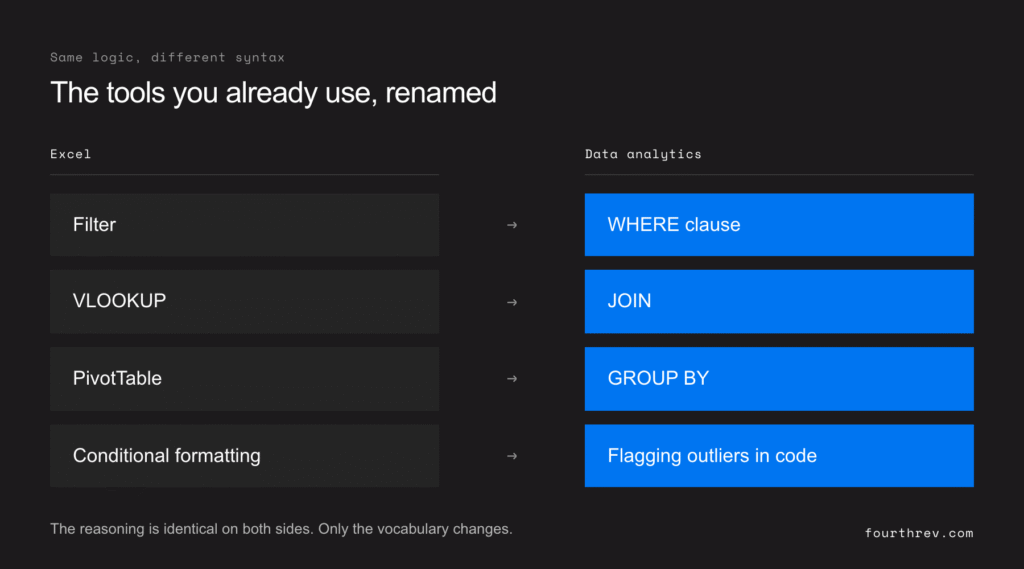
If that thought crossed your mind before you clicked on this article, you’re in good company, and it’s worth addressing before question one. It’s one of the most common things we hear from people looking at a move into data analytics: a worry that everyone else in the room will be better with numbers, or that the coursework will turn out to be maths in disguise. Here’s a more useful way to think about it: Excel interview questions are fundamentally about structured logic – the maths is secondary. They test whether you can break a messy problem into steps, spot the pattern in a dataset, and explain why you did what you did. If you’ve ever built a formula that failed, figured out why, and fixed it, that’s the actual skill – and it’s the same skill data analytics is built on, just applied with different tools. The diagram below shows what we mean. The four Excel tools most people already know map directly onto the tools data analysts use every day. Everything you need is already familiar; only the vocabulary changes.
And if you’re further along in your career and worry the gap is more about outdated tools than confidence, that’s a different, more solvable problem: your instincts are fine; your toolkit just needs a refresh.

General questions

These usually open the interview. They’re less about testing recall and more about understanding how you use Excel day-to-day.
    1. How would you describe your Excel experience? Be specific. “I use Excel daily” tells an interviewer very little. “I build weekly reporting dashboards using PivotTables and conditional formatting, and I’ve automated parts of that process with macros” tells them a lot.
    1. Talk me through a time you used Excel to solve a real problem. Have one or two examples ready, ideally ones where you cleaned messy data, spotted an error, or made something faster or clearer for a stakeholder.
    1. What’s your process for checking your work in a spreadsheet? Employers ask this because a wrong formula that “looks right” is one of the most common ways bad data ends up in a business decision. A good answer mentions spot-checking totals, using formulas like SUMPRODUCT or COUNTIF as sanity checks, and being sceptical of your own numbers.

Basic questions

These confirm the fundamentals are solid before the interview moves on.
    1. What’s the difference between a workbook and a worksheet? A workbook is the whole file; a worksheet is one tab within it.
    1. What’s the difference between relative and absolute cell references? A relative reference (A1) shifts when you copy a formula across cells. An absolute reference ($A$1) stays fixed. This one comes up constantly because getting it wrong is a common source of broken formulas.
    1. How do you freeze rows or columns, and why would you? Freeze panes keep headers visible while scrolling through large datasets – useful for anyone reviewing long lists of records.
    1. What file formats can Excel save to, and why does it matter? .xlsx, .csv, .xlsm (macro-enabled) and .pdf are the common ones. Knowing when to use .csv for data exchange versus .xlsx for formatting-heavy files shows you understand how spreadsheets fit into a wider workflow.
    1. How do you remove duplicate values from a dataset? Data tab → Remove Duplicates, or a formula-based approach using COUNTIF if you want to flag duplicates while keeping the original data in place – worth mentioning, since flagging first is often the safer approach.

Intermediate questions

This is where interviewers start testing whether you can actually work with real, messy data.
    1. What’s the difference between VLOOKUP and INDEX/MATCH? VLOOKUP searches for a value in the first column of a range and returns a value from a column to the right. INDEX/MATCH is more flexible – it can look left, stays more stable when columns are inserted, and is generally considered the more robust choice for larger or evolving datasets.
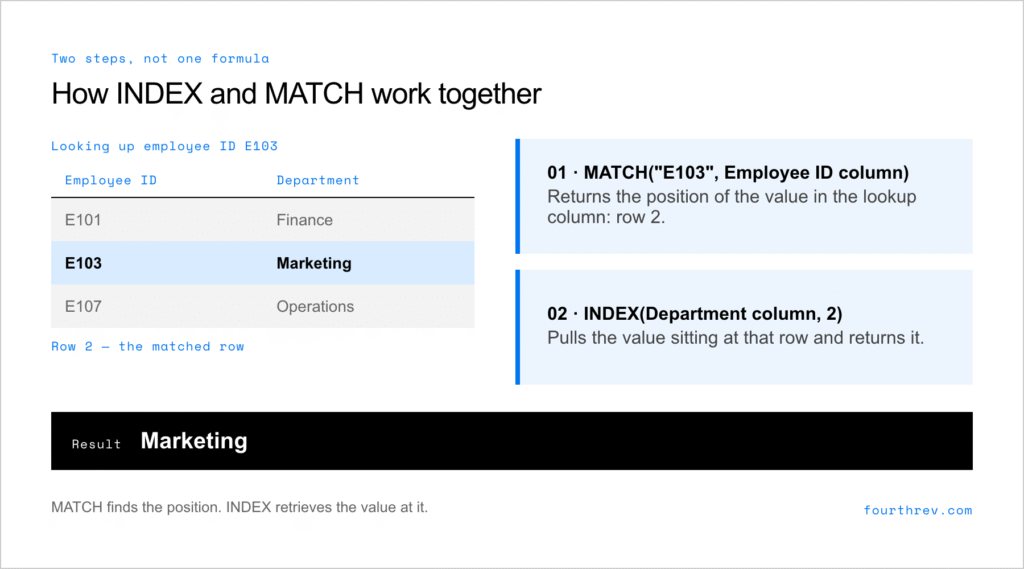
This is also the question where a lot of candidates freeze up, so it’s worth seeing the mechanism laid out rather than just the definition:
MATCH finds the position; INDEX uses that position to retrieve the value. Two simple steps, working together instead of one complicated one. Try it yourself: take any small table with an ID column and a second column of values. Pick an ID, and manually count down to find its row number. Then look across to that row in the second column. That’s the entire mechanism, run by hand, before a formula ever gets involved.
    1. What are the limitations of VLOOKUP? It can only search left-to-right, it breaks if columns are added or removed, and it’s slower on large datasets than alternatives like INDEX/MATCH or XLOOKUP.
    1. How would you use conditional formatting to highlight outliers in a dataset? Explain the logic first, then the button clicks: you’re setting a rule (e.g. values more than two standard deviations from the mean, or simply above/below a threshold) so exceptions are visible at a glance rather than requiring a manual scan.
    1. How do you build a PivotTable, and when would you use one over a formula-based summary? PivotTables are the fastest way to summarise and re-slice large datasets, skipping the need to write formulas for every combination of categories. The follow-up question is usually “why,” so be ready to explain that PivotTables are better for exploratory analysis, while formulas are often better when the output needs to feed into another system or report.
    1. What’s a macro, and have you built one? A macro records or scripts a repeated task in VBA. Basic familiarity is enough here – you should be able to describe a task you automated and roughly why it saved time.
    1. How do you handle a dataset with missing or inconsistent values? This tests judgement as much as tools. A strong answer covers identifying the gaps (filters, COUNTBLANK), deciding whether to exclude, flag, or impute them, and being transparent with stakeholders about what you did and why.

Advanced questions

These questions separate confident Excel users from people who’ve genuinely used it to solve harder analytical problems.
    1. How would you combine INDEX/MATCH with multiple criteria? This usually means nesting MATCH with an array formula, or using INDEX/MATCH across concatenated helper columns. The interviewer is checking whether you can extend a familiar tool to a less standard problem.
    1. What’s an array formula, and when have you needed one? Array formulas perform multiple calculations across one or more items in an array, returning either a single result or multiple results. A common real-world use is summing values that meet several conditions across scattered ranges.
    1. How would you build a dashboard that updates automatically as new data comes in? A strong answer touches on structuring source data as an Excel Table (so ranges expand automatically), using PivotTables or dynamic formulas linked to that Table, and being deliberate about what a “dashboard” is for – a small number of decisions it helps someone make, rather than every number available.
    1. What’s the difference between XLOOKUP and INDEX/MATCH? XLOOKUP is newer, simpler to write, and can search in either direction natively, but it’s only available in more recent versions of Excel – so knowing both matters if you’re likely to work across organisations with different setups.
    1. How do you audit a spreadsheet someone else built, to check if the formulas are trustworthy? This is a favourite among interviewers because it mirrors real work. Mention tools like Trace Precedents/Dependents, Evaluate Formula, and simply rebuilding a calculation independently to see if you get the same answer.
    1. Where does Excel start to break down, and what would you reach for instead? This is arguably the most important question on this list, and the one most candidates find toughest to answer. A good answer is honest: Excel struggles with very large datasets, version control across teams, and reproducibility. Tools like SQL, Python or Power BI take over from there – and knowing where that line sits is itself a sign of analytical maturity.

A quick self-check

Before you judge yourself against this list, treat it as a reflection exercise rather than a pass/fail test. Tick off what’s actually true for you:
    • I’ve built a formula that failed, then figured out why and fixed it.
    • I’ve used a filter or sort to answer a specific question about a dataset.
    • I’ve spotted an error or inconsistency in a spreadsheet before it caused a problem.
    • I’ve built or used a PivotTable to summarise something for someone else.
    • I’ve explained a number or a trend to someone less technical than me.
If two or three of those are true, you already have the reasoning data analytics is looking for. The rest, including the specific syntax of SQL or Python, is learnable – it’s a vocabulary problem more than an aptitude one.

How to actually prepare

A few things matter more than memorising function syntax:
    • Practise explaining your thinking out loud as well as producing the right answer. Interviewers are assessing whether you could explain a number to a stakeholder outside your technical team, because that’s the job.
    • Have two or three real examples ready – a time you cleaned messy data, automated something repetitive, or caught an error before it caused a problem. Genuine examples beat rehearsed definitions every time.
    • Know your limits, and say so honestly. “I’ve only built array formulas occasionally, but here’s how I’d approach it” lands far better than guessing.
    • Refresh the fundamentals, even if you’re experienced. Absolute vs relative references and VLOOKUP’s limitations come up more often than any advanced topic on this list, and it’s an easy way to lose credibility if you fumble them.
    • If you’re worried you’ve left it too late, that’s a timing question more than a capability one. Employers care whether your skills are current, more than how many years you’ve been working. Refreshing a toolkit that’s gone stale is a much smaller task than learning to think analytically from scratch – and if you’ve been doing the latter in Excel for years, you’ve already done the hard part.

When Excel questions reveal the real question

If you’re at the point where these questions feel routine – you’ve built the dashboards, cleaned the messy data, automated the repetitive reports – there’s a good chance you’ve already outgrown what Excel alone can offer you. That’s usually the moment we hear from people: not “I need to learn Excel,” but “I’m good at Excel, so why do these roles keep asking for SQL and Python too?” That gap – between being confident in Excel and being job-ready for a modern analyst role – is what we call the Excel ceiling, and it’s exactly what our Monash Data Analytics Career Accelerator is built to help you move past. Over six months (including a two-week orientation), you’ll build practical fluency across Excel, Power BI, SQL, Python and cloud databases, work on a live Employer Project with a real industry partner, and earn a Monash University Digital Credential, alongside career coaching that continues until you land the role. The entry criteria are broader than a lot of people assume: you can qualify with prior study or with relevant hands-on experience working with data, reporting or spreadsheets, and no coding background is needed to start. If you’re unsure where you stand, a short data readiness check is a good way to find out, rather than guessing. Demand for the role is real too: data analyst salaries in Australia range up to AU$110,000 a year according to Glassdoor, and up to AU$143,000 in senior roles, with demand forecast to grow 23.2% over the next five years.

FAQs

Do I need to know Excel perfectly before applying for data analytics roles?

No. Employers expect confidence, not perfection. Understanding the concepts behind VLOOKUP, PivotTables and conditional formatting matters more than having every function memorised.

Is Excel still relevant if I’m learning SQL and Python?

Yes. Most workplaces still use Excel for quick analysis, sharing results with non-technical colleagues, and smaller ad hoc tasks. It doesn’t disappear once you learn other tools – it becomes one of several tools you choose between.

How technical do Excel interviews usually get for entry-level analyst roles?

Most entry-level interviews stay within the basic-to-intermediate range on this list: references, lookups, PivotTables and conditional formatting. Advanced topics like array formulas are more common for mid-level or senior roles.

Do I need to be good at maths to succeed in data analytics?

No, not in the way people usually mean it. Day-to-day analytics work relies on logical thinking, pattern recognition and attention to detail far more than advanced mathematics – most of the actual calculation is done by the software. If you can follow the INDEX/MATCH example above, you already have the kind of reasoning the field is built on.
  Thinking about what comes after Excel? Explore the Monash Data Analytics Career Accelerator or read more about the range of careers data analytics skills can open up.

How to Break Into Tech Without a Tech Background

Most people trying to work out how to get into tech assume the door is only open to computer science graduates and 22-year-old engineers. If you’ve spent eight, ten or fifteen years building expertise in marketing, sales, teaching, HR or hospitality, it’s easy to think none of that counts.

That assumption is wrong, and increasingly out of date. The people thriving in tech now are usually career changers with a strong first chapter somewhere else entirely.

Tech in 2026 is not one career. It’s six or seven distinct disciplines, among them product management, UX and UI design, digital marketing, data analytics, data science, AI leadership and cybersecurity, each valuing commercial judgement and communication as much as code, and each open to people who built their first career somewhere else.

This guide covers what the UK tech market actually looks like, which lane fits your existing strengths, and the exact route to a role with a credential and evidence behind it.

If you want to skip ahead and see the full range of routes, you can browse all FourthRev Career Accelerators.

What tech actually looks like in the UK in 2026 (reality check)

Start with the numbers, because they explain why this door is opening rather than closing. UK tech employs around 2 million IT specialists, of whom 441,000 are women. Data roles alone have 178,000 to 234,000 unfilled positions, costing the UK economy roughly £57 billion a year in lost output.

AI-linked roles are growing around 32% year on year, and 61% of product manager job postings now ask for AI experience. The World Economic Forum’s Future of Jobs Report 2025 projects that AI and information processing will affect 86% of businesses by 2030, and that 39% of core skills across all roles will change. Put plainly: employers are short of skilled people, and what counts as “skilled” has shifted away from a computer science degree towards applied capability.

One caveat. Junior engineering roles are competitive and tend to go to CS graduates, so that isn’t where a career changer should aim. The high-value, harder-to-fill roles combine technical fluency with business judgement, and those reward the experience you already have. For a sense of where the money is, see the five highest-paying digital jobs right now.

Why tech is not just engineering (the biggest myth to drop)

This is the myth worth dropping first. The six or seven highest-paying, most in-demand tech disciplines in the UK in 2026, product management, UX and UI design, digital marketing strategy, data analytics, data science, AI leadership and cybersecurity strategy – are all tech roles, all in demand, and filled predominantly by people who didn’t start in engineering.

The mistake most career changers make is trying to become a software engineer, because that’s what “tech” sounds like from the outside. The better move is picking the discipline where your existing background already gives you a head start, then proving you can do the work with a real, briefed project rather than a certificate alone.

FourthRev calls this the head start most career changers don’t know exists: an employer-set brief, done as part of a structured programme, that a hiring manager can actually call and verify.

Your task, in other words, has two steps: pick the lane, then prove you can run in it.

What your non-tech background already gives you

Every professional background maps onto at least one in-demand tech lane. Here’s how the transferable strengths line up.

Your background Transferable strengths Best-fit tech lane
Sales, business development, account management Pipeline thinking, conversion writing, comfort with metrics, customer understanding Digital marketing, product management, AI leadership
Traditional marketing (brand, above-the-line) Brand strategy, audience insight, creative briefing, campaign planning Digital marketing strategy, product management (positioning), UX research
Teaching, training, L&D Structured explanation, empathy for the learner, feedback loops UX and UI design, product management, AI leadership
HR, recruitment, operations Stakeholder management, process design, data literacy Digital marketing (ops), product management, data analytics
Finance, accounting, actuarial Numerical rigour, statistical thinking, commercial modelling Data analytics, data science, cybersecurity leadership (risk)
Hospitality, retail, customer service Customer empathy, service design, real-time problem solving UX and UI design, product management, digital marketing
Healthcare and allied professions Systems thinking, evidence-based decisions, high-stakes judgement Data analytics, data science, product management (health tech), AI leadership
Consultancy, project management Structured problem-solving, stakeholder communication, delivery Product management, AI leadership, cybersecurity strategy

Employers hiring for these lanes now say the same thing, repeatedly: commercial judgement is scarce, technical execution is teachable. That is exactly the shape a career changer arrives in.

The seven tech lanes a non-tech professional can move into

Each lane below covers what the role does, why it suits a non-tech background, and typical UK salary bands for 2026. Advertised-role medians come from ITJobsWatch, based on permanent vacancies in the six months to 26 August 2026, and they refresh continuously, so treat them as a snapshot. Entry and career-stage ranges come from Prospects.

1. Product management

PMs own what gets built and why, sitting between business strategy, engineering, design and data. Suits consultancy, teaching, project management, HR, sales and operations backgrounds: the job is structured decision-making under uncertainty.

UK salary (2026): entry £33,000 to £34,000; median £65,000 UK, £75,000 London; senior £53,000 to £97,000 (averaging £73,000), Heads of Product £100,000+ in London. (ITJobsWatch, Prospects)

Your route in: King’s Product Management Career Accelerator.

2. UX and UI product design

UX designers research and map how people use software; UI designers build the visual layer. Suits teaching, hospitality, retail, customer service and healthcare backgrounds: the job is applied empathy and structured problem-solving.

UK salary (2026): entry (graduate) £20,000 to £26,000; experienced £35,000 to £55,000; median across advertised roles £60,000 UK and London (down 14.29% year on year); senior designers and consultants £40,000 to £65,000+. (ITJobsWatch, Prospects)

Your route in: King’s UX & UI Product Design Career Accelerator.

3. Digital marketing strategy and analytics

Digital marketers design and run measurable campaigns across paid, search, social, content and lifecycle channels, with data as the senior-level differentiator. Suits sales, traditional marketing, HR comms, teaching, PR and hospitality.

UK salary (2026): entry (assistant) £23,500 to £25,000; executive or officer £27,000 to £30,000; manager £40,000 to £60,000, median £67,500 UK, £60,000 London across advertised roles. (Prospects, ITJobsWatch)

Your route in: LSE Digital Marketing Strategy & Analytics Career Accelerator (also CIM Employability Programme certified).

4. Data analytics

Data analysts turn business questions into data answers, and the function sits underneath every other one. In 2026, the fastest-hired analysts are “augmented” analysts, fluent with AI tools. Suits finance, actuarial, healthcare, marketing, HR and operations backgrounds.

UK salary (2026): entry £23,000 to £25,000, graduate schemes at larger firms around £30,000; median £48,500 UK, £57,500 London; experienced, senior and consulting roles £60,000+, with data engineers and scientists earning more still. (ITJobsWatch, Prospects)

Your route in: LSE Data Analytics Career Accelerator. See also why now is the best time to pursue a career in data.

5. Data science

Data scientists build the models that predict, personalise and automate. Needs a stronger statistics and coding baseline than analytics, but it’s learnable for people who already use numbers professionally: finance, actuarial, academia, healthcare, engineering.

UK salary (2026): entry £25,000 to £30,000, rising to £40,000 with experience; mid-career £40,000 to £60,000; median £75,000 UK, £80,000 London (up 7.14% year on year); lead and chief data scientists £60,000+, up to £100,000 or more. (ITJobsWatch, Prospects)

Your route in: Cambridge PACE Data Science Career Accelerator.

6. AI leadership

AI leadership means owning how a business adopts AI: strategy, ethics and change, not coding. Built for people already senior in another discipline, ideally consultancy, operations, product, marketing, finance or project management, with ten or more years in.

UK salary (2026): roles requiring AI skills carry a median of £72,500 UK, £85,000 London (up 3.57% year on year, across 5,240 advertised salaries). AI now appears in 8.62% of all permanent UK IT vacancies, up from 4.70% two years ago. No UK source yet benchmarks AI leadership as a discrete role, so treat this as the AI-skills median, not an AI-leadership-specific band. (ITJobsWatch)

Your route in: LSE AI Leadership Career Accelerator.

7. Cybersecurity strategy and leadership

Cybersecurity strategy protects the business and designs its security posture: a strategy role, not a hacking role. Suits risk, audit, finance, defence, consultancy and operations backgrounds.

UK salary (2026): overall median £60,000 UK, £75,000 London (up 4.35% year on year); cybersecurity now accounts for 6.23% of all permanent UK IT vacancies; Head of Information Security median £90,000 UK, £99,500 London. (ITJobsWatch: cyber security, ITJobsWatch: Head of Information Security)

Your route in: Cambridge PACE Cybersecurity Strategy & Leadership Accelerator.

Still not sure which of the seven fits? Use FourthRev’s Which Career Accelerator should I choose? decision guide.

The step-by-step route in, once you’ve picked your lane

Step 1. Confirm the lane fits by talking to people already in it

Before investing six months, talk to three or four people already doing the job (LinkedIn outreach, Reddit threads and open-day webinars are enough). Ask what their Monday morning looks like, and what they wish they’d known. It costs nothing, and saves you from learning the wrong lane.

Step 2. Learn on a programme that gives you a credential and applied work

Self-teaching works for some. For most career changers, a university-partnered programme with a credential and a real employer project is the fastest credible route in: employers hiring for these lanes trust a Russell Group or equivalent partner, an applied portfolio piece, and evidence you can work with a real team.

See how to choose a credible online programme, what a Career Accelerator actually is, and how the FourthRev learning model works.

Step 3. Build proof as you learn, not after

Your biggest lever is a portfolio of applied work: a campaign case study, a UX case study, a data project, a product spec, an AI implementation plan. Build these from week one, so learning and portfolio-building are the same activity.

Here’s how project-based learning accelerates your career.

Step 4. Do real, briefed work with a real company

This is the part self-taught routes can’t replicate. A briefed project set by a real business, completed as part of your programme, gives you a portfolio piece a hiring manager can actually call and verify.

Read more about the head start most career changers don’t know exists.

Step 5. Frame the career change as an asset on your CV

Turn your previous career into a narrative on your CV, LinkedIn and cover letters. Commercial context, communication and judgement are exactly what tech hiring managers say they struggle to find in digital natives. Own the switch.

See overcoming imposter syndrome in a career change and your guide to switching career paths.

Step 6. Apply and interview with proof, not credentials alone

Lead every application with the portfolio piece, not the CV, and prepare to walk a hiring manager through it. Warm intros still convert best. Plenty of hiring managers in tech previously worked in marketing, sales, teaching or finance themselves, and will read your background sympathetically.

See 12 tips to ace your next interview and how a career coach can help you reach your goals.

How long does it take, and can I do this while working?

There are three realistic routes: fully self-taught, a bootcamp, or a university-backed career accelerator.

On a structured programme, six to seven months of focused effort, around 15 to 20 hours a week alongside a full-time job, is the standard route to a job-ready portfolio and credential.

Bootcamps compress the timeline but usually skip the credential and the employer brief.

Self-teaching can work, but it takes longer and gives sceptical hiring managers no independent signal of credibility.

See can you change careers while working full time?, cohort-based vs self-paced learning for career changers, and how to measure ROI on a career programme.

Do employers actually take non-tech career changers seriously?

Yes, and increasingly so. Employers are actively short of skilled people, as the state-of-industry figures above show, and the criteria for “skilled” now lean on judgement, communication and applied capability rather than where a candidate studied a decade ago.

A recognised Russell Group partner credential, combined with a briefed portfolio project, is exactly the combination hiring managers respond to.

Read more on whether employers value university certificates and university certificate vs certification vs diploma.

Real people who broke into tech without a tech background

    • Sofia moved from an HR role into digital marketing, using the LSE Digital Marketing Career Accelerator to build a channel strategy case study. Read Sofia’s story.
    • Luis broke into sports analytics through the LSE Data Analytics Career Accelerator, turning a lifelong interest in sport into a data-driven career. Read Luis’s story.
    • Emma made a mid-career shift from engineering into data analytics. Read Emma’s story.
    • Olena built the executive judgement to lead AI adoption in her organisation. Read Olena’s story.
    • Klaudia moved from hospitality into purpose-driven product design. Read Klaudia’s story.

For more, browse FourthRev’s impact stories.

FAQ

Can I get into tech without a degree in computer science?

Yes. Most high-demand tech disciplines, including product management, UX and UI design, digital marketing, data analytics and AI leadership, are filled predominantly by people without a computer science degree. What matters more is a relevant credential, a demonstrated project and commercial judgement.

Do I have to learn to code to work in tech?

No. Product management, UX and UI design, digital marketing, AI leadership and cybersecurity strategy don’t require you to write code day to day. Data analytics and data science lean more on technical tools, but both are learnable without a coding background.

Am I too old to change careers into tech?

No. AI leadership roles are built for people already ten or more years into a career, since they require the business judgement that comes with experience. Across every lane, employers value commercial context over age.

How long does it take to break into tech from a non-tech background?

On a structured, university-partnered programme, six to seven months of focused effort (around 15 to 20 hours a week) is typical for a job-ready credential and portfolio. Self-taught routes usually take longer and carry less credibility with hiring managers.

Which tech role should I pick if I come from marketing, sales, HR or teaching?

Marketing and sales fit digital marketing, product management or AI leadership. HR fits product management and data analytics well. Teaching fits UX and UI design, product management and AI leadership. See the full background-to-lane mapping above for more combinations.

Do employers take university-partnered certificates seriously?

Yes. Employers hiring into these lanes look for a recognised university partner, an applied portfolio piece and evidence of working with a real team, which is why a credentialed programme with an employer-briefed project carries more weight than a certificate alone.

Is AI going to close these routes into tech?

The opposite so far. AI-linked roles are growing around 32% year on year, and AI now appears in a growing share of job postings across product, marketing and data roles. It’s changing what these jobs involve, but currently expanding demand for people who can apply it with business judgement, not removing the need for them.

Ready to take your next step?

Tech is not one career. It’s six or seven, and your existing background is very likely a head start in at least one of them. Pick your lane, get a credential and portfolio packed with evidence that you can do the job, and lead every application with proof, not apology.

If you’re still weighing up your options, take the Career Accelerator decision guide. If you already know your lane, browse all Career Accelerators or see how the FourthRev learning model works.

Changing Careers at 40 in the UK (A Realistic Playbook)

Around 40, changing careers starts to feel less like reinvention and more like a practical calculation. 

You may have spent 15 or 20 years building a career, earning a decent salary and becoming very good at what you do. Yet the work feels less satisfying than it once did. Perhaps your industry is changing. Perhaps AI is reshaping your role. Or perhaps you have simply reached the point where another decade doing the same thing feels unappealing.

Then comes the practical maths. There is a mortgage or rent to pay. Children, parents or other people may depend on your income. Your current salary has taken years to build. Time is already scarce.

A career change at 40, therefore, requires a different strategy from one at 25.

The aim is to use the experience you already have, add the skills and evidence your next field requires and move across at the highest realistic level.

For a wider introduction to making the move, read your guide to switching career paths.

Is 40 too old to change careers in the UK?

The short answer is simple: 40 can be a very practical age to change careers.

The more useful answer comes from looking at what is happening to work itself.

The World Economic Forum expects 39% of workers’ existing skills globally to change or become outdated between 2025 and 2030. AI and big data are among the fastest-growing skills, alongside cybersecurity and technological literacy. Analytical thinking, leadership, resilience and creative thinking also remain important.

That creates an interesting labour market for experienced professionals.

Employers increasingly need people who can combine newer technical knowledge with skills that take longer to develop: commercial judgement, communication, stakeholder management and an understanding of how organisations actually work.

This changes the calculation for a midlife career change. Your existing experience can become part of your proposition to an employer rather than something you leave behind.

The strongest opportunities are usually roles where previous commercial or professional experience carries across. Many of the highest-paying digital jobs reward exactly this combination of specialist knowledge and broader business understanding.

The five real constraints of changing careers at 40

Career-change advice often focuses on choosing something you love, updating your CV and starting to network.

Those things have value. For someone changing careers at 40, five more immediate constraints usually shape the decision.

1. Your income has a floor

By 40, your monthly spending has usually expanded alongside your career.

Mortgage payments, childcare, school fees, elder care, insurance and other commitments create an income level that your next career needs to support.

This makes salary research one of the first stages of a career change.

If your target field offers salaries close to your current earnings, you may be able to move sideways while retaining a similar level of seniority. A larger salary gap calls for a phased transition, perhaps through an adjacent role that uses more of your existing expertise.

The goal is career progression with your financial life intact.

For a framework for evaluating the financial return of further study, read how to measure ROI on a career programme.

2. Your time is limited

A full working week leaves relatively few hours for retraining.

Add family responsibilities, exercise, commuting and the ordinary administration of adult life and 10 to 15 hours of study each week may already represent a substantial commitment.

Your learning plan needs to fit that reality.

A part-time programme spread across several months can allow you to develop new skills while continuing to earn. You can also read more about changing careers while working full time.

3. Your energy has value

Study time and productive study time are different things. Three focused sessions during the week and a longer block at the weekend may achieve more than repeatedly trying to study late into the evening.

A sustainable career change fits around your existing life for long enough to produce results.

4. Age can influence where you compete

Age bias remains part of the labour market, which makes role selection important.

A 40-year-old with 15 years of commercial experience has a different proposition from a graduate competing for their first junior position.

Roles that value judgement, domain expertise, stakeholder management and leadership give experienced professionals more opportunities to use what they have already built.

The question becomes: where does my experience increase my value?

5. Your professional identity has momentum

Spend 15 years describing yourself as an accountant, teacher, marketer, engineer or operations manager and that identity becomes powerful.

A career change gradually expands it.

You may be an operations leader learning data analytics, or a marketer developing product management expertise, long before you feel comfortable using your new professional label.

That overlap is part of the transition. For more on the psychological side of changing direction, read overcoming imposter syndrome in a career change.

Why 40 can be a strong age to change careers

Experience creates assets that become particularly valuable when combined with new skills.

Judgement

After 15 or 20 years at work, you have seen projects succeed, fail and drift somewhere in between.

You have probably dealt with unrealistic deadlines, difficult stakeholders, shifting priorities and budgets that suddenly disappeared.

That experience develops judgement, something employers value in roles where decisions carry commercial consequences.

Commercial context

Technical skills can be learned relatively quickly. Understanding how decisions affect customers, costs, revenue and organisational priorities usually takes longer.

A finance professional learning data analytics, for example, brings an existing understanding of what financial information means to a business. A salesperson moving towards product management already understands customers, objections and commercial value.

The previous career provides context for the new one.

Stakeholder fluency

Experienced professionals usually know how to run meetings, manage expectations, present ideas, influence decisions and communicate with senior colleagues.

These skills become especially useful in product, data, AI, cybersecurity and digital marketing roles where technical work needs to translate into business decisions.

A professional network

By 40, you may have former colleagues, managers, clients, suppliers and industry contacts spread across dozens of organisations.

That network can provide information, introductions and opportunities as you move.

A conversation with a former colleague working in your target field may tell you more about your realistic entry point than hours spent scrolling through job adverts.

Discipline

You already know how to complete difficult work alongside competing priorities.

This becomes especially valuable when retraining takes months rather than weeks. 

A realistic eight-step career change playbook

A successful midlife career change usually looks more like a managed transition than a dramatic leap.

Here is how to approach it: 

Step 1: Do the money maths first

Start with three numbers: your current after-tax income, your essential monthly spending and the salary range in your target field.

Then calculate how much income flexibility your household has.

If salaries in the new field sit reasonably close to your current earnings, look for ways to enter at a similar level by using your transferable experience.

A larger gap may call for an adjacent move first.

Doing this exercise early gives you a career plan grounded in your actual financial circumstances.

Step 2: Pick a field where you already have an advantage

The best career change at 40 is often adjacent to what you already know.

Someone from sales may bring customer insight and commercial thinking into digital marketing or product management. A finance professional may find their analytical background useful in data. A senior functional leader may apply years of management experience to AI strategy.

Look for overlap between your current strengths and the problems your target profession solves.

Your previous experience then becomes part of the case for hiring you.

Step 3: Choose study that fits your working week

For many mid-career professionals, the practical choice is between independent study and structured part-time learning.

Self-directed learning offers flexibility and low upfront costs. It also places responsibility for curriculum, momentum and proof of skills entirely on you.

A structured cohort-based programme provides deadlines, peers, expert guidance and, depending on the programme, practical projects and a recognised credential.

The right choice depends on your budget, learning style and target field. This guide to cohort-based versus self-paced learning for career changers goes deeper into the trade-offs.

Step 4: Choose credentials with a clear purpose

At mid-career level, a credential works best as one part of a broader case.

A university-partnered certificate can provide a recognisable signal of structured learning, particularly when you are moving into a field where your CV contains little direct experience.

Its value grows when it sits alongside practical work that shows how you apply what you have learned.

Read more about whether employers value university certificates and how to choose a credible online programme.

Step 5: Build evidence while you learn

A hiring manager assessing a career changer faces a simple uncertainty: can this person perform in the new field?

Practical work reduces that uncertainty. A data project can demonstrate how you analyse information and communicate insights. A marketing project can show how you develop a strategy from customer and performance data. A product case study can reveal how you approach customer problems and commercial priorities.

Aim for learning that produces something you can discuss in an interview.

That is the value of project-based learning and of completing an applied Employer Project.

Step 6: Start with your existing network

Before sending dozens of applications, map your network.

Who already works in the field you are considering? Who works at companies that employ people in those roles? Which former managers, clients or colleagues could introduce you to someone useful?

Ask for conversations before asking for jobs.

A 20-minute discussion can clarify job titles, salary expectations, skill gaps and realistic entry points. Several conversations can reshape your entire career-change strategy.

Step 7: Make your career change tell a coherent story

A CV for a career changer should connect the two parts of your professional life.

The reader needs to understand why your previous experience makes sense alongside your new direction.

A sales leader moving into product might emphasise customer insight, commercial decision-making and stakeholder management. An engineer moving into data analytics might foreground quantitative reasoning, problem-solving and domain expertise.

Then add the newer technical skills and practical evidence that complete the picture.

Your career becomes a progression rather than a collection of unrelated chapters.

For the next stage, read these 12 tips to ace your next interview.

Step 8: Give yourself a realistic timeframe

A serious career change takes time. Allow yourself several months to develop the relevant skills and evidence, followed by time to build your network, refine your positioning, interview and secure the right role.

For many people, 12 to 18 months is a more useful planning horizon than expecting an immediate switch.

Viewed across the next decade of your working life, that period starts to look relatively short.

Which fields suit 40-plus career changers in the UK in 2026?

The strongest choice depends on the experience you already have. Several digital fields offer particularly useful overlaps with established professional skills.

Digital marketing strategy

Digital marketing can suit people from sales, communications, PR, traditional marketing and other customer-facing fields.

Commercial thinking, customer understanding, communication and campaign experience can all carry across. New skills typically centre on digital channels, analytics, measurement, experimentation and marketing technology.

For a deeper route into the field, read how to move into digital marketing.

Product management

Product management rewards people who can understand customers, evaluate competing priorities and work across functions.

That makes backgrounds such as consulting, project management, operations, sales, business development and customer-facing roles potentially useful starting points.

The work combines customer insight, commercial thinking, prioritisation and stakeholder management with product-specific methods and tools.

Data analytics

Finance, actuarial, engineering, healthcare, operations and other quantitatively oriented careers can provide a strong foundation for data analytics.

The technical layer may involve tools such as Excel, SQL, Power BI, Tableau or Python. Domain expertise provides the context required to turn analysis into useful decisions.

The UK also continues to face a substantial data skills gap. For a closer look at the options, see careers you can pursue with data analytics skills.

AI leadership

AI leadership is particularly relevant for experienced managers who want to lead adoption and transformation rather than become software engineers.

The value lies in understanding where AI can create business value, evaluating risk, leading organisational change and making informed strategic decisions.

This is precisely where years of management and industry experience can become an advantage.

Cybersecurity strategy

Professionals from risk, audit, finance, consultancy, defence and related fields may find significant overlap with cybersecurity strategy.

For a wider look at possible routes, read how to break into tech without a tech background.

What does a career change at 40 actually cost?

Course fees are only one part of the calculation. Imagine you spend £6,000 on a six-month programme requiring roughly 300 hours of study.

There are three costs to consider:

First is the £6,000 fee.

Second is the value of the 300 hours you spend learning.

Third is the career opportunity attached to the investment. If the move allows you to maintain your current income, access a stronger long-term salary trajectory or move into work with better prospects, the return accumulates over several years.

This makes career-change ROI a longer-term calculation.

Compare the investment with another scenario: spending five more years in your current field while your interest, skills or earning prospects gradually lose momentum.

The financially sensible answer will vary by person. The important point is to compare both futures rather than looking at the programme fee in isolation.

Real examples of mid-career change

Career-change stories are useful because they show what a transition looks like beyond the job title.

FourthRev’s learner stories include Sofia’s move from HR into digital marketing and Emma’s mid-career shift from engineering to data analytics.

For experienced professionals thinking about AI, Olena’s story offers another model: developing the judgement required to evaluate and lead AI adoption from a senior position.

You can find more examples in FourthRev’s impact stories.

Being 40 changes the strategy

A career change at 40 comes with real constraints. It also comes with assets.

You have experience. You understand organisations. You have built relationships, made decisions and developed professional judgement.

The task is to combine those assets with the skills your next field requires.

Start with the financial maths. Choose a field where your existing career gives you leverage. Find a learning format that fits your week. Build practical evidence while you study. Use your network early. Then present the transition as a coherent progression.

Give yourself 12 to 18 months and treat the process as an investment in the decade or two of work ahead.

If you already know where you want to move, browse FourthRev’s Career Accelerators. You can also see how the FourthRev learning model works or start with what a Career Accelerator is.

FAQs

Is 40 too old to change careers in the UK?

Forty can be a practical point to change careers because you bring substantial professional experience alongside the opportunity to build newer skills. The World Economic Forum expects 39% of workers’ existing skills globally to change or become outdated by 2030, making continued learning increasingly relevant across age groups.

Can I change careers at 40 while protecting my salary?

Your best opportunity usually comes from an adjacent move that uses your existing experience. Research salaries in your target field and identify roles where your commercial knowledge, domain expertise or management experience supports entry above graduate level. A larger salary gap may suit a phased transition.

What are good career changes at 40 in the UK?

Digital marketing strategy, product management, data analytics, AI leadership and cybersecurity strategy can all offer useful routes for experienced professionals. The strongest option is usually the one with the greatest overlap between your current expertise and the problems employers need you to solve.

Do I need to go back to university to change careers at 40?

Several routes are available, including self-directed learning, professional qualifications and shorter university-partnered programmes. A part-time programme can suit mid-career professionals because it allows you to continue working while developing skills, a credential and practical evidence.

What about a career change at 45 or 50 in the UK?

The same principle becomes increasingly useful: choose fields where experience carries value. Leadership, commercial judgement, stakeholder management and domain expertise can support moves into areas such as AI strategy, product management, cybersecurity strategy and data leadership. As skills requirements continue to change, ongoing learning is becoming part of working life at every career stage.

How do I explain a career change at 40 on my CV?

Connect your previous career directly to your new direction. Show which skills transfer, explain the new expertise you have developed and lead with practical evidence that demonstrates your ability to perform in the target field. The aim is to present one coherent professional story.

How long does a realistic career change take at 40?

A planning horizon of around 12 to 18 months gives you time to learn, build practical evidence, develop your network and find the right role. The exact timeline depends on your starting point, target profession and the amount of time you can dedicate each week.

Do University Certificates Help You Get Hired?

You have completed the programme, earned the certificate and updated your LinkedIn profile. Now comes the more uncomfortable question. Does a university certificate actually move the needle when somebody decides whether to hire you?

The answer is yes, sometimes. But the certificate itself is rarely the whole story.

Online education has made credentials abundant. A hiring manager can now encounter everything from a badge awarded after a few hours of video lessons to a university certificate earned through months of assessed study. They may look similar when compressed into one line on a CV. They aren’t the same thing.

This abundance has created a new problem for candidates: credential fatigue. Employers have more qualifications to interpret, while candidates have more choices about where to spend their time and money. The institution behind a credential matters. So does the way you earned it. But increasingly, employers also want to know what you can actually do.

If you are exploring your options, start with 10 things to know about Career Accelerators.

The credential spectrum: not all certificates are equal

Completion badges vs. assessed credentials

The word ‘certificate’ covers an unusually broad range of educational experiences.

At one end are credentials that primarily demonstrate participation or completion. A learner enrols, works through a set of materials and receives evidence that the course has been completed. These can still be useful. They can introduce a new subject, help someone explore an unfamiliar field or provide a structured way to acquire a particular skill.

But completion and assessment are different signals. An assessed university credential signals demonstrated understanding against defined academic standards. 

That distinction becomes more important as online learning becomes more common. When certificates are plentiful, the process required to earn one matters.

As an example, the Cambridge PACE Data Science with Machine Learning & AI Career Accelerator illustrates the difference. Learners are assessed through projects rather than examinations, with practical work designed to demonstrate the application of data science knowledge. Academics involved in the programme have described the intended outcome as a combination of academic and industry skills, rather than academic knowledge in isolation.

The certificate therefore has value partly because of what sits behind it.

Bootcamp certificates vs. university certificates

Bootcamp certificates vary considerably in quality and recognition, which can make them harder for employers to assess at a glance. A recognised university offers a more familiar reference point. A hiring manager may know little about the specific programme, but institutions such as the London School of Economics (LSE), King’s College London and the University of Cambridge Professional and Continuing Education (PACE) bring established reputations.

That recognition is most valuable when it reflects rigorous learning and strong skills. In the early stages of hiring, it can provide a useful quality signal when employers have limited information about a candidate.

For career changers, this signal can be particularly valuable. When your previous experience does not directly match the role you are pursuing, a recognised credential provides additional evidence of your commitment and developing expertise.

For a fuller comparison of the choices, see Career Accelerator vs bootcamp vs online course.

When a university certificate genuinely helps

When you’re changing careers and need credibility

Career change presents employers with an awkward question. How do they judge whether somebody can perform a job they have never formally held?

Previous experience becomes a less obvious proxy. Job titles may not match. Industry experience may come from another sector. The candidate therefore needs other forms of evidence.

A university certificate can provide one. This is particularly important because career changers aren’t necessarily starting from zero. They may bring years of commercial judgement, communication skills, leadership experience or specialist industry knowledge. What they lack is a recognised bridge between that experience and the new discipline.

Research with learners considering the Cambridge PACE Data Science with Machine Learning & AI Career Accelerator found that enhancing professional credibility through reputable certification was a recurring job to be done. Learners described wanting meaningful certification rather than simply accumulating certificates, and saw a respected credential as a way to strengthen their CV and demonstrate commitment to the field.

That is a subtler benefit than a certificate simply getting somebody a job. It can make a candidate easier to understand.

A credential alone will not remove every doubt that comes with changing careers. But it can give the transition a more credible structure. For more on the psychological side of making that move, read about overcoming imposter syndrome during a career change.

And remember that new technical knowledge is only part of the proposition. Existing transferable skills are the key to success when they are positioned effectively alongside new capabilities.

When you need to pass automated screening

Before a hiring manager considers your carefully constructed career story, software may consider your CV.

Applicant Tracking Systems are now commonplace among large employers. They can help organisations organise applications and identify candidates using criteria such as skills, experience and qualifications. The often-cited figure is that 98% of Fortune 500 companies use an ATS.

A recognised university credential may therefore help in two ways.

First, it gives you a qualification that can be clearly described on your CV. Second, it associates your learning with an institution an employer is more likely to recognise.

But candidates should be careful not to treat this as a magic formula. An ATS doesn’t simply see a world-renowned university name and wave an application through. Relevant skills, terminology, experience and the requirements of the particular vacancy still matter.

The university name is a signal, not a substitute for relevance.

When the role requires proof of structured learning

Some employers place greater emphasis on formal learning than others.

Large organisations, government bodies and regulated industries may operate with more structured approaches to recruitment and professional development. In these environments, evidence that learning has been organised, assessed and delivered to defined standards can carry particular value.

The underlying reason is risk.

Hiring is an exercise in uncertainty. Employers are trying to predict future performance using imperfect evidence about past performance. A recognised credential can reduce one small part of that uncertainty by showing that an external institution has assessed the candidate’s learning.

This is where university certificate value is most easily misunderstood. The credential doesn’t prove that somebody will be an excellent employee. It simply gives the employer another credible piece of evidence.

When a certificate alone isn’t enough

The certificate without the portfolio

A certificate may help open the door. A portfolio gives an employer a reason to keep it open.

This distinction matters particularly in technical and applied fields. An employer considering a data scientist, analyst, product manager or designer is unlikely to be satisfied knowing that a candidate studied the subject. They want to see how the candidate thinks.

What did you build? What problem did you solve? Which tools did you use? What went wrong? How did you respond? What did you recommend?

These questions move the conversation from education to capability.

That is why portfolio development emerged as another important job to be done in research with Cambridge PACE Data Science with Machine Learning & AI Career Accelerator learners. Prospective learners wanted tangible proof of their abilities and a professional portfolio that could help differentiate them in the job market.

The strongest programmes recognise this. They don’t force learners to choose between earning a credential and producing evidence. They make the evidence part of earning the credential.

The Cambridge programme, for example, uses practical projects throughout the learning experience and culminates in an Employer Project. Zarif, a past learner, described the end-of-course projects as particularly useful because they allowed him to see how much he had learned and gave him work he could develop for his portfolio.

That changes the proposition. Instead of saying, “I have studied data science”, a candidate can say, “Here is how I applied it.”

Read everything you need to know about the Employer Project to understand how that kind of experience can create evidence alongside the credential.

The certificate without the narrative

A hiring manager looking at a project doesn’t automatically know what role you played, what decisions you made or what the experience says about your ability to perform the job in question.

Candidates have to provide the connective tissue. A certificate says what you completed. Your career narrative explains why you completed it, what changed as a result and how the experience prepares you for the role you now want.

This is especially important for career changers. Their strongest argument is rarely that their previous career is irrelevant and they have started again. It’s usually the opposite. Their previous experience and new skills create a combination that is useful precisely because it’s unusual.

Career coaching can help candidates identify and articulate that combination. Career Accelerators include individual career coaching designed to connect learning with intended career outcomes and help learners identify transferable skills.

Read more about how a career coach can help you reach your goals.

What hiring managers actually look for

Evidence over credentials

Imagine two candidates.

The first lists a certificate in data science from a recognised institution. The second lists the same certificate and can then discuss a project in which they analysed a difficult dataset, selected an appropriate method, explained their reasoning, worked with other people and translated the result into a recommendation.

The credential is identical. The hiring signal isn’t.

This is why the most valuable university certificates tend to be attached to programmes that require learners to produce substantial work. The assessment itself becomes part of the preparation for recruitment.

The real-world results of our LSE learners offer examples of how learning, credentials and practical experience can combine in career outcomes. You can also explore learner impact stories across FourthRev programmes.

Institutional brand as a quality signal

There is nevertheless a reason university names continue to matter.

Recruitment is time-constrained. Hiring managers cannot investigate the pedagogical design of every course listed on every CV. Familiar institutions therefore function as shortcuts.

For example, the Cambridge name and reputation act as a pull factor for prospective learners, who associate the institution with quality and stronger perceived career prospects. 

How to maximise the value of your certificate

Pair it with a portfolio

Don’t make an employer choose between trusting your credential and trusting your abilities. Give them both.

Where possible, select a programme that produces work you can discuss in interviews and showcase appropriately in applications or on LinkedIn. Projects should make your skills legible. An employer should be able to understand the problem, your approach and the outcome.

This is especially valuable for people without conventional experience in their target role. A portfolio cannot entirely replace professional experience, but it gives the conversation somewhere concrete to begin.

Use career coaching to position it

The same credential can play very different roles in different career stories.

For one learner, it might establish the technical credibility required to move from an adjacent profession. For another, it might formalise skills they already use at work. For somebody seeking promotion, it may demonstrate deliberate investment in a more advanced capability.

The certificate should therefore not be presented as an isolated achievement.

Explain why you chose the programme. Explain what you learned. Explain what you applied. Explain how it connects your previous experience to the problem the employer needs you to solve.

Choose the right programme in the first place

The value of a certificate begins long before it appears on your CV.

Look behind the credential. Who designed the programme? How are learners assessed? Is the curriculum connected to real industry requirements? Will you produce substantial work? Do you receive feedback? Is there an opportunity to solve realistic business problems? Does the programme provide career support? And is the institution issuing the credential one your target employers are likely to recognise?

These questions are more useful than asking whether online certificates are worth it in the abstract.

A weak programme doesn’t become strong because it produces an attractive certificate. Conversely, a programme that combines recognised academic standards, practical work, industry exposure and career support gives the credential substance.

If you are comparing options, use the guide on which Career Accelerator should I choose. For more detail on credentials, programme structures and outcomes, explore FourthRev’s frequently asked questions.

Certificates matter, but context matters more

So, do university certificates help you get hired? They can.

A university certificate from a recognised institution can strengthen credibility, particularly when you are changing careers, formalising existing skills or competing in a hiring process where employers have limited evidence on which to judge you.

But be sure to pair the credential with a portfolio that shows what you can do. Develop a career narrative that explains why your learning matters. Connect new capabilities with the experience you already possess. Choose a programme in which assessment requires you to apply your knowledge rather than merely consume information.

You can browse Career Accelerator programmes to compare your options.

For data-focused learners, explore the LSE Data Analytics Career Accelerator. For those pursuing design careers, see the King’s UX & UI Product Design Career Accelerator.

You can also learn about FourthRev’s Career Milestone Guarantee and the support available around career outcomes.

FAQs

Do employers value university certificates from online programmes?

Yes, particularly when the certificate represents assessed learning from a recognised institution rather than simple course completion. The university name can provide an initial quality signal, but employers will still want evidence that you can apply what you learned. Practical projects, relevant experience and a strong portfolio make the credential considerably more useful.

Is a university certificate better than a bootcamp certificate?

It depends on the programme, employer and role. A recognised university certificate may carry greater institutional recognition, particularly in larger or more formal organisations. A strong bootcamp can still be valuable where employers place greater emphasis on demonstrated practical skills. The more useful comparison is between what each programme requires you to learn, apply and produce.

Will a university certificate get me past ATS filters?

It can help strengthen the information available to an Applicant Tracking System, particularly when your CV clearly includes relevant qualifications, skills and terminology. But no university name guarantees that an application will pass automated screening. Your CV still needs to match the requirements of the role and accurately describe the skills and experience you bring.

Can I get a postgraduate certificate from a Career Accelerator?

Some Career Accelerators may provide routes into further formal qualifications, but the credential varies by programme and university. Prospective learners should check the specific programme before enrolling rather than assuming every Career Accelerator awards academic credit. 

From Spreadsheets to Strategy: How to Move Beyond Excel and Into Real Data Analytics

If you’re the person everyone comes to when the numbers need untangling, you’re already closer to a data analytics career than you think.

Maybe you’ve built five-tab Excel dashboards for your team. Maybe you live inside pivot tables, VLOOKUPs and forecasting spreadsheets. Maybe your role title says “operations manager”, “finance lead” or “marketing executive”, but half your job already revolves around data.

And yet, when organisations hire “data analysts”, the role often sits elsewhere.

That gap is becoming more visible as businesses shift from spreadsheets to scalable analytics, AI-assisted workflows and real-time decision-making. Data roles have grown significantly faster than the wider job market, while employers increasingly expect analysts to work across SQL, visualisation tools, Python and GenAI-enabled workflows.

The good news is this: moving beyond Excel does not mean starting your career over. In fact, your existing business experience may be your biggest advantage.

As Luis Cantu, an alumnus of the LSE Data Analytics Online Career Accelerator, puts it:

“What I was looking for was to reposition myself, leveraging my commercial background, but building a set of tools that would help me provide commercial teams with better insights.”

This article walks through a practical four-step path to make that transition – from diagnosing the Excel ceiling to building a portfolio and positioning yourself for a real analytics role.

The Excel ceiling – and why it holds so many careers back

Excel is still one of the most important business tools in the world. It teaches people how data is structured, how analysis works and how decisions get made.

But there comes a point where Excel stops scaling.

You feel it when spreadsheets start crashing under large datasets. When version control turns into “Final_v7_REALfinal.xlsx”. When every weekly report depends on you manually refreshing formulas. When teams can’t collaborate cleanly across systems. When repetitive work eats up hours that should be spent solving problems.

That’s the operational ceiling. Then there’s the career ceiling.

Today, “advanced Excel skills” alone rarely signal analyst-level capability to employers. SQL now appears in up to 60% of data analyst job postings, while Python and visualisation platforms increasingly sit alongside it in role requirements.

This matters especially for professionals trying to make a data analyst career change without “official” analyst experience. Many people already do analytical work every day – they just lack the technical stack and portfolio evidence that hiring managers recognise.

As Harry Kelleher, Course Facilitator on the LSE Data Analytics Online Career Accelerator, explained during a recent webinar:

“The analyst role has become a lot broader… not just doing your technical job very well, but having a very good understanding of the business problems that you’re investigating.”

Your Excel experience already gives you the business foundation. Modern analytics tools help you scale that impact across larger datasets, faster workflows and more strategic decisions. 

For a broader beginner’s view of the data analyst career path, our guide on how to become a data analyst covers the foundations – this article picks up where that one ends, for readers already comfortable in Excel.

And the market shift is structural, not cyclical – there are clear reasons why now is the best time to pursue a career in data, regardless of where you’re starting from.

Step 1 – Recognise when Excel stops scaling

The first step in any data analyst learning path is recognising the signs that your current workflow has outgrown spreadsheets.

There are usually five clear indicators:

1. Your datasets are becoming too large

Excel works brilliantly – until it doesn’t. Large operational datasets quickly become slow, unstable and difficult to manage.

2. Collaboration becomes messy

Spreadsheets are notoriously difficult to govern across teams. Different versions, conflicting formulas and unclear ownership create friction fast.

3. You become the bottleneck

If every dashboard refresh depends on you manually updating formulas or cleaning data, the process cannot scale.

4. Automation is limited

Modern analytics workflows rely on repeatability. Excel often struggles with robust automation, especially when pulling from multiple systems.

5. Insight delivery becomes reactive

You spend more time maintaining reports than solving strategic problems. That’s often the point where professionals start looking beyond spreadsheets.

Excel users already bring valuable business context, stakeholder awareness and operational understanding. The next step is building the technical stack that helps you scale that impact.

Step 2 – Learn the stack that replaces Excel at scale

The transition from spreadsheet user to analyst is less about learning “coding” and more about learning the right workflow.

Strong data analyst skills today are typically built in layers – each tool solving a problem Excel cannot solve efficiently at scale.

Start with SQL – the single most in-demand data skill

If you’re moving from Excel to SQL, the good news is this: the leap is smaller than most people expect.

SQL is essentially the language of business databases. It allows analysts to filter, join, aggregate and analyse millions of rows directly from the source.

For Excel users, the mental model already exists.

As Harry Kelleher explained:

“A really important foundation for anyone working with AI is knowledge in the subject matter, and therefore knowing your basics in coding, and being able to understand the data analytics lifecycle.”

Think of it this way:

  • Filters become WHERE
  • VLOOKUPs become JOINs
  • Pivot tables become GROUP BY

A good first milestone? Replicate one Excel report in SQL within two weeks.

Add visualisation – Tableau or Power BI

Excel charts communicate information. Tableau and Power BI communicate decisions.

Modern organisations increasingly expect dashboards to be interactive, shareable and connected to live data sources. Analysts are now expected to build tools businesses actually use – not static screenshots pasted into PowerPoint decks.

Luis Cantu, now a Data and Insights Analyst at Leeds United Football Club, moved into data analytics from a career in independent commercial consulting. In his current role, he has seen firsthand how effective data visualisation can influence decision-making:

“Showing them dashboards that come from the analysis… and condensing it into a concrete, well-presented dashboard… helped me feel confident going in front of directors.”

The programme includes dedicated visualisation training using Tableau, helping learners move from “reporting numbers” to telling business stories.

Layer in Python – for automation and real analytics

Python is often the point where Excel users stop repeating manual work and start automating it.

Instead of spending hours cleaning spreadsheets every week, Python allows analysts to automate workflows, process large datasets and perform analysis at scale.

It also unlocks capabilities that Excel simply cannot support effectively:

  • Predictive modelling
  • Sentiment analysis
  • API integration
  • Unstructured data analysis
  • Scalable automation

Python is often the point where Excel users start automating repetitive work. 

As Luis Cantu explained:

“Using advanced statistical tools like R and Python to really dig into the data using just a few lines of code is really powerful.”

Don’t skip GenAI fluency

The future-thinking analyst works alongside AI, using it to solve problems faster and more strategically. 

During the webinar, Harry Kelleher described it this way:

“We’re going to be writing less code, and we’re going to be more orchestrating the use of AI, and doing a lot more strategic thinking.”

That means analysts increasingly need to know:

  • How to prompt effectively
  • How to validate outputs
  • How to identify hallucinations or bias
  • How to apply AI within business context
  • How to communicate findings responsibly

The LSE research on data literacy in the AI era reinforces this change: the competitive advantage is moving away from pure tool execution and towards problem framing, strategic thinking and human judgement.

This stack opens up a much wider career surface than Excel alone – see the full range of careers you can pursue with data analytics skills for a sense of what becomes possible.

Step 3 – Build a portfolio that proves you can solve business problems

Hiring managers increasingly want proof that you can apply data tools to real business problems. 

That means building a data analyst portfolio.

The strongest portfolios are not built around generic datasets like Titanic survival predictions. They’re built around business problems that feel commercially real.

Good portfolio projects usually demonstrate:

  • A clear business problem
  • A structured analytical process
  • Appropriate tool selection
  • Actionable insight
  • Communication clarity

This is where Excel users often have a hidden advantage. You already understand how businesses operate. You know what stakeholders care about. You know what “good enough” looks like in a commercial environment.

Structured programmes can accelerate this process significantly. The LSE Data Analytics Career Accelerator culminates in a live Employer Project where learners solve real business challenges with organisations, including EdPlace and GAEA AI. 

Karen Munro, a Career Coach on the programme, described the transition this way:

“Coaching helps learners realise that they’re not starting from zero… helping them weave together previous experience with their new data skills.”

Emma Roberts’ mid-career shift from engineering to data analytics – and now to running her own analytics consultancy – shows what becomes possible when applied learning replaces theoretical study.

Step 4 – Position yourself for the role (not the restart)

One of the biggest mistakes career switchers make is positioning themselves as beginners. You are probably not a “junior analyst with no experience”.

You are more likely:

  • A marketer with analytics capability
  • An operations professional with automation skills
  • A finance lead with data visualisation capability
  • A commercial manager who can translate insight into revenue impact

That combination is extremely valuable.

As Luis Cantu explained during the webinar:

“We’re going to be measured not on how well we solve problems, but how much value we’re adding.”

Hiring managers increasingly want domain-fluent analysts – people who understand both the technical workflow and the commercial environment.

This changes how you position yourself:

  • Lead your CV with business outcomes, not tasks
  • Quantify impact wherever possible
  • Bring portfolio projects into interviews
  • Use existing professional networks
  • Reframe your experience as analytical, not administrative

This is also where coaching comes into play. Karen Munro described one of the biggest mindset shifts this way:

“Shifting from ‘I’m a student’ to ‘I’m a data professional who solves problems.’”

That reframing is often what unlocks the transition. And the outcomes can be significant. Career Accelerator graduates reported an average salary uplift of 31% after completion (FourthRev Completers’ Survey).

For a sense of what’s actually achievable in this transition, the real-world results of our LSE learners show what Career Accelerator alumni have gone on to do.

Make your move from Excel to analytics

The move from spreadsheets to analytics builds on the experience you already have.

The professionals best prepared for the future combine business understanding with modern analytics skills. 

The roadmap is straightforward:

  1. Diagnose the Excel ceiling
  2. Learn the modern analytics stack
  3. Build portfolio evidence
  4. Position yourself around business impact

The LSE Data Analytics Career Accelerator is built for exactly this transition. 

Over six months, learners build practical fluency in SQL, Python, Tableau, GenAI tools and data storytelling, culminating in a live Employer Project. Learners earn a Certificate of Competence from LSE and receive up to 12 months of 1:1 career coaching.

To learn more about the LSE Data Analytics Career Accelerator, download the programme brochure.


FAQs

Can I become a data analyst with just Excel?

Excel is an excellent foundation, but most modern analyst roles now also expect SQL, visualisation tools and some familiarity with Python or AI-enabled workflows.

How long does it take to move from Excel to data analytics?

That depends on your starting point and study intensity, but many professionals can build job-ready analytics capability within six to 12 months through structured, portfolio-led learning.

Do I need a degree to move into data analytics?

Not always. Many employers prioritise practical skills, portfolios and commercial experience. Structured programmes may also offer aptitude-based entry routes for experienced professionals without formal quantitative degrees.

How to Move into Digital Marketing (From Traditional Marketing or Sales)

Everyone seems to talk about digital marketing as though it’s a language you should have learned years ago. If you’ve spent the last decade building your career in traditional marketing or sales, it’s easy to feel as though you’ve missed the boat.

The reality is very different.

The strategic thinking, customer understanding and commercial judgement you’ve built over years of running campaigns, managing stakeholders or closing deals are exactly the foundations employers still value. What has changed is the toolkit. Today’s marketers are expected to combine those commercial instincts with digital channels, analytics, AI and campaign measurement.

If you’re wondering how to get into digital marketing, you don’t need to start your career again. You need to build technical fluency, learn how modern campaigns work end to end, and develop evidence that proves you can apply those skills in practice.

That’s exactly what this guide covers. Rather than focusing on collecting certificates, we’ll show you a campaigns-first roadmap that helps you build experience from week one. 

If you’re looking for structured support, explore the LSE Digital Marketing Strategy & Analytics Career Accelerator.

Is digital marketing a good career to move into? (2026 reality check)

For professionals considering a career change, digital marketing continues to be one of the strongest long-term options.

The average UK digital marketing salary now sits at approximately £36,592 per year. Digital Marketing Managers earn an average salary of £44,430, rising to around £47,548 in London, while Digital Marketing Leads command average salaries of more than £63,000.

The opportunity is being driven by genuine business demand. Digital marketing roles are forecast to continue growing by around 10% through 2026, while organisations are investing heavily in AI-enabled marketing capabilities. Around 87% of marketers are already using or experimenting with AI, and data analytics remains one of the biggest skills shortages across UK marketing teams.

These trends create an interesting advantage for experienced professionals.

Entry-level digital marketing roles are increasingly competitive because many graduates and career starters are applying for them. Mid-level digital roles, however, require something much harder to teach: commercial judgement.

Employers don’t just need people who know how to launch Meta Ads or build a GA4 dashboard. They need marketers who understand customers, can influence stakeholders, think commercially and connect campaigns to revenue.

That’s exactly where professionals from traditional marketing and sales have an advantage.

For a deeper look at where the industry is heading, read The future of digital marketing: AI and analytics and explore The 5 highest-paying digital jobs right now.

Can you move into digital marketing with no digital experience?

One of the biggest myths about changing careers is that employers expect you to have spent years working in digital marketing already. They don’t.

Hiring managers are typically looking for evidence of three things:

  • You can run a campaign
  • You can understand customers
  • You can analyse performance data

If you’ve worked in sales, you’ve already spent years understanding customer behaviour, qualifying prospects, handling objections and measuring performance.

If you’ve worked in traditional marketing, you’ve planned campaigns, developed messaging, commissioned creative work and managed budgets.

The missing piece is digital execution.

That means becoming confident using tools such as Google Analytics 4, Google Ads, Meta Ads Manager, Looker Studio, HubSpot and other CRM platforms, alongside AI tools that enable marketers to work more efficiently.

Many career changers already have strengths they can build on. While they may need to develop hands-on digital marketing skills, they often bring something equally valuable: commercial experience.

Experienced professionals understand why campaigns exist in the first place. They know how marketing supports business objectives, drives revenue and creates value for customers. As marketers progress into more senior roles, this commercial understanding becomes just as important as technical expertise.

If you’re feeling uncertain about making the switch, read Your guide to switching career paths, Overcoming imposter syndrome in a career change, and How Sofia moved from HR into digital marketing.

What your traditional marketing or sales background already gives you

One of the biggest mistakes career changers make is focusing entirely on what they don’t know.

A better approach is translating what you already know into digital marketing language.

From a sales background

Traditional sales skills translate remarkably well into performance marketing and demand generation.

Sales experience gives you:

  • Pipeline thinking that naturally translates into marketing funnels.
  • Persuasive writing that supports email marketing and paid advertising.
  • Experience working towards measurable KPIs.
  • Deep customer insight from real conversations.
  • An understanding of revenue, lifetime value and conversion.

These capabilities map directly onto lifecycle marketing, CRM, demand generation and performance marketing roles.

From a traditional marketing background

Traditional marketers often arrive with strengths that many junior digital marketers haven’t yet developed.

These include:

  • Brand positioning
  • Audience research
  • Campaign planning
  • Creative briefing
  • Stakeholder management
  • Media planning
  • Strategic thinking

These capabilities translate naturally into digital strategy, brand marketing, content strategy and paid social leadership roles.

Building technical execution takes practice, from configuring GA4 events and running A/B tests to using AI in campaign workflows.

These practical skills can be learned. Combined with commercial judgement and business experience, they create a strong foundation for long-term success in digital marketing.

Why a campaigns-first approach beats a certificate-first approach

Many career changers spend months collecting online certificates from Google, HubSpot and Meta before applying for digital marketing roles.

Certificates have value, but employers also want evidence that you can plan, launch and optimise a campaign.

A campaigns-first approach puts practical experience at the centre of learning. You build campaigns from day one, developing advertising, analytics and AI skills while working on real projects.

As your skills grow, so does your portfolio. Whether it’s a paid social campaign for a local business, an email journey for your employer or a content campaign for your own project, each one demonstrates what you can do.

That’s why project-based learning consistently produces stronger career outcomes than certificate-first learning alone. Read How project-based learning accelerates your career to learn more.

The campaigns-first roadmap

Step 1. Audit what you already have

Before learning anything new, take stock of the experience you already have.

Look back over the past few years and translate your achievements into digital marketing terms.

If you’ve worked in sales, you’ve likely nurtured leads, analysed conversion performance and managed customer journeys. If you’ve worked in marketing, you’ve planned campaigns, worked with agencies, interpreted audience insights and measured results.

These experiences provide a strong foundation for digital marketing. Document your best examples and use them as the starting point for your portfolio.

Step 2. Learn the core digital toolset by using it

The essential toolkit for 2026 includes:

  • Google Analytics 4
  • Google Ads
  • Meta Ads Manager
  • Looker Studio or another BI platform
  • HubSpot, Mailchimp or another CRM
  • AI copilots such as ChatGPT, Claude or Gemini

Focus on completing real work with each platform rather than learning every feature. Employers place greater value on demonstrated capability than theoretical knowledge.

For practical guidance, read How to use AI strategically as a digital marketer.

Step 3. Get fluent in analytics and attribution

This is where many experienced professionals stand out.

Today’s marketers are expected to do more than launch campaigns. They need to measure performance, explain what worked and make better decisions using data.

That means answering questions such as:

  • Which channel generated the most revenue?
  • What was customer acquisition cost?
  • Which audiences converted best?
  • Which creative drove the highest return?

Professionals with sales or commercial experience often bring this mindset naturally. Developing stronger analytics skills builds on that foundation and is one reason these capabilities continue to command higher salaries across the industry. 

For more on this shift, read Why smart marketers are mastering AI and analytics now.

Step 4. Run your first end-to-end campaign

The most valuable portfolio piece you can create is a real marketing campaign. It doesn’t need a large budget or a well-known brand. A paid social campaign, an email nurture sequence, a landing page for a side business or a Google Ads experiment can all demonstrate your ability.

Document every stage of the campaign, including the business challenge, your hypothesis, audience, channel selection, creative decisions, measurement plan, results and what you would improve next time.

Recruiters are more interested in how you think than whether every campaign succeeds. A campaign with mixed results and thoughtful analysis often makes a stronger impression than a flawless theoretical case study.

Step 5. Do real, briefed project work

Self-initiated campaigns are a great starting point, but they can only take you so far.

Hiring managers want to know how you perform when you’re working to a genuine business brief, balancing stakeholder expectations, deadlines and commercial objectives.

That’s why employer-set projects carry significantly more weight than hypothetical exercises. They demonstrate that you can apply your skills within real business constraints rather than ideal conditions.

A structured programme that includes an Employer Project gives you this experience. Instead of inventing a case study, you’ll solve an actual business challenge, present your recommendations and leave with credible portfolio evidence that you can confidently discuss during interviews.

If you’re considering a structured route into the profession, explore the LSE Digital Marketing Strategy & Analytics Career Accelerator, and learn more about how the Employer Project works in the LSE Digital Marketing Career Accelerator.

Step 6. Build a portfolio of campaign case studies

By the time you’re applying for roles, your portfolio should tell a clear story about how you think as a marketer.

Aim to build three or four campaign case studies that each follow the same structure:

  • Business problem
  • Campaign objective
  • Hypothesis
  • Audience
  • Channel strategy
  • Creative approach
  • Budget
  • Measurement framework
  • Results
  • Key lessons learned

Include a mix of self-directed campaigns and at least one project completed for a real organisation.

Most importantly, include numbers wherever possible. Employers remember measurable outcomes far more than lists of software you’ve used.

For inspiration, look at “Building a Digital Marketing Strategy for Cancer Support Netherlands,” which demonstrates how a real Employer Project can become a compelling portfolio piece.

Step 7. Frame your career-change story as an asset

Many career changers position their previous experience as something to explain away. Position it as your competitive advantage.

Your previous career has already taught you skills employers consistently struggle to find.

If you’ve worked in sales, you’ve developed commercial acumen, customer empathy and revenue-focused thinking.

If you’ve worked in traditional marketing, you’ve built experience in campaign management, stakeholder communication, audience research and strategic planning.

Those capabilities become the foundation that makes you more effective than someone with technical knowledge alone.

Use your CV, LinkedIn profile and cover letter to show how your previous experience strengthens your digital marketing capability.

Step 8. Apply, network and interview with proof

When you’re ready to apply, lead with your portfolio.

Many candidates list completed courses. Strong candidates walk hiring managers through a campaign they planned, executed, measured and improved.

Be ready to explain:

  • the business problem
  • why you chose your strategy
  • what worked
  • what you learned
  • what you’d improve next time

Hiring managers value marketers who think critically, solve problems and keep improving.

Your existing network can also open doors. Sales and traditional marketing teams often work closely with digital colleagues, and a conversation with someone you already know could lead to your first digital marketing opportunity.

For additional support, read 12 tips to ace your next interview and discover How a Career Coach can help you reach your goals.

What makes a strong digital marketing case study?

One strong campaign case study is often more persuasive than five certificates because it shows how you think and solve business problems.

Explain the challenge, your strategy, audience, channel choices, execution, measurement, results and what you learned.

Focus on business impact rather than the tools you used. Instead of saying, “I implemented GA4,” explain how you used it to improve performance, such as identifying underperforming landing pages that reduced customer acquisition costs by 22%.

Always provide context by explaining the baseline, objectives and commercial outcome. Thoughtful reflection on what you’d improve also demonstrates the critical thinking recruiters value.

A great example is Building a digital marketing strategy for Cancer Support Netherlands, which demonstrates how strategy, execution and commercial thinking come together in a real Employer Project.

How long does it take, and how should you learn digital marketing?

There’s no single route into digital marketing, but some approaches prepare you for employment much more effectively than others.

A fully self-taught route using platforms like Google Skillshop and Meta Blueprint can be inexpensive, but it requires exceptional discipline. Many learners struggle to maintain momentum, and while certificates build knowledge, they don’t automatically create portfolio evidence.

Bootcamps typically offer a more structured learning experience over a shorter period. They’re often intensive and practical, although the quality of employer engagement and career support varies considerably.

A university-backed Career Accelerator combines structured teaching with practical projects, career coaching and recognised credentials. For career changers with an existing foundation in sales or marketing, this is often the strongest option because it develops both technical capability and portfolio evidence simultaneously.

Realistically, someone with an established commercial background can become job-ready within four to eight months of focused learning.

The LSE Digital Marketing Strategy & Analytics Career Accelerator is designed specifically for this journey. Delivered over six months, it includes project-based learning, an Employer Project, career coaching, a Certificate of Competence issued by The London School of Economics and Political Science (LSE), and recognition through the CIM Employability Programme and CPD certification.

If you’re comparing learning options, these resources can help:

Real people who moved into digital marketing

Career changes can feel daunting until you see people who have already done it.

Sofia transitioned from HR into digital marketing by developing practical campaign experience and building confidence through project-based learning. Her story demonstrates how transferable skills can become a genuine competitive advantage. 

Read Sofia: HR to Digital Marketing.

You can also explore more learner experiences through FourthRev Impact Stories, where professionals from a range of backgrounds explain how practical learning helped them move into future-focused careers.

Frequently asked questions

Can I move into digital marketing from sales?

Yes. Sales professionals already possess many of the commercial skills digital employers value, including customer insight, conversion thinking, pipeline management and performance measurement. Adding technical marketing skills makes this experience highly transferable.

Can I move into digital marketing from traditional marketing?

Absolutely. Strategic planning, campaign management, brand development and audience insight all translate directly into modern digital marketing roles. Most career changers simply need to develop technical execution and analytics capability.

How long does it take to move into digital marketing?

For professionals with an existing sales or marketing background, building a job-ready portfolio typically takes between four and eight months of focused learning and practical campaign work.

Do I need a certificate to get into digital marketing?

Not necessarily. Employers ultimately hire based on evidence of capability. A recognised certificate strengthens your credibility, but campaign experience and measurable results usually have a greater impact during recruitment.

Is digital marketing still a good career in 2026 with AI?

Yes. AI is changing how marketers work, but it’s increasing demand for professionals who can combine strategic thinking, analytics and commercial judgement with AI-enabled workflows.

Self-taught, bootcamp or Career Accelerator: which is best?

That depends on your goals. Self-study can build knowledge, bootcamps provide structure, while a university-backed Career Accelerator combines recognised credentials, employer projects, portfolio development and career coaching, making it one of the strongest options for career changers.

How to Transition into Product Management (From Ops, Marketing or Customer Success)

Every product manager starts somewhere. Many professionals reach a point where they feel ready for greater ownership, closer collaboration with customers and stronger influence over the products and services they help create. 

At the same time, many product management roles ask for previous product experience, which creates a challenge for aspiring candidates.

The encouraging reality is that professionals working in operations, marketing or customer success already use many of the same skills that successful product managers rely on every day. The opportunity comes from recognising those transferable skills, strengthening product-specific knowledge and building clear evidence that demonstrates your experience. 

If you’re exploring how to become a product manager, this guide shows how your experience, transferable skills and practical steps can help you land your first product role. 

Read our complete guide on how to become a product manager for a broader overview of the profession.

Is product management a good career to move into?

Product management attracts professionals from a wide range of industries because it combines strategic thinking, customer understanding, business impact and collaboration. Product managers guide products from concept through delivery, working with engineering, design, marketing, sales and leadership teams to solve meaningful customer problems.

Across the UK, product managers enjoy competitive salaries and strong opportunities for progression into senior leadership and strategy roles. As organisations continue investing in digital products, demand remains high for professionals who understand customers and deliver value.

Competition for entry-level roles is strong. Professionals from adjacent careers bring a valuable advantage through their experience in business operations, customer insight or commercial strategy, creating a strong foundation for a successful transition into product management.

If you would like a closer look at what a product manager actually does day-to-day, our guide explores the role in greater detail.

Why Operations, Marketing and Customer Success are natural launchpads into product management

Many aspiring product managers underestimate the value of their current experience. Every function develops skills that product teams rely on.

The key lies in translating your experience into product language and connecting your achievements with customer outcomes, collaboration and measurable business impact.

You can learn more about why transferable skills are the key to success as you prepare for your transition.

From Operations to Product Management

Operations professionals excel at creating efficient systems, improving processes and coordinating teams across complex environments.

These experiences align closely with product management because successful products rely on clear execution, thoughtful prioritisation and strong collaboration.

Operations professionals often bring strengths such as:

  • Process improvement
  • Cross-functional collaboration
  • Project coordination
  • Data analysis
  • Resource planning
  • Prioritisation under changing business needs
  • Stakeholder management

Product management builds on these skills by placing customer outcomes at the centre of every decision. Product managers identify customer problems, evaluate opportunities and balance business priorities with user value. 

From Marketing to Product Management

Marketing professionals spend their careers understanding audiences, developing messaging and measuring campaign performance.

These skills translate naturally into product management because successful products begin with a deep understanding of customer needs and market opportunities. 

Marketing professionals typically arrive with experience in:

  • Customer research
  • Market analysis
  • Positioning
  • Messaging
  • Experimentation
  • Analytics
  • Commercial thinking

Product management expands these strengths through closer collaboration with engineering and design teams, product discovery and technical decision-making.

From Customer Success or Customer Support to Product Management

Customer success professionals develop one of the strongest foundations for product management because they spend every day listening to customers.

They understand recurring pain points, recognise patterns across customer feedback and advocate for better experiences.

These professionals often bring valuable experience in:

  • Customer interviews
  • Relationship management
  • Stakeholder communication
  • Problem solving
  • Product feedback
  • Customer education
  • User advocacy

Product management broadens these strengths through roadmap planning, prioritisation and balancing customer requests with wider business goals.

What does a product manager actually do?

Product managers connect customer needs with business goals and technical delivery.

Every organisation defines the role slightly differently, although several responsibilities appear consistently across industries.

Product discovery

Product managers research customer needs through interviews, surveys, analytics and market research. They identify meaningful problems and evaluate opportunities that create value for customers and the business. 

Prioritisation

Every organisation has more ideas than available time and resources.

Product managers evaluate opportunities, assess impact and prioritise initiatives that deliver the greatest value.

Roadmapping

Product roadmaps communicate where a product is heading and why. Product managers align stakeholders around shared priorities while creating visibility across teams.

Writing product requirements

Product managers communicate product direction through clear documentation. This includes user stories, product requirements and success metrics that help engineering and design teams deliver effectively.

Measuring success

Every product decision creates measurable outcomes.

Product managers track product performance using metrics such as adoption, retention, engagement, conversion and customer satisfaction. These insights guide future decisions and continuous improvement.

Collaborating across teams

Product managers spend a significant portion of their time working with engineers, designers, marketers, customer success teams and business leaders.

Influence, communication and collaboration often create greater impact than formal authority.

Check out the core skills that make you stand out as a product manager for a deeper breakdown of the capabilities employers value most.

How to get into product management without a product title

Many aspiring product managers wonder how to get into product management when their current job title sits outside product.

Several pathways create opportunities: 

Internal mobility

Many organisations encourage employees to move between functions. Existing knowledge of customers, products and internal processes creates a strong foundation for product roles.

Associate Product Manager roles

The Associate Product Manager route offers one of the strongest entry points into the profession.

These roles provide structured development while allowing new product managers to learn alongside experienced mentors.

Product adjacent roles

Business analysts, implementation specialists, operations managers, marketing managers, project managers and customer success managers often move into product management after building relevant experience.

Build evidence before the title

Hiring managers value demonstrated capability. Leading customer research, improving internal products, running experiments or writing product requirements within your current role helps create meaningful evidence that showcases your readiness.

Our guides on your guide to switching career paths, overcoming imposter syndrome in a career change and product management FAQs answered by experts provide further support as you prepare for your transition.

The transition roadmap

A successful move into product management follows a series of practical steps. Each stage builds confidence, capability and evidence that hiring managers value.

Step 1: Audit and reframe your transferable skills

Start by reviewing your current responsibilities. Look for examples where you improved customer experiences, collaborated across teams, analysed data, influenced stakeholders or delivered measurable business outcomes.

Then rewrite these experiences using product language.

Focus on customer impact, measurable results, business outcomes and collaboration.

Review why transferable skills are the key to success for additional guidance.

Step 2: Close the core product management skill gaps

Build practical knowledge across:

  • Product discovery
  • User research
  • Prioritisation frameworks
  • Roadmapping
  • Product metrics
  • Writing product requirements
  • Working with engineering and design teams

The best way to learn is by putting your skills into practice. 

Step 3: Start doing product management work in your current role

One of the fastest ways to strengthen your transition into product management is by creating opportunities within your current role. Every organisation has products, services or internal processes that benefit from stronger customer insight and structured decision-making.

Look for opportunities to:

  • Run customer interviews to understand user needs
  • Write a product requirements document for a proposed improvement
  • Lead a discovery workshop
  • Analyse product or customer data
  • Recommend improvements based on customer feedback
  • Collaborate with engineering or design teams
  • Present recommendations to stakeholders

These experiences create valuable examples for your CV, LinkedIn profile and future interviews. They also help you develop confidence through practical application.

Step 4: Build proof through a real product project

Hiring managers look for evidence that demonstrates product thinking in action.

A portfolio project allows you to show how you identify customer problems, evaluate opportunities, prioritise solutions and measure success. Strong projects also demonstrate your ability to communicate clearly and collaborate effectively.

Personal projects can provide useful experience. Projects completed alongside employers create an even stronger level of credibility because they reflect genuine business challenges, stakeholder collaboration and measurable outcomes.

Learn more about how project-based learning accelerates your career, and here’s an example of solving a real business problem on the King’s Product Management Career Accelerator.

Step 5: Build credibility through structured learning

Many aspiring product managers choose a structured learning pathway because it brings together expert guidance, practical experience and recognised credentials.

A high-quality programme helps you:

  • Develop core product management skills
  • Learn directly from experienced practitioners
  • Complete employer-led projects
  • Receive personalised feedback
  • Build a portfolio of work
  • Earn a respected university-backed credential
  • Join a professional community of peers and mentors

A structured programme also creates momentum through clear milestones and practical application.

Read more about the King’s Product Management Career Accelerator to see how this approach supports career changers.

You can also learn more about the King’s PM postgraduate certificate.

Step 6: Rebuild your CV and LinkedIn profile

Your experience already tells an impressive story. The next step involves presenting that experience through the lens of product management.

Focus every achievement around outcomes rather than responsibilities.

Instead of listing tasks, describe the impact you created.

Examples include:

  • Increased customer satisfaction through process improvements
  • Improved adoption by introducing customer-informed changes
  • Reduced delivery time through stronger collaboration
  • Improved conversion through experimentation and analysis

Employers value measurable business impact, customer understanding and collaborative leadership.

Your LinkedIn profile should also reflect your product aspirations. Share insights about product management, engage with the product community and highlight projects that demonstrate your experience. 

Read these CV tips from a product management recruiter before submitting applications.

Step 7: Prepare for product management interviews

Product interviews look at how you think, communicate and solve problems.

Common interview themes include:

Product sense

Interviewers want to know how you identify customer needs and develop valuable solutions.

Execution

These conversations focus on prioritisation, decision-making and delivering successful outcomes.

Metrics

Expect discussions around measuring success, selecting meaningful metrics and interpreting product performance.

Behavioural questions

Employers also want to understand how you collaborate, influence stakeholders and navigate challenges.

Your transition story plays an important role throughout the interview process.

Frame your previous experience as preparation for product management by connecting transferable skills with measurable business outcomes.

Read more:  12 tips to ace your next interview and learn how to negotiate your salary as you approach your first offer.

How to build product management skills

Every aspiring product manager follows a slightly different path – there is no one right way. 

Self study

Books, podcasts, articles and online resources provide an accessible introduction to product management concepts.

This route offers flexibility and supports independent learners who enjoy building knowledge at their own pace.

Online courses

Courses provide structured learning, guided exercises and practical frameworks that strengthen core product skills.

Career Accelerators

Career Accelerators combine structured learning with practical projects, mentorship and recognised university credentials.

For career changers, this combination creates a compelling balance of knowledge, practical experience and professional credibility.

Most learners reach a job-ready position within six to twelve months, depending on their starting point, previous experience and level of commitment.

See what a Career Accelerator in product management is, compare cohort-based versus self-paced learning, discover how to choose a credible online programme and understand the difference between a university certificate, certification and diploma.

You can also look at which Career Accelerator suits your goals and discover how the FourthRev learning model works.

Real people who transitioned into product management

Career transitions become easier to imagine when you see professionals who have already completed the journey.

  • Mike used the programme as a springboard from sales into entrepreneurship. His experience demonstrates how product thinking supports innovation and business leadership.

Read Mike’s story from sales to startup CEO through the King’s Product Management Career Accelerator.

  • Polly strengthened her strategic impact by developing deeper product management expertise and applying new approaches within her career.

Read more about Polly’s journey from tactical to strategic product leadership.

Also read how a King’s alumnus landed a major product role or browse additional FourthRev impact stories.

Frequently asked questions

Can I become a product manager with experience from another career?

Yes. Many successful product managers begin their careers in operations, marketing, customer success, consulting, project management and other customer-focused roles. Transferable skills provide a valuable foundation, while practical product experience and structured learning strengthen your readiness for product roles.

How do I move from marketing, operations or customer success into product management?

Start by identifying your transferable skills, build product-specific knowledge, complete practical projects, strengthen your CV and apply for Associate Product Manager or junior product opportunities.

How long does it take to transition into product management?

Many professionals become job-ready within six to twelve months. Your timeline depends on your previous experience, learning pathway and the amount of practical evidence you build along the way.

What skills do I need to become a product manager?

Successful product managers combine customer research, prioritisation, product strategy, roadmapping, communication, stakeholder management, data analysis and collaborative leadership.

Should I apply for an Associate Product Manager role first?

Associate Product Manager positions provide an excellent starting point for professionals entering product management because they combine structured development with practical experience.

Do I need a technical background?

A technical background can support product management in some environments. Customer understanding, commercial thinking, communication and strategic decision-making create value across every product team.

Your current experience can become your greatest advantage

Every successful product manager builds on previous experience. Whether you work in operations, marketing or customer success, your skills provide a strong foundation for a product career.

Build on those strengths with product management skills, practical project experience and credible evidence to create a profile that stands out to employers.

Learn more about the King’s Product Management Career Accelerator and discover how employer projects, expert mentorship and a university-backed qualification can help you build the confidence, skills and proof that employers value.

You can also browse all Career Accelerators to explore programmes aligned with your career goals.